In telling the full story of George Gray and his family in New South Wales we also need to look at the family of his first wife Ann Lock. Both were raised on the Isle of Wight and their families stretch back generations.
George Gray’s family were largely involved in farming and agricultural pursuits whilst the Lock family expanded out into trades especially as stonemasons and builders. Both these stories and occupations of the Lock and Gray families have an impact in the telling of the story of George Gray and Edmund Bull in their new life and ventures on the Hunter River in the colony of New South Wales.
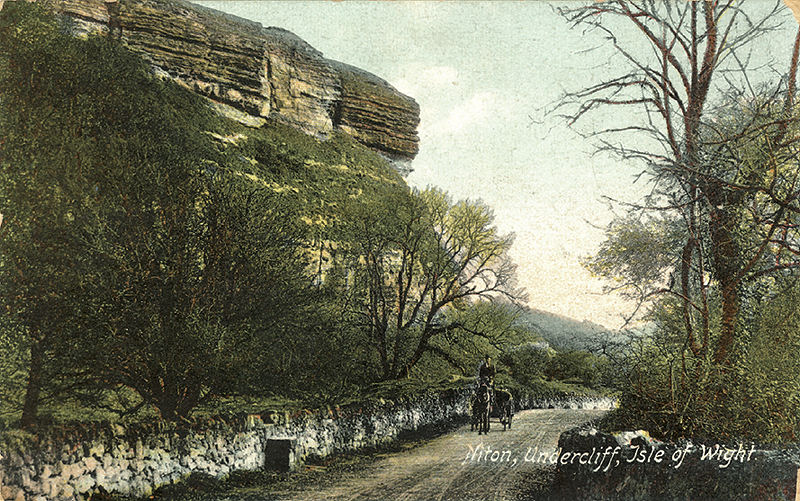
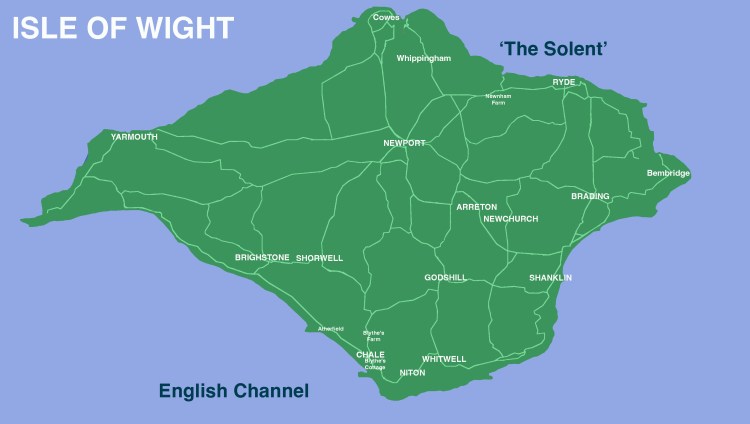
However Maurice Lock also had links to a shadier side occupation to which the Isle of Wight is linked, that of smuggling. Being close to the English Channel and France, the island is ideally situated especially around the area of Niton which had natural coastal rock shelves and caves. It was here that Ann Lock’s father Maurice was born. In fact there is even a Niton Smugglers Trail you can follow including along the ‘Old Blackgang Road’. The Niton and Whitwell Parish Council website has a brief outline of the ‘Niton Smugglers (The Story That HAs Yet To Be Told)’
Maurice Lock’s life is far from straight forward and has aspects we may never find the true story.
Maurice or Morris Lock : 1798 – 1899
Maurice Lock also known as Maurice Locke/Morris Lock was the son of William Locke born in Niton, Isle of Wight and Jane (Jenny) Rainer (Rayner) born in Chale, Isle of Wight. Maurice Lock was born about 1798 in Chale on the Isle of Wight.
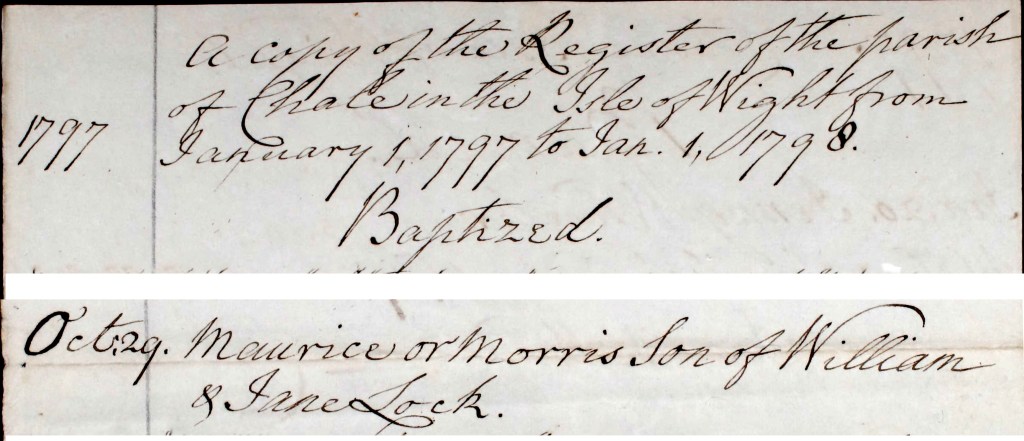
The St Andrew’s Church, Chale register has a record for the baptism of ‘Maurice or Morris Son of William & Jane Lock’ on 29 October 1897.
The next record is for his marriage to Ann White.
Ann White : 1796 -1879
Ann White was the daughter of James White of Godshill and Francis Smith of Newchurch, Isle of Wight. Ann White was born 5 September 1800 in Arreton, Isle of Wight.
As with Maurice Lock, Ann’s Baptismal record has survived. It is in the Parish Church Register from Jan 1797 to Jan 1798.from this both Ann and her parents at this time in Arreton.
Her record of Baptism is straight forward: ‘November 27 Ann Daughter of James and Frances White’.

Marriage – Morris Lock and Ann White
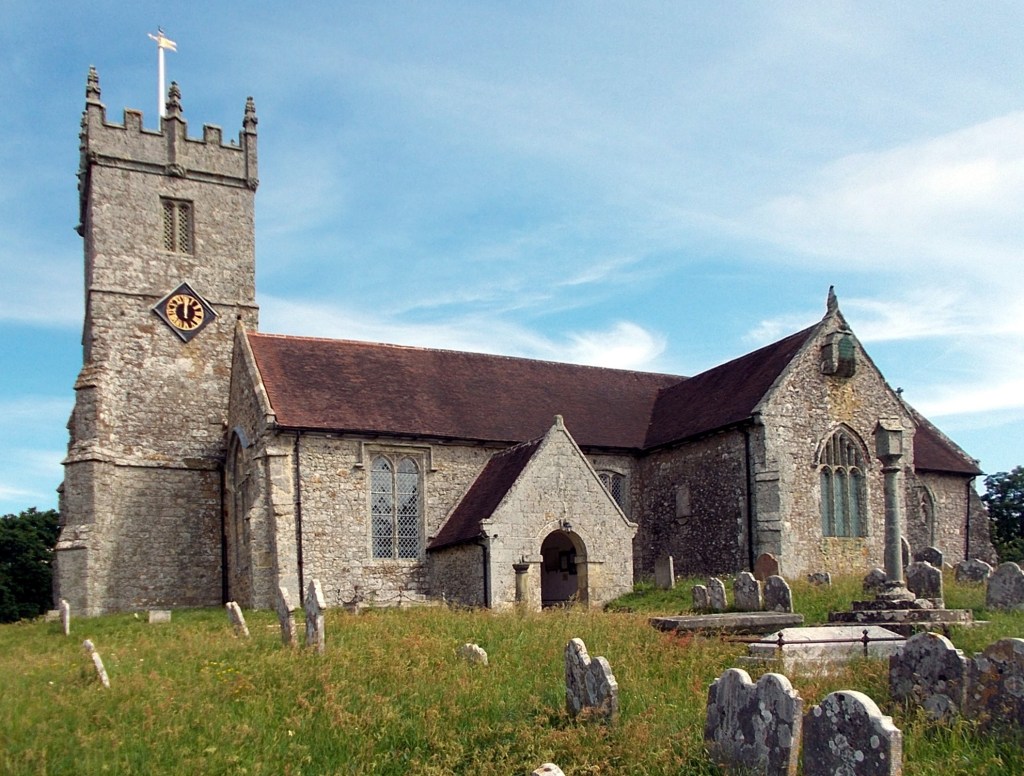
Maurice and Ann’s first child William Lock was born on 31 January 1815 before their marriage. The first marriage record for Maurice Lock and Ann White was on 20 June 18151 at St John’s Church, Northwood. The family story is that Ann’s father did not like her choice of husband. Of note in this marriage is Ann’s use of the surname ‘Gray’ instead of ‘White’. Apparently William White finally relented and so the official second service was on 6 July 1815 with Morris Lock of Godchild, marrying Ann White of Whitwell at All Saints’ Church, Godshill.2


Anne White’s father was a farmer in Godshill, however James died in November 1815 just a few months after his daughter was married. Maurice and Ann remained at the farm in Whitwell with their first three children being born there : William 31 January 1815 (prior to their marriage), Frances in 1816, and Maurice in 1818.
Maurice Lock of Niton : Found on board Smuggling Vessel : 1823
On 6 May 1823 (Boards order) ‘Maurice or Morris Lock of Niton’, the father of Ann Lock, was charged with ‘Being found on board a Smuggling Vessel. Penalty £100’ with the ‘Writ of Subpoena issued 9th June‘ resulting in ‘In the Exchequer at the Crown’s Charge‘. Online calculators estimate £100 in 1823 to be £14,067.65 in 2022 which is $25,293.85 Australian dollars in 2022. Given the wages at the time this would have been a huge amount of money.
The newspaper 3 records that this is the same Morris Lock of Whitwell. There appears to be no further record of the outcome that can be found to this date.
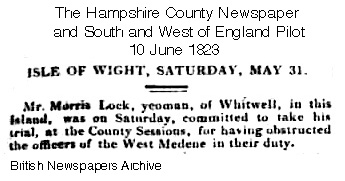
The Cowes Customs website 4 collated by Mark Southwell the last Customs Officer at Customs House Cowes, Isle of Wight has the following record. This clearly links Maurice Lock to the smuggling vessel at that time.
CUSTOMS RECORD: 6 May 1823 (Boards Order.) : Maurice or Morris Lock of Niton : Being found on board a Smuggling Vessel. Penalty £100 : Writ of Subpoena issued 9th June : In the Exchequer at the Crown’s Charge.
Whitwell to Shanklin
The next ten children of Maurice and William Lock were all born in Shanklin : Ann Lock who married George Gray was born 4 November 1821, Aaron in 1825, Ellen in 1826, Edith in 1830, Andrew on 25 Oct 1833, Mary on 4 Jan 1836, Elizabeth on 26 Jan 1838, John in July 1839, and their final child Francis in July 1841.
Shanklin – Maurice Lock, Mason and Builder
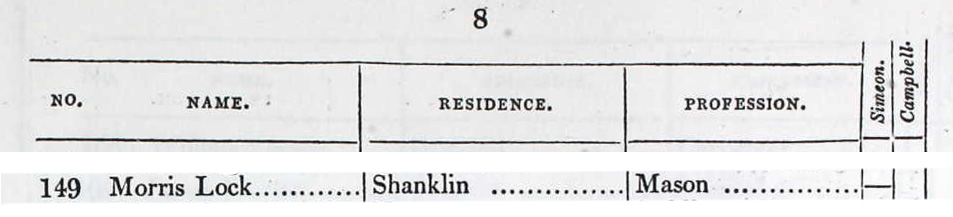
The 1932 Poll book places Morris Lock ‘Mason’ residing in Shanklin. This is the last document along with the the 1839 Vectis Directory listing : Lock, _, Mason, Shanklin1 linking Morris Lock to Ann Lock up until reports of his apparent death in 1842 and his Probate administration in 1843.
Ann Lock – Lodging Housekeeper, Oak Cottage, Shanklin
In the 1841 Census Ann Lock was a ‘Lodging Housekeeper’ in Shanklin with her son James a ‘Mason’ and other children Elle, Edith, Andrew, Eliza and John.
On the same census, Ann Gray nee Lock, Maurice and Ann’s daughter is also living in Shanklin with her husband George Gray an ‘apprentice mason’ and another daughter Frances Bull nee Lock, living with her husband Edmund Bull ‘Fisherman’ and children Fanny and Ann.
Of significance is in the same 1841 census, Maurice’s parents William and Jane Lock (nee Rayner – Reiner) are recorded as living at Blythe’s Cottage, Chale, Isle of Wight. There seem to be no records to be found of where Maurice Lock was in 1841.
There are however some anomalies in the story of Maurice/Morris Lock which are around a disastrous sea voyage in 1842, an Estate administration in 1843 and his death register in 1879.
Lost at sea – an odd tale
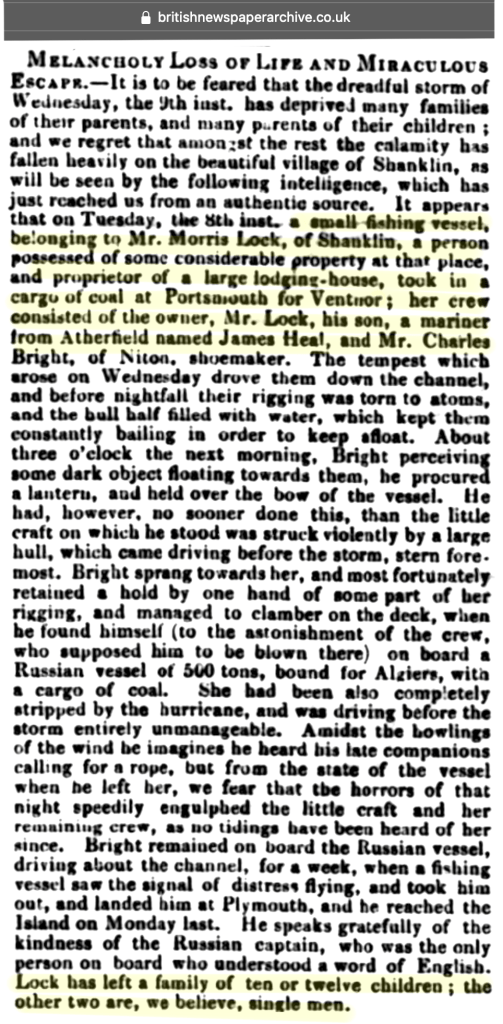
A newspaper article on 26 March 1842 tells of a miraculous escape of Mr Charles Bright on board a fishing boat owned by ‘Mr M Lock of Shanklin his son, and James Heal, mariner’. The boat was full of coal in a wild storm, Charles Bright managed to get on bard of a Russian vessel but it was said Lock and the other men were lost at sea.

Another report of the accident has more details.
It notes the fishing vessel ‘belonging to Mr Morris Lock, of Shanklin, a person possessed of some considerable property at that place, and proprietor of a large lodging-house, took a cargo of coal at Portsmouth for Ventnor ; her crew consisted of the owner, Mr Lock, his son, a mariner from Atherfield named James Heal, and Mr Charles Bright, of Niton, shoemaker … Lock had a family of ten or twelve children ; the other two are, we believe, single men.’
There was a John Heal ‘Fisherman’ in Atherfield on the 1841 census, and other Heal family members in the area.
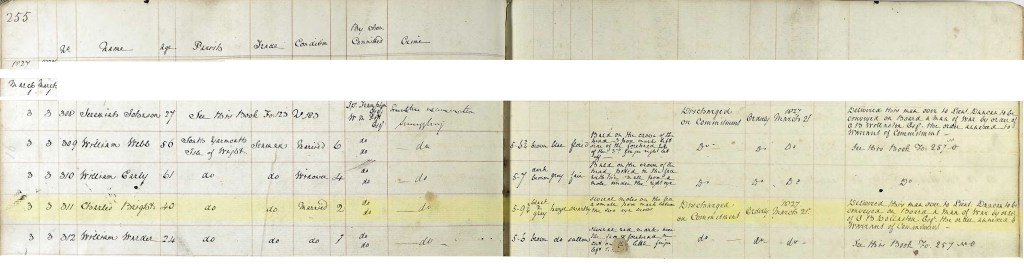
Charles Bright had been linked to smuggling in 1927, and brought before the courts. ‘Delivered this man over to Lient.: ? to be conveyed on Board a man of war by order of A B Wollaston Esq. … warrant o f commitment.’ He was discharged on Commitment.
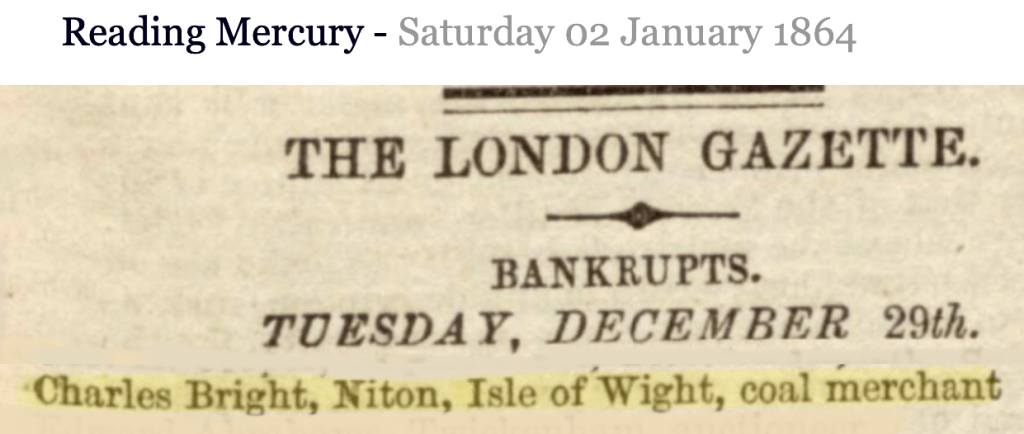
A Bankrupty record in 1864 states Charles Bright of Niton, Isle of Wight occupation as ‘coal merchant’. This is in line with the 1842 account of the fishing vessel ‘laden with coal’.
Probate : Estate of Maurice Lock of Shanklin, Stonemason
It took a year after the reports of Maurice Lock’s death for Ann Lock to be able to administer his Estate. There appears to be no death register record for 1842 but she would have to wait the year so he could then be assumed as dead so she could finally claim what goods, chattels and property he may have. Maurice Lock did not have a Will so it was an intestate estate with his wife Ann and two sons William and James who made the claim.
The Estate included the need for a penal bond, with the considerable sum of £3,000.
An explanation of a penal bond can be found in the Durham University Library : ‘Before the Durham probate court would grant probate or administration to the personal representatives of the deceased, the executors or administrators would be required to enter into a bond with the bishop … The purpose of these bonds was to bind the bondsman to perform a set of defined actions at or before certain dates, and in this way to ensure the testator’s will was fully executed or that the intestate’s estate was properly administered. Should these actions fail to occur, the bondsman became liable to a penalty, the penal sum of the bond, usually twice the value of the deceased’s estate.’ 5
So on 10 March 1831, ‘Ann Lock in the Isle of Wight in the county of Southampton Diocese of Winchester Widow, William Lock of the same place and James Lock also of the same place StoneMason’ applied for the administration of the intestate Estate of her husband ‘Maurice Lock of Shanklin aforesaid Stone Mason’.
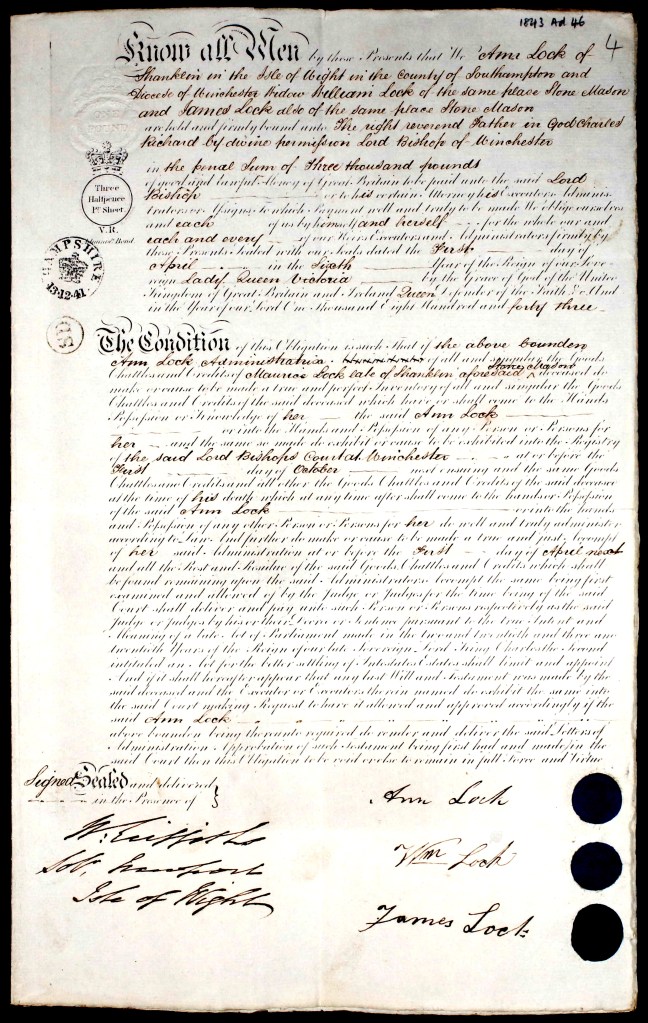
The record shows the requirements on Ann and her sons of this £3000 penal bond sum to produce a ‘perfect inventory of all and singular the Goods Chattels and Credits and other goods which have or shall come to Minds or perception or Knowledge of her the said Ann Lock …’.
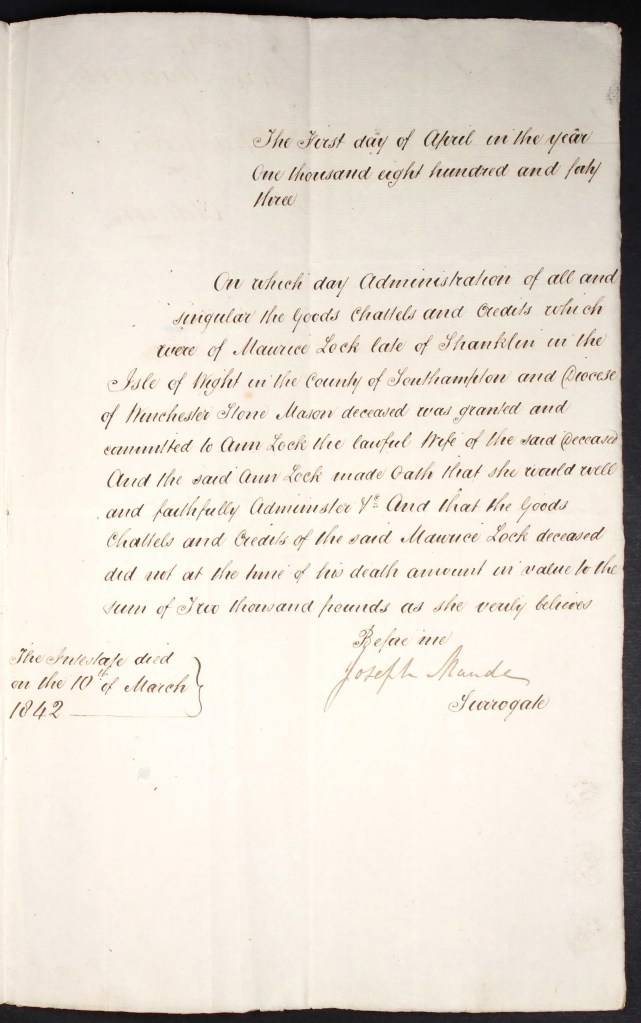
The second page from Hampshire, England, Wills and Probates, 1398-1858 for Maurice Lock states: ‘And that the Goods Chattels and Credits of the said Maurice Lock deceased did not at the time of his death amount in value to the sum of Two thousand pounds as she verily believes’.
There seems to be no further records regarding this administration.
Living without Maurice
From at least 1841, Ann Lock at just 40 years of age was working as a lodging housekeeper living at Clarendon Cottage, Parish of Shanklin with her children: James (occupation listed as ‘Mason) aged 20 years, Ellen aged 14 years, Edith aged 10 years, Andrew aged 7 years, Eliza aged 3 years and John aged 1 year. Ann is now left to work and raise the younger children and watch over the lives of her older children and their families, it did not always go easily.
Sale of Oak Cottage at Clarendon House
On 27 October 1845 ‘Clarendon House’ where Ann Lock and children were living was advertised to be sold. There were two allotments: the VILLA RESIDENCE and the second known as ‘OAK COTTAGE, a substantial stone-built Residence, situate int eh village of Shanklin, now occupied by Mrs Lock, an comprising two parlours, kitchen, laundry, pantry, spacious wash-house with brick oven therein, four bed rooms, and two closets ; together with about half an acre of LAND, a great part of which presents an excellent building site.’
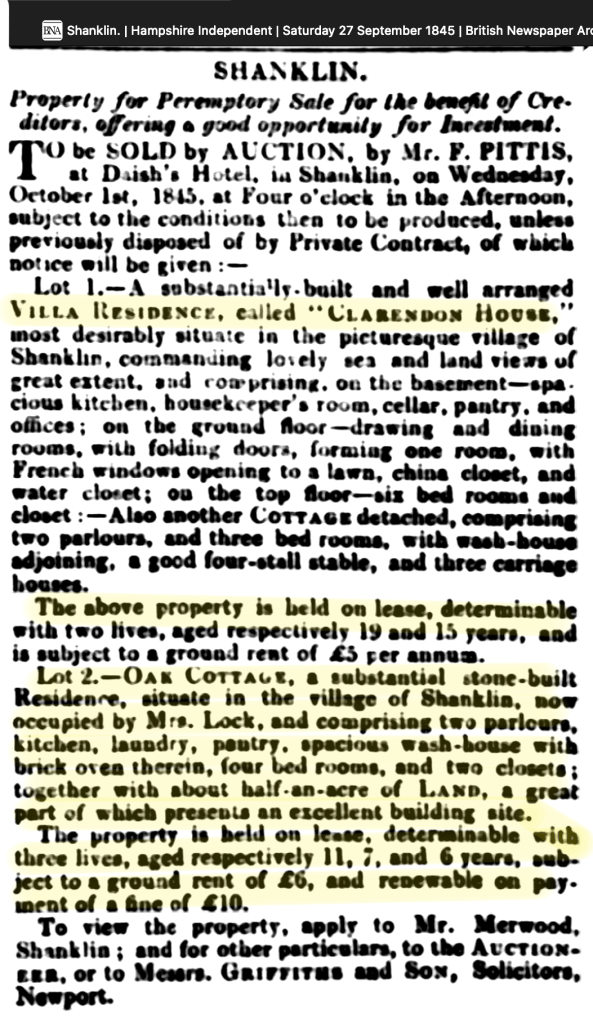
However, the advertisement includes some provisions to Ann Lock remaining at the property : ‘The property is held on lease, determinable with three lives, aged respectively 11, 7, and 6 years, subject to a ground rent of £6, and renewable on payment of a fine of £10.’ The next record 10 years later shows a significant change in circumstances for Ann and her family.
Life in Newchurch and Ryde
By the 1851 Census Ann Lock is at ‘Wood Cottage’ in the Parish of Newchurch working as a ‘laundress’. Recorded with her are her children, Ellen (laundress), Eliza, John and Francis with grandson William. By the 1871 Census Ann Lock is living in Swanmore Road, Ryde, Isle of Wight still working as a laundress with her daughter Ellen and a lodger named Daniel Bartlett, a Coachman.
Maurice Lock – Blythe’s Cottage, Chale
However Ann Lock’s husband Maurice Lock’s story did not end with story of his demise on his fishing boat crossing the channel in 1842. It can be traced using his parents at a place called ‘Blythe’s Cottage’ in Chale, not that far from Shanklin with current google maps estimating approximatley a 45 minute bike ride from Clarendon House to Blythe’s Cottage.
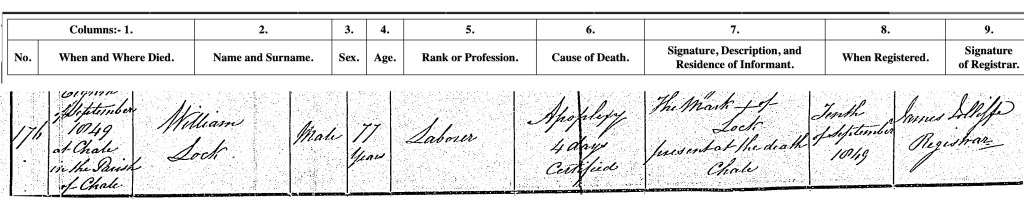
The 1841 Census places Maurice Lock’s parents William and Jane Lock at Blythe’s Cottage, Chale, Isle of Wight, William’s occupation is stated as an ‘agricultural labourer’. There are several others also listed at this residence but they do not include Maurice Lock. On 8 September 1849 Maurice’s father William Lock ‘labourer’, died ‘at Chale’ with just ‘The mark of Lock present at the death’. The cause of death was ‘apoplexy’ for four days, meaning he was unconscious, perhaps from a stroke.
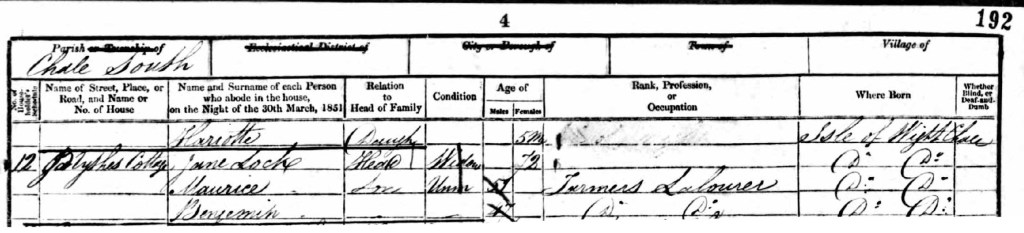
By 1851, Maurice Locke, son of Jane Locke along with his brother Benjamin Locke both stating their occupation as agricultural labourers, are living with their mother at Blythe’s Cottage, Chale. Perhaps by becoming ‘Maurice Locke’ instead of ‘Morris Lock’ and an ‘agricultural labourer’ instead of a stone mason he was able to evade detection or perhaps with the passage of time and his possessions transferred to his wife and sons, it was no longer an issue if he simply did not try to reclaim the property.
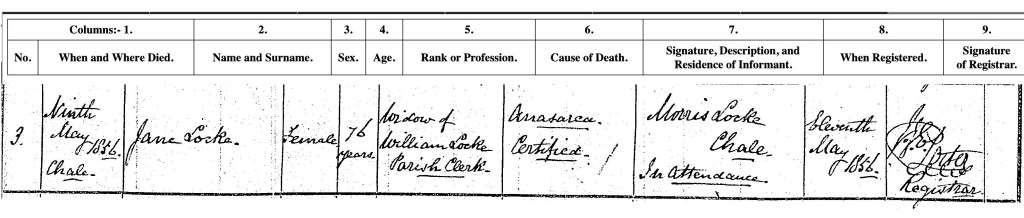
In 1856 the death of Maurice’s mother Jane Locke nee Raynor (Reiner) is recorded in the death register. On 9 May 1856, Jane Locke aged 76 years died of ‘anasarca’ which is the severe swelling with fluid in different parts of the body. Perhaps Maurice came to help his brother with the care of his mother after his father’s death. This time the informant on the death register was her son ‘Morris Locke, Chale, In attendance’.
The 1861 Census records Maurice Lock aged 61 years at Blythe’s Cottage with a lodger, Henry Dichard aged 20 years, both ‘labourers’.
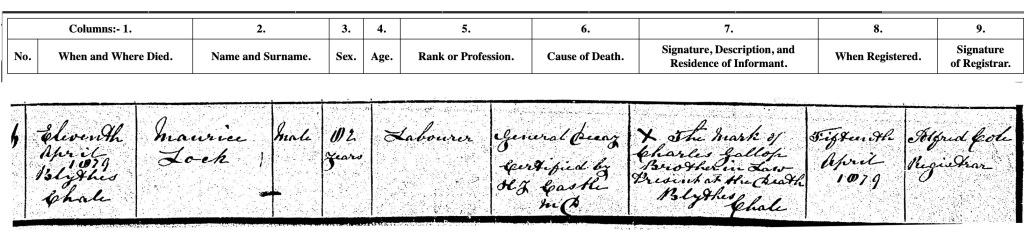
The 1871 Census places Benjamin Lock at what was the Union Workhouse, Chaplins House and Hospitals in Newport where he died in June 1886. The same 1871 Census places Maurice Lock, agricultural labourer at 63 Chale Rectory which is a little unclear but perhaps it indicates where he was when the census was recorded. However by 1879 he is back living in Blythe’s Cottage where he died on 11 April 1879 aged 83 years of ‘general decay’. The informant was Charles Gallop signing the an ‘X’ who was his brother in law present at his death of Blythe’s, Chale. Maurice’s sister Ann Locke had married Charles Gallop in 1872 at the Wesleyan Chapel in Ryde, Isle of Wight.
Maurice Lock : Death 11 April 1879
Maurice’s sister Ann Galllop continued to live in Blythe’s cottage after her husband Charles’ death in 1884 and recorded as still living there in the 1891 Census with her brother Moses Lock. On the 1901 Census she is recorded as living in Sweetbriars ‘living on her own means‘ where she died on 19 October 1905. Ann Gallop’s Probate recorded her effects valued at £55 8s.

Death of Ann Lock nee White : 1796 -1879
Just a few months after the death of Maurice, his wife Ann died on 11 October 1879 at Swanmore Road, Ryde, Isle of Wight. The death registration states: Ann Lock ‘widow of Maurice Lock a Builder’, died. The cause of death was ‘senile debility’, the witness was Mary Bartlett of 4 Surrey St, Ryde who was present at her death.
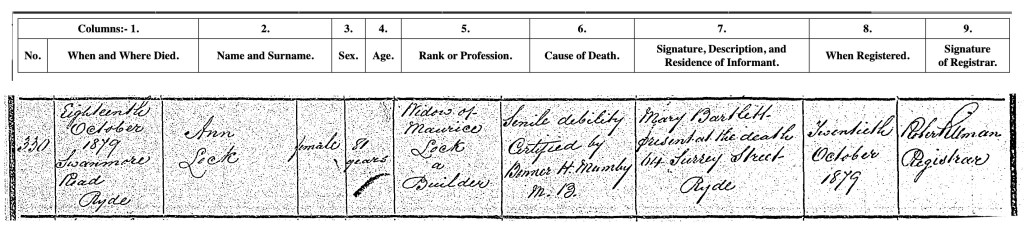
It seems that after Maurice appeared to go missing in that storm in March 1842, that Ann Lock had a difficult life. The occupation of laundress is usually one women took up to support themselves and their children when they had no husband or from of support. Ann was 41 years of age when Maurice went missing, her eldest child James aged 20 years was working as a ‘Mason’ so some additional income, and Ellen was 15 years, the youngest John was just 2 years. The advertisement mentions the need to pay both a ground rent of £6 a fine of £10. This would have been a large sum of money for a single woman whose husband disappeared presumed dead. It is not surprising that Ann’s circumstances seemed difficult and remained that way until her death working as a laundress for likely most of the remainder of her life.
References
- Will bonds and Administration bonds https://familyrecords.awh.durham.ac.uk/nei/NEI_bonds.pdf
- The most deadly disease of asylumdom: general paralysis of the insane and Scottish psychiatry, c.1840–1940 by G Davis, Wellcome Lecturer in the History of Medicine, School of History, Classics and Archaeology, University of Edinburgh, UK https://www.rcpe.ac.uk/journal/issue/journal_42_3/davis.pdf
- The Vectis Directory of Isle of Wight General diode, containing a classification of the nobility, gentry, banker, professional gentlemen, and traders, resident in the towns of Newport, Ryde, Cowes, and Yarmouth, also of the villages generally, including Ventnor, Shanklin, Carisbrooke published by William Lambert 1839
 George Gray - Stonemason & Builder