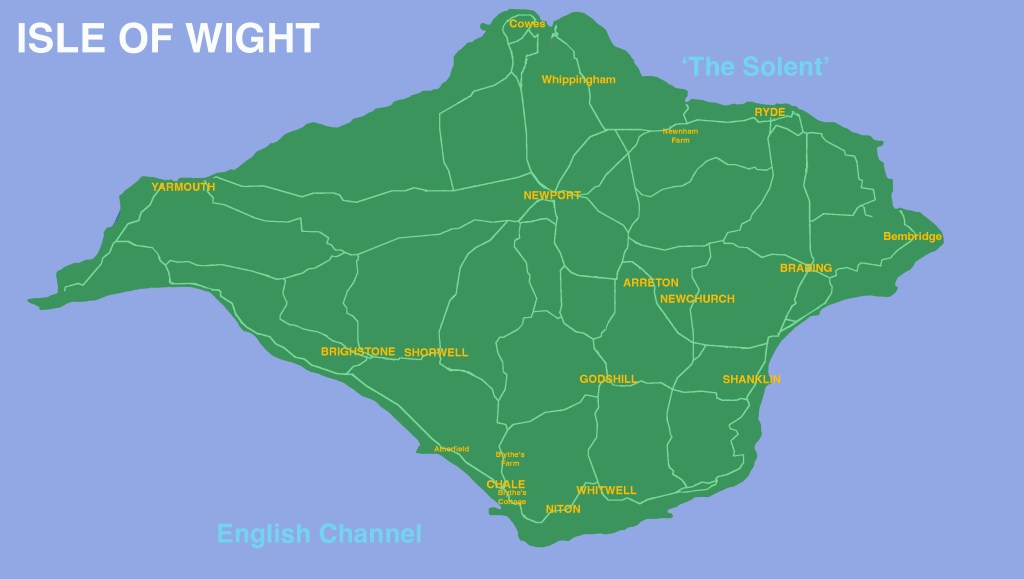
The story of the Gray family begins on the Isle of Wight in England where they have a lineage back to at least 1720. The focus on the island where George Gray and Ann Lock lived is around the southern section of the island near the coastal areas.
Generations of Grays are all recorded as being born and living there. The first James Gray was born there in about 1720, he married Jean Crew in 1748, she died in 1750 and he then married Betty Rodgers in 1751. Their eldest son was the next James Gray born 24 Jan 1756 who married Mary Gattrell in 1786. Their eldest son another James Gray was born 1786 and he married Sarah Cheek. This last couple were the parents of George Gray who immigrated to Australia in 1848.
The earlier Gray family male occupations were listed as labourers living in the Arreton region, they most likely were all agricultural labourers. What little we can glean of their lives is found largely in census or similar records and births deaths and marriage registers which can record ages, where they were living and their occupations or circumstances.
The Isle of Wight is a beautiful island off the south coast of England, the sea between it and mainland England is known as ‘the solent’ and on the other side is the English Channel stretching across to the Cotenin Peninsular region of southern France. The early Gray ancestors were agricultural labourers or farmers in the Arreton Valley region.
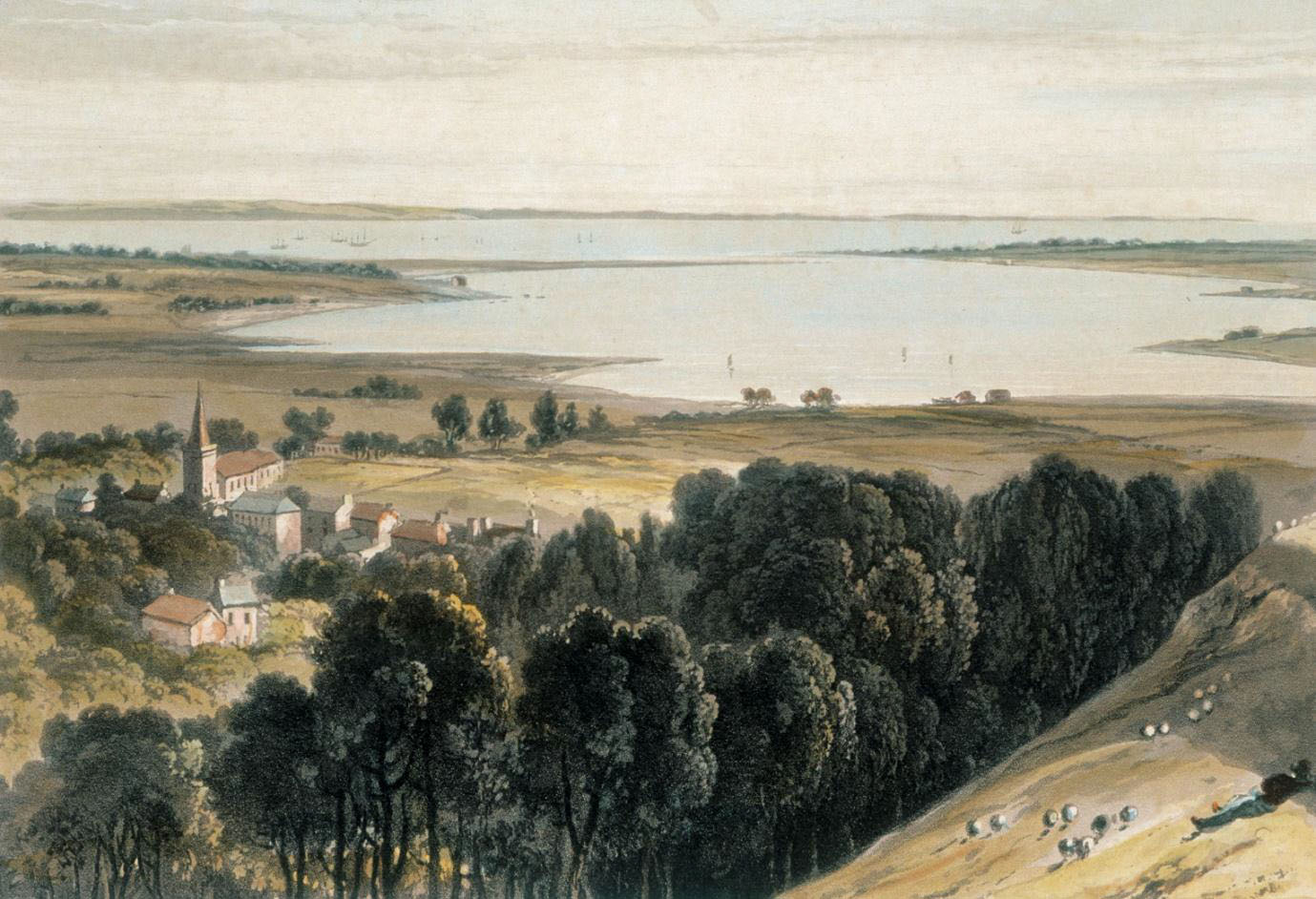
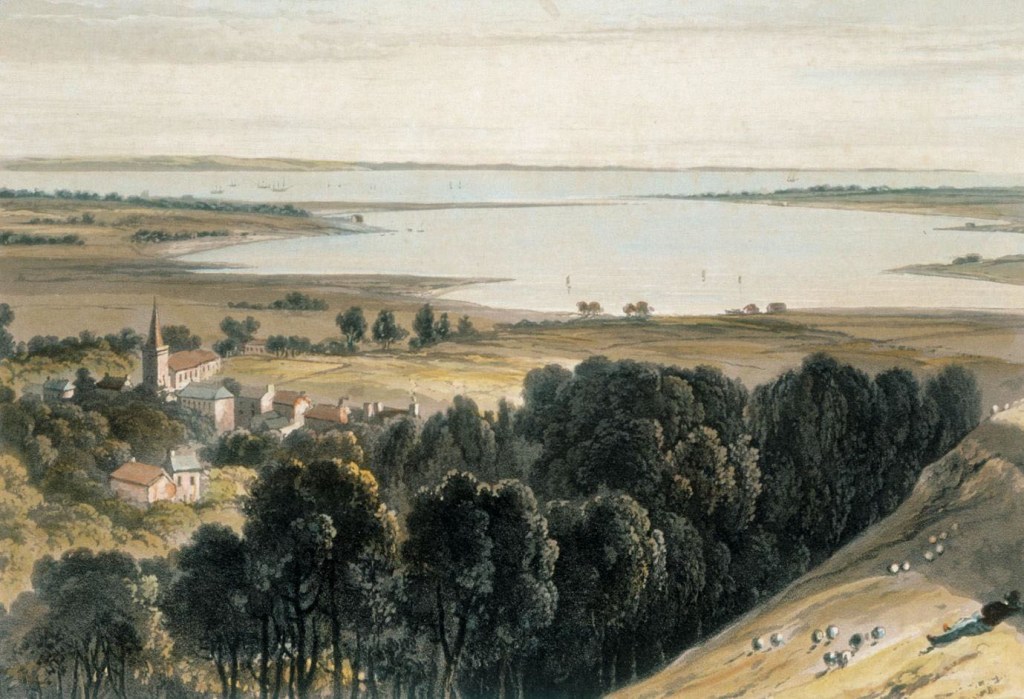
Although there are no photographs of the Isle of Wight back in the early times of the Gray family living there, many artists produced paintings, prints and drawings of the Isle of Wight was a popular place for artists to visit especially after Queen Victoria built Osborne House, a summer residence in East Cowes, in the 1840’s.
The document Down To The Coast, Artscape by Professor Robin McInnes OBE FICE FGS FRSA gives an insight through paintings and prints of what the Isle of Wight looked like when the Gray family ancestors were living there.1
‘The overlying chalk provides some of the most complete successions to be found in Europe and is displayed dramatically across the Isle of Wight. Deposited in clear seas, the chalk is formed of the remains of minute marine algae and other shells.‘ 2

The video below gives an overview of Shanklin and the surrounding areas.
This region is part of the East Wight AONB – an Area of Outstanding Natural Beauty. The chalk cliffs, shoreline and Shanklin Chine can all be seen from Shanklin where James and Sarah Gray were living when they married in 1841.

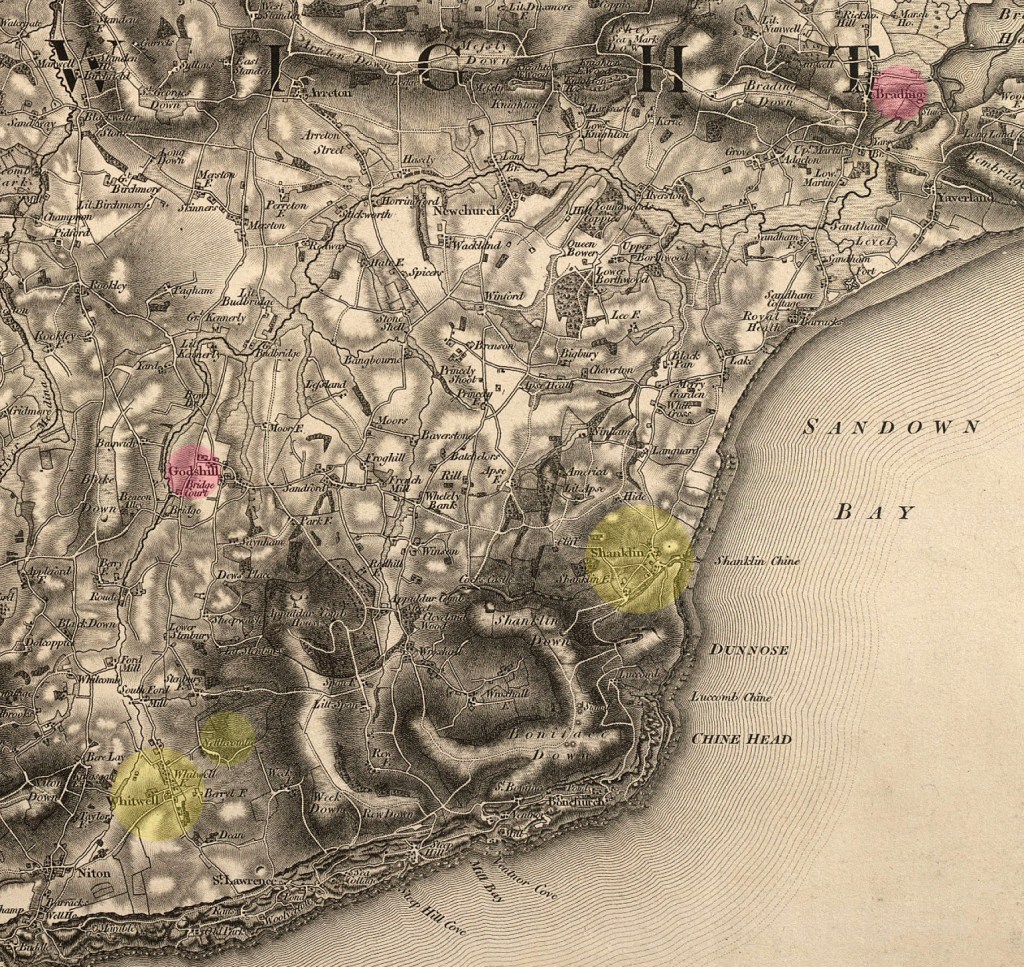
GEORGE GRAY born on Nettlecomb near Whitwell and his wife Ann LOCK born in Whitwell
SON of GEORGE GRAY : George Abner GRAY born Shanklin
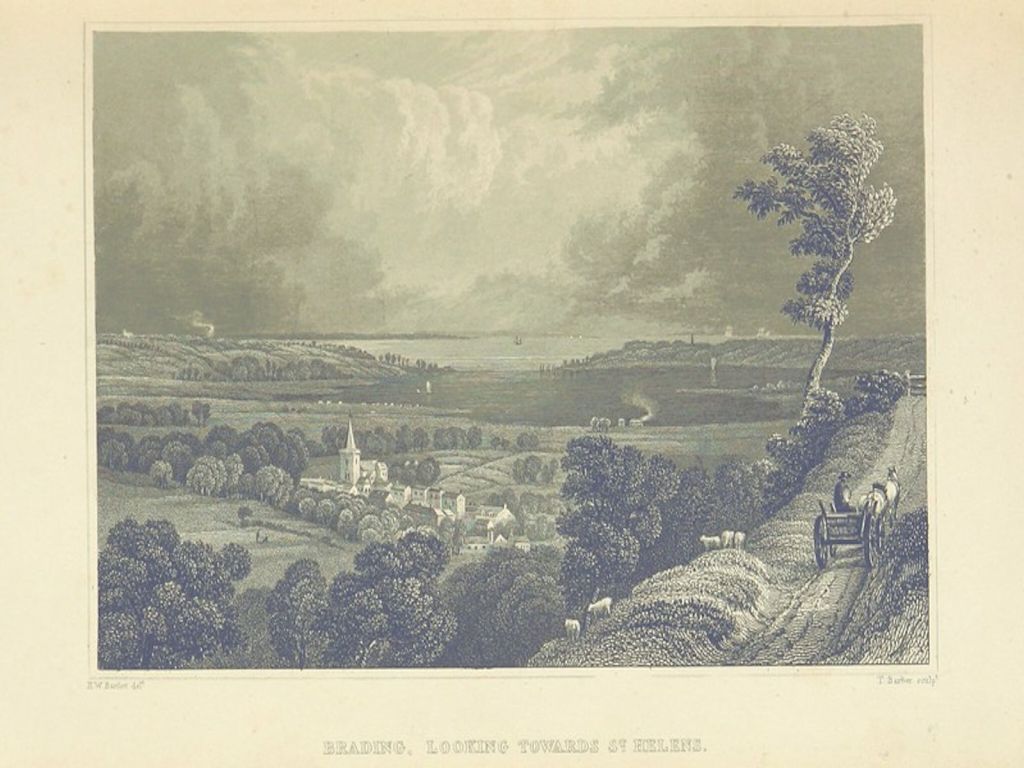
“From early times, Brading ranked as an important Island port. The ancient name of Brerdynge, from which ‘Brading’ is derived, probably meant the people living by the ridge of the Downs, and dates from at least 683.
Until the 16th century the port was active. Ships lay alongside at the quay behind the Bugle Inn in the High Street. Ships came into Brading Haven for shelter and for provisions, particularly water, which was of a high quality. The north-eastern part of the haven was closed off by an embankment completed in 1594, much of which is still present. Ships would then tie up at the far end of Quay Lane on the other side of the embankment.
Throughout the Middle Ages various attempts were made to drain off the rest of the harbour; for it had gradually become silted up and, except for the main channel of the river, was too shallow to be of any commercial use … this reclamation was finally accomplished in 1881 by the building of a substantial embankment right across the harbour, with the building of the railway to Bembridge.”
So Brading is now a seaport without any sea. Losing access to the sea caused Brading to decline in importance.” 4
In the Mason’s Handy Guide of 1872 it says; “It is surrounded by wood of venerable growth, indeed some of the decaying, but still majestic oaks appear to have been coeval with the Conquest … Brading is a corporate and market town. Near the church there is an ancient town hall, and the stocks, nether of which are used … At the upper part of the town may be seen the ring formerly used for bull-baiting, the favourite, but barbarous sport of our forefathers. Here is a large Congregational Chapel situated on the Mall, with a neat Cemetery attached; and a Bible Christian Chapel.‘ 5
James Gray and Betty Rogers
– Great Grandparents of George Gray
It is difficult to trace early records but the records that can be found, show that James Gray, George Gray’s grandfather, was born about 1720 on the Isle of Wight dying in 1763 aged about 43 years at Carisbrooke, Isle of Wight. James Gray married Jean Crew on 2 November 1748, according to the marriage record she was born about 1733. Very little can be found at this point about Jean but it is believed that Jean died 15 May 1750 just two years after they married, aged only about 17 years. James Gray then married Betty Rogers in Whippingham, Isle of Wight on 25 November 1751. Their son James Gray was born some time before 1756 with his baptism being recorded on 24 January 1756 at Whitwell, Isle of Wight.
James Gray ‘Labourer’ and Mary Ann Gatrell
– Grandparents of George Gray
James Gray the son of James and Betty Gray and his Mary Ann Gatrell were the grandparents of George Gray stonemason and builder in the Hunter region, NSW.
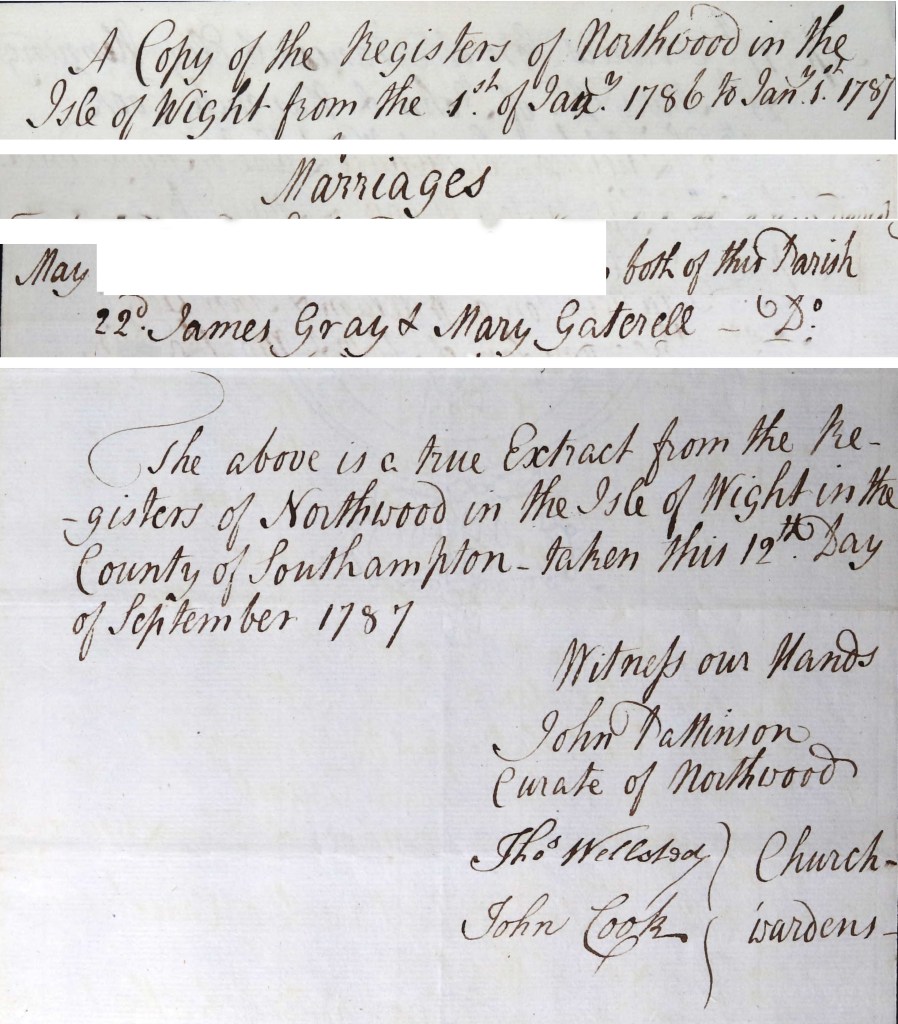
The ‘Registers of Northwood on the Isle of Wight … Jan 1876 – Jan 1857’ records the marriage of James Gray and Mary Ann Gatrell/Gaterell in the little village of Northwood, Isle of Wight on 22 May 1856.
Aside from the 1841 census when they are living at Apse Reach Cottage in Newchurch with James occupation as ‘labourer’ aged 50 years and Mary as his ‘wife’ and these death register records, little is known of James and Mary Ann’s life together.
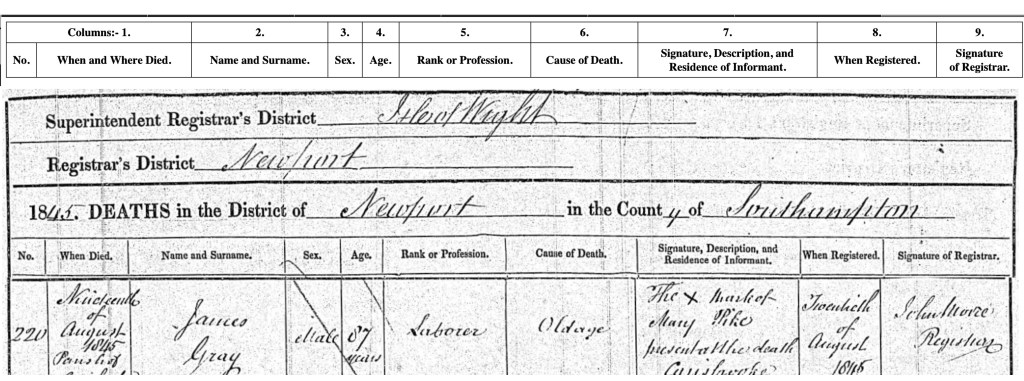
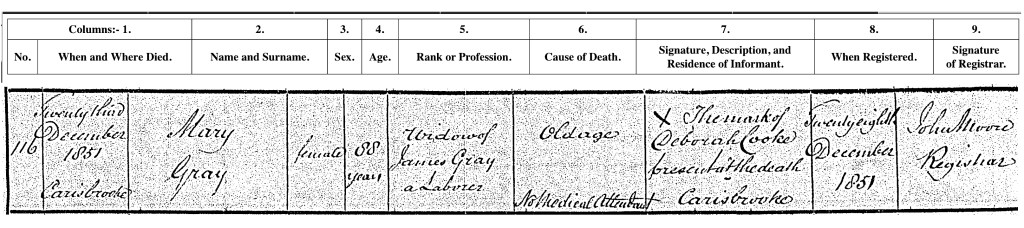
James Gray died 19 August 1845 aged 87 years and his wife Mary Ann Gray nee Gatrell died in 23 December 1849 aged 88 years, both died in Carisbrooke, Isle of Wight. The death register records for both of them cite ‘old age’ as the cause of death.
Aside from the 1841 census when they are living at Apse Reach Cottage in Newchurch with James occupation as ‘labourer’ aged 50 years and Mary as his ‘wife’ and these death register records, little is known of James and Mary Ann’s life together.
James Gray and Sarah Cheek
– Parents of George Gray
James Gray – Agricultural Labourer, Lake Brading
The third James Gray and the father of George Gray, was an ‘agricultural labourer’ and like his parents was born, worked and lived all his life on the Isle of Wight. He is recorded as living in the townships of Brading, Whitwell, and Carisbrooke.
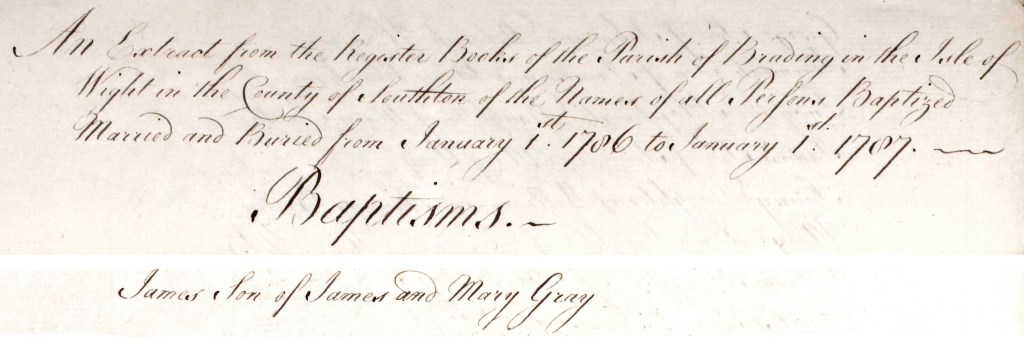
The Parish of Brading church register records the baptism of ‘James Son of James and Mary Gray’ with transcripts of the original record stating the baptism was on 14 Mar 1756 his birth 24 January 1756 at Whitwell.
Sarah Cheek
George Gray’s mother Sarah Cheek was born in Godshill, Isle of Wight, the daughter of William Cheek (Chick) who was baptised on 26 July 1748 at Niton, so perhaps his family was linked to smuggling if the old stories of ‘everyone who lived in Niton was a smuggler’ are true.
His mother was Sarah Rider born in Whitwell in 1748, the daughter of John Rider and Jane Boyce. They were married on 26 Mar 1769 in Godshill living their entires lives in Whitwell.
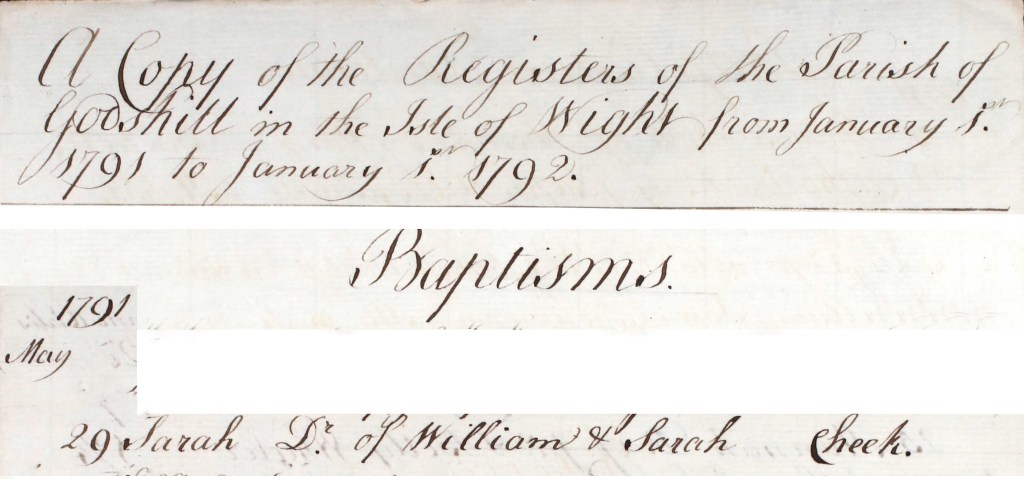
The baptism of their youngest and last child Sarah Cheek is recorded in the Register of the Parish of Godshill, Isle of Wight on20 May 1791 ‘Sarah D. of William & Sarah Cheek’. Her father William died in 1794 and her mother in 1830.
Sarah Cheek & James Gray
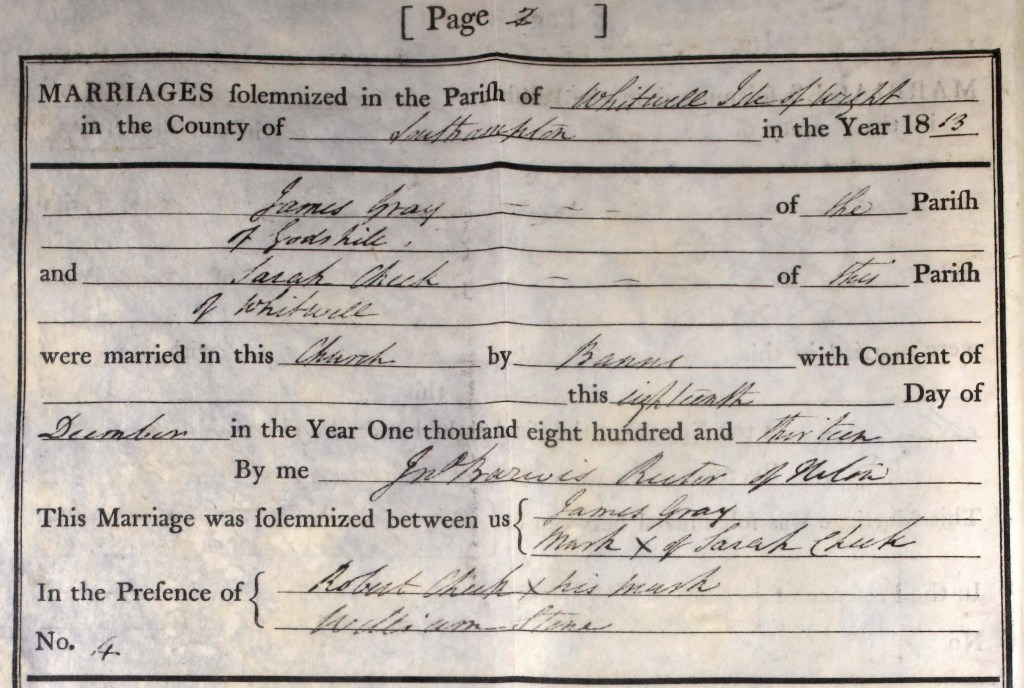
On 18 December 1813 Sarah Cheek married James Gray at the Whitwell Church on the Isle of Wight. Whilst James signed his name, Sarah signed with an ‘x’. Many of these early records have signatures of ‘x’.
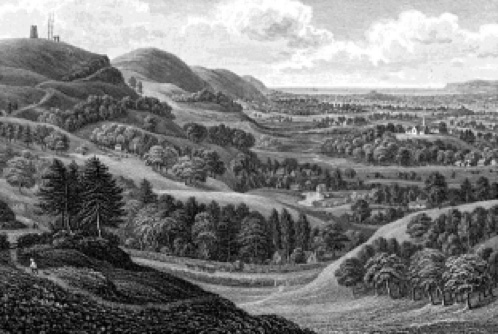
From ‘Down To The Coast’ Artscape Professor Robin McInnes p80
The Mason’s Handy Guide of 1872 is hardly flattering about Whitwell; “lies to the south-west of Godshill, offers nothing more remarkable than its ancient church”.7 This view however, perhaps is not entirely accurate as it was part of the important agricultural and farming land of the Arreton Valley lands.
This region is part of the Arreton Valley farmlands; “This area comprises the Arreton Valley, which can be broadly defined as the low-lying land between the Central Downs and the Southern Downs, together with the corridor running south-north from the Downs behind Niton and Whitwell towards Godshill. Most of this area is composed of the Lower Greensand and its sheltered position and rich soils have led to the area being of significant economic importance for agriculture.” 8
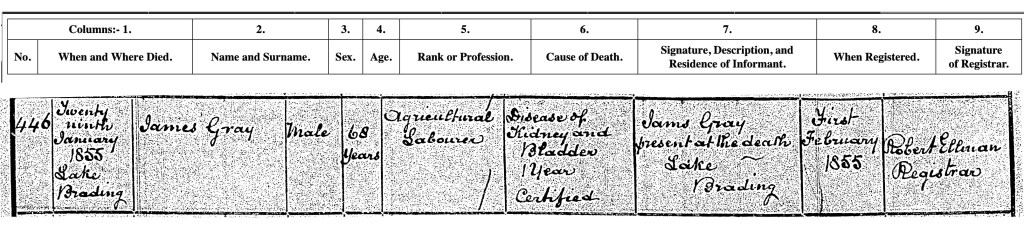
George Gray’s father died after he left for New South Wales. James Gray died on 29 January 1855 at Lake Brading aged 68 years. The cause of death was ‘Disease of Kidney and Bladder 1 year’ with James Gray his eldest son being the informant present at his death.
Sarah Gray nee Cheek died 1863
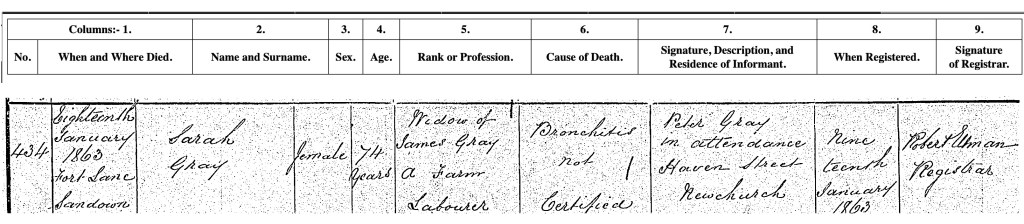
Sarah Gray nee Cheek died on 18 January 1863 at Fort Lane, Sandown, Isle of Wight aged 74 years. It is noted she was ‘Widow of James Gray a Farm Labourer. The cause of death was bronchitis with the informant being Peter Gray of Haven Street, Newchurch, her third son with both James her eldest and George Gray her second having both died before her.
References
- DOWN TO THE COAST Artscape Professor Robin McInnes OBE FICE FGS FRSA
- DOWN TO THE COAST Artscape Professor Robin McInnes OBE FICE FGS FRSA p15
- DOWN TO THE COAST Artscape Professor Robin McInnes OBE FICE FGS FRSA p18
- https://en.wikipedia.org/wiki/Brading
- Mason’s New Handy Guide to the Isle of Wight – Mason, Publisher, Ryde – 1872 Edition
- Select Births and Christenings, 1538-1975 Baptism Date 21 Dec 1817 FHL Film No 1470893 Ref ID item 15 p 11
- Encyclopaedia Britannica – The Victorian British economy https://www.britannica.com/event/Victorian-era
- https://en.wikipedia.org/wiki/Nettlecombe,_Isle_of_Wight
- Mason’s New Handy Guide to the Isle of Wight – Mason, Publisher, Ryde – 1872 Edition
- DOWN TO THE COAST Artscape Professor Robin McInnes OBE FICE FGS FRSA p93
 George Gray - Stonemason & Builder