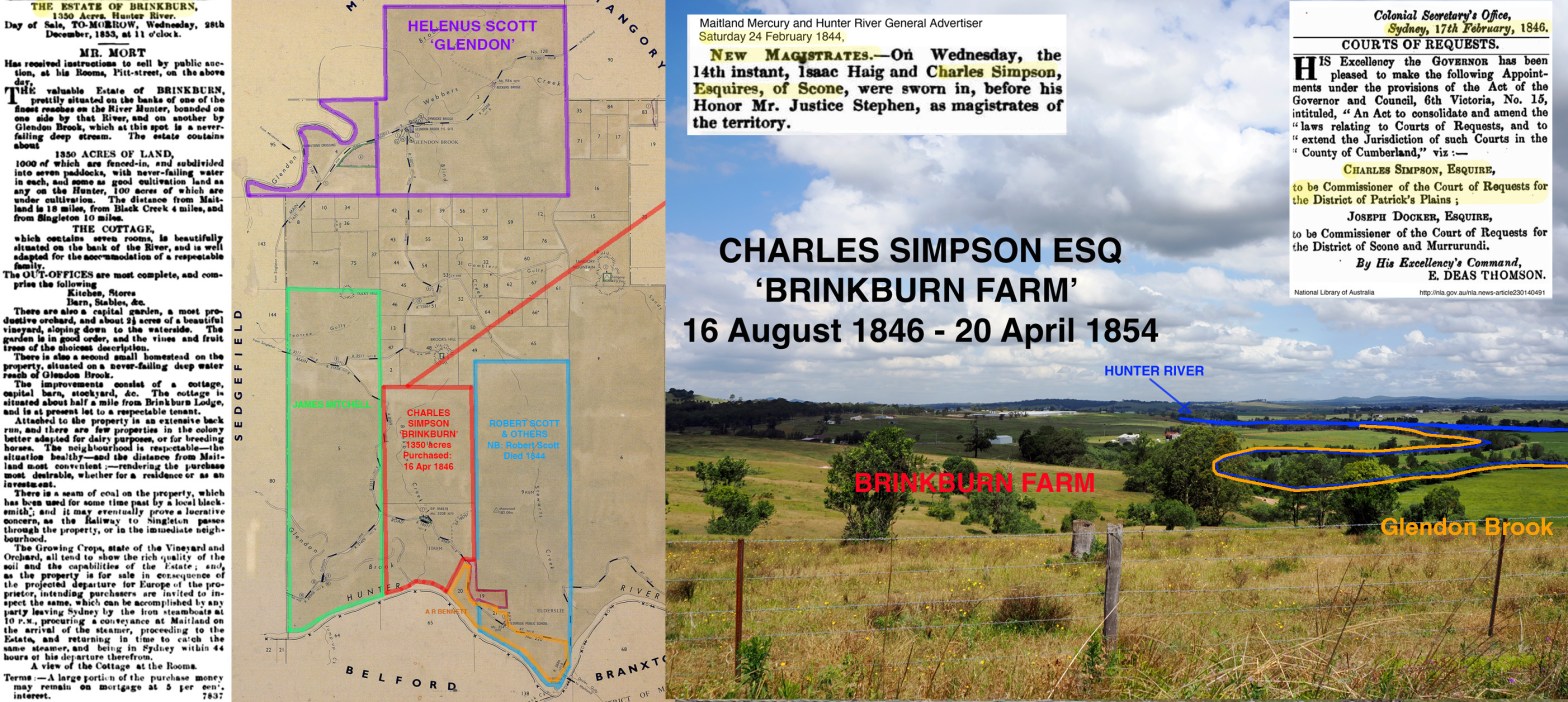
Magistrate and Justice of the Peace Charles Simpson 1845 – 1846 – Patrick’s Plains and Singleton
On 16 September 1844, Charles Simpson was appointed a Church Warden at the Scone Parish of the Church of England: ANGLICAN DIOCESE OF NEWCASTLE – SCONE PARISH: [See also A5252 (i)] + GRAY, NANCY: A6083 (i) Agreement to appoint William Dangar, Charles Simpson and John Bingle as Churchwardens, September 16th, 1844.1 It is clear that Charles Simpson had close links with important families in the colony such as the Dangar’s. It can also be noted that the Rev John Morse was the Rector at Scone Parish and that connection will be important in 1854 in telling the story of Charles Simpson.
In 1845 Charles Simpson appointment was extended as the Commissioner to the Court of Requests in Scone along with a letter to the Editor of the ‘Maitland Mercury’ correcting the record on their reporting of cases and their outcomes in the Court.

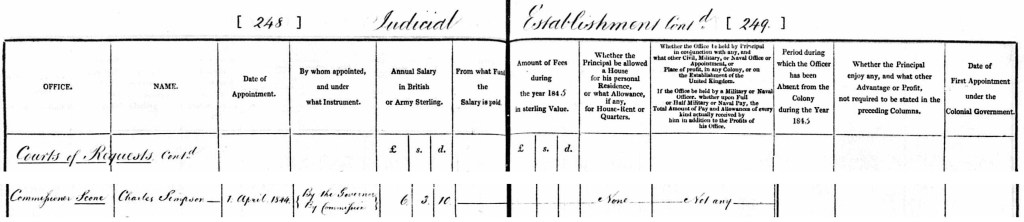
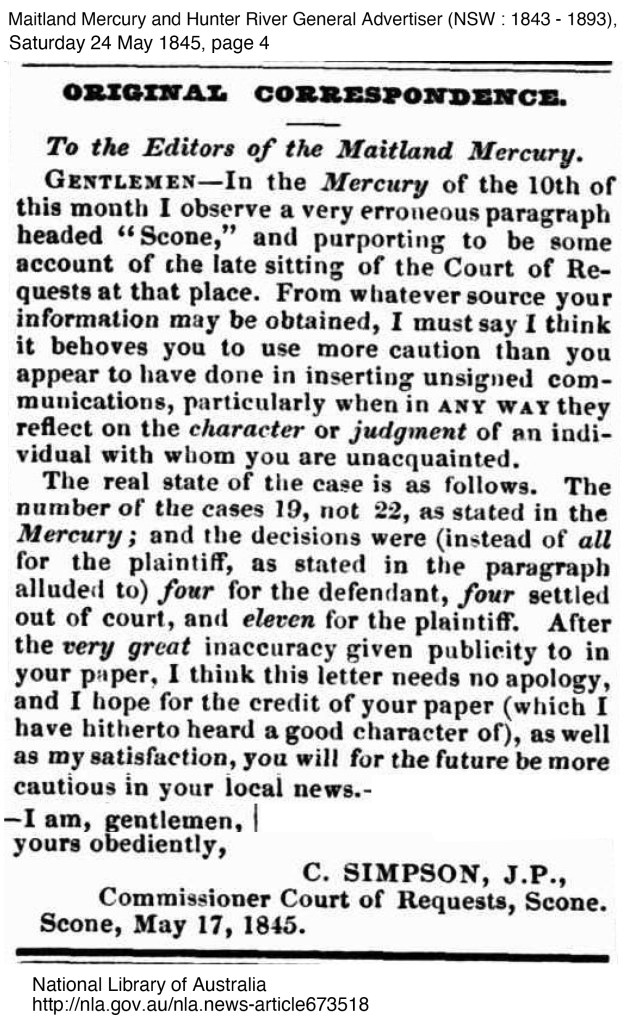
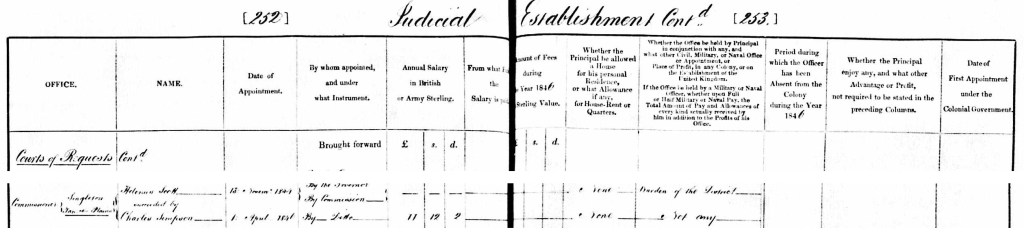
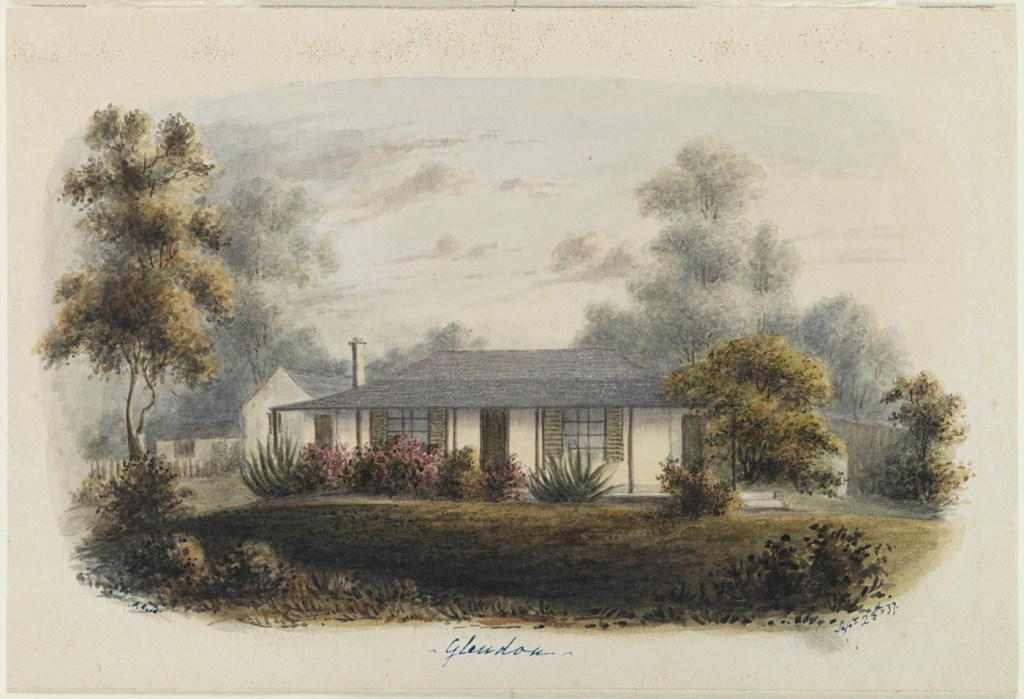
Charles Simpson was appointed to take over from the well respected Helanus Scott who was the owner of ‘Glendon’ Station near New Freugh who moved into Newcastle working as a stipendiary magistrate and whose son and granddaughters were well known naturalists and artists living on Ash Island.
Singleton and Nearby – Settlers of Magistrates & Politicians
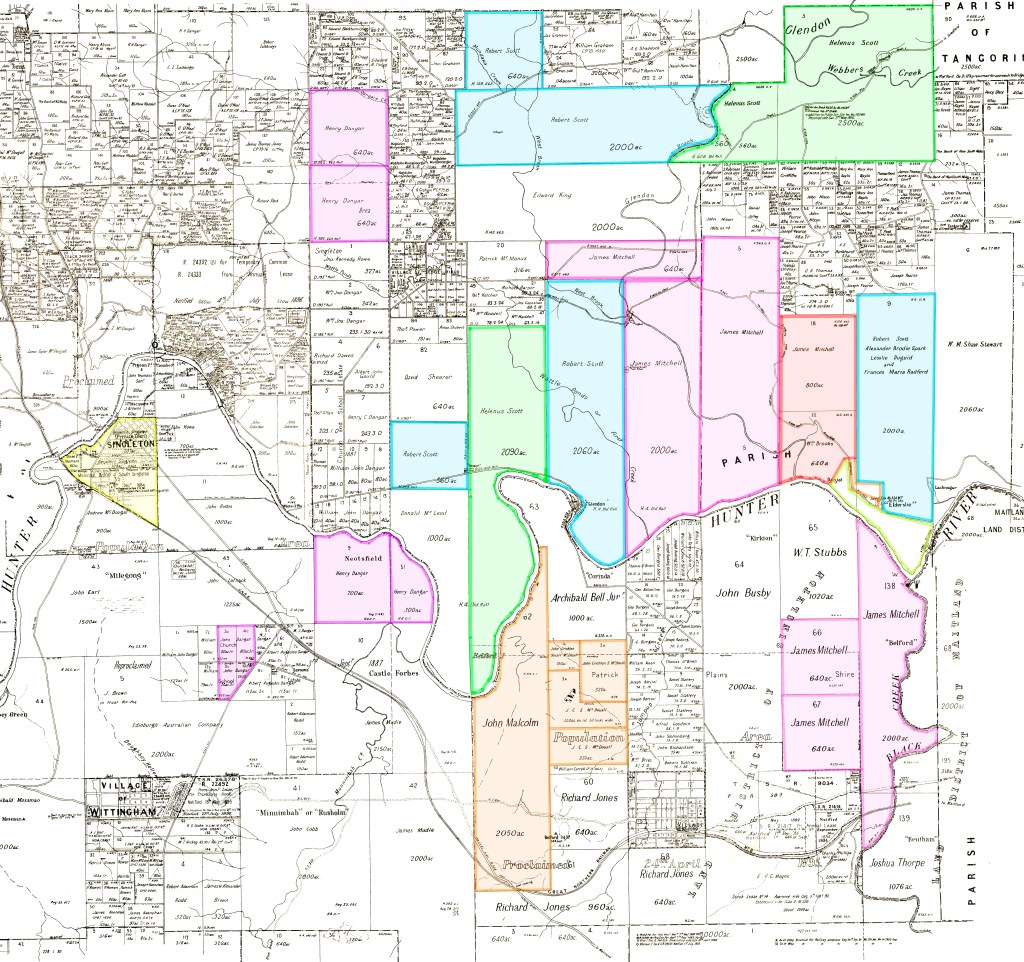
When Charles Simpson moved from Scone towards the end of 1846 the ladn he purchased was in amongst some of the most influential settlers and colonisers of the District. Names like Henry Dangar, J C S McDouall, Helenus and Robert Scott and Dr James Mitchell were to be his neighbours, these are just the ones he had as direct neighbours or with whom he was recorded as working in the Magistry.
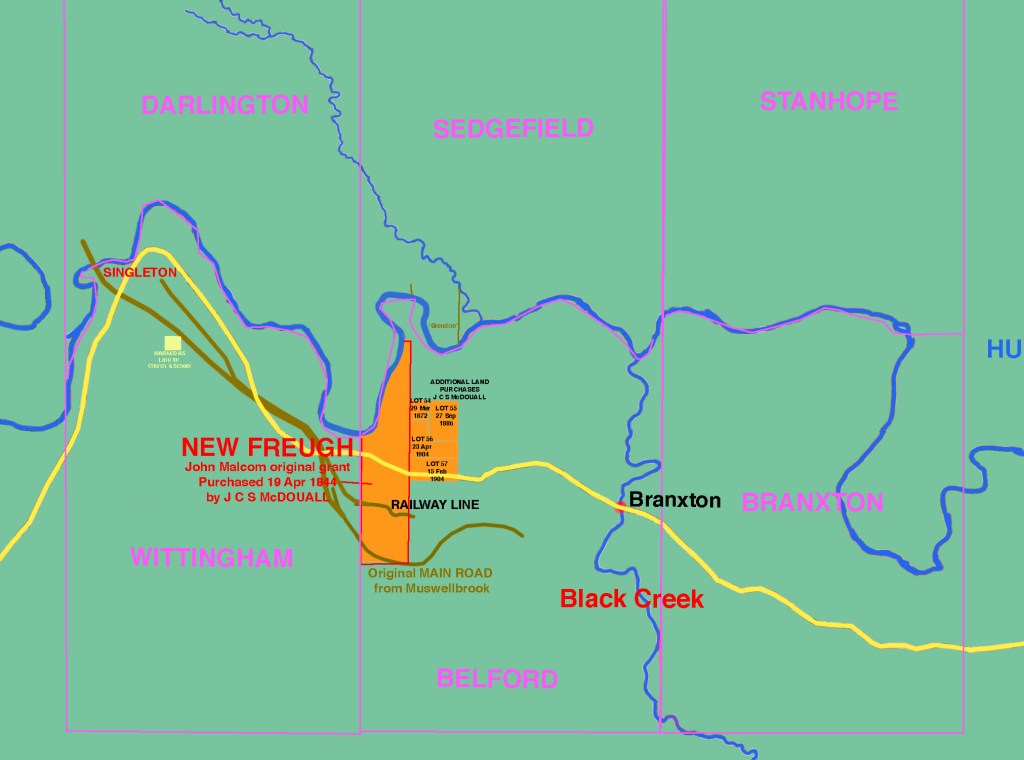
The map below is the amalgamation of several parish maps – the red section indicating the original land grant to Williams Brooks is ‘Brinkburn Farm’ with the orange farm where George Gray, Edmund Bull and Benjamin Baker were living and working in the late 1840’s was the orange section (original land grant of John Malcolm) belonging to J C S McDouall known as ‘New Freugh’.
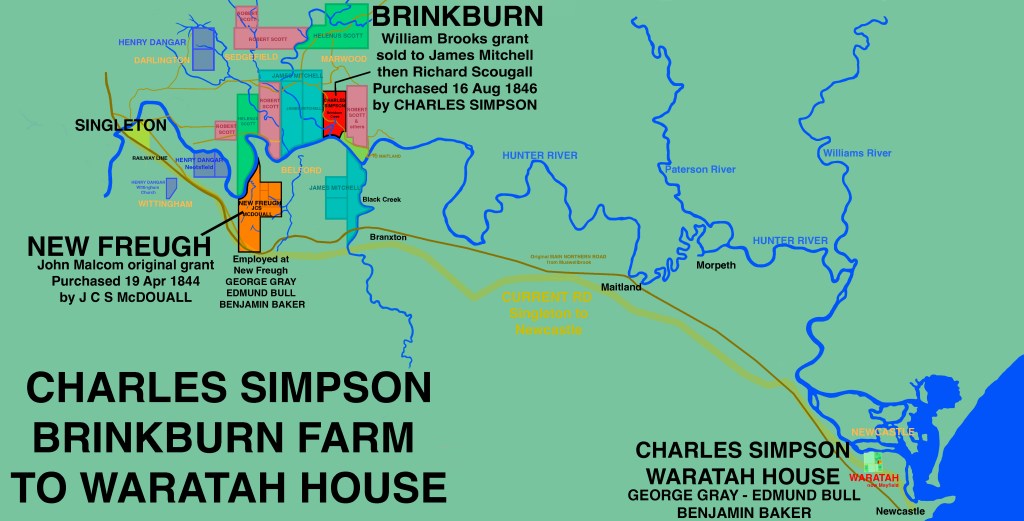
The map below shows indicates the basic position of the land portions in relation to each other and to Singleton, Waratah House and Newcastle.
The Scott Family of Glendon and Ash Island
It is necessary to note here the connection between Dr James Mitchell and the Scott Family. Dr Helenus Scott (1758 -1821) was a Scottish born doctor who worked as a surgeon in Bombay, India. He married his second wife Augusta Maria Frederick (1775-1840) in 1800 but when his heath was failing he sought a better climate and life for what he planned to be four years in the new colony of New South Wales, unfortunately he died at sea on the voyage and is buried at the Cape of Good Hope.2 There is also a website telling the history of Ash Island where Alexander Walker Scott, a brother to Helenus and Robert lived and worked along with his two exquisite artist daughters which tells a brief history of Helenus Scott – ash island.org.au
Helenus and Augustus had five children all of whom except Patrick played a roll in the Hunter District:
- Augusta Maria Frederick Scott (1798 – 1871
- Robert Scott (1799 – 1844)
- Alexander Walker Scott (1800 – 1883)
- Helenus Scott (1802 – 1879)
- Captain David Charles Frederick Scott (1804 – 1881)
- Patrick Scott (1808 – 1887)
Helenus (the younger) and his brother Robert continued the journey after their father died and arrived in Sydney in 1821. Like William Brooks they received grants of 2000 acres on the Hunter River which they names ‘Glendon’. ‘Robert and Helenus, the younger, each received land grants on the Hunter River near Singleton, N.S.W., which they combined to form the estate ‘Glendon’. Augusta Maria Scott and her remaining children, Alexander Walker, Augusta Maria, David Charles Frederick, and Patrick, also settled in New South Wales.’ 3
Robert Scott Esq
Robert Scott’s politics aligned with the ‘exclusivists’ described as: ‘sociopolitical faction of free settlers, officials, and military officers of the convict colony of New South Wales, formed in the late 18th and early 19th centuries. The Exclusives sought to exclude Emancipists (former convicts) from full civil rights.‘ 4 His was made a Magistrate and Justice of the Peace in 1824 however his support of the settlers who committed the Myall Creek Massacre against the Wirrayaraay people who were given reprieve staying on Henry Danger’s property at Myall Creek near what is now Bingara. Robert Scott was part of a group of settlers who funded the defence and sought to intimidate jurors and witnesses.
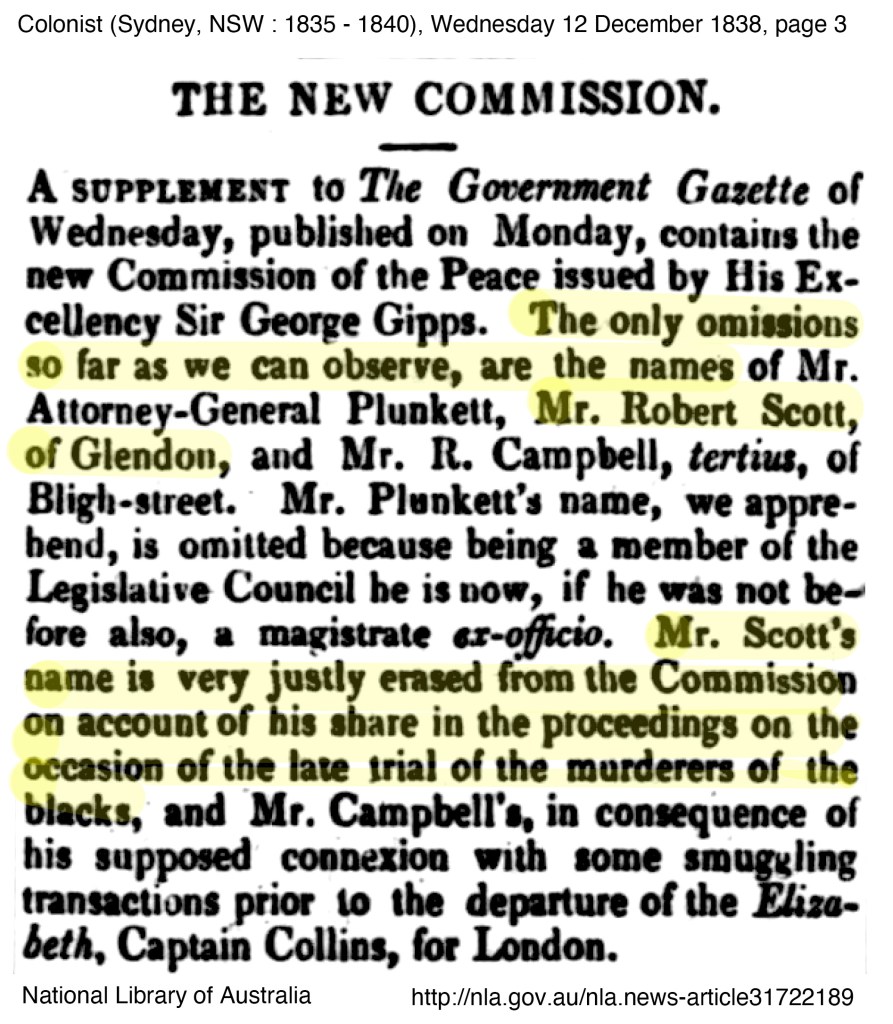
As a result of his interference in the trials of the men he was removed from his position of Magistrate being revoked by Governor George Gipps in 1838.
Governor Gipps publicly stated: ‘Mr Scott’s name is very justly erased from the Commission on account of his share in the proceedings on the occasion of the late trial of the murdered of the blacks’ 5
In 1843 Robert Scott was a candidate seeking election in the County of Durham in what was New South Wales first colonial elections for seat in the New South Wales Legislative Council. Another candidate in Durham County was Richard Windeyer who eventually won in this election and who amongst the electioneering public meetings had some challenging views of Robert Scott: ‘Mr Robert Scott they all knew thieve a large stake in the colony, as a land and stockholder, and that he had undoubtedly the opportunity by the education that had been bestowed on him of acquiring information which was essential to the character of a legislator. But since the truth must be said, he thought that as far as they had been enabled to judge, Mr Scott was in every other respect the least desirable as a representative for Durham of all the candidates in the field.‘6
At the same meeting Henry Dangar stated: ‘As to Mr Scott. his principles were well known to be of the High Church and tory order; in Church matters his principles were of the most illiberal nature, and in other matters he thought it quite fair to presume, they were equally illiberal. He was a gentleman of great property and influence, but his influence was confined to his own order, and that order he might designate the order of magistrates. Mr Scott seemed to look down upon all those who had not the J.P. appended to their names. Some years ago, Mr Scott had been friendly with some of his neighbours he had been on visiting terms with himself (Mr Dangar), but this familiarity had declined insensibly. Mr Scott had effectually estranged himself from them – and in return even for the contemptuous neglect with which he has treated its.’7
It should be noted here that Richard Windeyer was a journalist, barrister, agriculturist who appeared for the defendants in the Myall Creek Massacre case.8 The massacre had taken place on Henry Dangar’s land and he too supported the defendants in raising defence council. So the remarks made by them about Robert Scott are particularly telling.
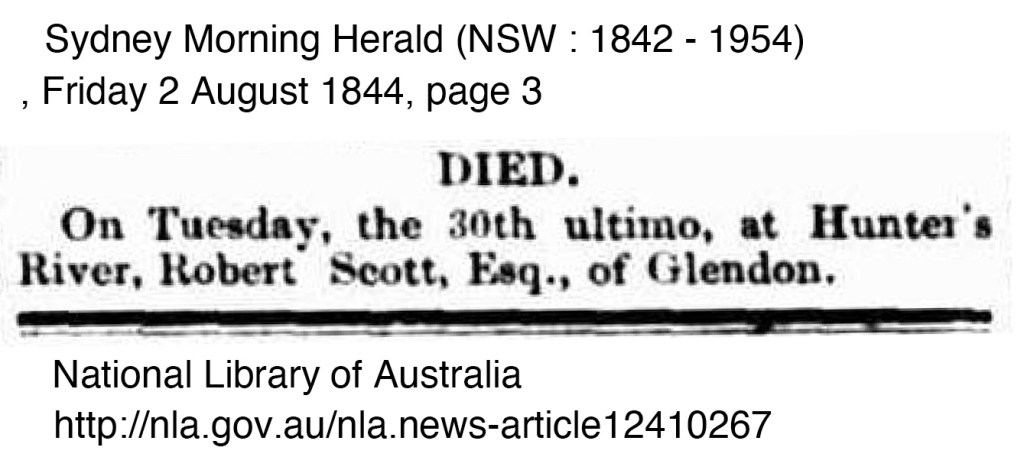
Robert Scott died on 30 July 1844 at his Estate house of ‘Glendon’. Measuring his wealth by quantity rather than quality of land, and totally unskilled in farm management, Scott spent lavishly for small return, but as host to artists, explorers, clergy and scientists he made Glendon a cultural centre unique in its place and time. He died unmarried at Glendon on 30 July 1844.9

Helenus Scott Esq
According to the Australian Dictionary of Biography Helenus Scott preferred life at Glendon to the cavalry cadetcy proffered by relatives. His soundness of character and devoted service as magistrate and district warden of Patrick’s Plains weighed more heavily than did his family connexions when Governor Gipps recommended him in 1844 for a colonial order of merit. His brother’s early death, the depression of the 1840s and his family’s involvement in the failure of the Bank of Australia left him almost penniless.
Helenus and Robert Scott were known for horse breeding: In his online blog local Scone Veterinary Bill Howey records: ‘Scott, Robert (1799–1844) & Helenus Scott (1902 – 1879) Keith R. Binney writes in his monumental tome ‘Horsemen of the First Frontier (1788 – 1900) and The Serpent’s Legacy’ that “from the viewpoint of a thoroughbred researcher, without any doubt the two most important pioneer Hunter Valley bloodhorse breeders were the brothers Robert and Helenus Scott”.
Their importation of British Stallions ‘Toss’ (1829), ‘Trumpet (1830), ‘Dover’ (1836) and ‘Cap-a-pie’ provided a superb foundation of broodmares and sires for most Hunter Valley, Richmond and Clarence River Studs. They were supplemented by locally bred sires ‘Tamerlane’ (1835), ‘Pelham’ (1842) and ‘Hector’ (1843). Among those to benefit were Charles Reynolds’ Tocal Stud, George Wyndham’s Dalwood and Bukkula, Barnes and Smith Bros. Dyraaba and Gordon Brook as well as Messrs Dangar’s Neotsfield, Turanville and Baroona. Further afield, the Lee’s Bylong and Leeholme and the Rouse’s Biraganbil were replete with Glendon bloodlines.“10
Australian Dictionary of Biography by Nancy Gray: ‘He was appointed a stipendiary magistrate and, after service in several country towns, sold Glendon and settled permanently in Newcastle with his wife Sarah Anne, née Rusden, an accomplished linguist and scholar. He died on 24 August 1879 at the Newcastle police barracks and was buried at Glendon; he was survived by eight children, of whom the most notable was Rose Scott.’ 11
Alexander Walker Scott Esq of Ash Island
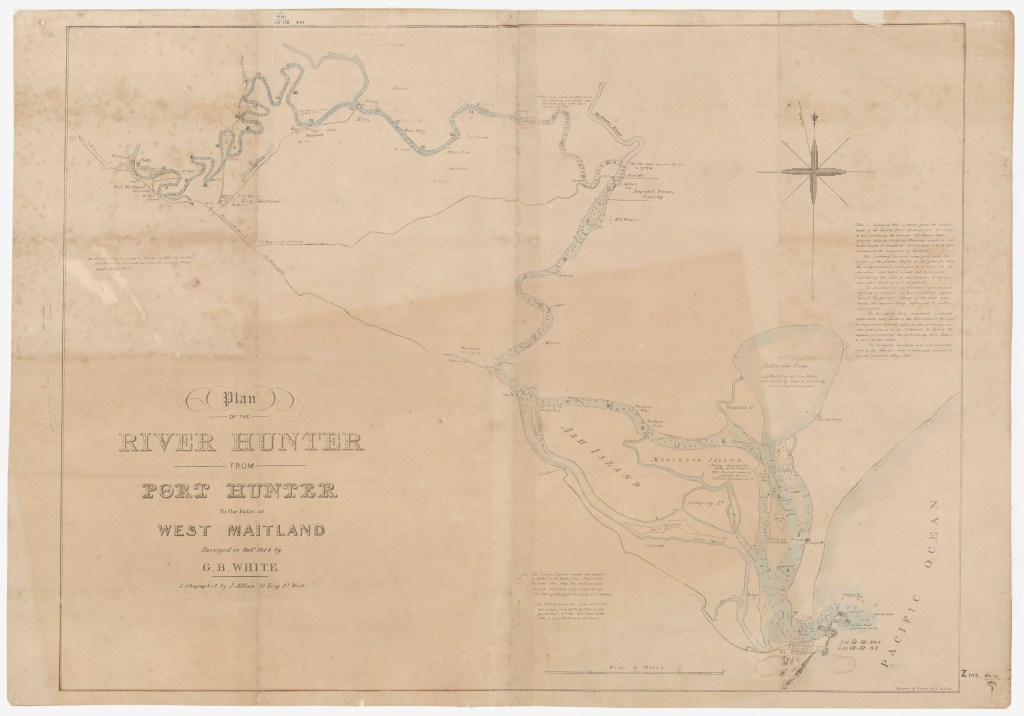
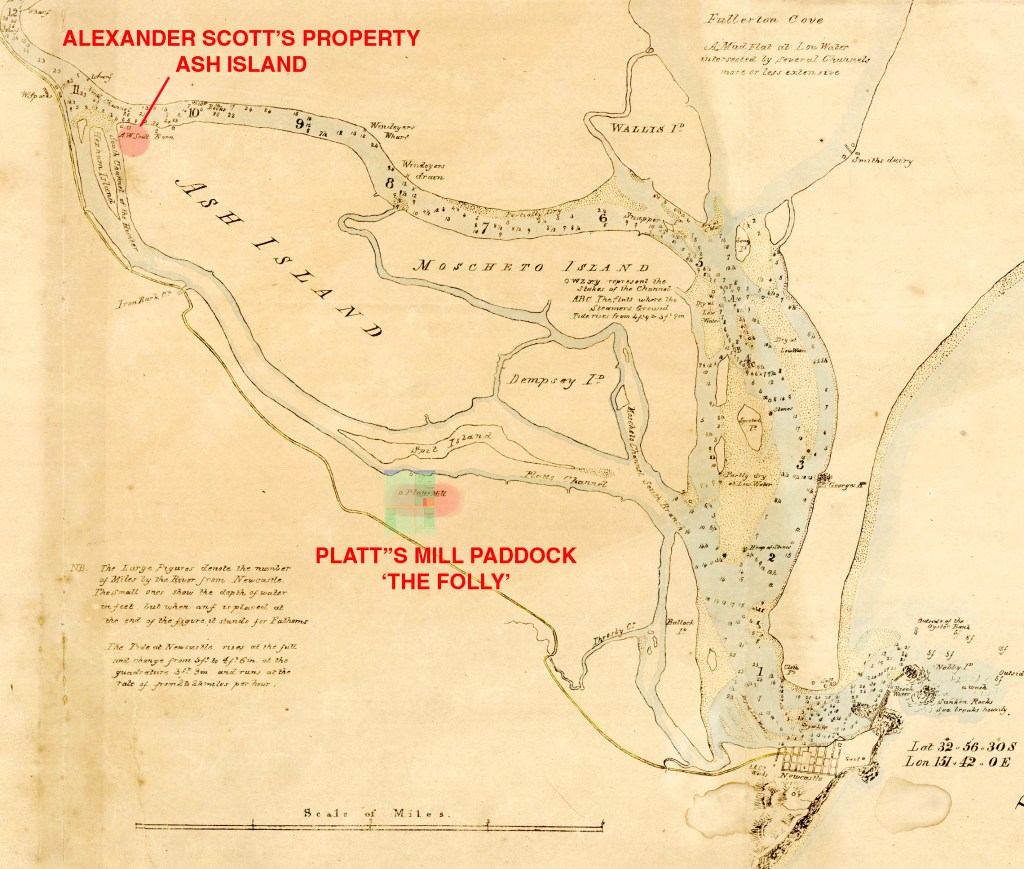
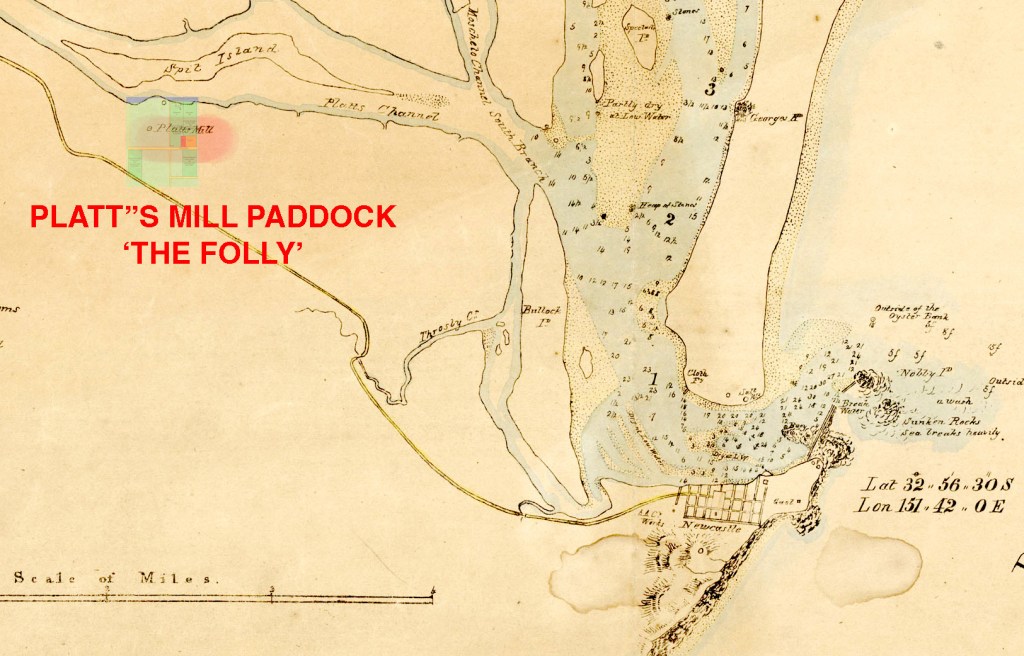
There was another son who is of note to the Newcastle area near ‘the folly’ along with his two daughters. He was Alexander Walker Scott12 an entomologist and entrepreneur, who made Ash Island his home after his marriage on 29 December 1846 to Harriet Calcott. He had two extremely talented daughters who were both artists and naturalists, Harriett and Helena Scott. Ash Island is situated just north and along Platt’s channel from where George Gray settled on Charles Simpson’s land. There is a lot if interest in the Scott’s of Ash Island with some excelelnt information being provided on the Hunter Living Histories website and the Australian Museum websites. I was fortunate to have been able to see some of theri original work at the Australian Museum in Sydney ‘Transformations: Art of the Scott Sisters’ with an App ‘The Art of Science’ and book ‘Transformations’ being produced in conjunction with the exhibition. Given the proximity and small population of the area, the similar circles Charles Simpson and Alexander Scott moved in, the it is possible George Gray could also have met the Scott family of Ash Island.
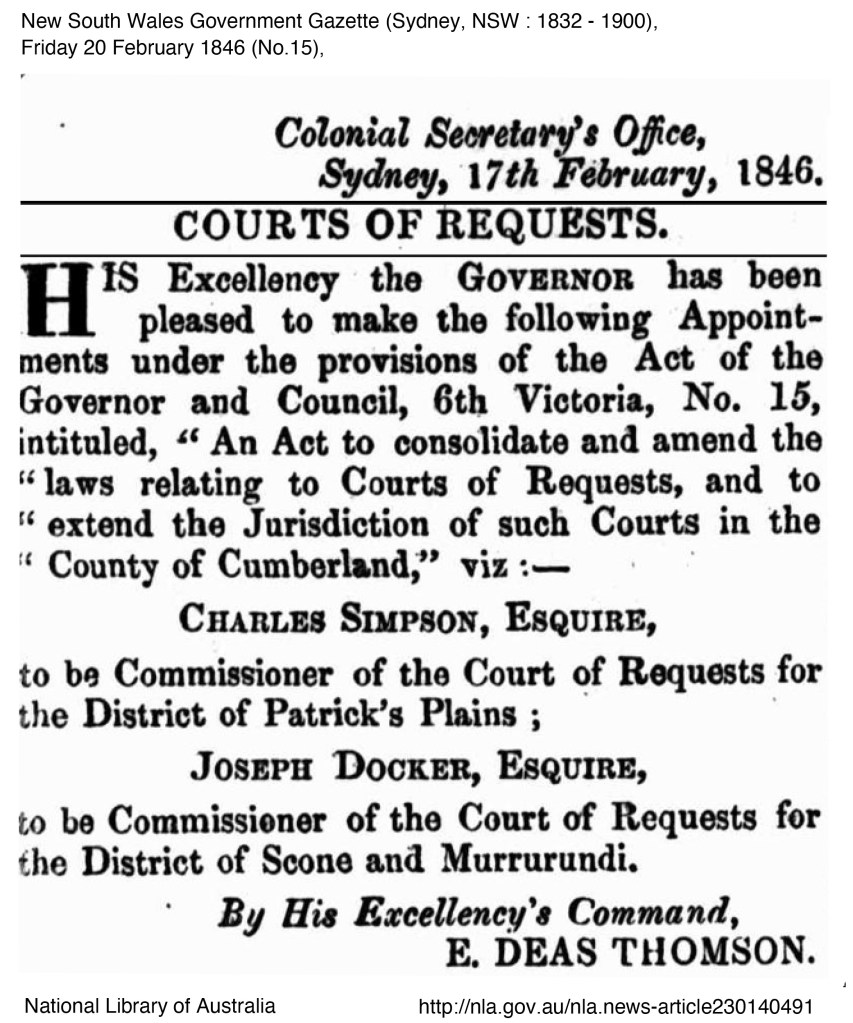
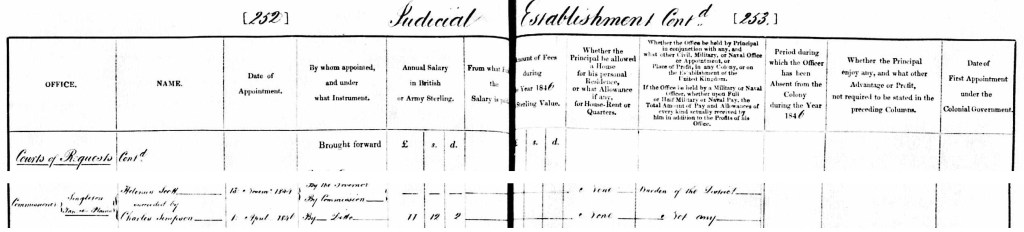
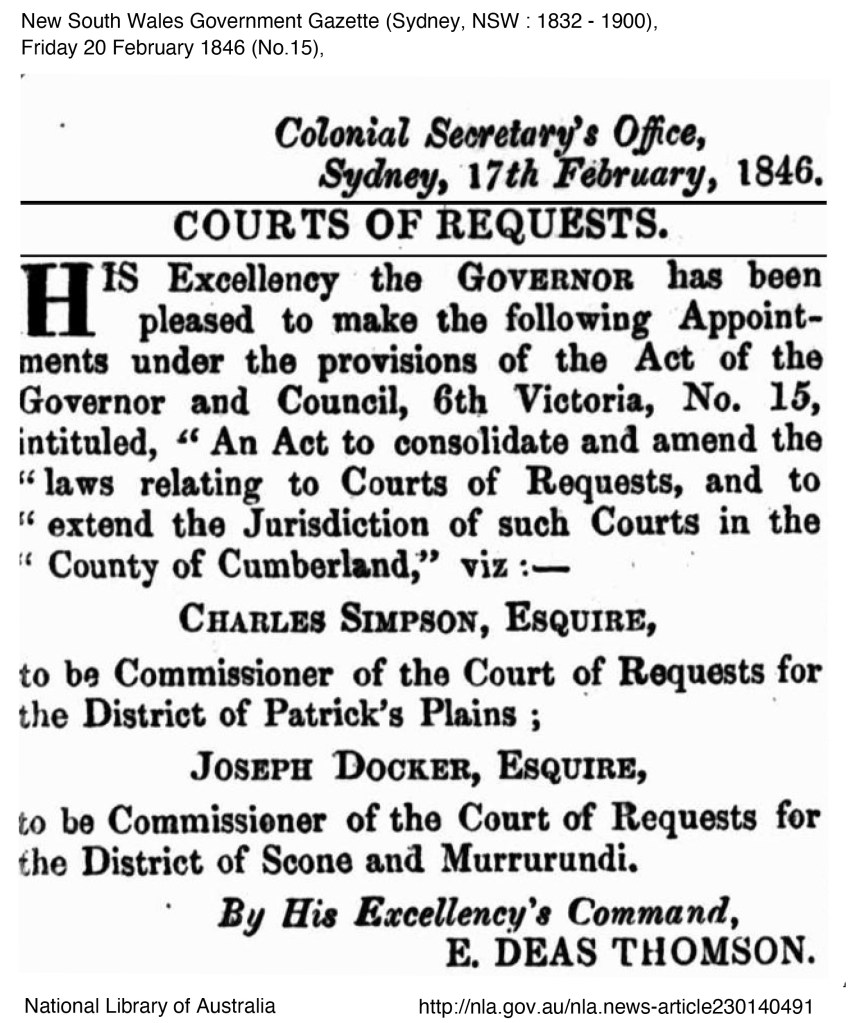
Charles Simpson and Helanus Scott were also linked by their work as is clearly evidenced in a record in the Blue Books (Returns of the Colony) 1822-5713 where on 1 April 1846 Charles Simpson was appointed as the new Commissioner in the Courts of Request for Singleton and Patrick’s Plains. The previous Commissioner and Warden of the District was Helanus Scott.
Charles Simpson and Helenus and Alexander Walker Scott
The two Scott brothers who have clear links to Charles Simpson are Helenus Scott and Alexander Walker Scott.
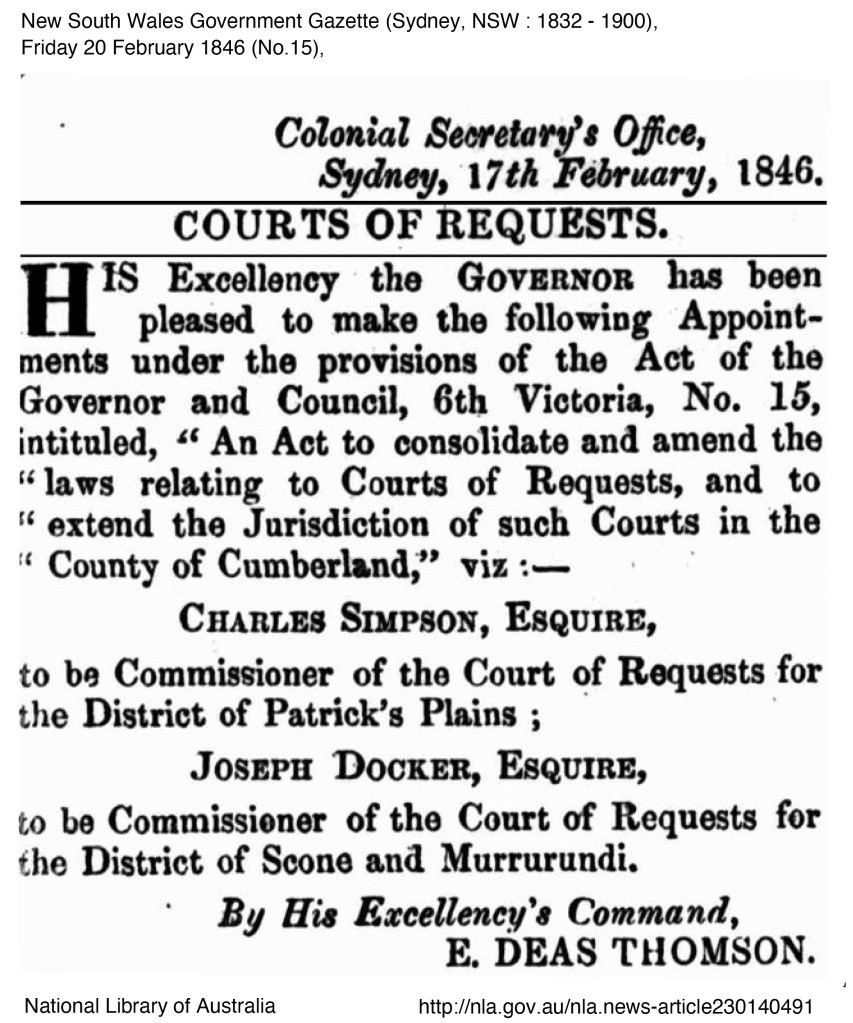
NSW Government Gazette record of the appointment of Charles Simpson, Esquire as the Commissioner of the Court of Requests for the district of Patrick’s Plains.14
This clearly places Charles Simpson in the New Freugh area alongside his magisterial colleagues, Helanus Scott and John McDouall who by mid April 1846 had purchased the land which became New Freugh Station.
A connection to Alexander Walker Scott can be seen in the next chapter of Charles Simpson’s life in the Hunter District and more particular in Waratah and Newcastle.
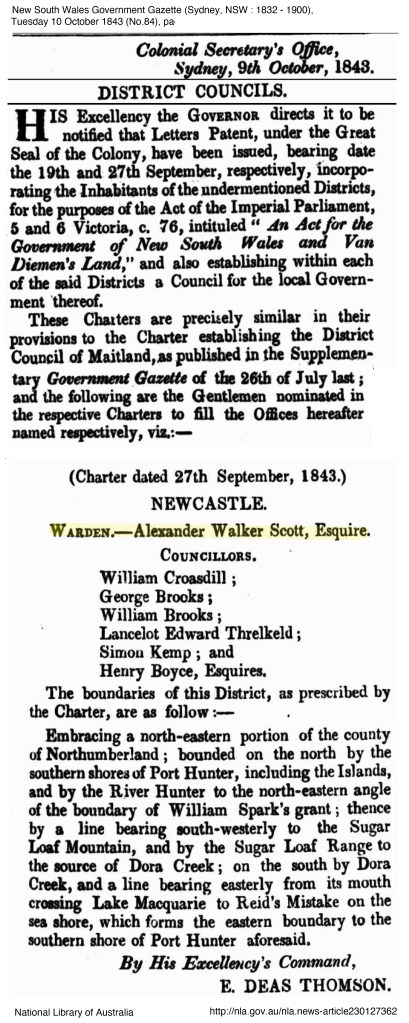
It involved the position of Warden of the District Council of Newcastle of which Alexander Walker Scott Esq was appointed to on 27 September 1843.
Whilst Alexander Walker Scott’s appointment to this position is widely known and reported, later Wardens details do not seem to have made it to the public record aside from the contemporary Gazette’s and newspaper notices.
Dr James Scott and Augusta Maria Frederick Scott
In regards to Dr James Mitchell, he married Augusta Maria Frederick Scott on 22 August 1833 at St James Church, Sydney.15
So when James Mitchell decided to explore farming and land it would have been obvious to look at properties close to his wife’s Scott family.
The NSW Parliament website records: ‘Landowner, industrialist and company director. Educated locally. Appointed assistant surgeon to Sydney Hospital in 1823. Surgeon from 1829 until 1837. Carried on private practice from c.1833 until mid 1840s. Elected to medical board in 1845. President in 1852. Purchased land in the Hunter River district. Director and shareholder of Bank of Australia which failed in 1843. Built copper smelting works on Burwood estate. Established Newcastle Coal and Copper Company in 1853. A founder of the Australian Mutual Provident Society. Director 1852 until 1859. Chairman from 1860 until 1865. Trustee of Australian Museum from 1853 until 1869. Benefactor of St Pauls College. University of Sydney. Shareholder of Newcastle Mechanics Institute.’16
The Scott brother’s only sister Augusta Maria Mitchell nee Scott’s link was through her husband Dr James Mitchell, that Charles Simpson purchased his ‘Brinkburn Farm’ property via an insolvency proceedings from the indentured Richard Scougall to James Mitchell property trail.
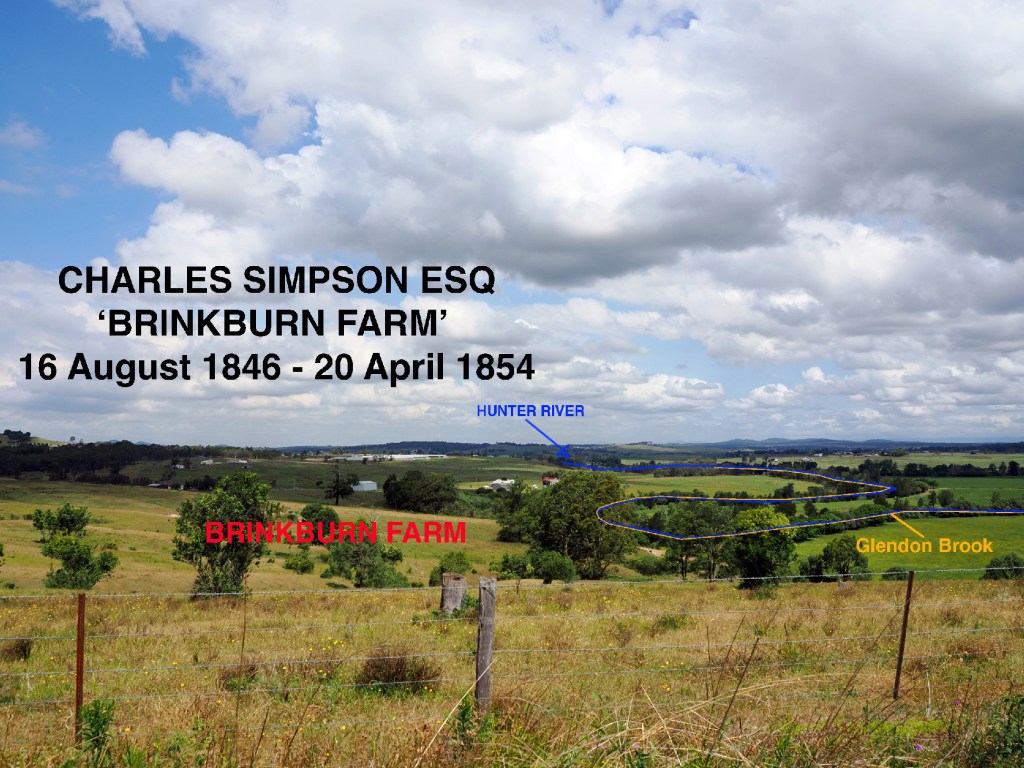
‘Brinkburn Farm’ Purchase by Charles Simpson
On 16 August 1846 Charles Simpson mad a significant purchase which appears to be the first one he made on the Hunter River and in New South Wales. It consisted of 1350 acres on the bank of the Hunter River northwards across Glendon Brook, near Brinkburn Creek. In order to understand all the complexities of all the parties and situations there is a need to follow through all the conveyancing documents and situations that occurred from the original owner and transactions in 1827 until Charles Simpson purchased the farm in 1847.
The traditional owners of the land were the Wonnarua, Wanaruah people.
William Brooks and ‘Dalziel’
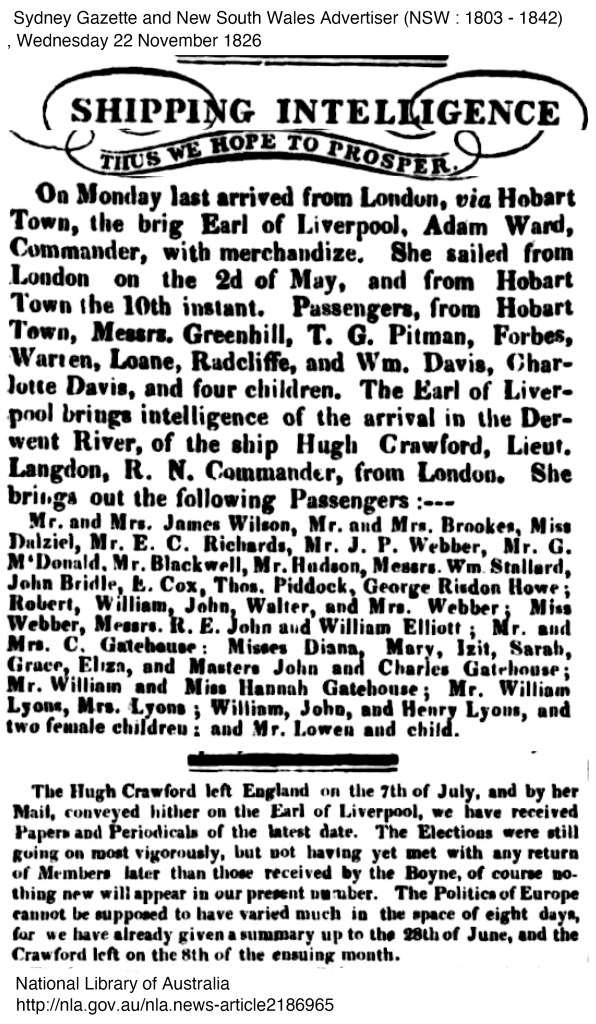
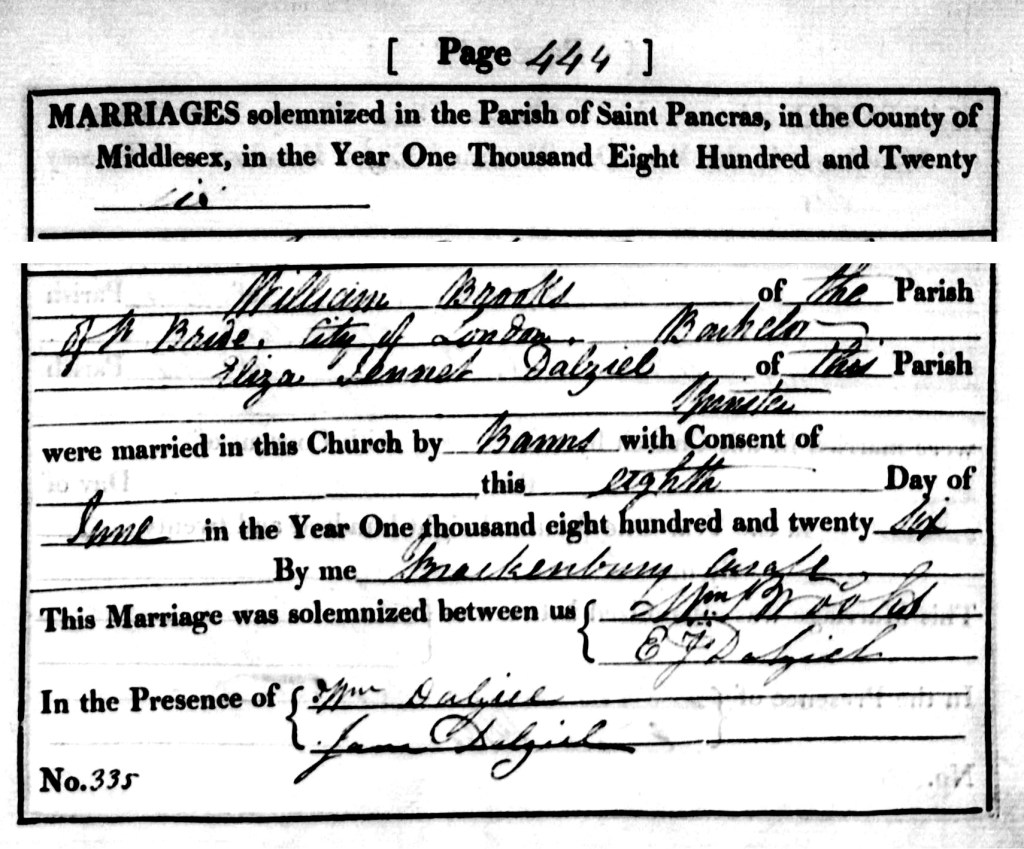
The website Free Settler and Felon, Convict and Colonial History that documents many records of the Hunter Region states: ‘William Brooks arrived in the colony with his wife Eliza Jennet nee Dalziel on the Hugh Crawford in November 1826. They had been married on 8th June 1826 at St. Pancras, London shortly before sailing.‘ 17 The following documents confirm those statements, starting with the marriage record for William Brooks and Eliza Jennet Dalziel the shipping records.
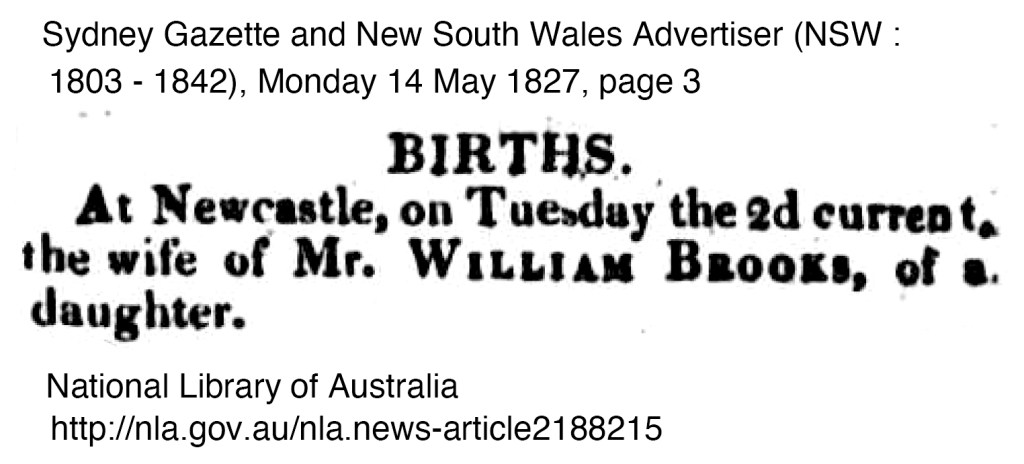
Their daughter Euphemia Janet was born in May 1827 at Hexham, Christ Church.18
William Brooks acquired the land Grant of 1279 acres on 19th February 1827 in County Durham on the Hunter River. NSW Land Titles Primary Application 13480 outlines the passage of William Brooks land to Charles Simmons and beyond: ‘As to 1279 acres Portion 18 and part of Portion 11 Parish of Marwood County of Durham Glendon Brook, hunter River Brinkburn Creek.’ William Brooks named the farm ‘Dalziel’ which is a direct connection with his wife’s family name.
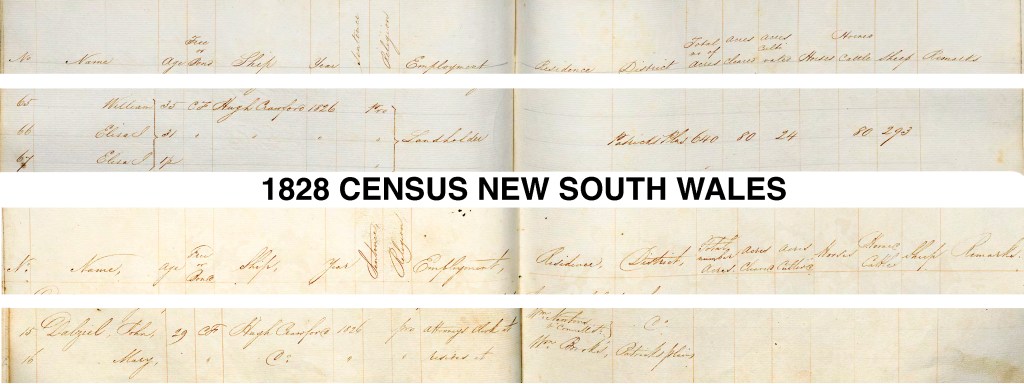
In the 1828 Census we see that William and Eliza Brooks, their daughter Eupehmia and Eliza’s sister Mary Dalziel are all living at ‘Dalziel’.
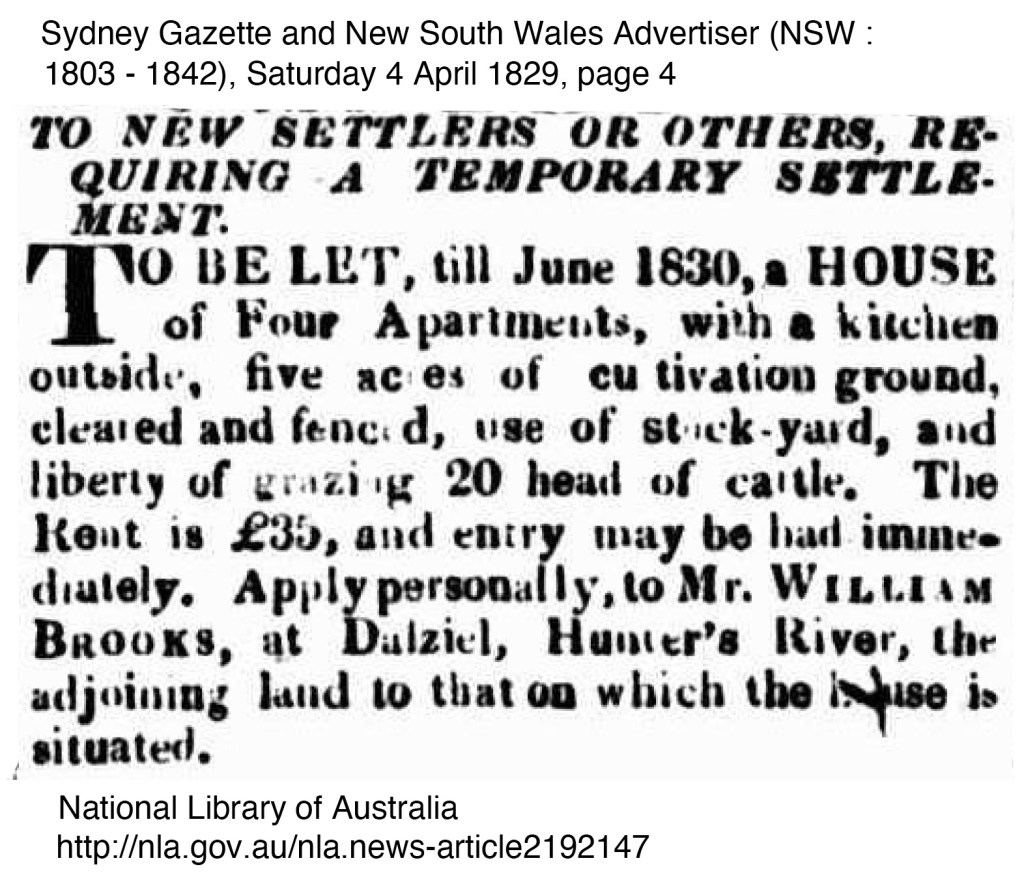
On 4 April 1829 a notice was placed for the lease of a house and four apartments, a kitchen outside and five aces of land at ‘Dalziel’, Hunter’s River, apply William Brooks personally at Dalziel.
Unfortunately just 5 weeks later his wife Eliza died and was buried on 15 June 1829 at Christ Church Cathedral, Newcastle on 15 Jun 1829.19
On 22 January 1834 Williams Brooks obtained a Marriage License and on 28 January at St Phillips Church, Sydney, he married Elizabeth Evans.
On 20-21 January prior to his marriage William Brooks made provision for his daughter Eupehmia and his sister in law MAry Dalziel.

A Lease and Release Settlement was enacted on 20 – 21 January 1834 NSW Land Titles Bk-No F-647 is a memorial of settlement. It states that in the Estate of William Brooks in consideration of love and affection and that the: ‘Estate conveyed To trustee Mary Dalziel in fee in Trust for m. Brooks for life Remar. to Euphemia Janet Brooks for life Remdr. to trustee to preserve contingt. remar. Remar to use of E.P. Brooks for life Remar. to heirs of body of E.P. Brooks Remdr. to Wm. Brooks and his hs.’
This record includes a description of the property: ‘All that the Messuage tenement buildings farm land and other premises with their appurts. commonly called or known by the name of Dalziel in the Co.of Durham & Colony afsa. which said farm is bounded on the South by the River Hunter on the North by unlocated land on the East by land in the possession of Dr. Radford which was originally granted to Mr Shand and on the West by land purchased by Dr Mitchell containing by estimation 640 acres be the same more or less and now in the tenure or occupation of the said Wm. Brooks’20
Essentially he was ensuring the farm ‘Dalziel’ be passed to his daughter Euphemia Janet Brooks and her children. It was to be held in trust by her Aunt, Mary Dalziel (Spinster) of Dalziel. This further explains the next document when the land was sold in 1838.
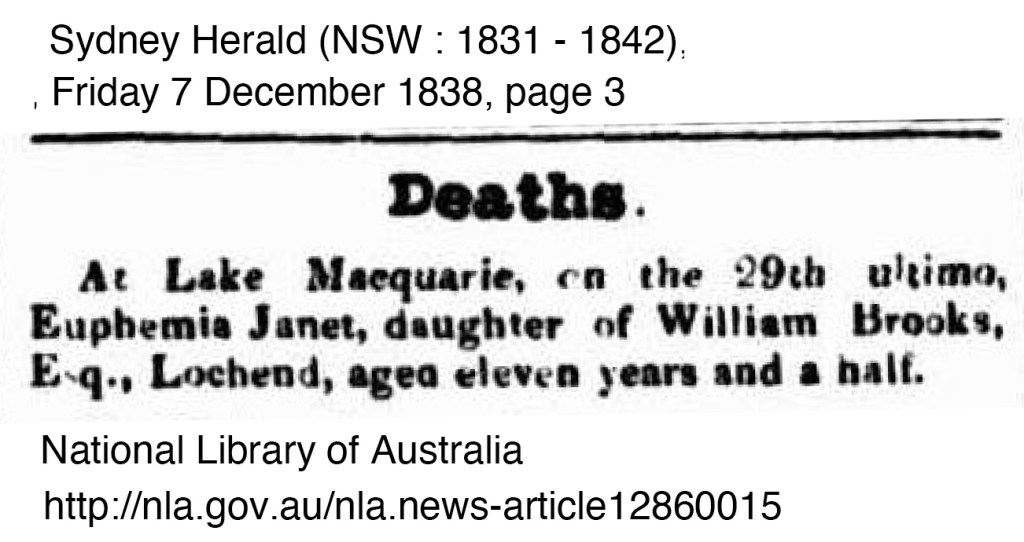
On 28 November, 1838 tragedy again struck William Brooks when his daughter Euphemia just 11 years of age and living with her Aunt Mary Dalziel in Newcastle, died of influenza. She was buried with her mother in the Christchurch, Newcastle.
Within weeks of the death of his daughter there is another Land Title record in Bk-Number P-432 and dated 17 – 18th December 1838, an Indenture of Lease and Release between: ‘William Brooks of Lockend Lake Macquarie near Newcastle in the Colony of New South Wales Esquire and Elizabeth Brooks his wife to James Mitchell of Sydney in the said Colony Esquire.’ This land was Portion 11 of 640 acres which he sold to James Mitchell for £750.21
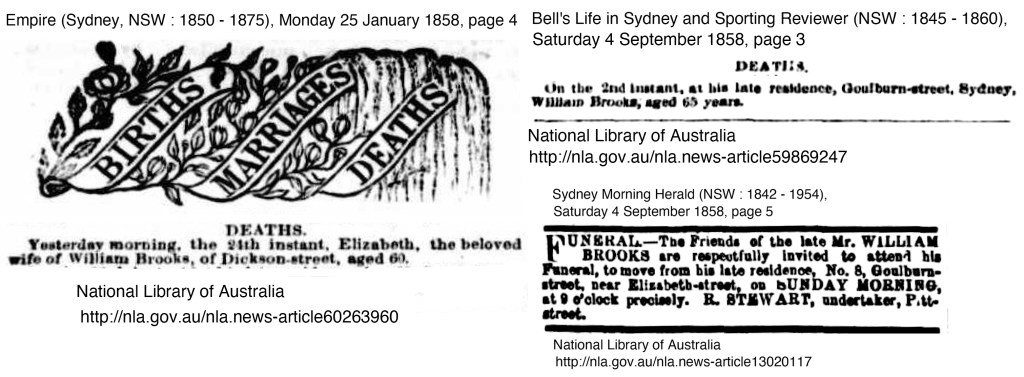
It is at this point that William Brooks association with what was to become Charles Simpson’s Brinkburn ends. Elizabeth Brooks the second wife of William Brooks died on 24 January 1858 followed later in the same year on 2 September 1858, both in Sydney. There are four sons recorded in the NSW birth registration with William and Elizabeth Brooks as parents with the region code as PC: Presbyterian in Derbie; Hunter District; Maitland; Morpeth; Paterson; Singleton regions. They are: William H Brooks born 1834, John E Brooks born 1836, George C Brooks born 1837 and Alexander D Brooks born 1839.
Dr James Mitchell – Portions 18 and 11
On 19 September 1837 James Mitchell obtained a grant of land above Portion 11 belonging to William Brooks, this is Portion 18 (Lot 184). It was adjacent to James Mitchell original 2000 Land Grant to the west – Portion 5.
This transaction is recorded in the Primary Application 13480 in the NSW Land Titles.22
So when he purchased William Brooks land Portion 11, James Mitchell consolidated this holding of 800 acres with the additional 640 acres of William Brooks making a total of 1440 acres.
Dr James Mitchell in 1838 when he began to diversify his interests into land and farming.
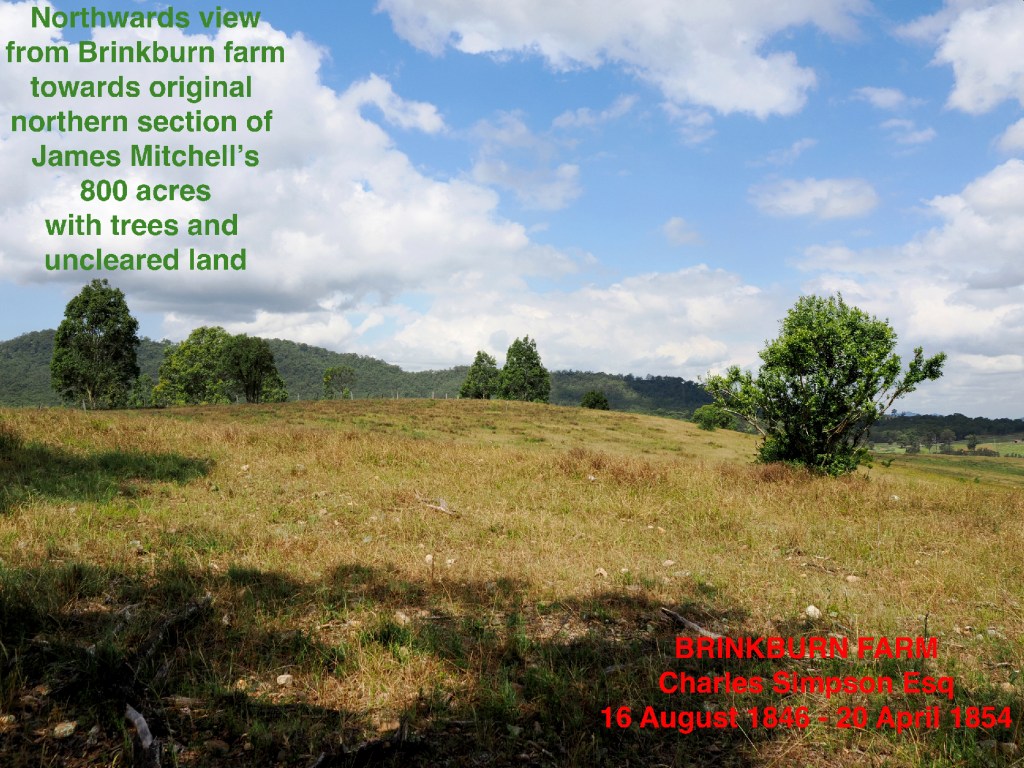
The image below is looking north east across the top section of William Brooks original 640 acres towards the original 800 acre grant of James Mitchell. This 800 acres is largely uncleared land on a raised area of the land.
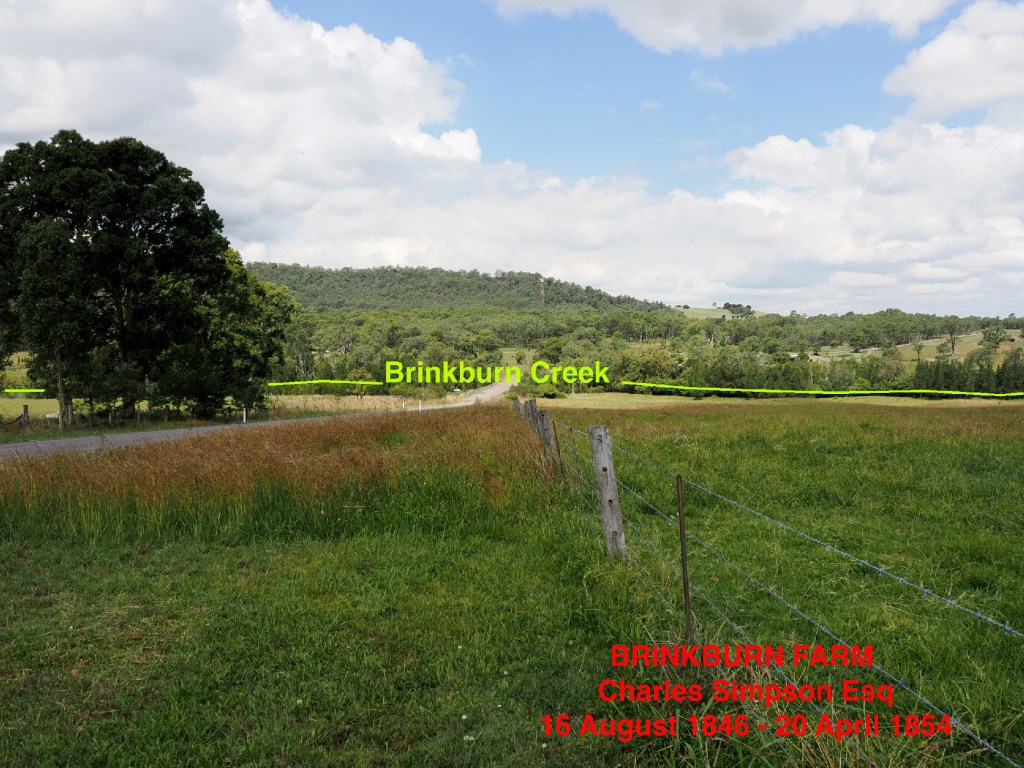
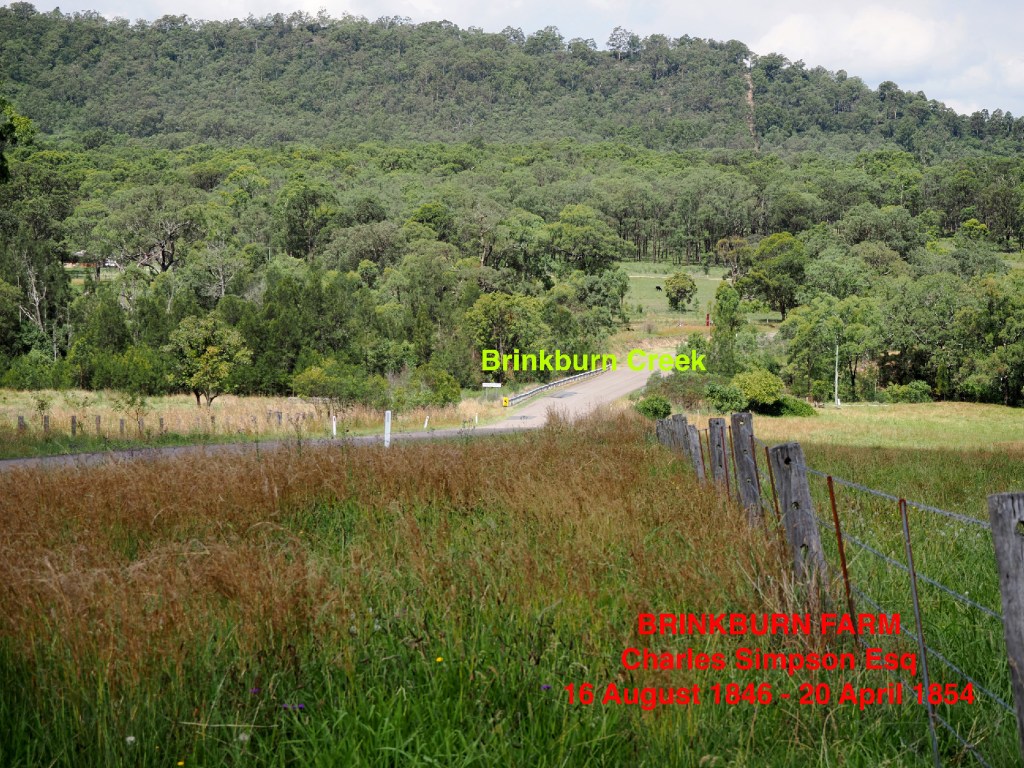
The images below are taken from the entrance to Brinkburn farm off Elderslie Road showing where Brinkburn Creek crosses the road. The images also show the raised hill areas, tree and vegetation which continued across the 800 acres of the original grant to James Mitchell. Whilst William Brooks cleared and farmed his land, James Mitchell simply owned the land but did not develop it. With hindsight these largely uncleared areas no doubt are important to the ecology.
Richard Scougall
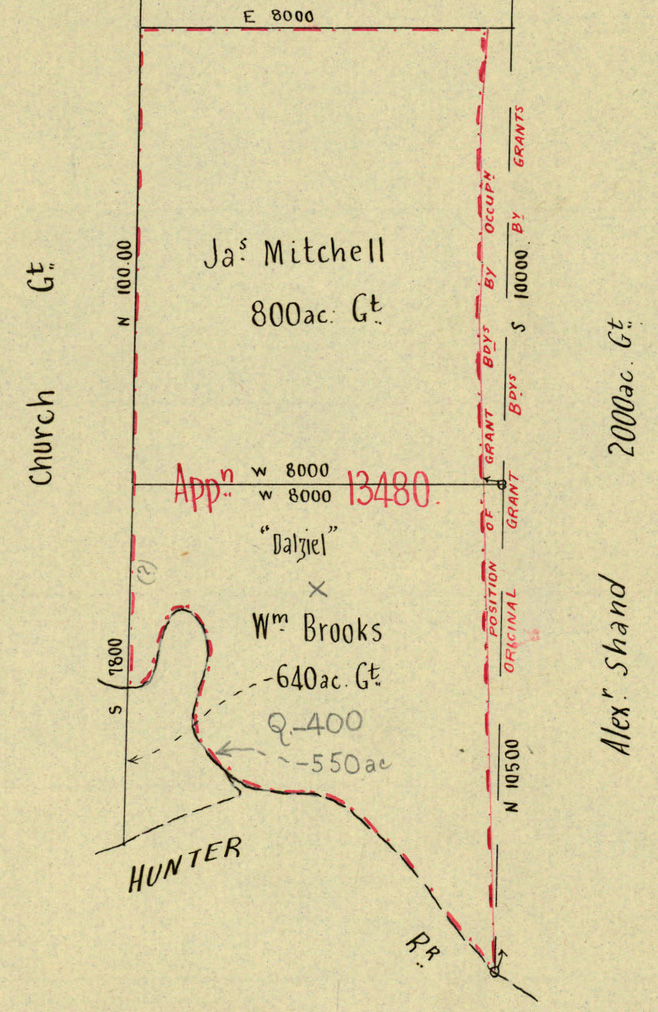
The next transaction involves a conveyance document between James Mitchell to Richard Scougall on 2 – 3 December 1839 the record is contained within the NSW Land Title Book-Number Q-400. At this point the original Williams Brooks Portion 11 land is reduced from the original 640 acres to 550 acres by adjusting the boundary to the Glen Brook line incorporating it into James Mitchell’s adjacent Portion 5 on the western boundary as seen in the excerpt above from the NSW Land Titles Application 13480 sketch.
The NSW Land Titles Book: Q Number: 400 names the parties in the transaction: ‘James Mitchell & Augusta Maria Mitchell his wife of lst. part Richard Scougall of Hunters River of 2nd. part and Willoughby James Dowling of the 3rd. part’
The payment is described: ‘Two hundred & forty seven pounds ten shillings paid by R. Scougall to James Mitchell and one thousand pounds to be pa. to the sa. J. Mitchell with intrst. thereon & also 10/ pd. by W. J. Dowling to the sd. James Mitchell’. Noting that W J Dowling, the third party was Willoughby James Dowling, a Solicitor.
This record provides the description of the land/property being conveyed to Richard Scougall: ‘All that parcel of land situate in the Parish of Marwood County of Durham containing by admeasurement 800 acres‘ which is James Mitchell’s land. Then: ‘And also that parcel of land containing five hundred and fifty acres situate in the Parish of Marwood & suffield in the County of Durham afsd.’
Of importance was the distinction of the original William Brooks boundary to the new boundary: ‘On the West by a South line by Compass to Glendon Brook & on the south by that Brook to its confluence with the River Hunter & by that river to the South West corner of the said Alexander Shand’s Grant & which sd. parcel of 550 acres is parcel of the second hereinbefore mentioned Grant of 640 acres’.24
Richard Tod Scougall known as Richard Scougall was another Scotsman born in Leith, City of Edinburgh, Scotland in 1805. Although unable to find shipping records for his arrival, there is an intestate record after the death of his brother George, so likely the brothers may have arrived at in the new colony at or around the same time. The first records that appear in Trove citing Government Gazette and Colonial Secretary records relating to the purchase and leasing of large areas of land begin in 1833.
George Scougall died in Tent Hill, Ipswich Queensland in 1848 with the administration of his Estate being given to his brother Richard.
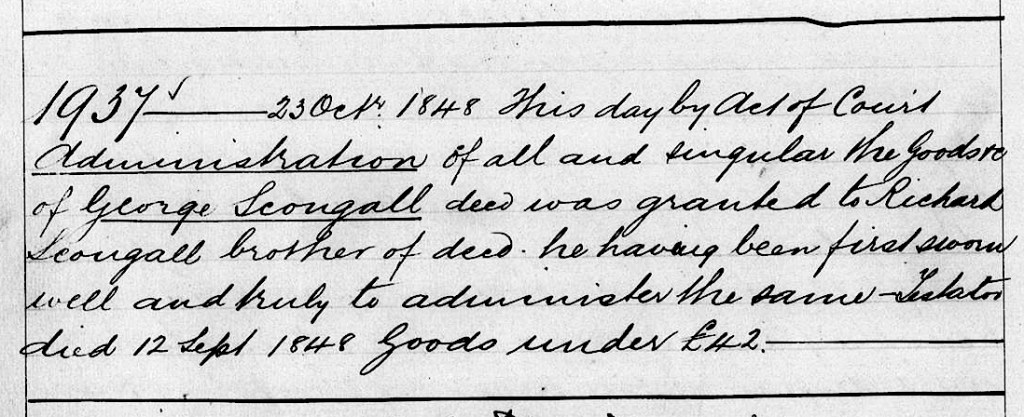
On 22 September 1840 Richard Scougall Esq of ‘Dalziel’ married Catherine Hammond Dun a daughter of William Dun of ‘Duninald’, Paterson River.
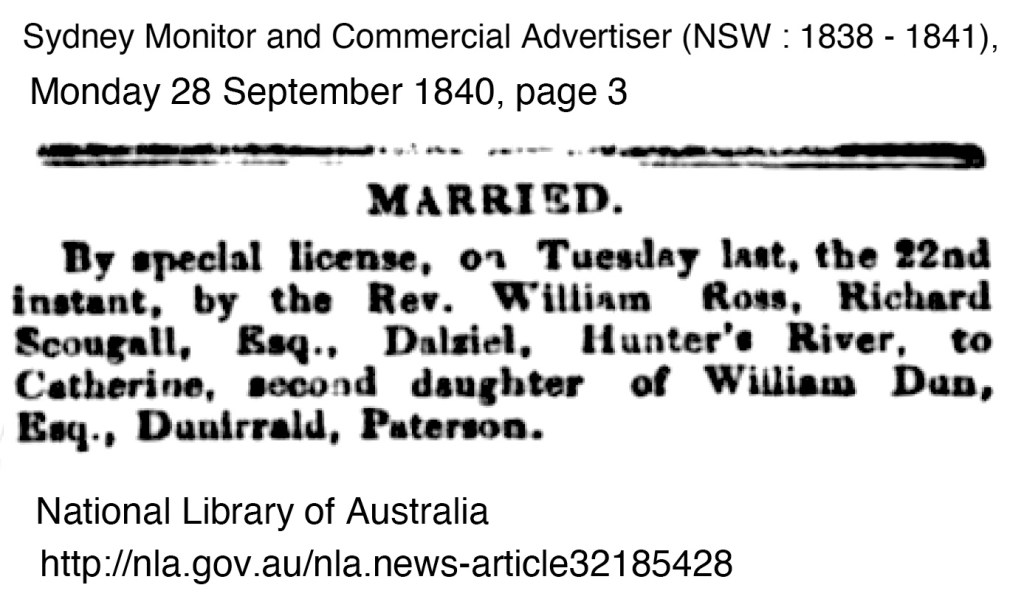
However it was not long into their marriage that Richard Scougall Esq was having financial difficulties.
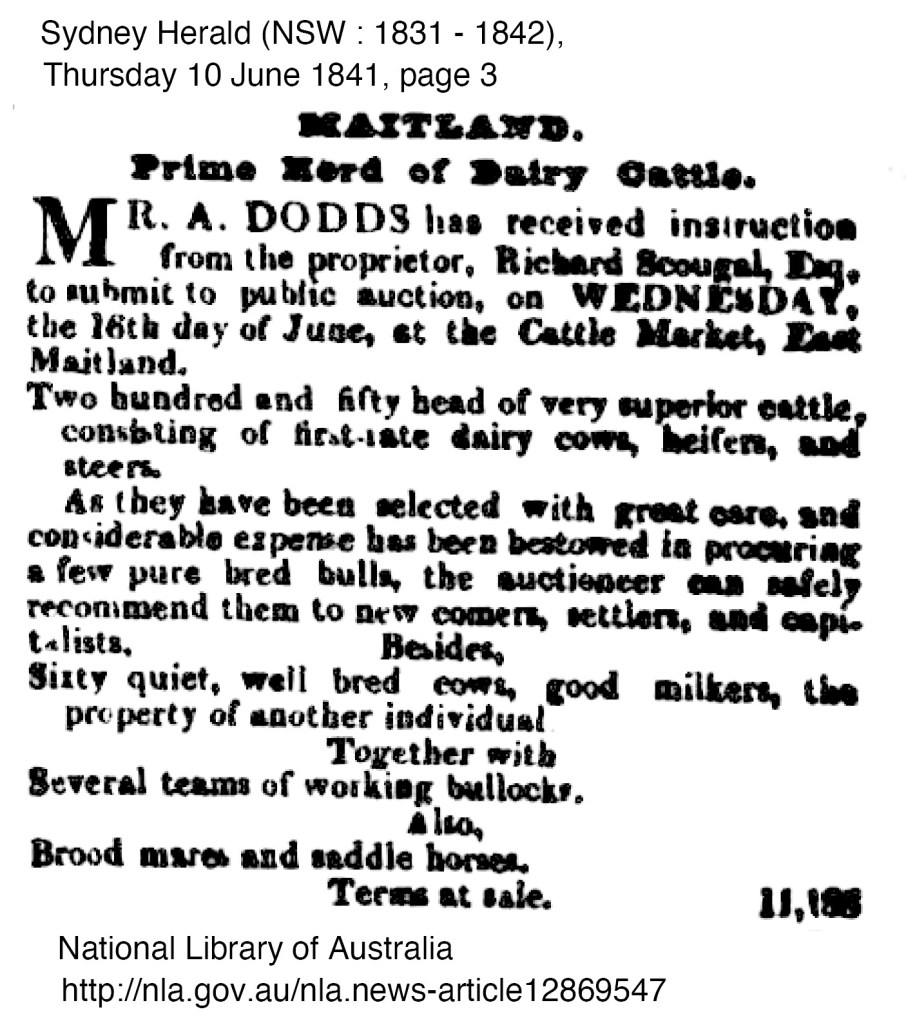
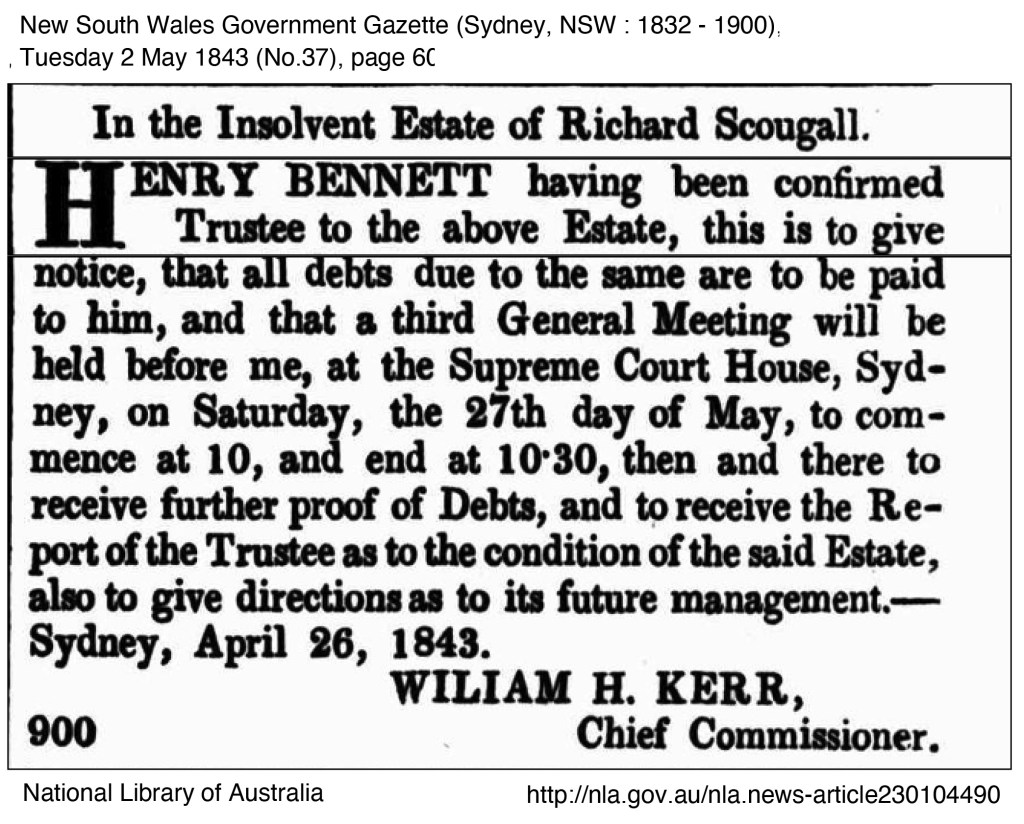
In June 1841 Richard Scougall appeared to be doing well advertising the sale of cattle, bullock and horses. However by March 1843 his Estate was insolvent.
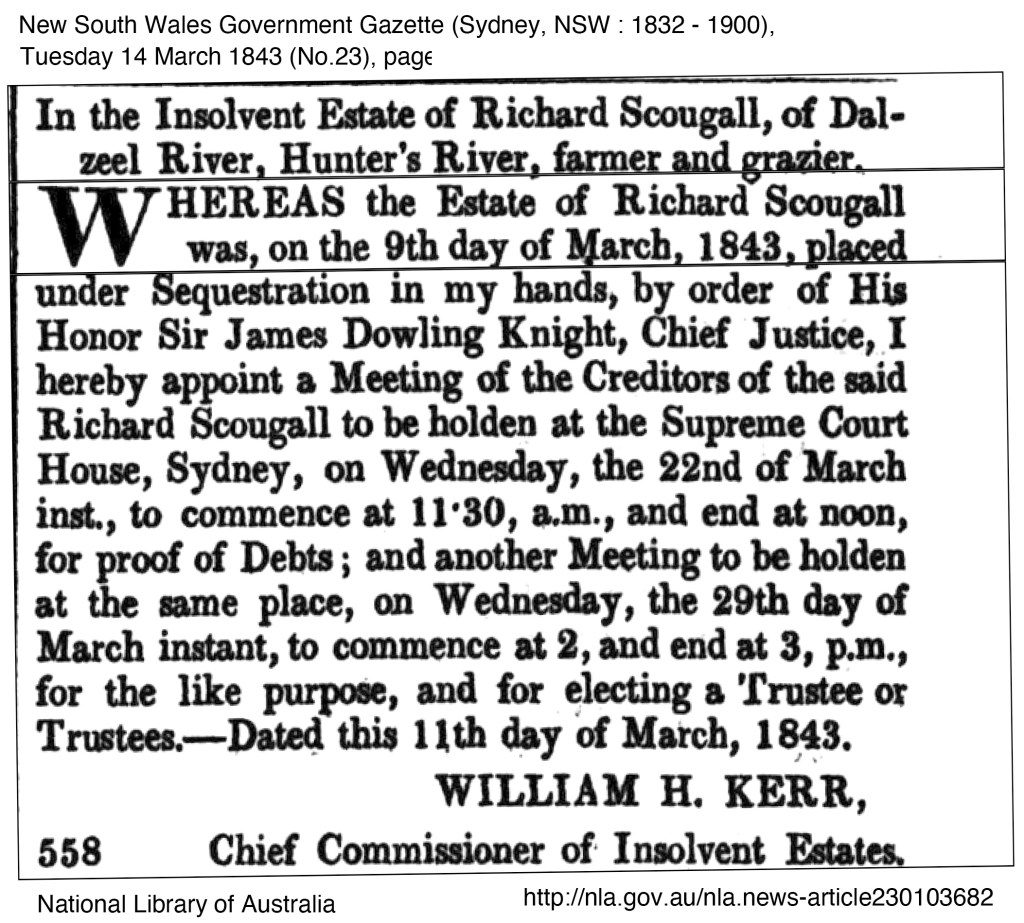
The extent of Richard Scougall’s debt in pounds shillings and pence as with insolvents was laid out in the newspapers; £509 13s 9d.
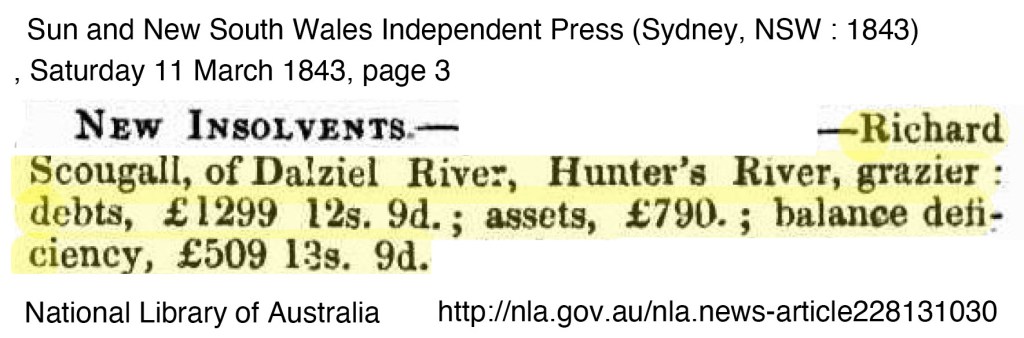
These are just three of the advertisements relating to Richard Scougall’s insolvency with creditors coming forward trying to recoup what they are able from the insolvent Estate.
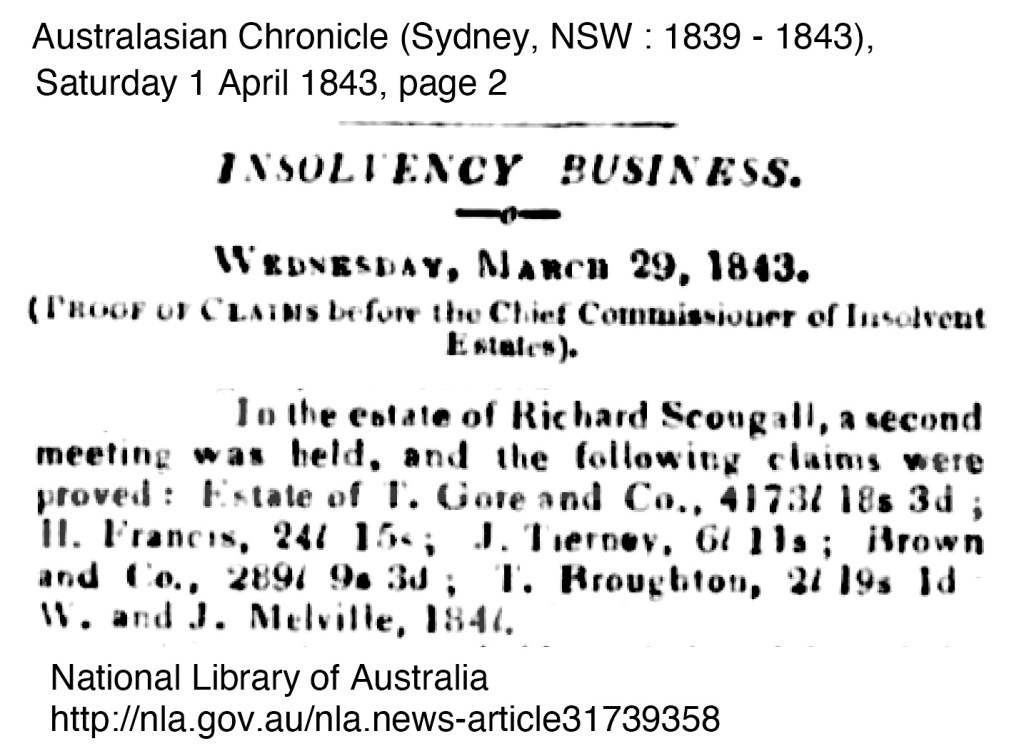
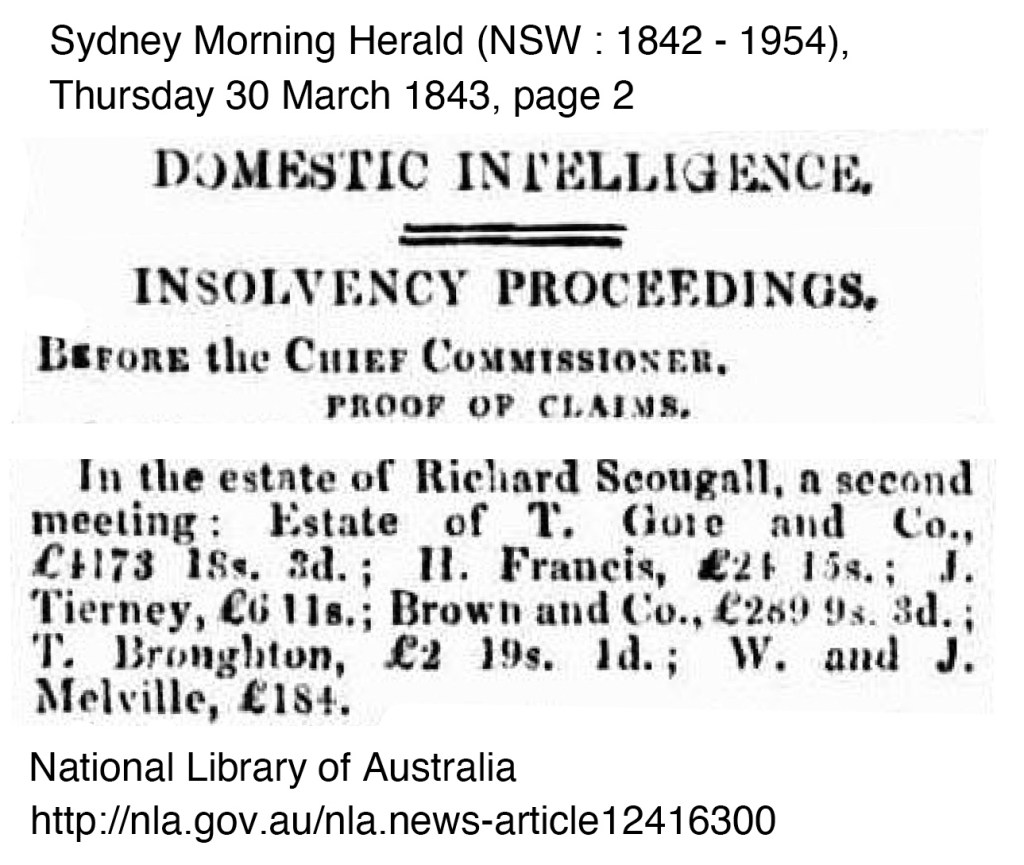
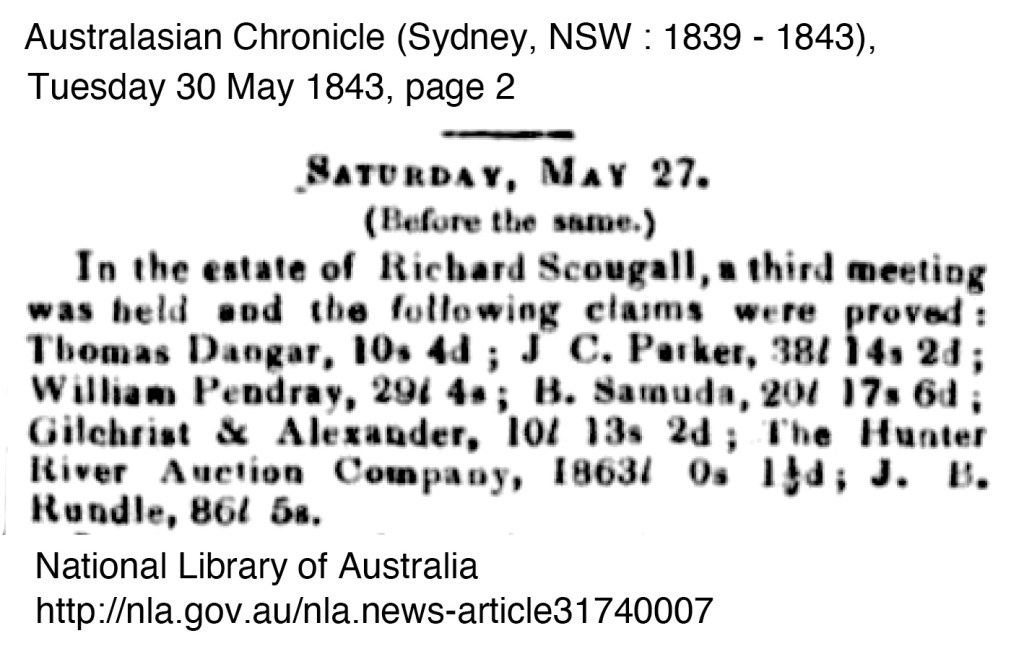
As seen with many of these early settlers and speculators, the new colony’s climate conditions were challenging alongside a system which was built on credit upon credit set up a situation where insolvencies occurred from large wealthy owners like the Scott brothers to small landholders, businesses and individuals.
Often one bankruptcy had a flow on effect where when one person defaults their debts, the person that is owed ends up in financial strain because they had provided credit by using credit. The effects to those smaller creditors is often overlooked.
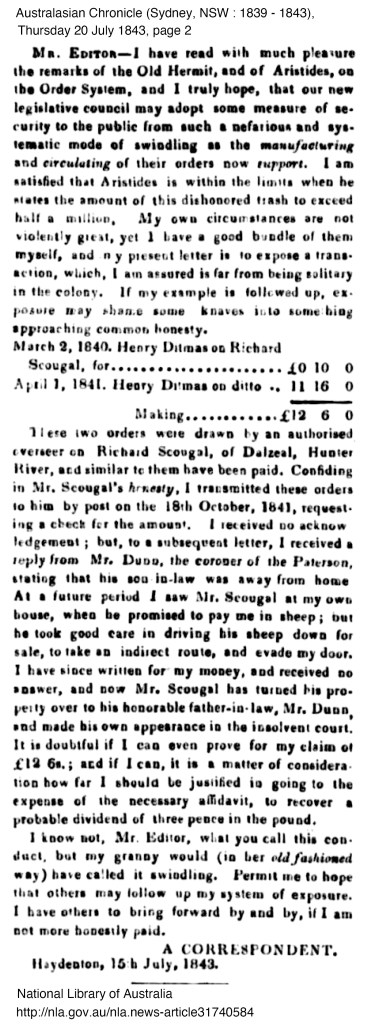
An unnamed letter writer expressed his concerns with the system his circumstance over what had occurred with the debt he was owed by Richard Scougall. It also speaks to some of the character of Richard Scougall and the length he went to avoid recompense the smaller creditors to who he owed money.
The 1840’s was the first depression in the new colony and we see this in relation to Richard Scougall and his land.
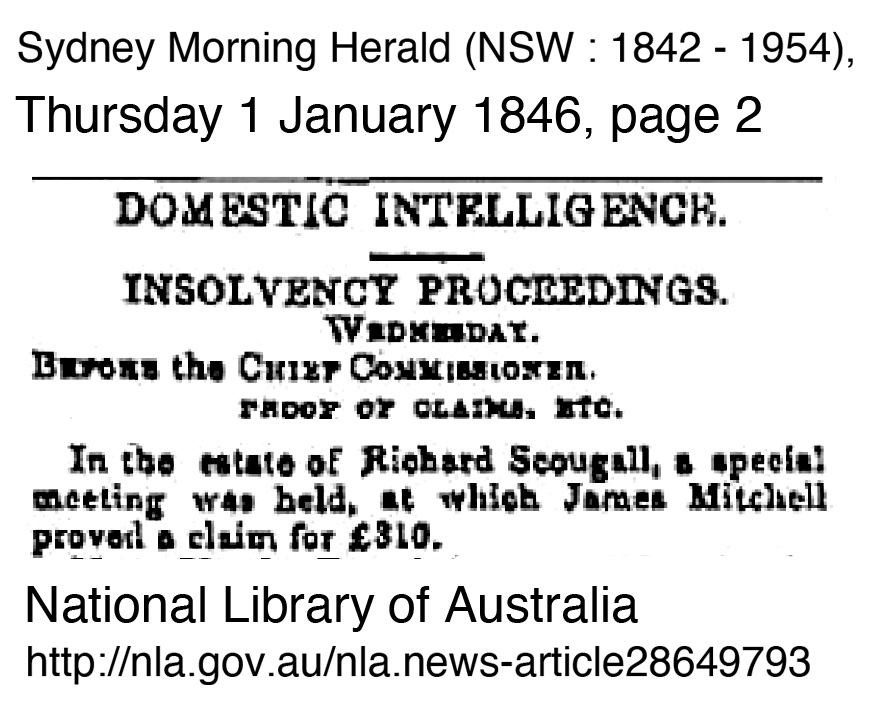
It was in January 1846 that the insolvency proceedings finally mentioned a proved claim for James Mitchell to the amount of £310.
This was to be recouped by the sale of the land Portions 18 and 11 at Glendon Brook on the Hunter River.
Charles Simpson’s ‘Brinkburn Farm’
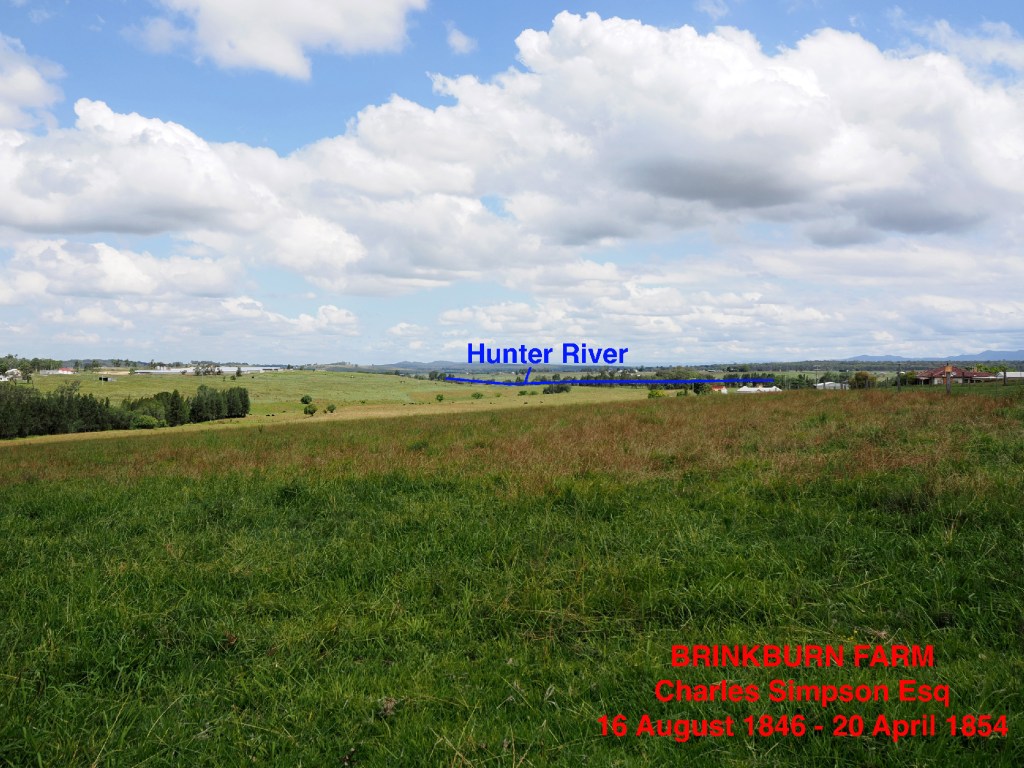
Tracing the conveyancing of what was called ‘Dalziel’ becoming Charles Simpson’s ‘Brinkburn’ was made more difficult by having to navigate records involving a number of additional parties names as well as the insolvency of Richard Scougall.
On the NSW Land Titles records Book 11 Number 480 conveyancing indenture between James Mitchell and Charles Simpson, there are four parties mentioned: James Mitchell … of the first part, Henry Bennett … of the second part, Richard Scougall … as the third part andCharles Simpson … as the fourth part.25 Henry Bennet was the Trustee and Accountant for the Insolvent Estate.
There was a condition that had been attached to the transaction on purchasing this land: ‘To hold the same to the said J. Dowling & his heirs But nevertheless to & for the uses intents & purposes expressed concerning the same viz:- To the use of the said James Mitchell his executors. administrators & assigns for the term of 500 years & immediately after the expiration of the said term of 500 years. And also in the mean time subject only thereto and to the payment of the said principal money and interest intended to be thereby secured To the use of R Scougall his heirs & Assigns for ever. Proviso is said R Scougall his heirs executors or administrators shall pay to James Mitchell his executors or administrators or assigns the sum of £1000 with interest at 12 per cent.
Book 11 Number 480 notes that the land sale is subject to the sequestration of the Estate of Richard Scougall due to insolvency with Henry Bennett an Accountant as being appointed as the Trustee in the administration of the Estate on 5 April 1843. It also notes that James Mitchell’s debt against the insolvent estate had been proved: ‘in the affidavit produced by him at the time of proving his said debt, valued his said security at the sum of nine hundred and fifty pounds.’ The Indenture states that the Creditors on Richard Scougall’s insolvent estate attended a meeting and ‘directed the said said Trustee to sell the same Fee Simple in reversion of the Land and hereditaments herein after described and all other the estate and interest of the said Insolvent in the said Land and hereditaments hereafter described .’ As a result the Trustee called for the and to be put up for Sale by Public Auction by W John Blackman.
The highest bidder at the Auction on 28 December 1843 was not in fact Charles Simpson but was James Mitchell being the highest bidder being declared the purchaser thereof at the price or sum of one pound but no conveyance of the land had been undertaken up until the conveyance record in favour of Charles Simpson.
This more complex conveyance it appears that James Mitchell sought another buyer, perhaps to therefore get a better return for the land in the height of the 1840’s depression but that is uncertain. The Indenture record for Charles Simpson purchase and conveyance then states: ‘contracted and agreed with the said Charles Simpson for the sale to him of the said Land and hereditaments hereinafter described and dated at or for the price or sum of seven hundred and eighty pounds.’
The land was described in the indenture record: ‘eight hundred acres more or less commencing at the Eastern extreme of the north boundary line of William Brooks grant …. parcel of five hundred and fifty acres of land is parcel six hundred and forty acres granted by the Crown to Mr William Brooks’ 26
As can be seen, this is Charles Simpson’s ‘Brinkburn Farm’ of 1350 acres with the loss of the previous 90 acres of William Brooks land grant ceded back to James Mitchell. James Mitchel also managed to be paid £780 which meant along with his initial payment from Richard Scougall of £247 10s he overall received £1027 10s. as seen in the initial purchase James Mitchell had paid £750 to William Brooks 640 acres.
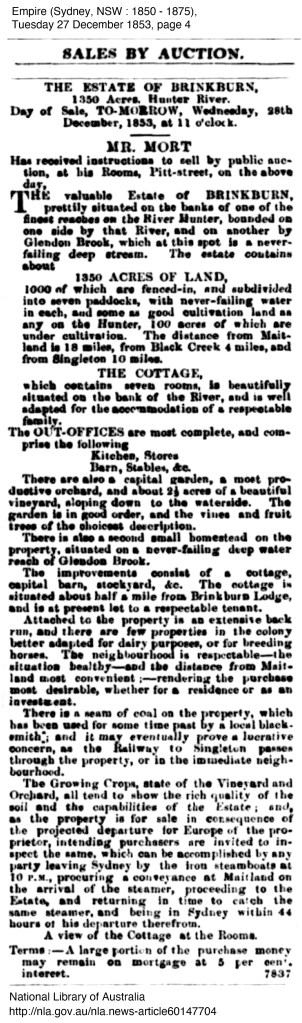
The description for the auction sale is enlightening with a description of not just the land as outlined in the indenture records but also the building on the land.
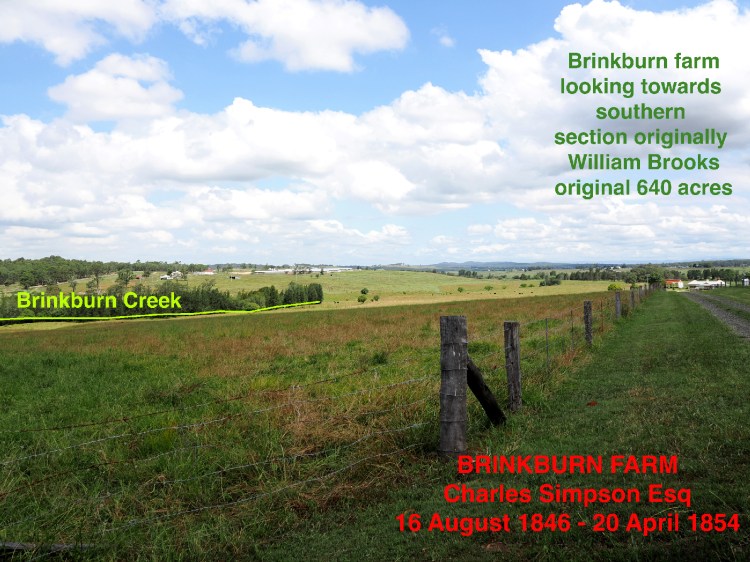
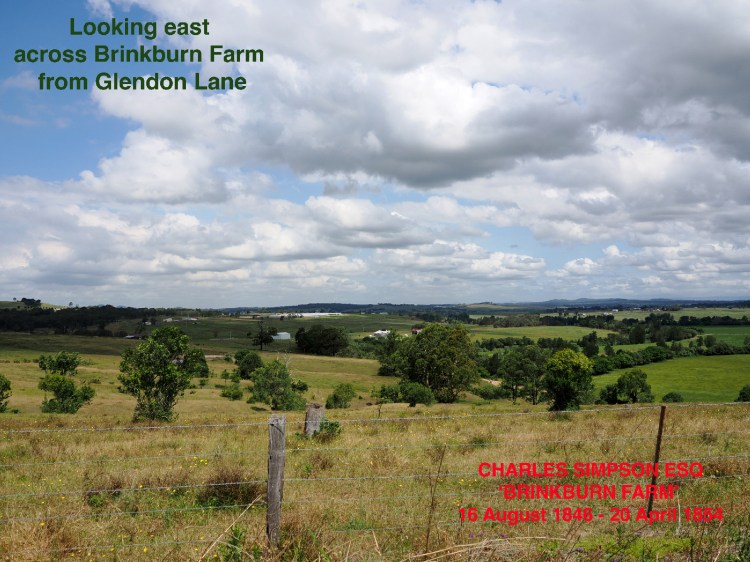
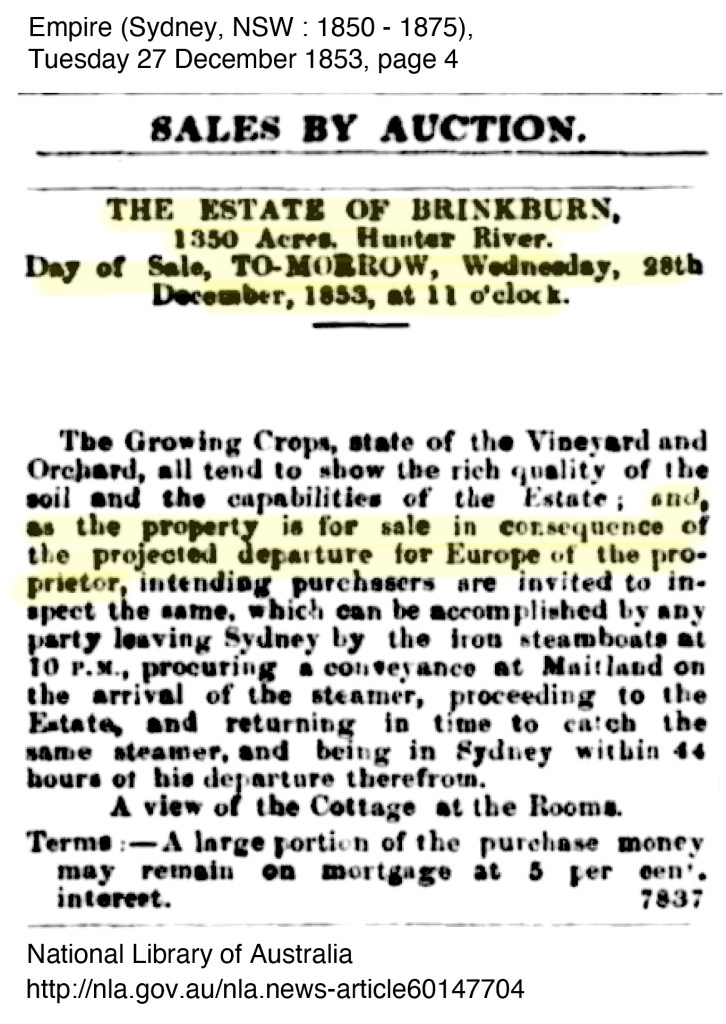
The estate contains about 1350 ACRES OF LAND of which are fenced-in, and subdivided into seven paddocks, with never-failing water on each, and some as good cultivation land as any on the Hunter, 100 acres of which are under cultivation. The distance from Maitland is 18 miles, from Black Creek 4 miles, and from Singleton 10 miles.
THE COTTAGE, which contains seven rooms, is beautifully situated on the bank of the River, and is well adapted for the accommodation of a respectable family.
The OUT-OFFICES are most complete, and comprise the following – Kitchen, Stores, Barn, Stables etc.
There are also a capital garden, almost productive orchard, and about 2 ½ acres of a beautiful vineyard, sloping down to the waterside. The garden is in good order, and the vines and fruit trees of the choicest description.
There is also a second small homestead on the property, situated on a never-failing deep water reach of Glendon Brook. The improvements consist of a cottage, capital barn, stockyard, etc. The cottage is situated about half a mile from Brinkburn Lodge, and is ay present let to s respectable tenant.
Attached to the property is an extensive back run, and there are few properties in the colony better adapted for dairy purposes, or for breeding horses. The neighbourhood is respectable – the situation healthy – the distance from Maitland most convenient; rendering the purchase most desirable, whether for a residence or as an investment.27
Brinkburn Farm appears to be an ideal venture for Charles Simpson, not only from the perspective of what appears to be a well appointed land, cottages and farm but also because of its position. Even so it would have taken Charles Simpson about an hour to ride from Brinkburn Farm to Singleton. It was about a 20 minute ride to Glendon House across the Hunter River from New Freugh.
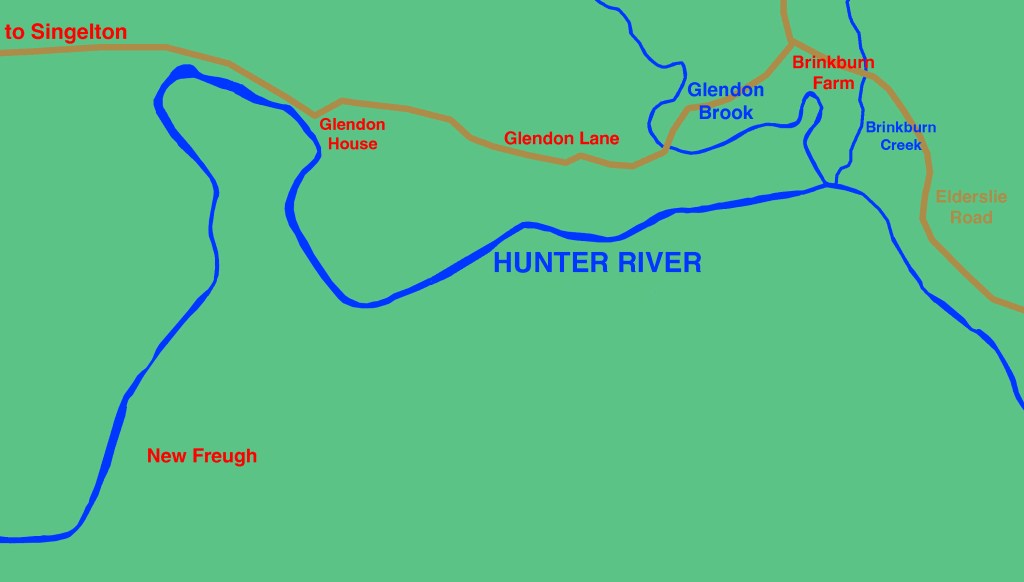
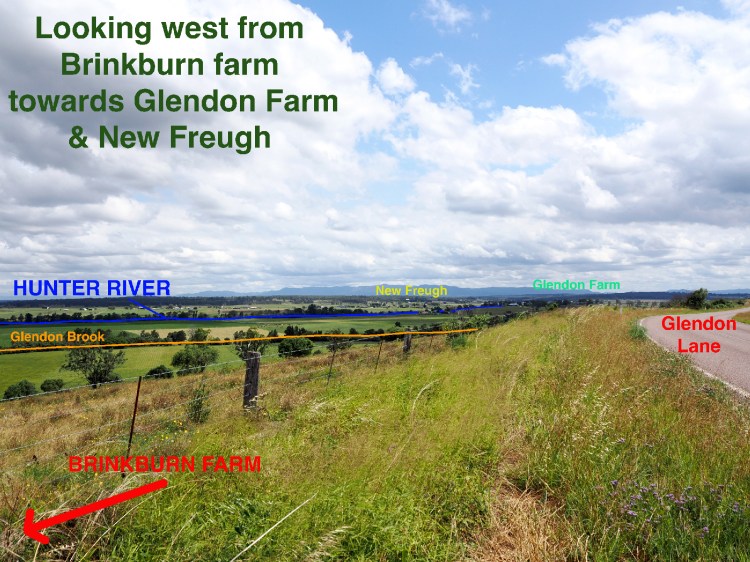
As seen at the beginning of this chapter Charles Simpson was not only still associated with Scone but he was made a Magistrate listed there although newspaper articles do not show him working un Scone, but in Singleton from 1845 to 1851.
The change in the size of the acres reducing Charles Simpson’s Brinkburn by 90 acres to 1350 acres is what was initially confusing regarding Charles Simpson’s ‘Brinkburn’ but is solved by these two land titles records. As recorded previously, the Primary Application 13480 sketch is what provides the answers giving the actual boundary lines of ‘Brinkburn’.
Charles Simpson Esq – Magistrate at Singleton

Charles Simpson continued in his roles within the local courts of Scone, and on 1 April 1846 he was appointed as a Commissioner succeeding Helenus Scott in the position.28
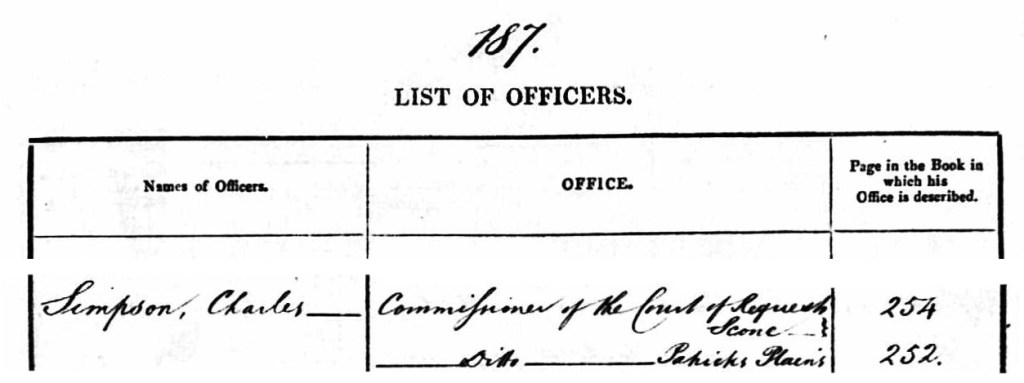
Newspapers have some records of Charles Simpson work as a Commissioner of the Peace, Magistrate, Police Magistrate and some of the cases in which he was involved. These accounts include the names of others who Charles Simpson worked with: Henry Dangar, J C S McDouall and Archibald Bell were all neighbours along the Hunter River in this area. Being 10 miles to Singleton Charles Simpson could easily access his work in the Magistry work and Courts.


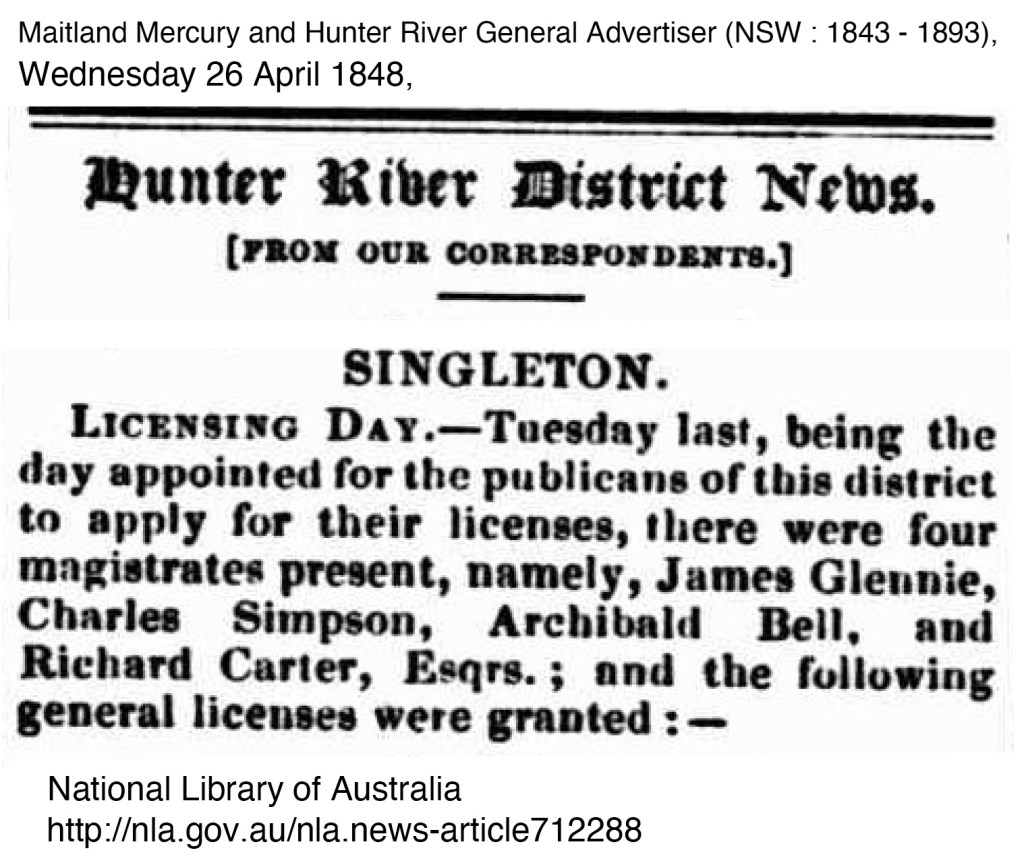
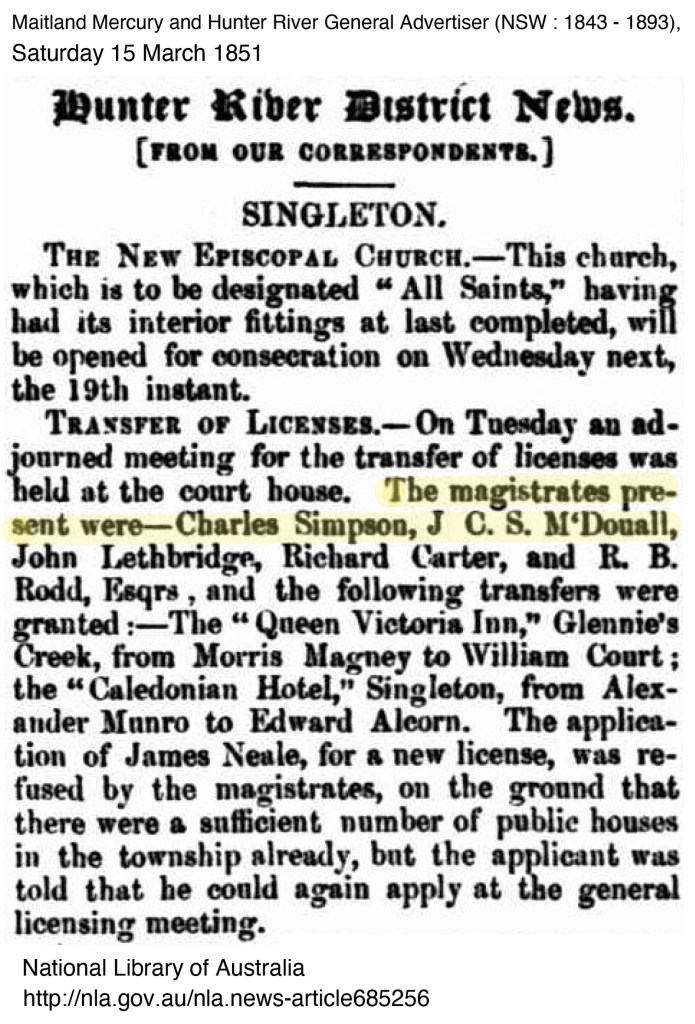
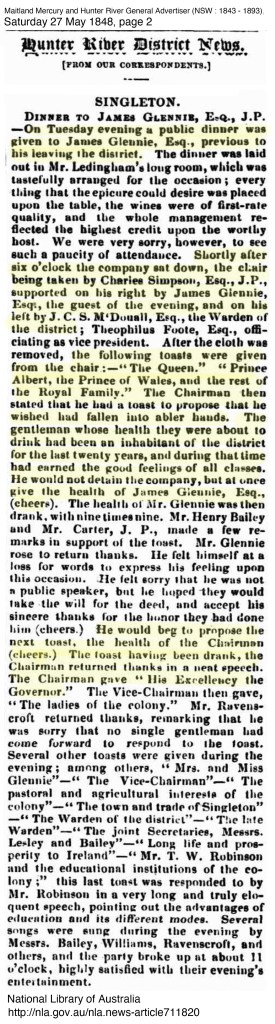
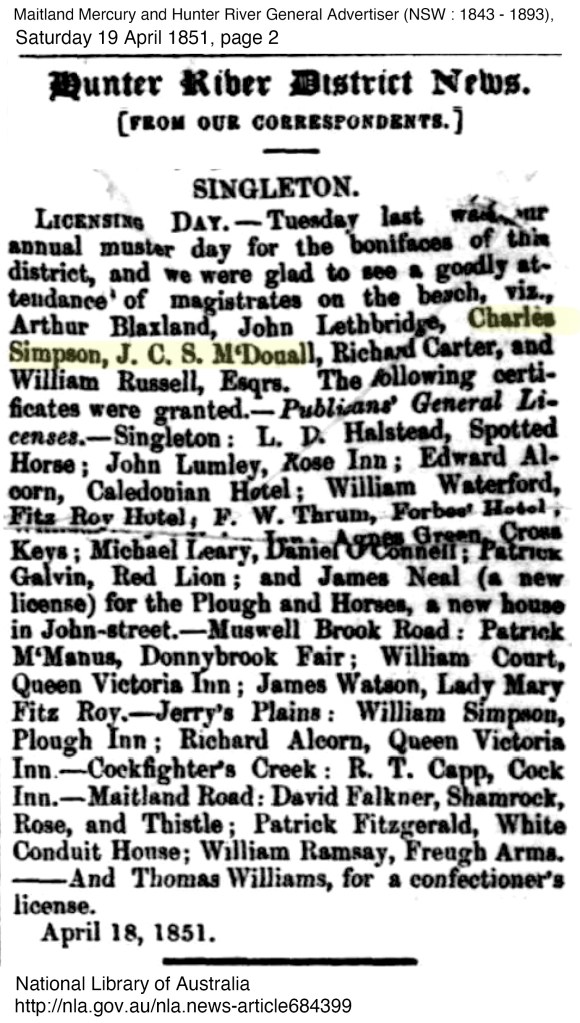
1851 – 19 Apr – MAGISTRATE LICENSING DAY Charles Simpson SINGLETON
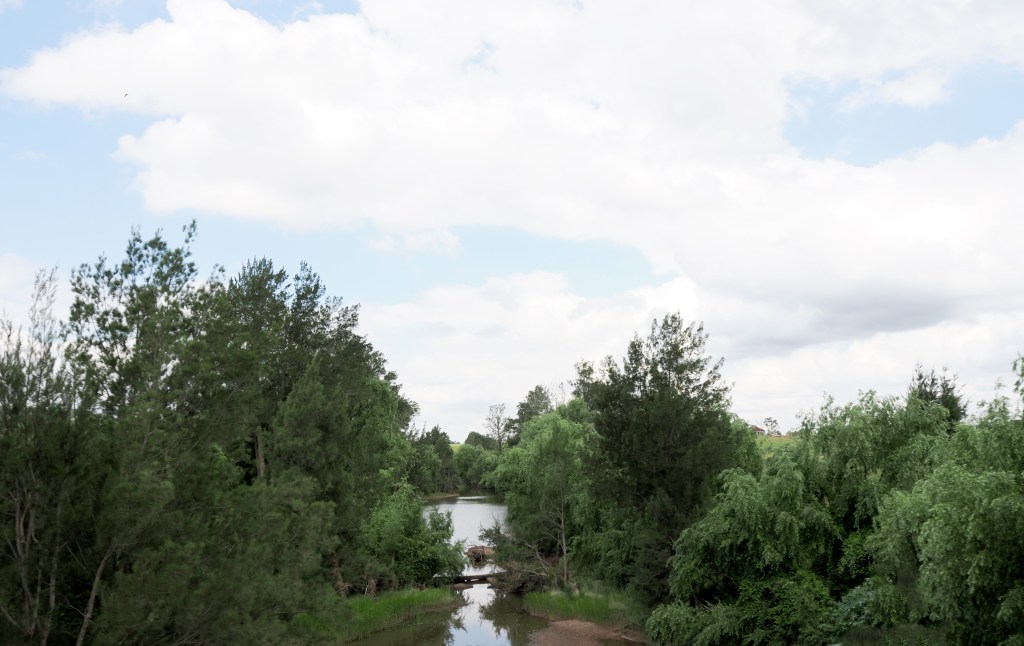
It is easy to see in the image below the value of the land with ‘with never-failing water on each, and some as good cultivation land as any on the Hunter, 100 acres of which are under cultivation‘ as the advertisement for its sale in 1853 stated. Although a large section of the 1350 acres was not under cultivation, the land close to Glendon Brook and the Hunter River would have provided good resources for farming.

Charles Simpson and J C S McDouall of New Freugh
Having established Charles Simpson’s land, residence and work from Scone to Singleton it was also within close proximity to J C McDouall’s New Freugh situated across the Hunter River across the river to the east from New Freugh,
These links through both the Magistry and as neighbours is an important one for the next chapter in Charles Simpson’s life and career and alongside the new settlers George Gray, Edmund Bull and Benjamin Baker who were living and working at New Freugh. These connections were important in looking at Waratah House and the Folly, Waratah.
Sale of Brinkburn Farm
The next chapters tell of Charles Simpson move from Brinkburn Farm by the beginning of 1851, the building of his Waratah House, work as Warden of the Council of Newcastle and eventual return to England in Janauary 1855.
As part of his move first to Waratah and Newcastle, Charles Simpson leased his property, advertising leases from late 1851. When he was arranging to go back to England, Charles Simpson sold his Brinkburn Farm property.
As see in the advertisement, Brinkburn House was sold by auction on28 December 1853.
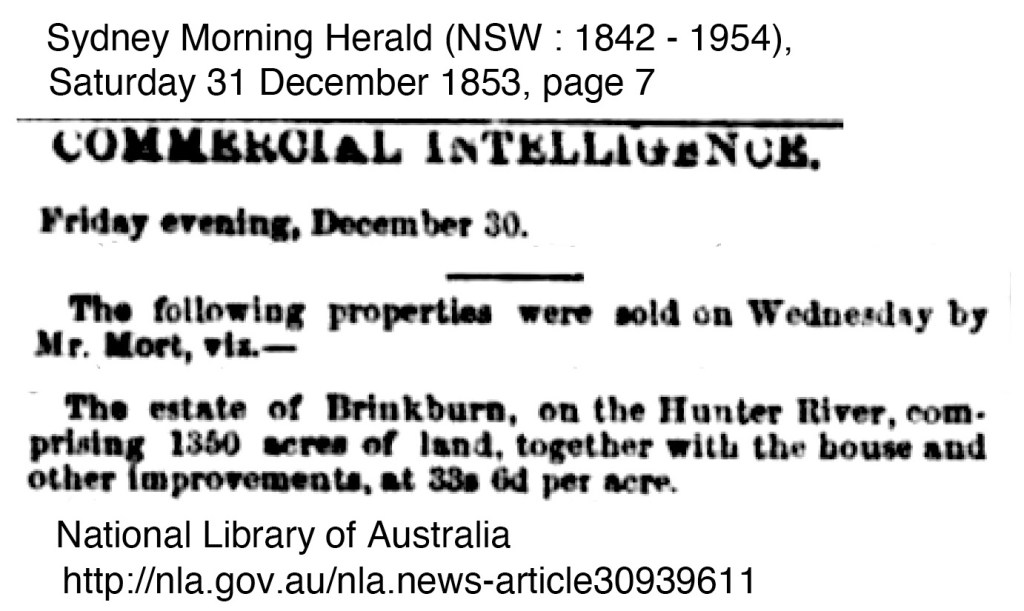
The sale price was listed on the 31 December, it sold of 33s 6d per acres
South Gundagai Land Purchases – Charles Simpson
There are a number of land transactions of a Charles Simpson at South Gundagai in the 1840’s. These are included within the NSW State Archives in the Colonial Secretary Papers however this is unlikely to be Charles Simpson Esq. from the Hunter River. Trove has advertisements for land in the 1840’s alongside the Colonial Secretary papers of the transactions and in 1843 relating to a stray horse with a reward if the horse is delivered to ‘Mr Charles Simpson, Gundagai’. This is indicating that there was another Charles Simpson living in Gundagai. On 11 Aug 1876 the local newspaper ‘The Gundagai Times’ carries an obituary for ‘Mr Charles Simpson, one of the old identities of Gundagai … He died at his residence in Wagga onTuesday last.’
References
- Source: Gionni Di Gravio OAM, ASAAP | University Archivist Special Collections (Archives) Auchmuty Library Chair, Hunter Living Histories Initiative – ANGLICAN DIOCESE OF NEWCASTLE – SCONE PARISH
- Australian Dictionary of Biography – Helenus Scott (1802-1879) by Nancy Gray https://adb.anu.edu.au/biography/scott-helenus-2851
- Scott family papers, 1780-1924, together with papers of the Rusden family, 1834-1898 NSW State Library https://archival.sl.nsw.gov.au/Details/archive/110311950
- Encyclopaedia Britannica online Exclusivists https://www.britannica.com/topic/Exclusive-Australian-history
- THE NEW COMMISSION Colonist (Sydney, NSW : 1835 – 1840), Wednesday 12 December 1838, page 3 https://trove.nla.gov.au/newspaper/article/31722189
- NEWS FROM THR EDITOR – DURHAM ELECTION Meeting ay Singleton – The Sydney Morning Herald 3 April 1843 https://trove.nla.gov.au/newspaper/article/12413610?searchTerm=durham%20election%20meeting%20at%20singleton
- NEWS FROM THR EDITOR – DURHAM ELECTION Meeting ay Singleton – The Sydney Morning Herald 3 April 1843 https://trove.nla.gov.au/newspaper/article/12413610?searchTerm=durham%20election%20meeting%20at%20singleton
- “a very bad business”: Henry Dangar and the Myall Creek Massacre 1838 by Lyndall Ryan – University of Newcastle https://www.newcastle.edu.au/__data/assets/pdf_file/0015/31056/Henry-Dangar-and-the-Myall-Creek-massacre.pdf
- Australian Dictionary of Biography – Robert Scott (1799–1844) by Nancy Gray https://adb.anu.edu.au/biography/scott-robert-2642
- Scott, Robert (1799–1844) & Helenus Scott (1902 – 1879) – Scone Vet Dynasty by Author & Veterinarian Bill Howey https://sconevetdynasty.com.au/scott-robert-1799-1844-helenus-scott-1902-1879/
- Australian Dictionary of Biography – Helenus Scott (1799–1844) by Nancy Gray https://adb.anu.edu.au/biography/scott-helenus-2851
- Australian Dictionary of Biography – Harriett Scott (1830–1907) by Nancy Gray https://adb.anu.edu.au/biography/scott-harriet-4925
- Blue Books (Returns of the Colony) 1822-57 – NSW State Archives https://mhnsw.au/articles/1286/#Public-Service-Lists-1858-1870
- New South Wales Government Gazette (Sydney, NSW : 1832 – 1900) Friday 20 February 1846 https://trove.nla.gov.au/newspaper/article/230140491?searchTerm=courts%20of%20requests%20colonial%20secretary%27s%20office
- NSW BDM Registration Number 192/1833 V1833192 17
- Parliament of NSW – Members – Dr James MITCHELL (1789 – 1869) https://www.parliament.nsw.gov.au/members/Pages/member-details.aspx?pk=234
- Free Settler and Felon, Convict and Colonial History – William Brooks – Settler https://www.freesettlerorfelon.com/william_brooks.htm
- NSW BDM BIRTH Registration Number Euphemia Brooks 8754/1827 V18278754 1C
- NSW BDM DEATH Registration Number Eliza Jennet Brooks V18291383 13/1829
- NSW Land Titles – Reference – Book: F Number: 647 (F-647)
- NSW Land Titles – Reference – Book: P Number: 432 (P-432)
- NSW Land Titles – Reference – Primary Application 13480
- NSW Land Titles – Reference – Primary Application 13480
- NSW Land Titles – Reference – Book: Q Number: 400 (Q-400)
- NSW Land Titles – Reference – Book 11 Number 480 (11-480)
- NSW Land Titles – Reference – Book 11 Number 480 (11-480)
- Empire (Sydney, NSW : 1850 – 1875), Tuesday 27 December 1853, page 4 – SALES BY AUCTION – THE ESTATE OF BRINKBURN
- Maitland Mercury and Hunter River General Advertiser (NSW : 1843 – 1893), Saturday 29 March 1851, page 2 SINGLETON. Charles Simpson, Esq., J.P.
- Newcastle Morning Herald and Miners’ Advocate (NSW : 1876 – 1954), Saturday 3 October 1936, page 5 WARATAH’S FIRST SETTLERS Mr. Braye Reviews Early History
 George Gray - Stonemason & Builder