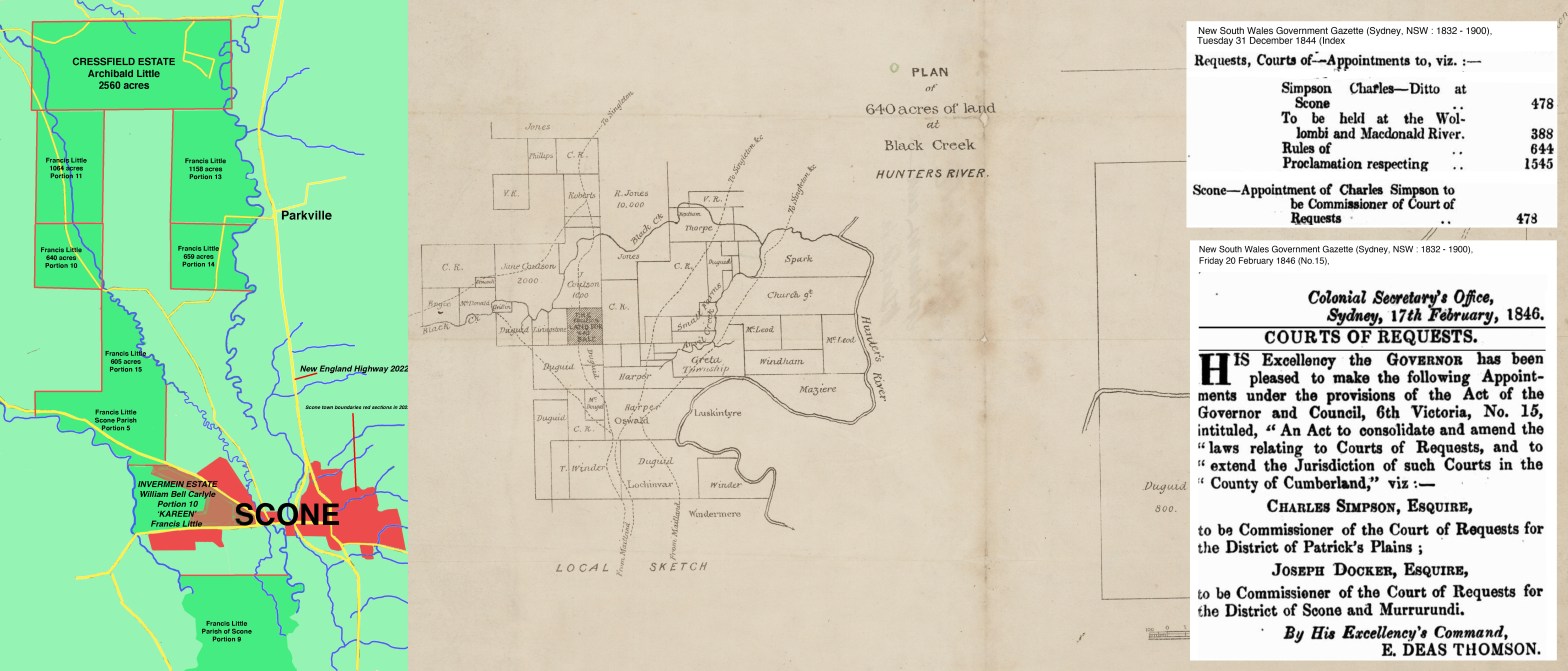
Magistrate – Justice of the Peace – Warden of Newcastle
One question that appears to have never been explored is:
Who was Charles Simpson?
In relation to the story of Waratah House and the building of that important first significant property, and one could also correlate to the an importance in the white settlement at Waratah, Charles Simpson is important.
Although described by T A Braye and in numerous newspaper reports and repeated histories of the time as being a ‘Customs Officer’, working for or with Charles Bolton who was a Customs Officer, this is not actually the case. Perhaps because he purchased land alongside Bolton at the folly, or perhaps because they shared the same first name of ‘Charles’ this myth has perpetuated.
Charles Simpson was also a significant person within the lives of George Gray and Edmund Bull. He employed George Gray and Edmund Bull on his property at ‘the folly’, provided them with a place to live and the opportunity to purchase small parcels of land within the Waratah House land. So to gain a greater understanding around the life of George Gray, it seems important to enquire more into the life of one of his main supporters and benefactors, Charles Simpson.
In 1936 newspaper an article titled “Waratah and the Original Grants” by T A Braye, written by solicitor and early local Newcastle historian Thomas Braye names both ‘Bull and Gray’ as early settlers who acquired land in 1854 when the land subdivided into 5 acre lots and sold their grants.
The man they acquired the land from was ‘Charles Simpson Esq of Black Creek’. The indenture (mortgage) relating to the sale from Charles Simpson to George Gray can be found in Book-Number 32-541 in the Land Titles HLRV. The record dated 9 June 1854 states: ‘No 541 Book 32 Conveyance. This indenture made the ninth day of June – in the year of Our Lord one thousand eight hundred and fifty four Between Charles Simpson of Waratah near Newcastle in the Colony of New South Wales Esquire (hereafter called the Vendor) of the one part and George Gray of Waratah aforesaid Builder (herein after called the Purchaser) of the other part Witnesseth that in consideration of the sum of nine pounds sterling to the said Vendor paid by the said Purchaser (the recipe whereof is hereby acknowledged ).‘ 1
Charles Simpson Esq.
Whilst some characters within the family history stories are easy to find, they are in newspapers, documents and archives, others are much more difficult. Some require a lot of research often connecting up small ‘breadcrumbs’ or notations in documents which can then lead to actual documents that connect to the larger story.
Charles Simpson, his wife Eliza Harriet Darby nee Browne and his step daughter Gertrude Darby have been elusive with very little written of them and their time living in the Newcastle District or further afield in the Northumberland County from Scone to Patrick’s Plains to Newcastle from about 1841 until at least 1857.
The story of Charles Simpson is important in that he was the main employer of George Gray, the first being John Crichton Stuart McDouall about whom a lot has been written and recorded. Sometimes you need to research not just the relative or person, in this case George Gray, about whom there is little written, but you need to look further afield to the people connected to George Gray in order to confirm stories or details. In this case the story of Charles Simpson is quite important in that it allows us to better connect the stories and notes that George Gray was the builder of Waratah House and other houses in Newcastle.
Charles Simpson is referred to as a ‘customs officer’ in later newspaper reports regarding the history of the Waratah – Mayfield areas of Newcastle. Further research shows he was much more than this and quite an important figure in the early life of Newcastle and the districts west to Scone.
In his address to the Newcastle Historical Society, he states: ‘The next settler of note was Charles Simpson. He was a collector or Customs in Newcastle in the early 40’s, and to him must be ascribed the honour of giving the name Waratah to the district. In 1848 he took possession of 33 1/2 acres of the land on the banks of the river adjoining what was now known as Kerr street. It was then called Occupation road, half a chain wide. He cleared the land of dense tropical bush and erected what was considered in the early days quite a mansion. He was rowed up and down to his duties by Government men. On the rise at the back of that house it was said waratahs grew, and to signalise that he called the home “Waratah House”.2
This report as with others that have quoted this newspaper report, is not correct.
Although it has been impossible to find both a definitive arrival and departure from New South Wales by Charles Simpson as the records do no seem to exist. This is despite extensive searches at the NSW Archives etc, it is possible to trace who Charles Simpson was, where he came from and where he ended up. By researching Simpson it is possible to ascertain the significant connections he had within Newcastle and the government public service thereby by extensions George Gray may have been able to develop for his work as a builder.
Charles Simpson – Early life – York, England
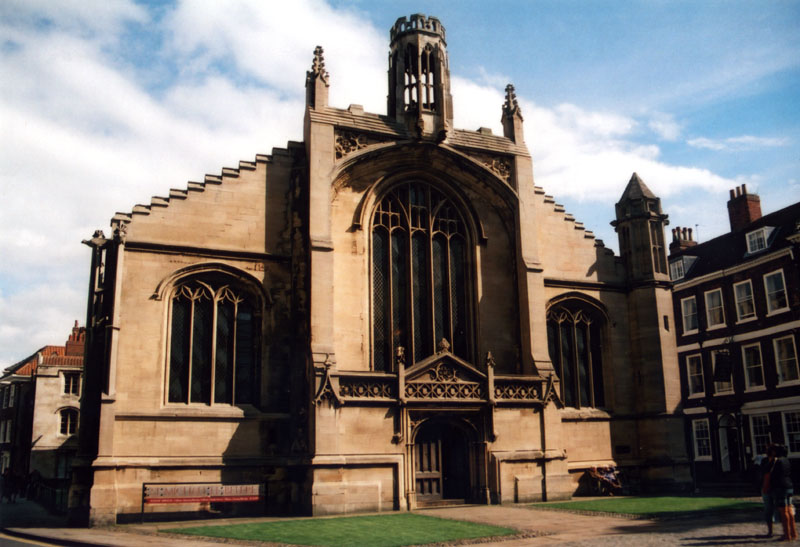
Charles Simpson was born in York on 7 March 1816 and was baptised at the Saint Michael-Le-Belfrey on 13 March 1816, the son of Rev Frances Simpson and Anne Strickland.
| Name: | Charles Simpson |
|---|---|
| Gender: | Male |
| Baptism Date: | 13 Mar 1816 |
| Baptism Place: | Saint Michael-Le-Belfrey, York, England |
| Father: | Francis Simpson |
| Mother: | Anne |
| FHL Film Number: | 0990913, 0990914 |
Parents – Ann Strickland & Rev Francis Simpson
Ann Strickland was the daughter of Sir William Strickland 6th Baron Strickland of Boynton Hall and Dame Strickland, Henrietta Cholmley.
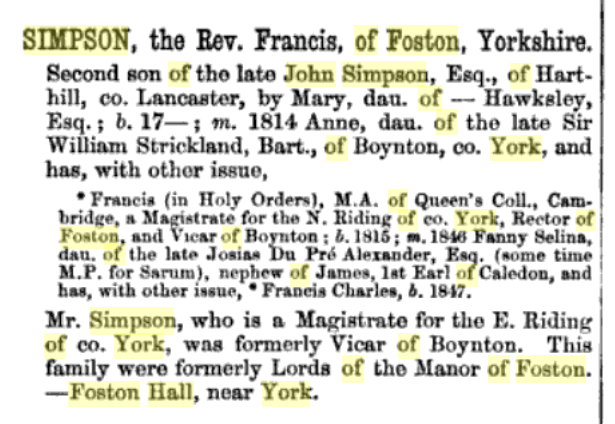
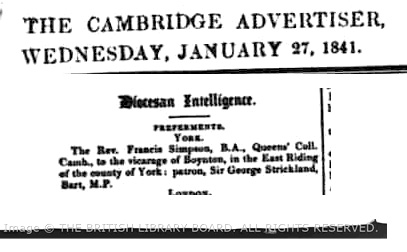
The Rev Francis Simpson was the second son of John Simpson (1758-1802) of Hart Hill was a cotton spinner, industry innovator, property owner and magistrate. John Simpson also the Lord of the Manor of Foston Hall, he was the son of a mining magnate Adam Simpson, who was operating cotton mills with his brother Samuel Simpson went into business with Richard Arkwright Snr (1732-1792). Richard Arkwright’s son Richard married Mary a sister of John Simpson in 1780. The history of Eccles Road along with the story of John Simpson can be read on this website – Eccles Road, Uncovering Salford’s Lost Heritage 3 – it is an excellent resource. Rev Francis Simpson was a Vicar at Foston Hall and then at Boynton Hall Vicarage sponsored by his father in law Baron Strickland.
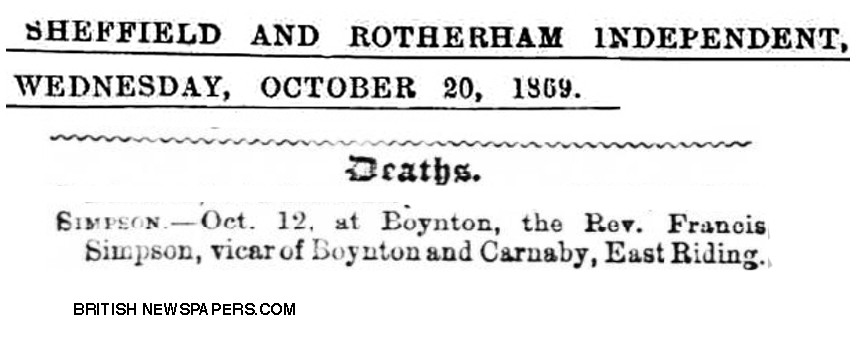
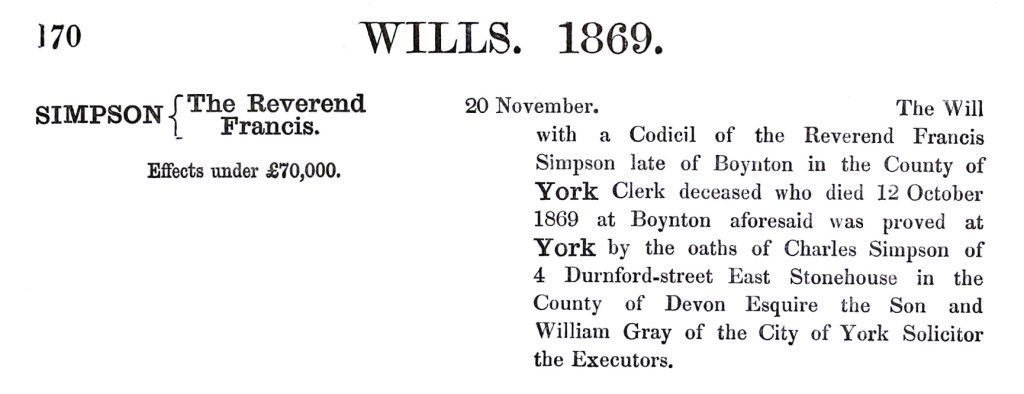
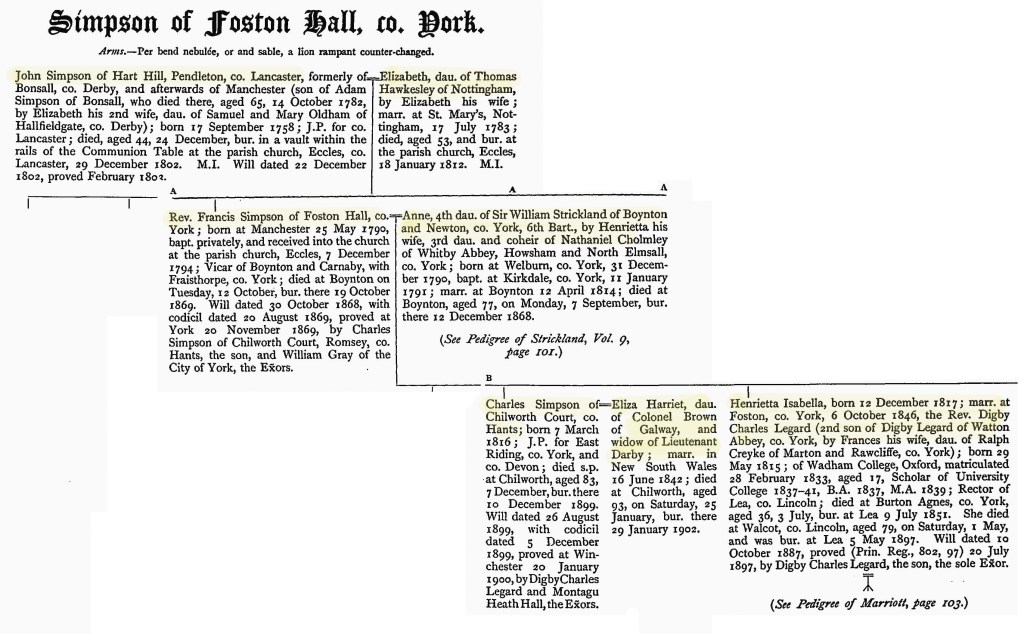
Peerage of Charles Simpson
The edited version below of the Peerage of Charles Simpson is below providing clear links which can be used to establish the Charles Simpson the son of Rev Francis Simpson is the same Charles Simpson Esq who built Waratah House at ‘the folly’. 4
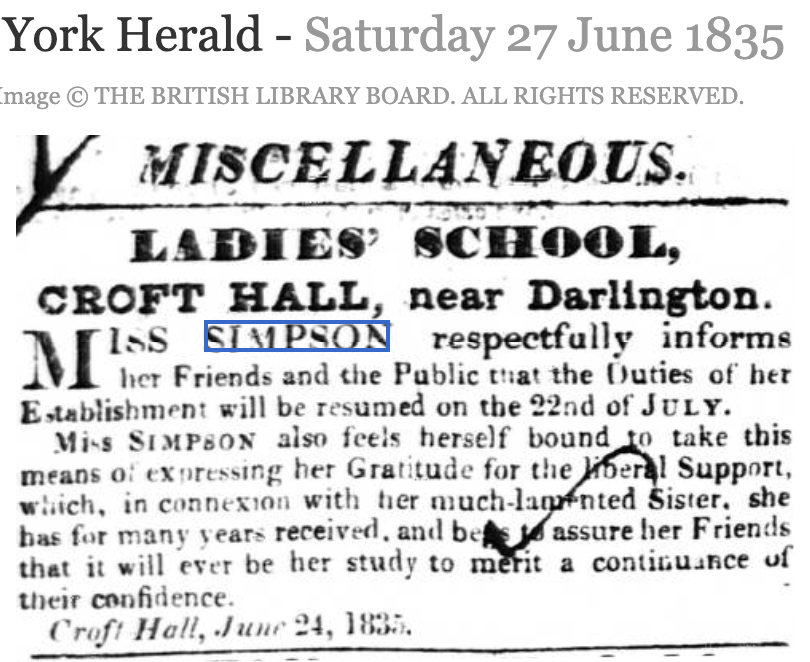
Mary Emily Simpson – Teacher & Sister of Charles
As an interesting aside, Charles had one brother Rev Francis Simpson (like his father) and four sisters. Henrietta Isabella Simpson married Rev. Digby Charles Legard who was one of Charles executors, Emma (twin), Mary Emily (twin) and Louisa none of whom married. Mary Emily was a gifted teacher who when at Boynton Hall help the local young farming men to learn to read and write by running a night school, she later operated a Ladies school at Croft Hall and convalescent home at Claybrook Hall. She wrote extensive journals which were published into a book by her brother in law Rev Charles Digby ‘Ploughing and Sowing: or the Annals of an Evening School in a Yorkshire Village and the work that grew out of it- By a Clergyman’s Daughter’ 5
Mary Emily Simpson 1820 – 1844 – further information links:
http://www.eylhs.org.uk/dl/136/mary-simpson-of-boynton-vicarage
Claybrooke Hall
The Public Service – Colony of New South Wales
So in establishing Charles Simpson as coming from peerage and wealthy families, the next question is why would he come to the new colony of New South Wales to work largely as a Public Servant in different roles? It as at this point worth looking at the governance of New South Wales at the time and the role of the Public Service.
The Governor of Sydney from 1838 to 1846 was Sir George Gipps who was navigating a difficult time in the governance of the colony with those in the young colony seeking to gain local control and those back in England who had established the colony and were largely still funding many aspects of its running under the Secretary of State for the Colonies or Colonial Secretary, were in a struggle for a way forward. There was a turning point in 1842 with George Gipps introducing the first NSW Constitution Act. The Colonial Secretary from 1841 until 1845 the relevant time frame for when Charles Simpson took up his initial positions, was Lord Edward George Geoffrey Smith.
The 1830’s had been a boom time for the new colony including large tracts of land sales/grants into ever increasing wider areas of the country, it was followed by the depressed times of the 1840’s. Much information about this time can be found in the Colonial Secretary’s correspondence and the Returns of the Colony or as they are known, the ‘Blue Book’s’.
How does this affect Charles Simpson? There was a tussle between the public servants who had risen up through the rank in the new colony and those being appointed from England by the Colonial Secretary. In her book ‘Politics, Patronage and Public Works, The Administration of New South Wales Vol 1 1842 – 1900’, in which the author, Hilary Golder explains how the ‘Prospects and Patronage in the 1840’s’ worked. ‘The prospect of promotion tempted men to come out to the colony, but their progress there could be disrupted by the arrival of fresh talent.’ 6 Although there appears to be no records about why Charles Simpson came out to the colony, his family had a background of being Justice of the Peace in England, his brother was educated at Eton, his sister was also well educated, so one can presume Charles was well educated and capable. Being part of the upper levels of society he would also have had the possible access to the Colonial Secretary and powers that made appointments to the New South Wales Public Service. ‘There were plenty of other families in Britain who saw the colonial public service as an opportunity, or perhaps a last resort: they bombarded the Colonial Office with requests for a position in New South Wales. Throughout the 1830’s, therefore, many of those positions were filled by nominees in London.’ 7
Charles Simpson – Voyage to New South Wales
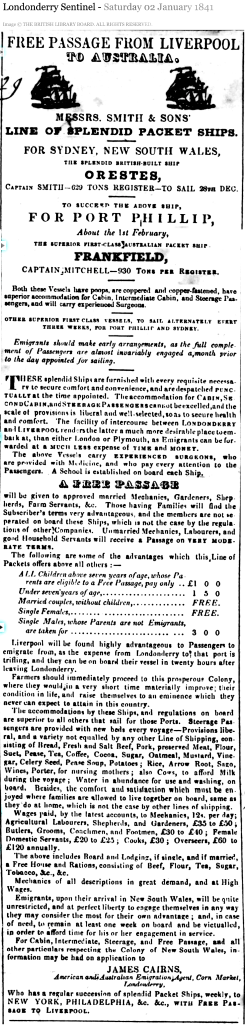
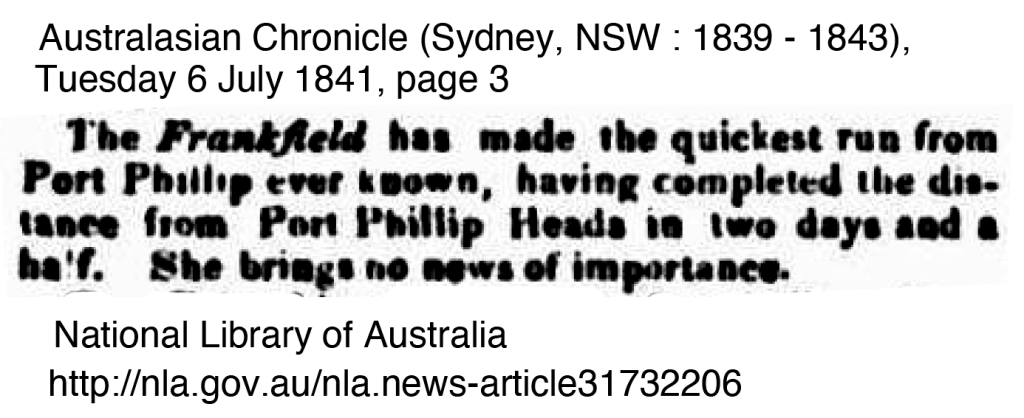
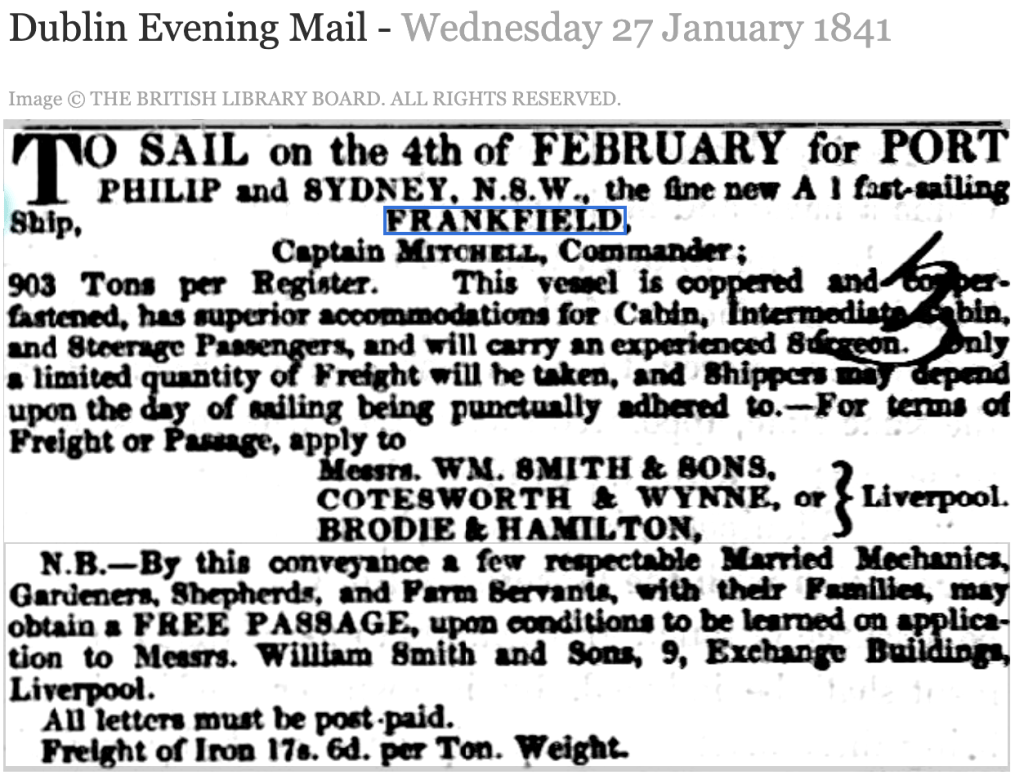
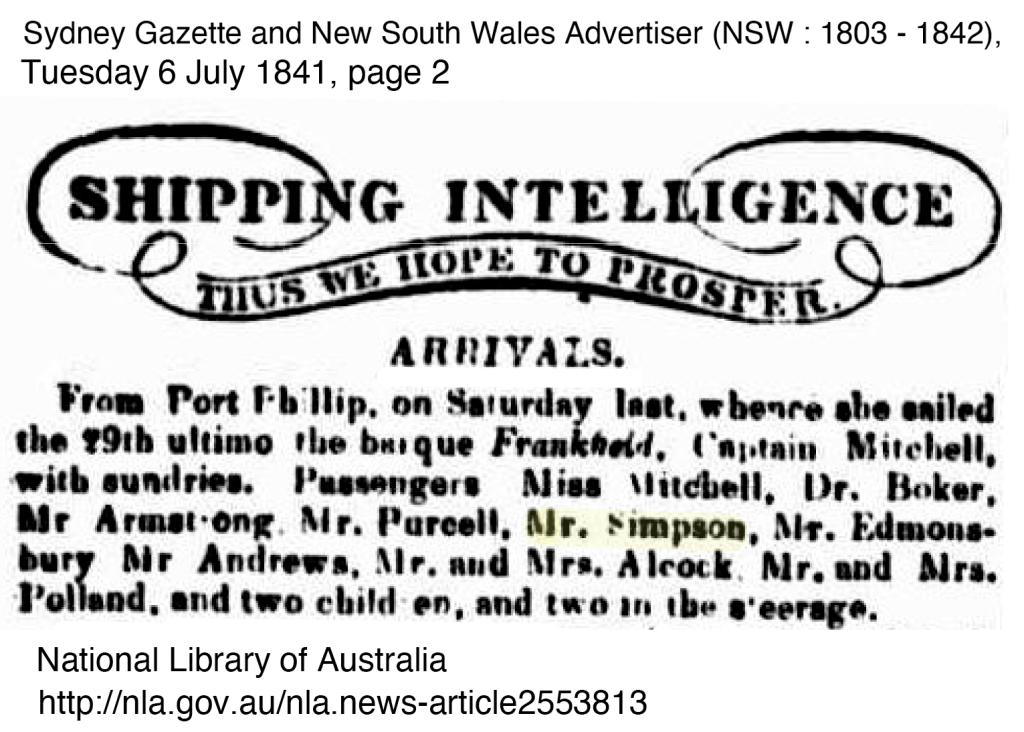
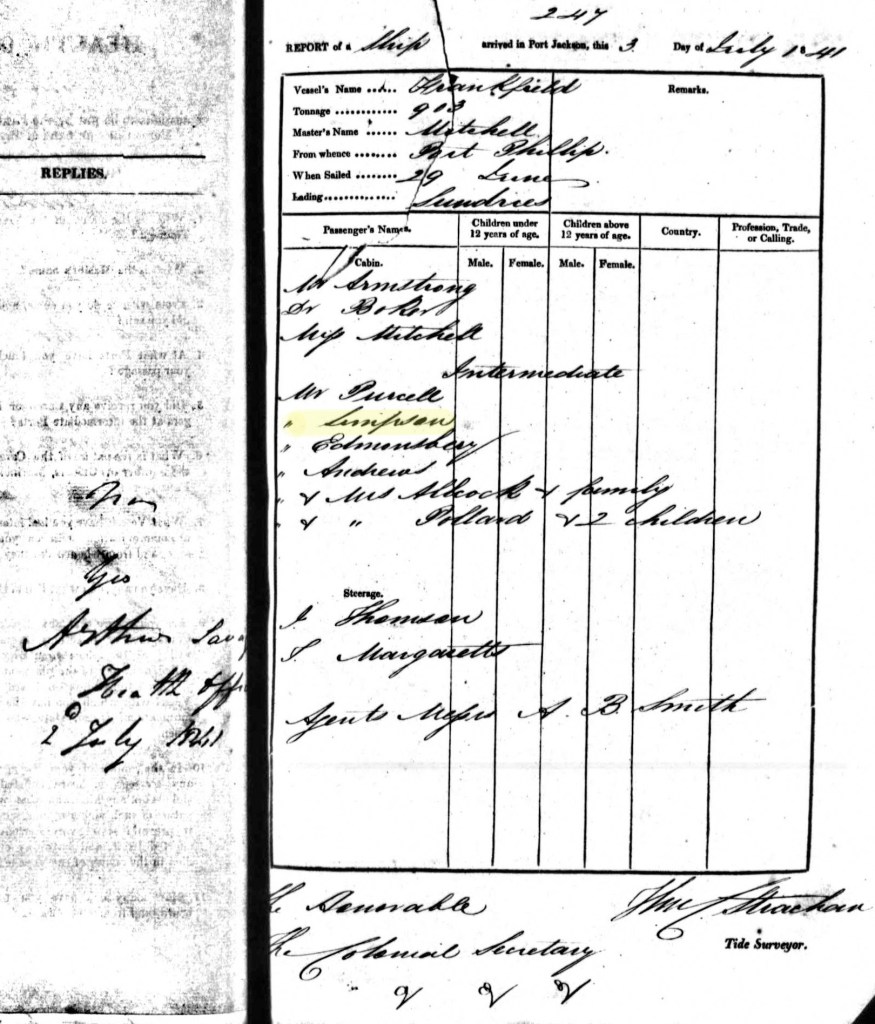
Although it is difficult to find the definitive immigration records cannot be found as records are sporadic for the time period in question, there is one record that is a possibility as it fits the framework of the first times places where Charles Simpson was recorded. On 3 July 1841 the Frankfield sailed into Port Jackson from Port Phillip it was the fastest voyage between the two ports ever recorded. The ship had left London in January 1841 and included in an ‘Intermediate Cabin’ a ‘Mr Simpson’ who was travelling as an unassisted immigrant. One can imagine someone of the social standing of Charles Simpson, would have been inclined to travel in this way. The description the the advertisement on 2 January 1841 shown below, states: ‘These splendid Ships are furnished with every requisite necessary to secure comfort and convenience, adn are despatched PUNCTUALLY at the time appointed. The accomodation for CABIN, SECOND CABIN and STEERAGE PASSENGERS cannot be excelled, and the scale of provisions is liberal and well-selected, so as to secure health and comfort … The above Vessels carry EXPERIENCED SURGEONS, who are provided with MEdicine, and who pay every attention to the Passengers … The accommodation by these Ships, and regulations on board are superior to all others that sailed for these Ports.’
References
- NSW Land Registry Services – No 541 Book 32 Conveyance https://hlrv.nswlrs.com.au/
- Newcastle Morning Herald and Miners’ Advocate (NSW : 1876 – 1954), Saturday 3 October 1936, page 5 WARATAH’S FIRST SETTLERS Mr. Braye Reviews Early History
- Eccles Road, Uncovering Salford’s Lost Heritage – John Simpson
- England and Wales Visitation, Volume I, III-XIV, Visitation of England and Wales Vol. 10, Simpson of Foston Hall, co. York, Simpson of Foston Hall, co. York – Original data: Joseph Jackson Howard, ed. Visitation of England and Wales. Vol. I-XIV. Privately printed, 1893-1906.
- ‘Ploughing and Sowing: or the Annals of an Evening School in a Yorkshire Village and the work that grew out of it – By a Clergyman’s Daughter’ Signed M. E. S., i.e. Mary E. Simpson Edited by FD Legard https://www.google.com.au/books/edition/Ploughing_and_Sowing_or_Annals_of_an_Eve/sKUUA1rgAewC?hl=en&gbpv=0
- ‘Politics, Patronage and Public Works, The Administration of New South Wales Vol 1 1842 – 1900’ by Hilary Golder p83
- ‘Politics, Patronage and Public Works, The Administration of New South Wales Vol 1 1842 – 1900’ by Hilary Golder p86
 George Gray - Stonemason & Builder