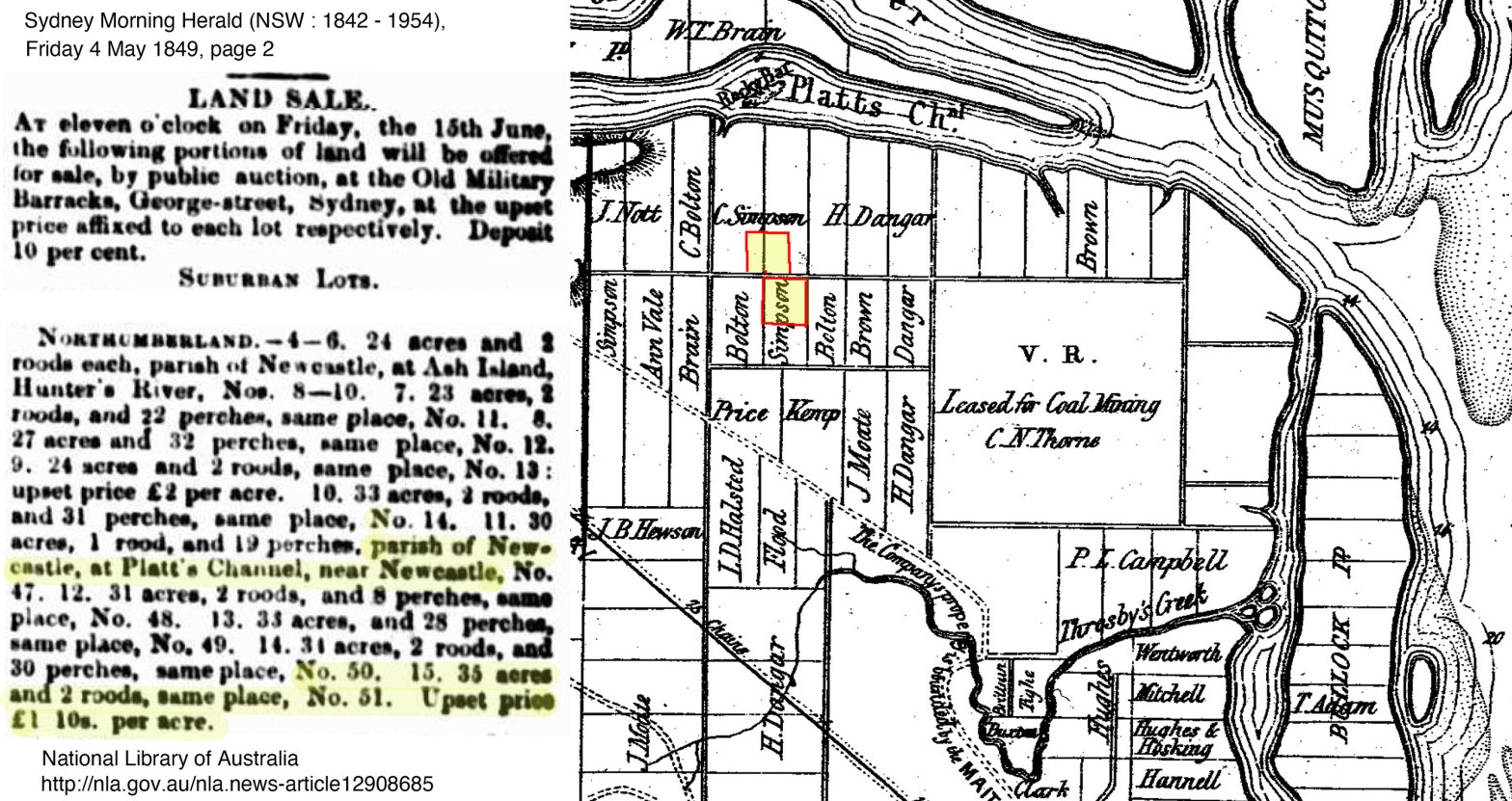
Charles Simpson 1848 – 1854 – Land Purchase at ‘The Folly’
The link between the Charles Simpson of Black Creek (Brinkburn Farm) is established when Charles Simpson purchased the land known as ‘The Folly’ in 1848 he was recorded on the Title Deeds as ‘Charles Simpson of Black Creek’.
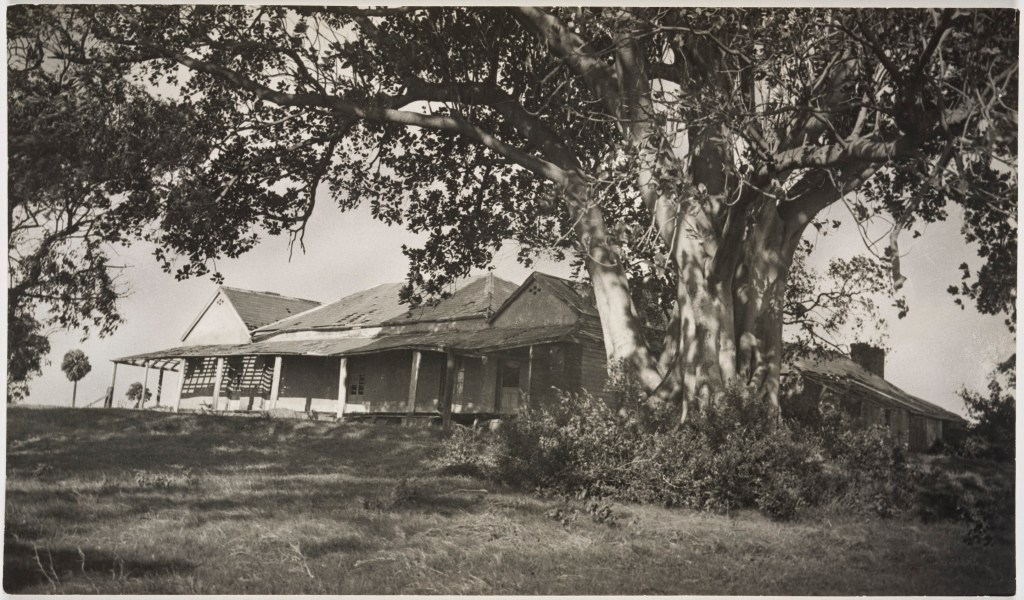
Charles Simpson – ‘The Folly’ and Waratah House
The article in the Newcastle Morning Herald and Miners’ Advocate on Saturday 3 October 1936 gives details of an address by Thomas Alfred Inglis Braye a former Mayor of Waratah, Solicitor and speaking under the auspices of the Newcastle and Hunter Historical Society: He said he regretted there were no authentic records which could be referred to earlier than 1860. Nevertheless, he gave information of Waratah as far back as 1820, which he had obtained 45 years ago from residents who were then 70 years of age. Mr. Braye said it was not clear how Waratah got its name, but the explanation given to him was that the locality known as North Waratah was the most northerly point in Australia where the Waratah flower grew, and from that derived its name.‘ 1
In an address to the Newcastle Historical Society in 1836 ‘Waratah and the Original Grants’, T A Braye gives an outline of his research into the early settlers in the area from John Laurio Platt’s original grant and takes in a larger area than the focus of this research which is Charles Simpson’s land. He states: ‘Of all the numerous grantees of land within the area, and there were very many that I have not had time to mention, there were only four of the original grantees who resided on the lands granted to them as settlers. These were John Laurio Platt, Thomas Grove, Charles Simpson and William Thomas Brain. All the other grantees apparently only bought for the purpose of holding the land, and made no use of it, and these, together with the families that settled at the Folly or North Waratah, whose names I have mentioned, and those on the Waratah side up to 1857, constituted the only permanent residents in the area.‘
He gives more details in regards to Charles Simpson and of note are the names ‘Gray’ and ‘Bull’ as amongst first settlers in ‘Waratah’. As outlined in the next chapters, the original purchasers of small portions from Charles Simpson’s land contained with the larger allotments was George Gray, Edmund Bull, Philip Kuhn, Benjamin Baker and Peter Crebert. The focus of this research is Charles Simpson’s land and does not include sales of land owned by Charles Bolton. Another name of note as a first settler is Henry Crowther ‘Colony Yeoman’ who also worked for Charles Simpson. He purchased half an acre on 29 August 1954. Much of what Braye wrote is correct except in regards to Charles Simpson with the official purchase of Allotment 51 being 1849, Simpson’s occupation as ‘Collector of Customs’, and some of the details of how he ‘cut up his land into 5 acre blocks’.
‘The next settler of note, as bringing about settlement in the area, was one Charles Simpson. Charles Simpson was Collector of Customs at Newcastle in the early 40’s, and to him the honor must be ascribed of giving the name or Waratah to the district. In 1848 he took possession of 35 ½ acres of land which he had bought from the Government, on the banks of the river adjoining to the eastward what is known as Kerr Street, but it was then called an Occupation Road of half a chain wide. This land near the river was covered with dense tropical brush, and some portion of the old trees still remain. Mr. Simpson cleared a portion of this brush, and from what I know of the country around there, it must have been a most mosquito-infested place at the time, and there he built what was considered in the early days of Newcastle quite a mansion, and he was rowed up and down to his duties in Newcastle by Government men. On the rise at the back of this house it is said was the place where the Waratah grew, and to signalise this. he called his home “Waratah House.” The people of Newcastle just as promptly, designated it “Simpson’s Folly” and from these circumstances the the same “Waratah House” still survives, and “The Folly” was the same by which all that part of North Waratah was known, the word “Simpson” having been dropped.
In addition to this grant of 35 acres, Mr. Simpson also obtained grants of 34 acres and 20 acres all in the same neighbourhood. He lived on his property from 1848 to 1854. In 1854 he, in conjunction with Mr. Charles Bolton, known as Major Bolton, another grantee, cut up their grants on the southern side of what is now known as Bull Street, and sold it in 5 acre blocks. The settlers who acquired the land cultivated it as vineyards and orchards. Among the notable families that settled there was Mr. Peter Crebert (after whom Crebert Street is named), who was one of the purchasers in 1854, and planted vineyards on his block, and made wine there for many years afterwards. Another was Phillip Kuhn, and other purchasers were Crowther, Walters or Waters, Robertson, Russell, Bull, Gray and Baker, and these settlers can be taken as the first of the early settlers in the area in 1854. Most of them were living on their properties in my childhood days at the end of the 70’s.
The railway line was opened from Newcastle to Maitland in 1859, and the station at Waratah, owing to most of the inhabitants then living on the North Waratah side, was named Waratah from that fact, as, owing to Simpson, the neighbourhood had been called “Waratah,” and so the name has remained to this day.
In 1854 Simpson sold his land to Messrs. Morse & Tourle, of New England, squatters. Mr. Tourle lived there for many years, and also planted vineyards and carried on winemaking, which was still going on in the late 70’s.‘ 2
The map references for the land purchased by Charles Simpson 3 contained within maps do not give Vol-Fol references but they do give dates and are as follows:
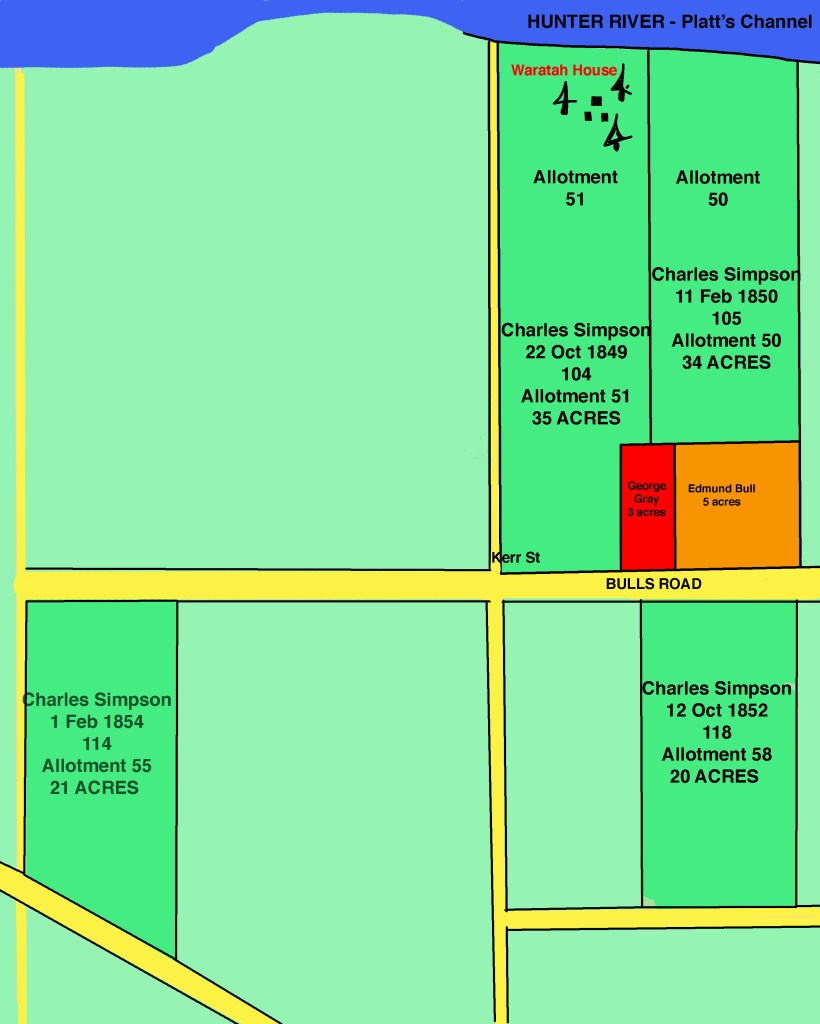
- Portion 104 Allotment 51 Date: 22-10-1949 Size: 35 acres
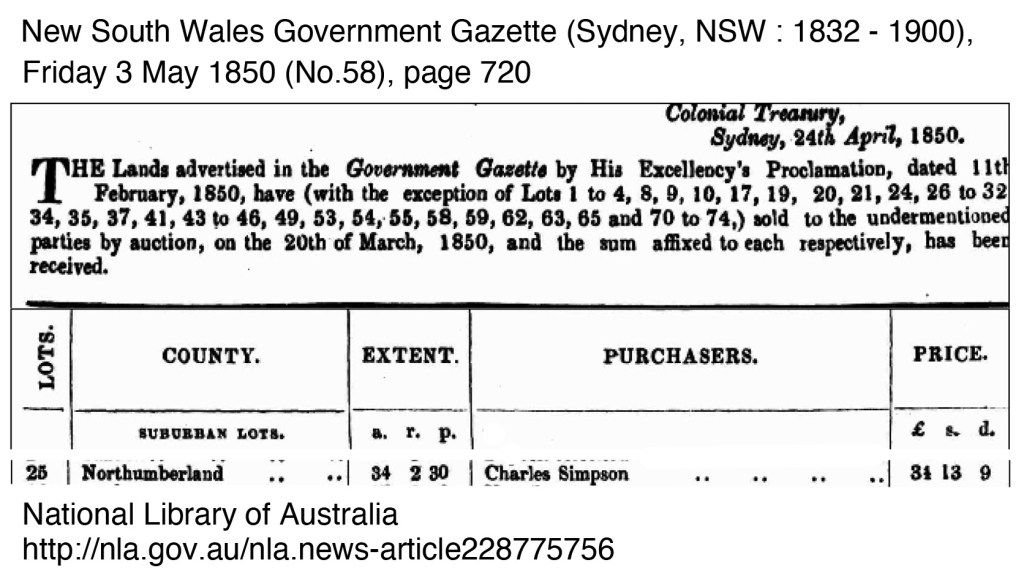
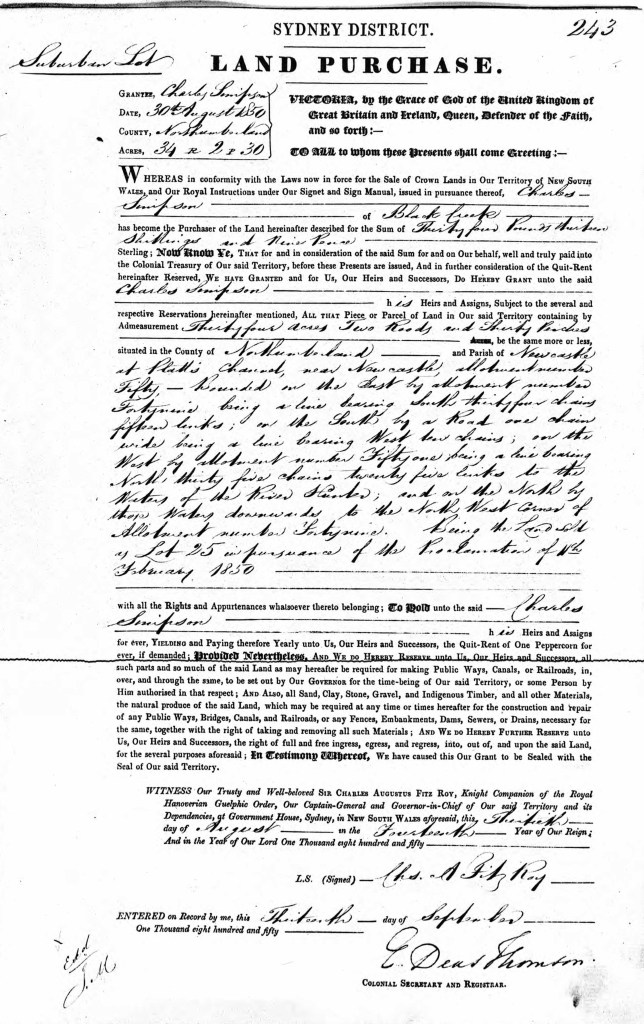
- Portion 105 Allotment 50 Date: 30-8-1850 Size: 34 acres
- Portion 118 Allotment 59 Date: 12-10-1852 Size: 20 acres
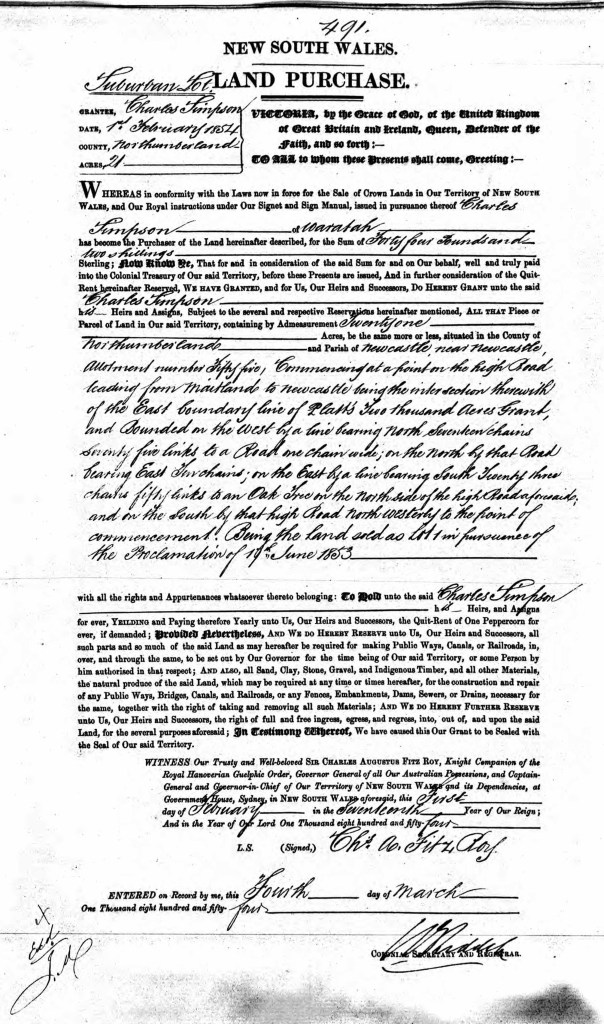
- Portion 114 Allotment 55 Date: 1-2-1854 Size: 21 acres
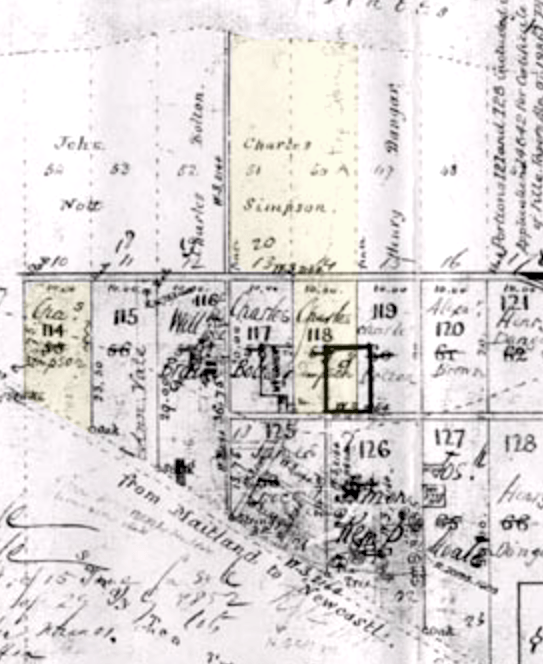
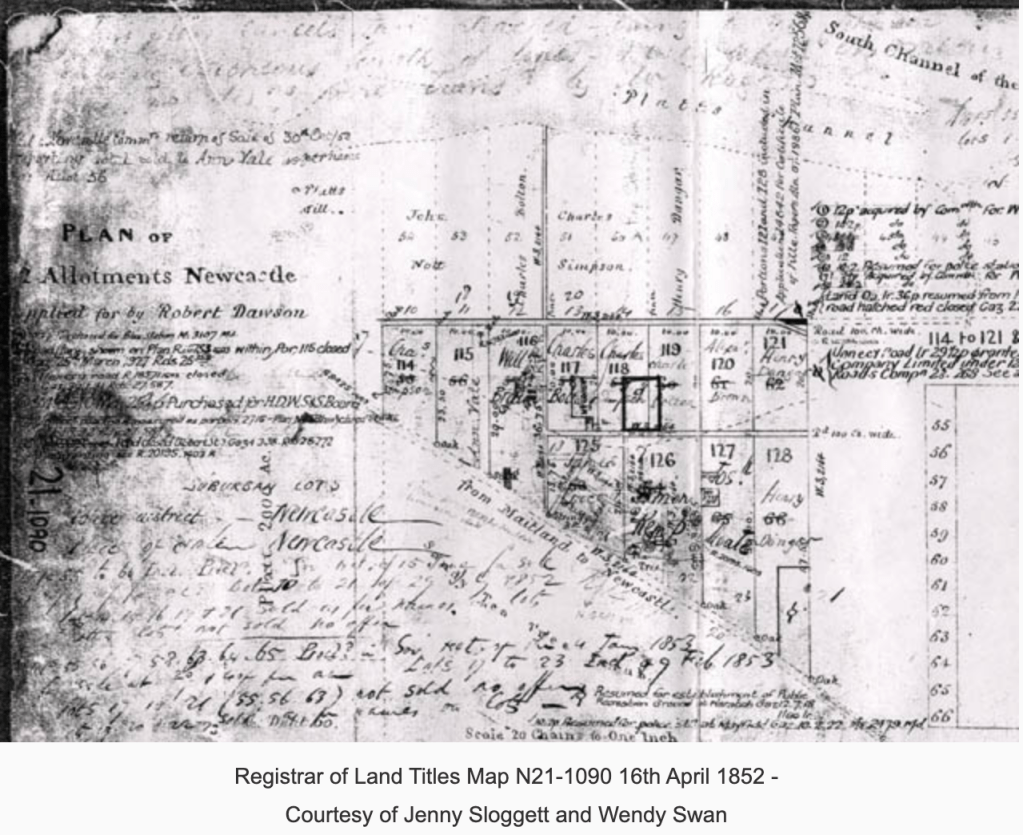
An original 1852 map below shows the original land taken up by Charles Simpson. This land is shown as Simpson’s on subsequent maps which is at odds with map references to 1854 for portion 114.
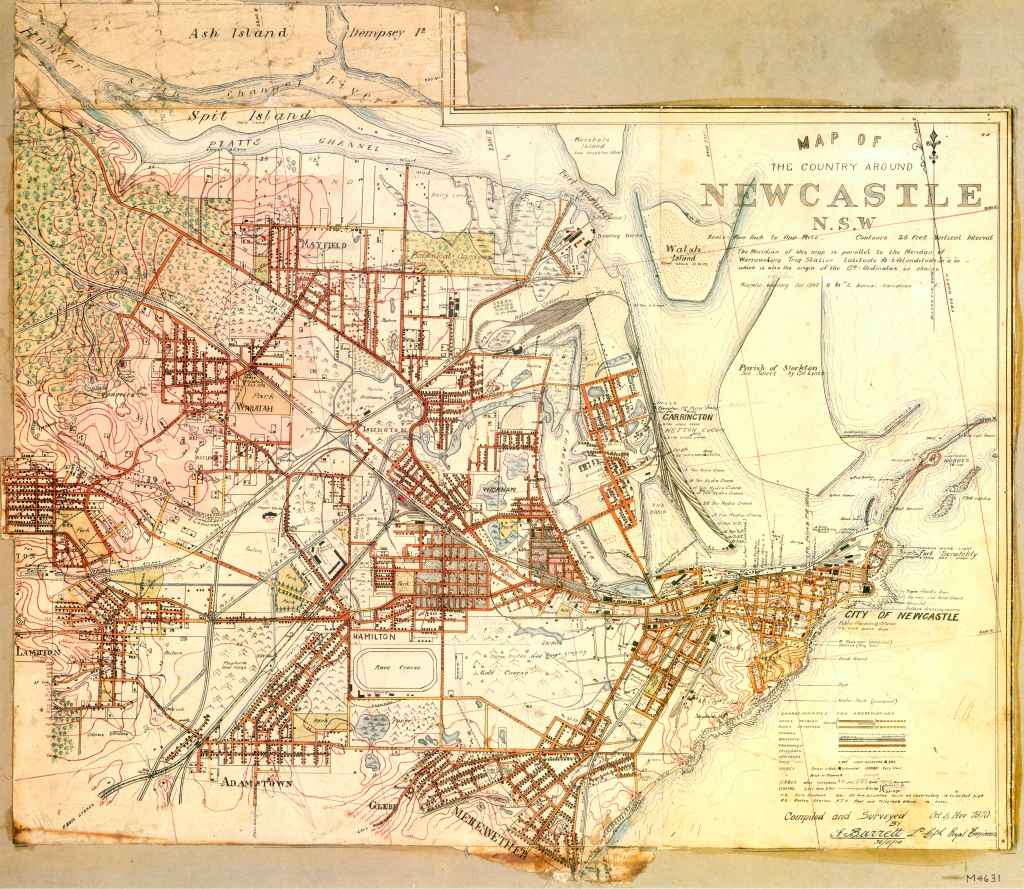
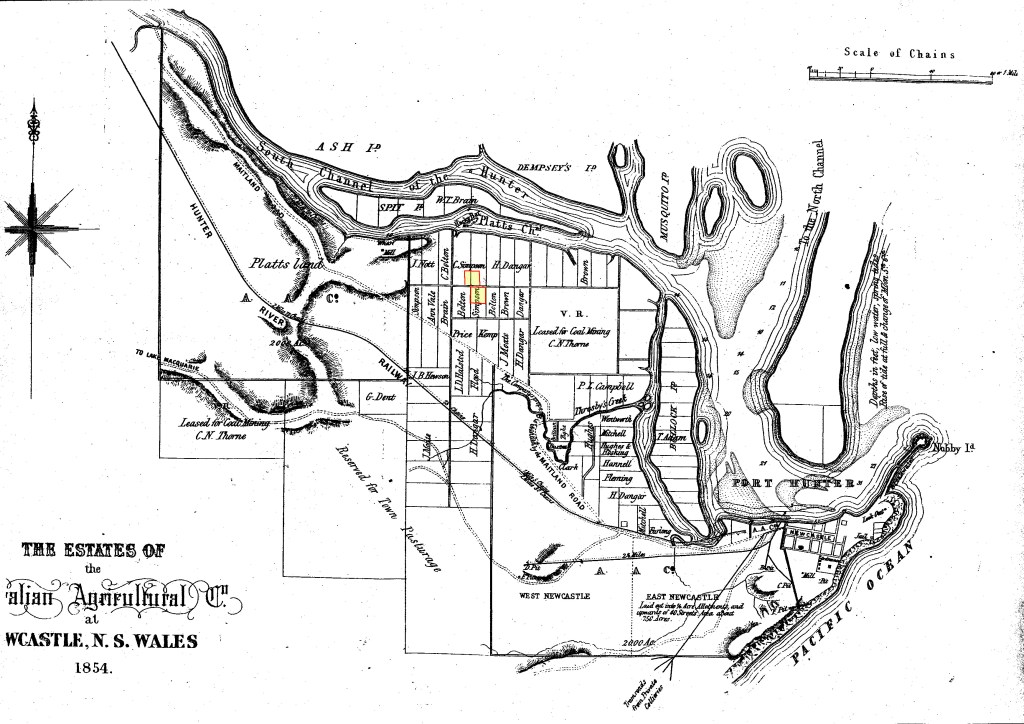
The 1854 map4 shows the Estates of the Australian Agricultural Co which include the four allotments of land purchased by Charles Simpson. Charles Bolton allotments are nearby as are some allotments owned by Henry Dangar the brother or William Danger who was appointed a Church Warden in Scone in 1844 along with Charles Simpson.
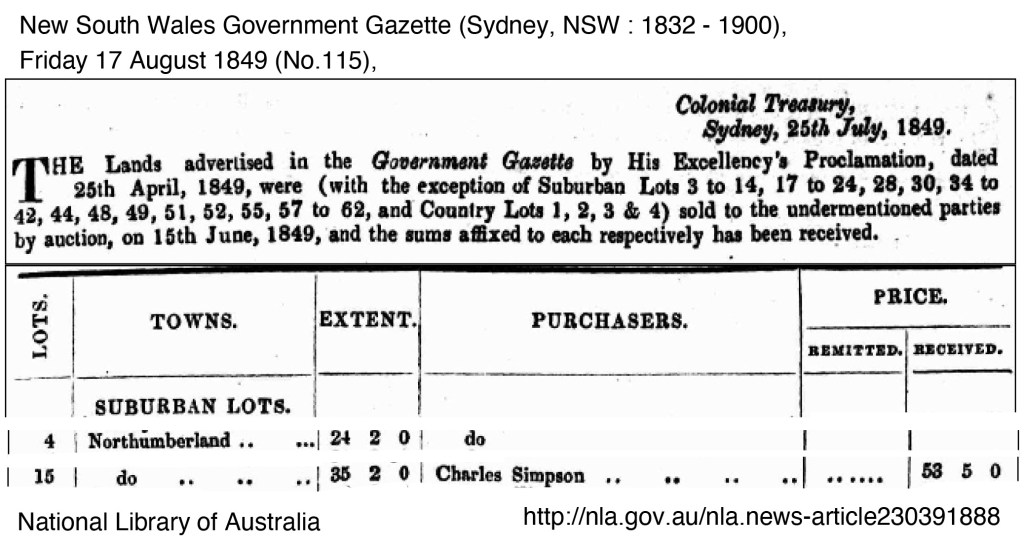
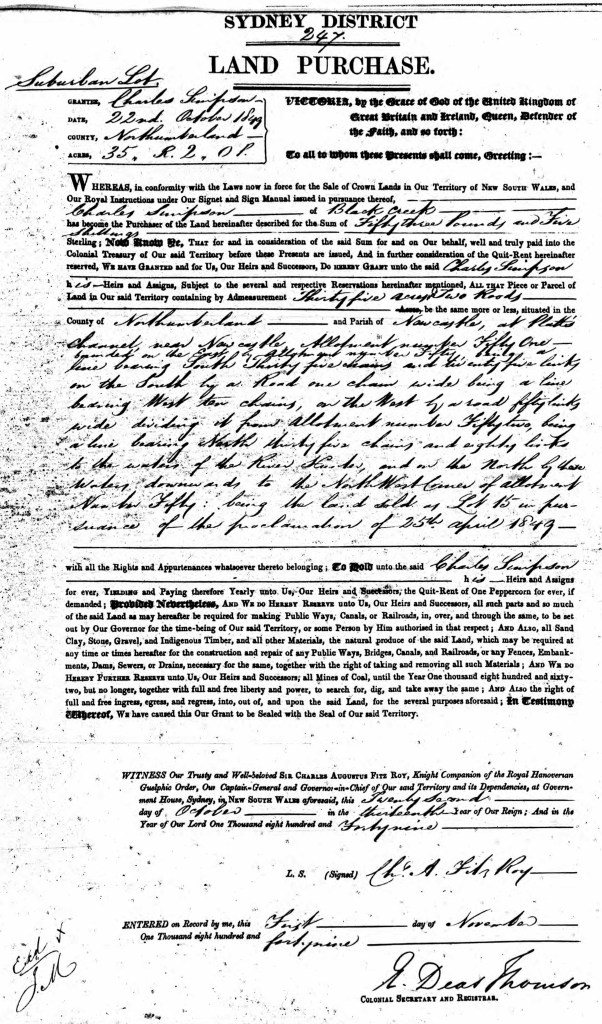
Charles Simpson purchased four allotments of land at ‘the folly’ which later became known as Waratah and is now known as Mayfield at Newcastle. Below are the Title Deeds for each of the properties which gives clear dates of purchases for the properties. In relation to George Gray and Edmund Bull, it is the first two properties which is significant as their small allotments of land which they purchased from Charles Simpson were part of the original allotments 51 and 50.
Of particular significance is Allotment 50 the original Lot 15 which is where the original Waratah House was built. It clearly shows that the Title Deeds are dated 22 October 1849 which establishes that Waratah House must have been built some time after this date of purchase. It can be noted that this land was purchased from the government.

Sale of Charles Simpson land to William Henry Morse, George Phillips Morse of Abington New England and Thomas Tourle
On 17 July 1854 Charles Simpson sold his land at ‘the folly’ Platt’s Channel to brothers William and George Morse along with their close friend and business partner Thomas Tourle. William and George Morse were the sons of the Rev John Morse who was the rector at Scone Church in 1844 when Charles Simpson was appointed a Church Warden there.
An indenture for the sale can be found in Book 33 Volume 535 at the NSW Land Titles for Allotment fifty one – 35 acres Lot 15 – Platts Channel purchased 5 April 1849 by Charles Simpson, Allotment fifty – 34 acres Lot 25 – Platts Channel purchased 11 Feb 1850 by Charles Simpson, Allotment Fifty nine – 20 acres Lot 25 – And north east corner of Allotment fifty eight – Lot 14 – Platts Channel purchased 15 June 1852 by Charles Simpson, And Also all that other piece or parcel of land in the said Territory containing Eighty perches or thereabouts being Lots Numbers Fourteen and Fifteen of Section D on Australian Agricultural Company’s place of Newcastle purchased by the said Charles Simpson of the said Company being a portion of the said Company’s land and situated in the County and parish Newcastle.6
There were however five parcels of land contained within the allotments which had been excluded from the sale as Charles Simpson had already sold the small portions. These included the sales of these portions of land to George Gray, Edmund Bull, Philip Kuhn, Benjamin Baker and Peter Crebert.
The indenture for the main portions of land was between Charles Simpson of Waratah near Newcastle in the County of Northumberland in the Colony of New South Wales Esquire of the on part and William Henry Morse of Abington New England in the said Colony Esquire George Phillips Morse of the same place Esquire and Thomas Tourle Esquire of the other part. For the amount of four thousand five hundred pounds sterling.7
In regards to Allotment 55 additional information with the schedule of sale is provided in Book 571 – Vol 716 page 2 of the NSW Land Titles records. It states:
’14th July 1854 Conveyance of this date made between the said Charles Simpson of the one part and the said William Henry Morse George Phillip Morse and Thomas Tourle of the other part.
18th July 1854 Mortgage with release endorsed made between the said William Henry Morse George Phillip Morse and Thomas Tourle of the other part and the said Charles Simpson of the other part.’ 8
These documents regarding the sale of all the Allotments of Charles Simpson’s land for the sale of the bulk of Allotments 50, 51, 55 and 59 alongside the small portions contained within these allotments sold to Gray, Bull, Kuhn, Crebert and Baker finally give definitive documentation as to the first landowners following Charles Simpson at Waratah.
The property owned by the Morse brothers and Thomas Tourle known as Abington, was a pastoral station about 45 kilometres north-west of Armidale and 20 kilometres south-east of Bundarra, it was first settled in 1836 by John Cameron from Dartbrook, Invermein, near Scone. A little of the history of the Morse brothers at Abington on the ‘Unlocking Regionals Memory’ website: That same year, Barlow, keen to focus on a nearby property, sold Abington for the handsome sum of £1,200 to William Henry and George Phillips Morse.
The Morse brothers, trading under that name, took the same approach as Barlow and developed Abington as a sheep station. By 1856, the number of cattle on the property had been reduced to 400, while the number of sheep had increased to 14,500. They at first lived in Barlow’s old homestead, but after George was married to May Sperling in 1872, a new brick building with a corrugated iron roof and shingled verandah was erected nearby. It was surrounded by nearly an acre of gardens replete with a stream, rustic bridges and fruit trees. Behind the homestead were the station’s work buildings; stables with cobbled floors, a coach house, smithy, granary, pigeon house and stores. There was also a wine cellar, stockyards, a footbridge and further up the hill the woolshed.
The Morses were keen viticulturalists, and a vineyard was planted across the creek from the homestead. From that time on, George Morse always bottled his own wine and in 1876 the Agricultural Society of New South Wales awarded the brothers a handsome bronze medal for the product developed on Abington Station.9
Thomas Tourle and George Morse were the original European settlers in 1841 on Balala Station south of Uralla where they built the original homestead.23 The Unlocking Regional Memory website gives a brief outline of Thomas Tourle’s connection with the Morse family and their business as well as personal relationships: ‘Tourle arrived in Sydney on the ‘Lady Raffles’ in 1839 having befriended Reverend John Morse during the voyage. He and Morse went into partnership to purchase Balala Station in New England and in September 1840 Tourle travelled there 180 miles by horse.
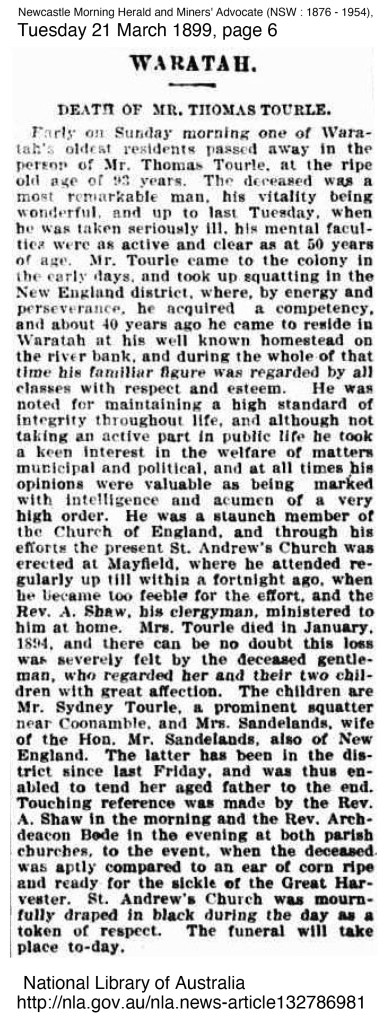
By 1845 the station was running 380 head of cattle, 9 horses and 10,000 sheep. Although they worked hard they made little money through the 1840s depression but eventually survived to become wealthy. Tourle married Helen Morse in 1846 and in 1854 bought Waratah House at present-day Mayfield, near Newcastle. He lived there until his death.’ 10
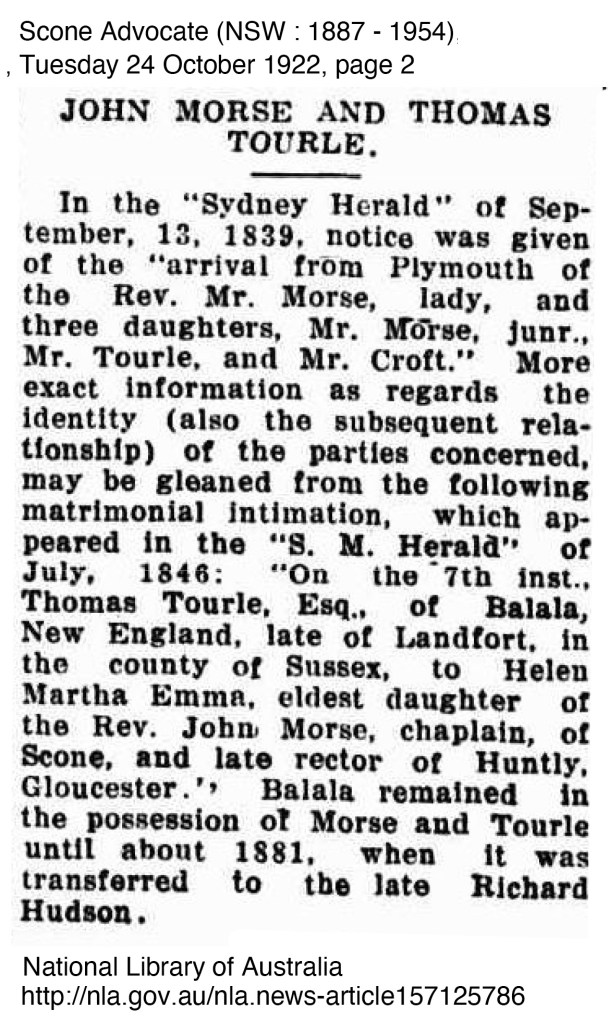
William Henry Morse died on 19 April 1885 at Abington Station.
George Phillip Morse died at his residence, Esrom House Armidale on 11 December 1908.
On 23 October 1869 a reconveyance of the previous mortgage was discharged by William Henry Morse. It is recorded in Book 121 number 509 in the Land Titles records. Charles Simpson’s signature is witnessed by Thos Phillips of Plymouth in the County of Devon England, Solicitor where Charles Simpson was then living. 11
References
- Newcastle Morning Herald and Miners’ Advocate (NSW : 1876 – 1954), Saturday 3 October 1936, page 5 WARATAH’S FIRST SETTLERS Mr. Braye Reviews Early History
- “Waratah and the Original Grants” By T. A Braye Read before the Newcastle & Hunter District Historical Society on October 1st 1936 pages 124 – 125 chrome-extension://efaidnbmnnnibpcajpcglclefindmkaj/https://hunterlivinghistories.com/wp-content/uploads/2021/07/a6595_iii_braye.pdf
- Map: the estates of the Australian Agricultural Company at Newcastle, NSW, 1854 Hunter Living Histories
- Newcastle Sun Monday 28 March, 1932, Page 4 ‘Waratah 80 years ago’ George Abner Gray
- NSW Land Titles BOOK 33 Volume 535 INDENTURE See RPA Vol 2752 Fols 9 & 10 (Application 16309)
- NSW Land Titles BOOK 571 Volume 716 – INDENTURE Conveyance of Allotment 55 by MORSE BROTHERS & THOMAS TOURLE – dated 27 September 1887 – previous Charles Simpson land purchased 7 June 1853
- NSW Land Titles BOOK 571 Volume 716 – INDENTURE Conveyance of Allotment 55 by MORSE BROTHERS & THOMAS TOURLE – dated 27 September 1887 – previous Charles Simpson land purchased 7 June 1853
- References: Anne Harris, Abington: A History of a Station and its People (Armidale: University of New England, 1982) https://www.nswera.net.au/biogs/UNE0590b.htm
- Balala Station Website https://www.balala.com.au/contact and Brief Biography compiled by Robin Hammond, January/February 2004 ‘Unlocking Regional Memory’ https://www.nswera.net.au/biogs/UNE0468b.htm
- ‘Unlocking Regional Memory’ https://www.nswera.net.au/biogs/UNE0468b.htm
- NSW Land Titles Records – Mortgage Discharge – 23 October 1869 – BOOK 121 Volume 509
 George Gray - Stonemason & Builder