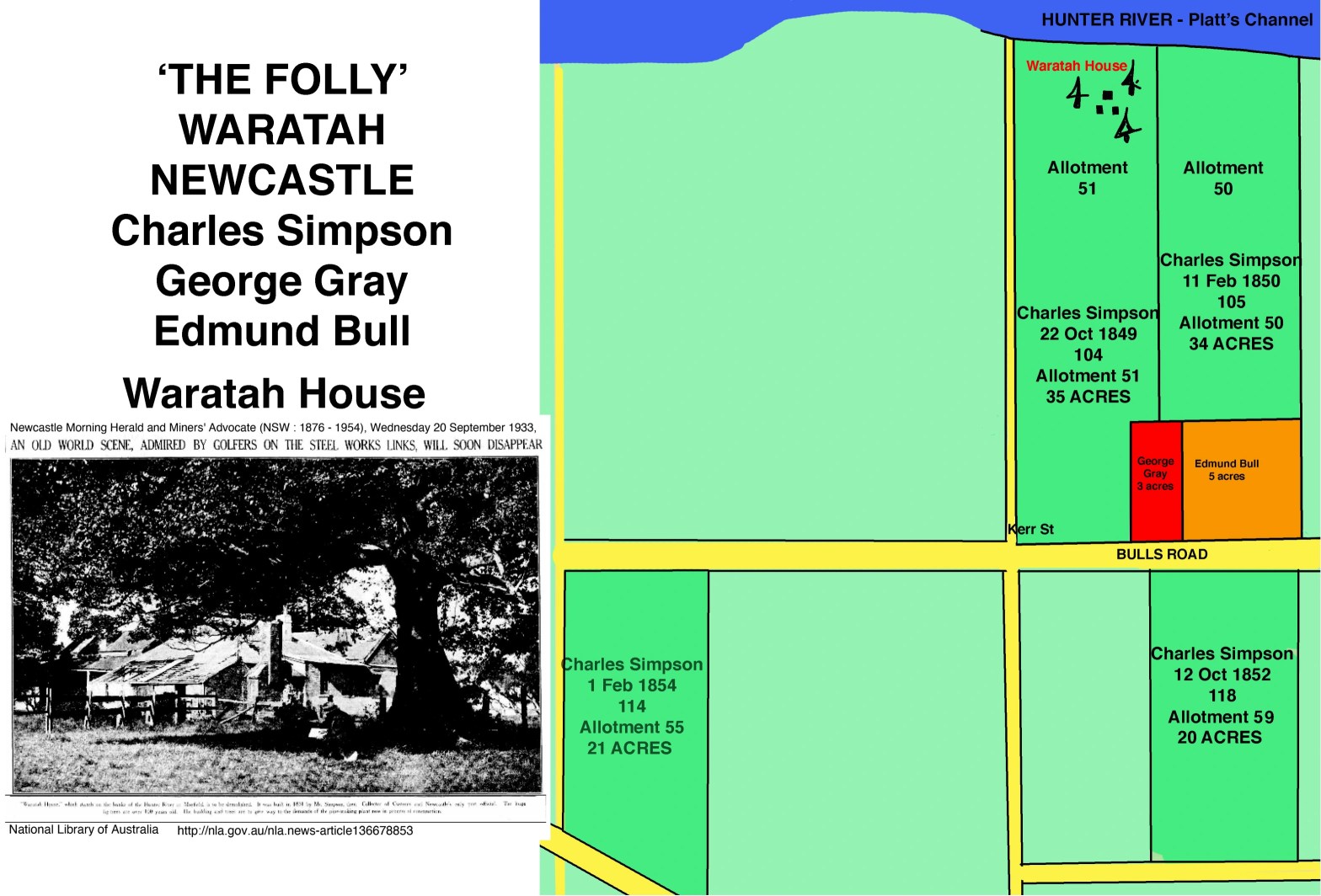
Building a house & estate at ‘the folly’ 1850 -1853
A thesis submitted in 1971 by Ross M. Deamer – Houses Erected on Original Land Grants in the Lower Hunter, Paterson and Williams River Valleys Between 1800 – 1850 2 encompasses aspects of building some of the original houses in the Hunter Rover regions. Including in Chapter 4: Components and Construction where he discusses how many of the early settlers set out to build their houses in these new land grant areas where there is little if any supportive trades, or infrastructure.
As Ross Deamer stated in his opening remarks on his research of particular houses: ‘To understand a house or any other building of a bygone era it is essential that it be visited and the imagination be brought into play to conjure up the spirit of its time and relate to its inhabitants and their mode of living. It is also essential to understand the persons for whom it was built.’ 3
This chapter aims to draw together the limited threads of Charles Simpson’s work situations, life, the life of those who worked for him and the building of Waratah House.
Based on the limited available information the time frame for the building of Waratah House and setting up the surrounding gardens and vineyards is from no earlier than September 1850 as Charles Simpson purchased Allotment 50 (portion 115) on 30 August 1850, through until he started his new position with the council of Newcastle in July 1853.
Alongside this whilst there is no actual accounts of building ‘Waratah House’, what can be looked at is the progression of building a house around the time of the 1850’s and the materials used.
In the case of Charles Simpson’s ‘Waratah House’ although much closer to more established and establishing towns like Maitland and Newcastle, this time Charles Simpson Esq was taking on the task of starting from land land that was largely if ever cleared at ‘the folly’ on Platt’s Channel.
On an early trip up the Hunter River, John Dunmore Lang described the landscape in his written account of 1834, of he saw from the steamer heading to Morpeth: ‘For the first fifteen or twenty miles by water from the mouth of Hunter’s River, the land on either side is generally low, swampy, and sterile, though for the most part thickly covered with timber; but higher up, and along the banks of the two tributary streams, the soil for a considerable distance from the banks is entirely alluvial, and of the highest fertility, and the scenery from the water exceedingly beautiful.‘ 4 The land on which Waratah House was built is approximately eight miles from the entrance to the Hunter River at Nobby’s Lighthouse.
Clearing the Land
There are many references to the land at the folly where Waratah House was built when Charles Simpson purchased it in 1848 -1850. The local historian Thomas Alfred Inglis Braye known as T A Braye was originally a solicitor, so his name does appear in this capacity on historical legal documents, wrote often of this area of land. He also lived and grew up in the Waratah area.
In his History of Waratah written for an address to the Historical Society on 1 October 1936 he states: ‘As to how the District got the name “Waratah” is not very clear, but when I come to speak of Simpson’s Grant, the time and circumstances under which the name arose will be detailed. The explanation given to me was that the locality which we knew as “North Waratah” was the moat Northerly point in Australia where the Waratah Flower grew in a state of nature.’ 5
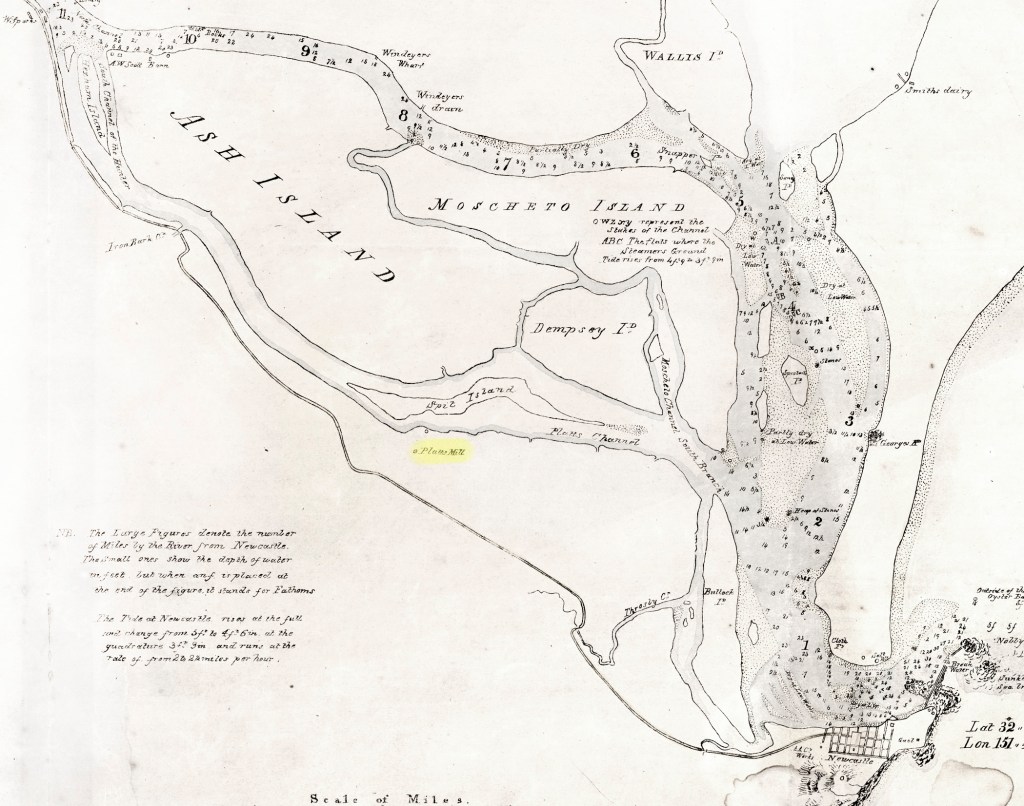
Braye continues further in his address: ‘This land near the River was covered with dense tropical brush, and some portion of the old trees remain. Mr Simpson cleared a portion of this Brush from what I know of the country around there, it must have been a most mosquito-infested place at the time, and there he built what was considered in the early days of Newcastle, quite a mansion.’ 7
This description of the land was repeated in many reports : ‘impenetrable scrub’ 8 ; ‘He obtained a grant of land running back from the river as far as what is now known as Crebert street. Along the river bank. and for some distance back there then existed a dense tropical brush (a small portion of thin brush remained when the writer was a boy and was known Bolton’s brush). Mr. Simpson caused a space to be cleared in the middle of this jungle and set about building what for those days was quite a mansion.’ 9 ; ‘Convicts were set to work to clear a spot among the huge scrub bushes that lined the river bank, huge tropical foliages according to older residents.’ 10 ; ‘Simpson had the land cleared and erected his mansion. Government men rowed him up and down, between his home and the office.’ 11
So given that this land had not been occupied, it is possible it may have been used from grazing of cattle around the 1830’s but as T A Braye stated, the land had likely grown back over if it had been grazed. The first task would have been to clear the land where the house was to be built and the surrounds for vineyards and gardens. It is here where George Abner Gray’s recollections are useful as he was living with his father George Gray and stepmother on Simpson’s land. Most of the other accounts are from those who came after the initial three familie. George Abner Gray recalls, ‘We and 2 other family being first to settle at Waratah’ which aligns with the three George Gray, Edmund Bull and Ben Baker with their families. A single man called Henry Crowther who worked with Ben Baker as a sawyer was also there, but was not married until March 1856. He later purchased land from Charles Bolton’s allotments.
‘”Mr Charles Simpson purchased an estate previously called ‘The Folly’ and he named it Waratah” writes Mr Gray. “At that time there was no other settler within miles. The first who came were in Mr Simpson’s interest. He had a brick house built and soon made wonderful improvements. The two sawyers who cut the necessary timber for the house were Ben Baker and Harry Crouthers, while the builders name was Gray. The gardener was Mr Bull, the grandfather of Dick Tressider, the boat puller.” … when his sister Georgina Gray was born in June/July 1851, George Abner Gray recalls ‘Mr Simpson had a road cut through the bush and nailed to a stringy bark tree a finger post indicating the way to Waratah.’ 12
The first steps in building the house would have involved land clearing and setting up the site for building. Tradesmen were not easy to find, especially good tradesmen. As seen in previous craters, George Gray was not only a builder but stonemason and was already building at least one home on or near New Freugh but also with the opportunity for Charles Simpson to meet him, Edmund Bull, who was a gardener and labourer and Benjamin Baker a carpenter who turned his hand to sawyer. So a ready made small team of men to help him build his new grand house and gardens.
Convict or Ex Convict Labourers
‘Then came to building of the house. With so many hands the task did not take long. Huge cellars were built, for in after days wine was made on the residence … With the completion of the house the fig trees were planted. In after years these small trees grew to such an amazing size that the shade from the foliage covered the house. Rich and rare plants were imported for the beds, which were huge. The convicts made light work of keeping such an area in proper order. There were so many of them available to do the work. The home was named “Waratah House”.’ 13
Although the above description is a more lyrical version than the obvious ‘mosquito infested’ thick scrub which was the reality. The theme of using convicts as labour is a half truth, by the 1850’s the was no penal settlement as such left in Newcastle as it ended there in 1823, then transitioned from a penal to a free settlement.14 The Newcastle Goal continued to operate until most of the inmates were transferred to Maitland with some remaining in Newcastle until 1855 to work on the Newcastle breakwater.15
George Abner Gray referred to his father’s use of ‘ex-convicts’ who he said his father used as labourers: ‘My father used to imply the X-convicts to do contract work. They always included in the contract a serten amount of rum ranging from a quart to 2 gallons and when the job was done they would all have a jolly spree.’ 16 He then recounts his first experience with rum given to him by these ex convicts who worked for his father so it is a likely true recollection. His half sister Georgina’s granddaughter, Mabel Grierson adds some additional notes: ‘Miss Grierson said she had often heard that Waratah House was built by convicts, but this was incorrect. It was built (of brick) by her grandfather, George Gray, who was a building contractor. “He brought the workmen from Sydney to build it in 1848,” she said.’ 17 In the time frame that Waratah House would have been built, George Abner Gray was a child of 5 – 7 years . At this point Georgina would have no recollection of the time when Waratah House was built so would be relying on recollections of her mother and older siblings George and Maurice as Sarah Ann remained at New Freugh during the Waratah House building time. George Gray died in 1861 so Georgina was 10 years of age and George Abner 15 years of age when their father died.
It is possible additional labour help did come from Sydney to help build the house, there is the shipping record in January 1851 when Charles Simpson went to Sydney and several other references to ‘Mr Simpson’ on the shipping records between Newcastle and Sydney in the early part of 1851 which may or may not have been Charles Simpson Esq.18 It is more likely though that the bulk of the general labouring would have been as George Abner retold of his father’s work, by local labourers and ex-convicts.
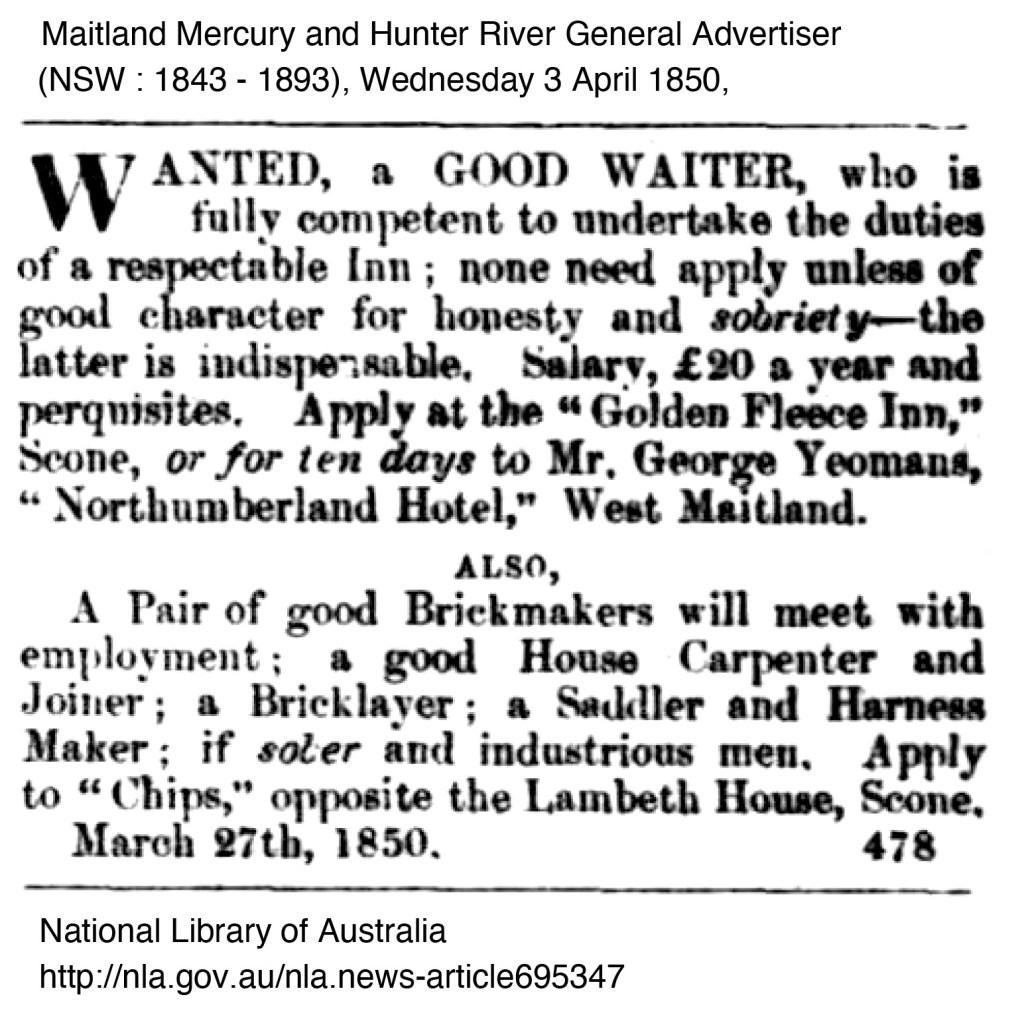
There appears to be no advertisements for tradesmen or materials in the newspaper advertisements of the time indicating that Charles Simpson sourced both himself. It could be reasonably assumed that George Gray, his brother in law Edmund Bull and Ben Baker were the first three families at Simpson’s land on Platt’s Channel and that given their occupations and the reports of family that they were the builders of Waratah House. It is also likely that they employed ex-convict labour to help clear the land for building and to set up the land for gardens and the vineyard.
Building Materials and Tradesmen
It is clear that Waratah house is built from bricks and with a shingle roof. There would need to be the use of timer in pitching the roofs.
Bricks
In looking at the construction of Waratah House the first material to consider are the bricks. Some times if there was available clay and materials, bricks were made onsite either sun drying or with the use of an on site kiln. Other times the bricks were made further afield, perhaps Maitland, Newcastle or even Sydney then transported to site. As Waratah House was on the banks of the Hunter River it ma have been possible to bring materials via boats, the building was also not far from the Maitland to Newcastle main road. It is unknown where the bricks came from.
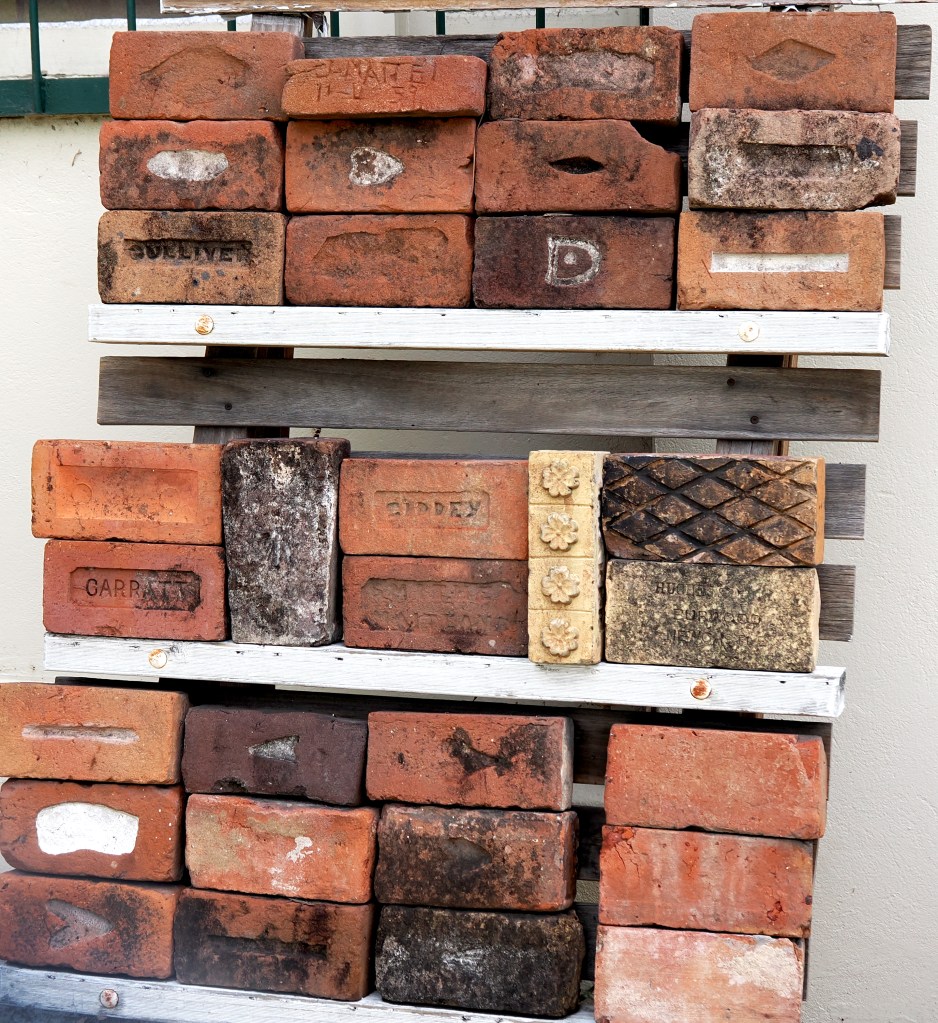
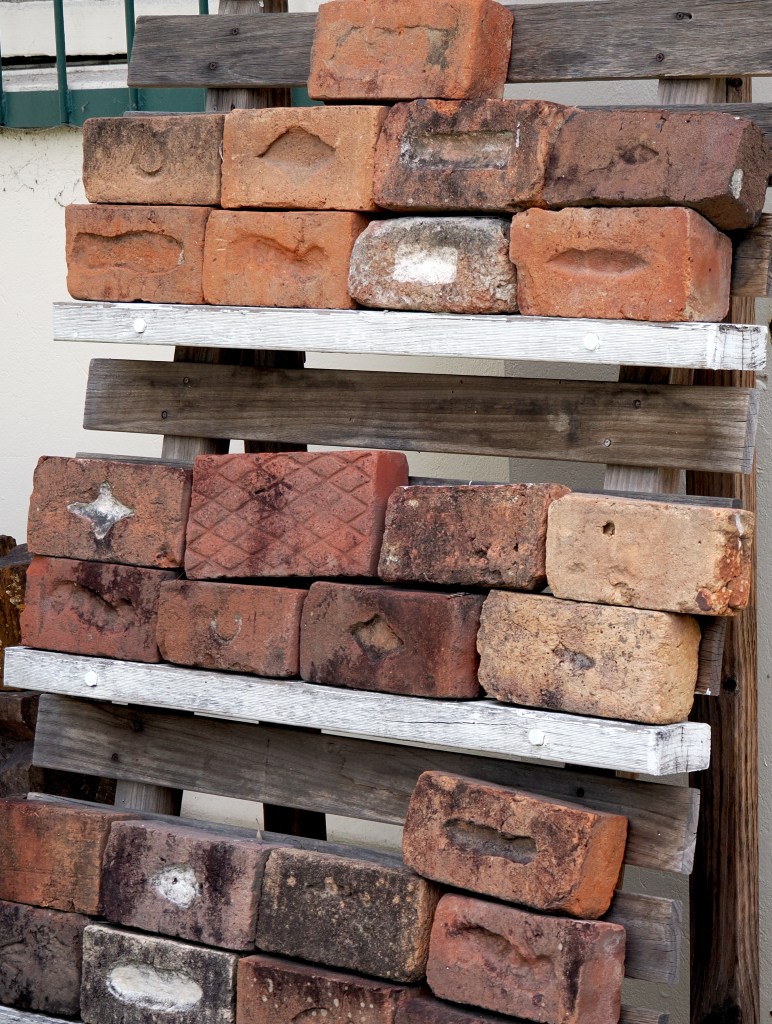
There are however advertisements for local brickmakers and bricks wanted in the local newspapers in 1850 – 1852. Ross Deamer mentions the brickmaker Thomas Cooper,19 he was operating in 1843 in Newcastle but there are insolvency notices in the same year. Some of the advertisements call for a certain number of bricks to be made, below are references from the newspapers.
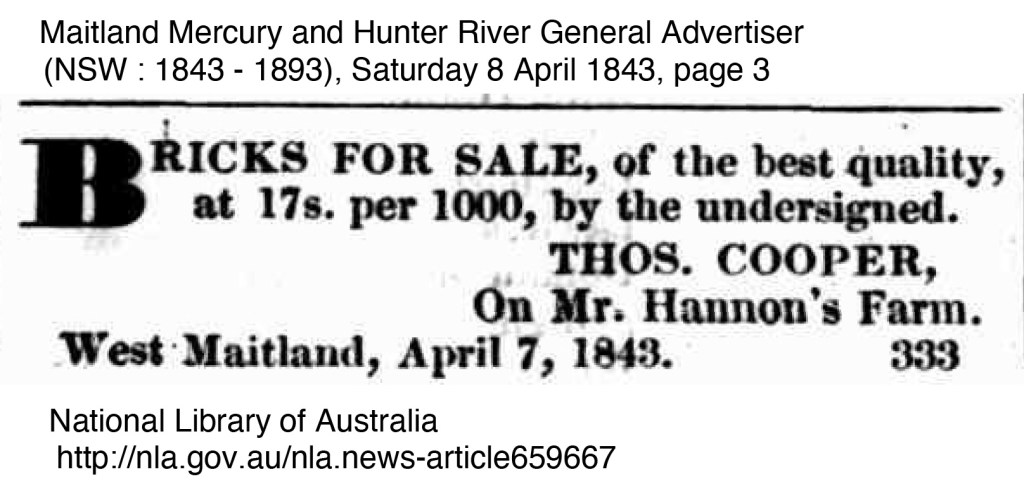
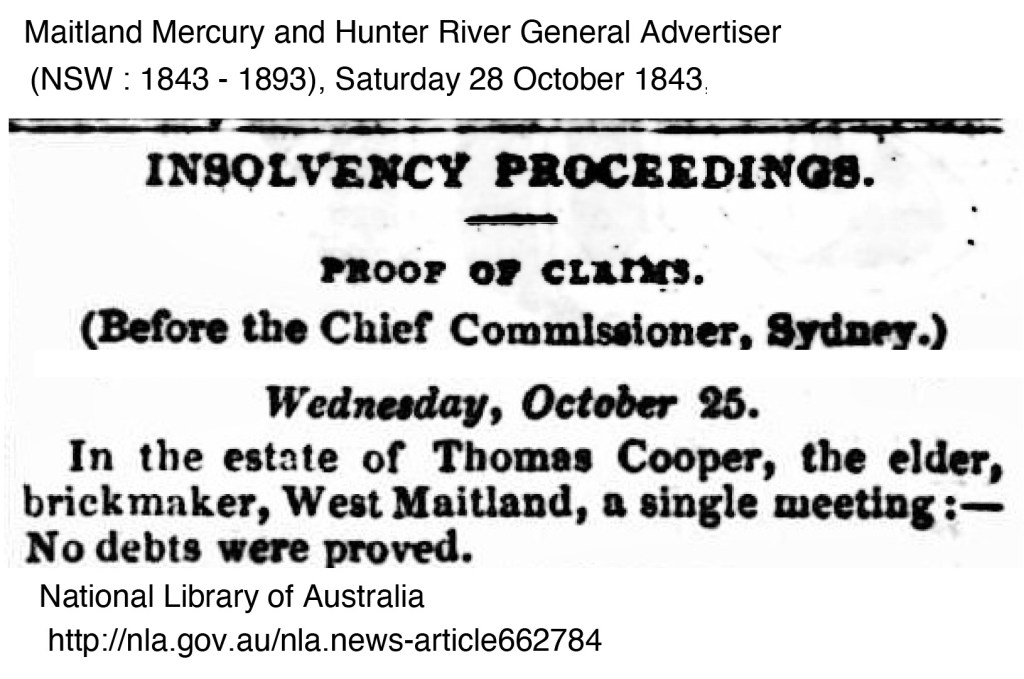
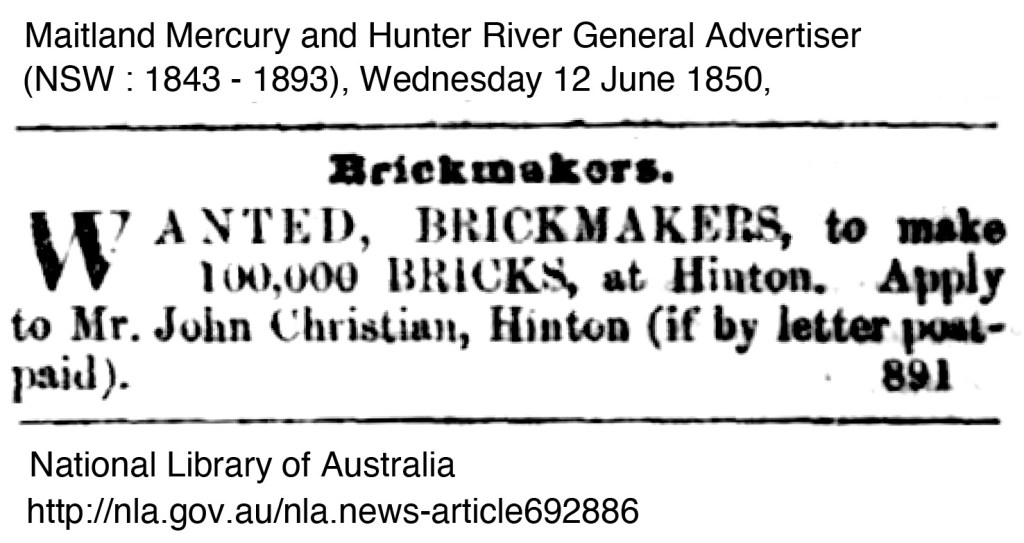
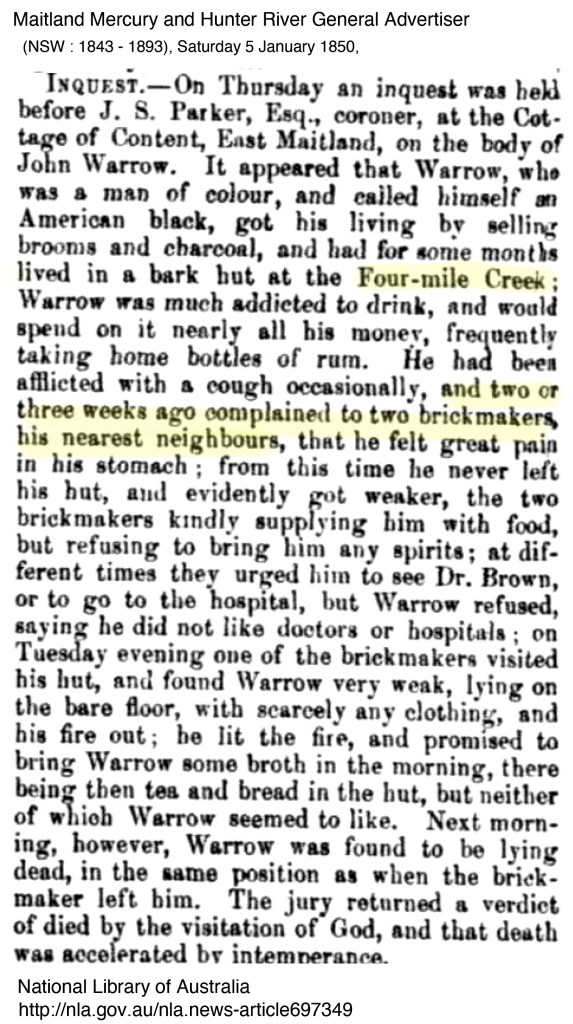

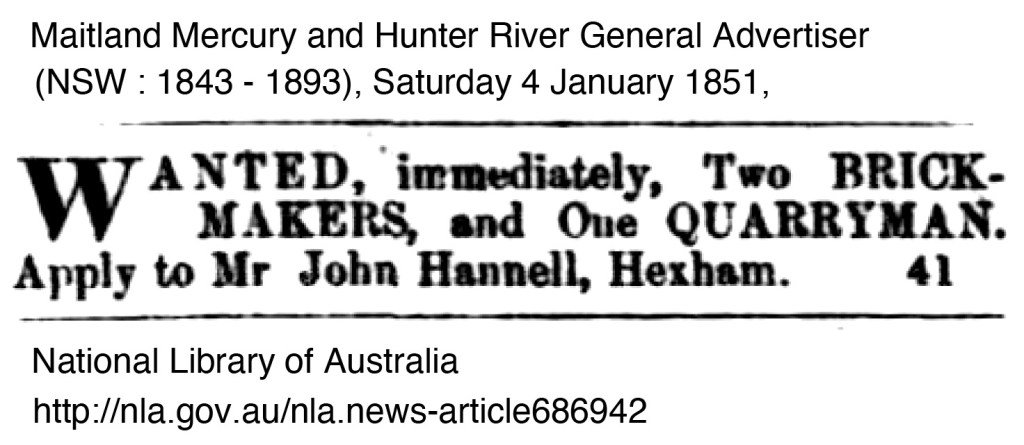
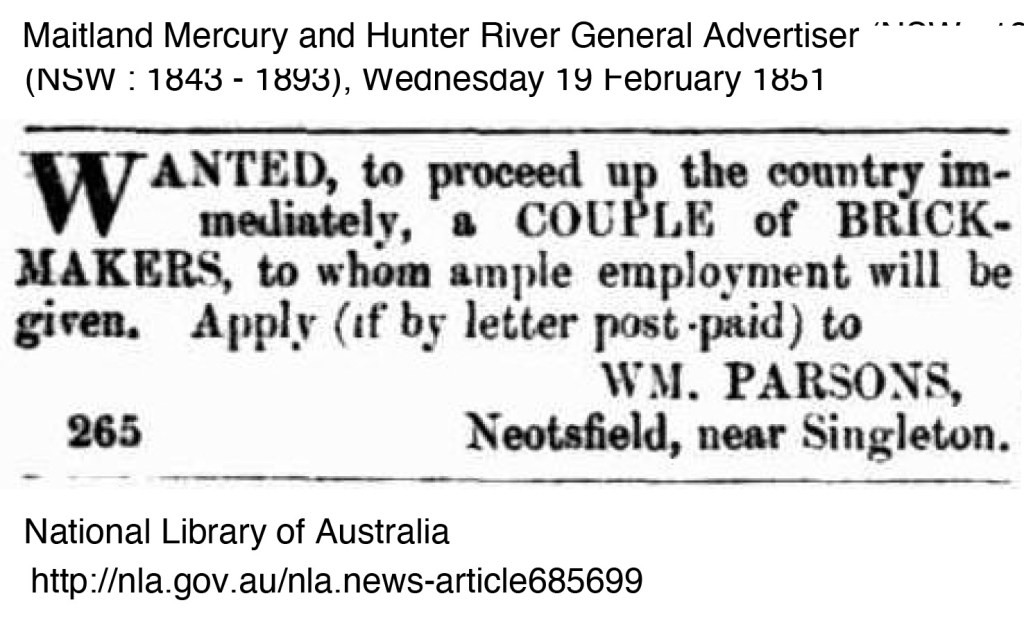
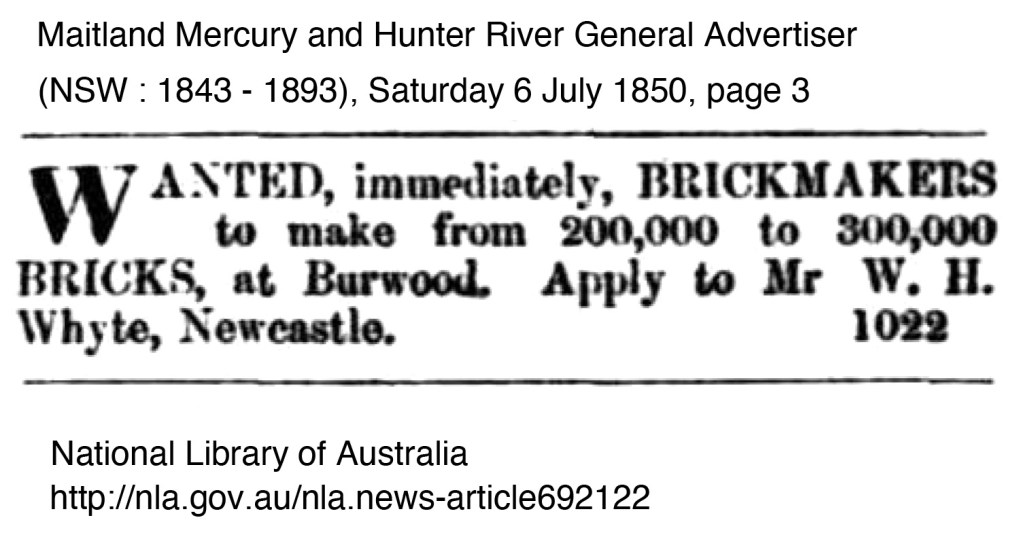
As a stonemason and builder George Gray was qualified to lay the bricks and to employ and direct labourers.
Timber and Sawyers
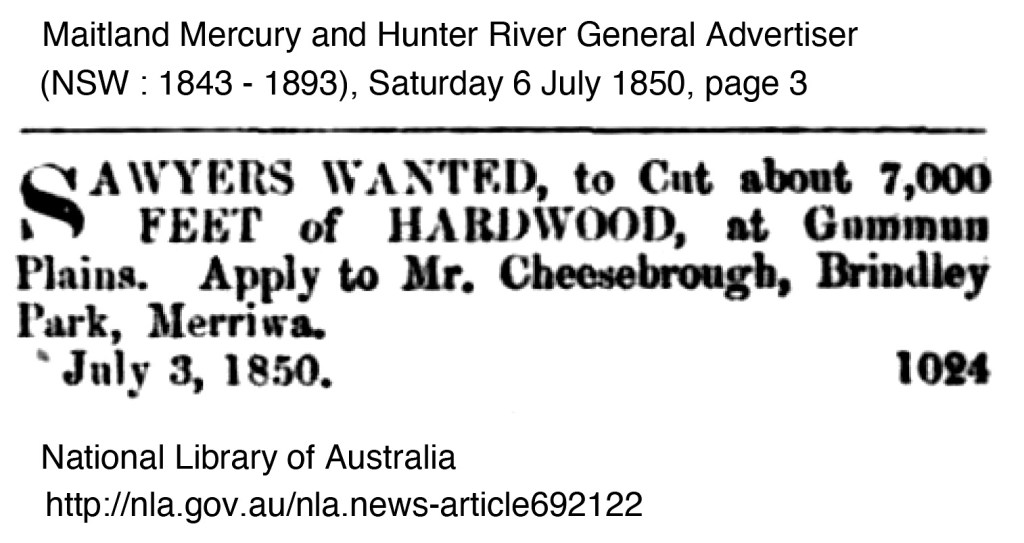
As with bricks and bricklayers, sawyers and carpenters were also in demand. George Abner Gray recalls: ‘”At that time all timber required for Newcastle was got from around the country where Lambton now is, and out at Dark and Cockle Creeks, where Wallsend now stands. All sawn timber was done by the saws at the pits. The timber trade employed many hands, and most of the timber was pulled o Newcastle by bullock teams. The A A Company used horse teams to haul the proper for the coal pits.”‘20
Advertisements for tradesmen including sawyers.
Charles Simpson – Waratah House
Ross Deamer discusses the early techniques, building materials and practices of the building of their large houses up until the 1850’s: ‘As with the earlier houses, those of this phase, with but few exceptions, were constructed in stages, or the total accommodation was divided into blocks containing the various activities and the total housing complex was then erected a block at a time.’ 21 He goes on to describe the building of George Wyndham’s ‘Dalwood’ house : ‘The work of completing the house to its final magnitude then proceeded a room at a time while the Wyndham family was in occupation … “Dunmore House”, “Stradbroke House”, and the “Homestead” at Louth Park were all examples of the second type of progressive building. John Dunmore Lang’s description22 of his building of his brother’s house adds weight to this method : “Dunmore House” which is located near Largs consisted of main central two storeyed block housing the main rooms of the house and two flanking wings of one storey which formed a “U” shaped group. The western wing containing the kitchen, stores and bedroom , was the first section erected, and was built in 1831 and was used as a second temporary residence.‘ 23
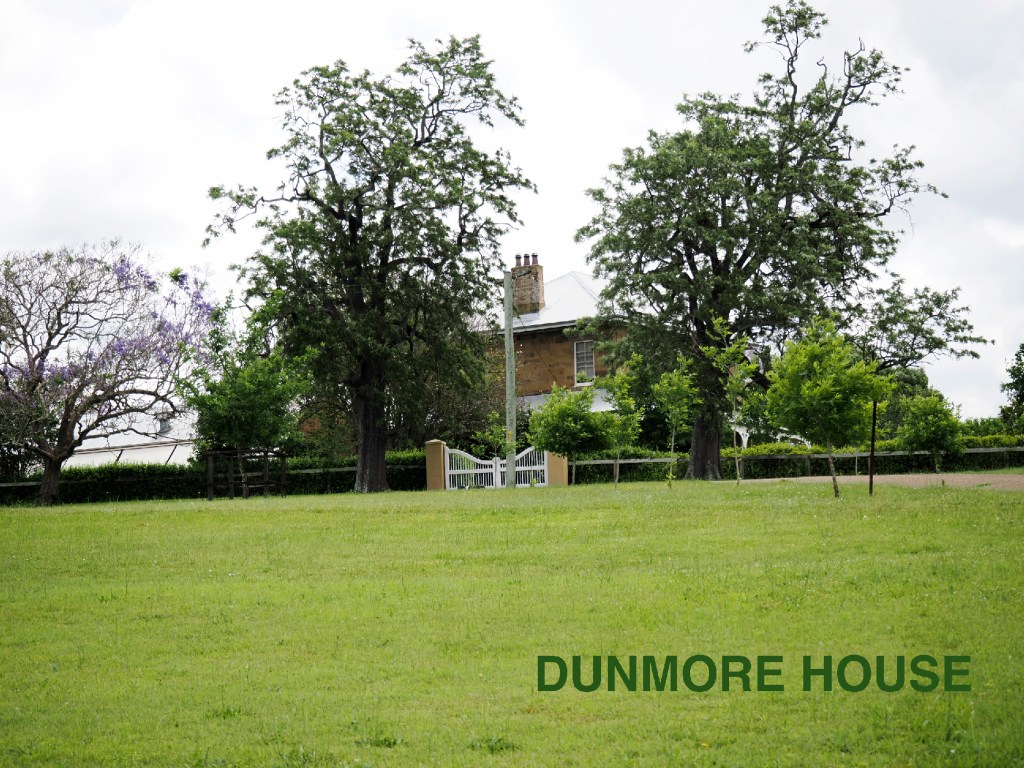
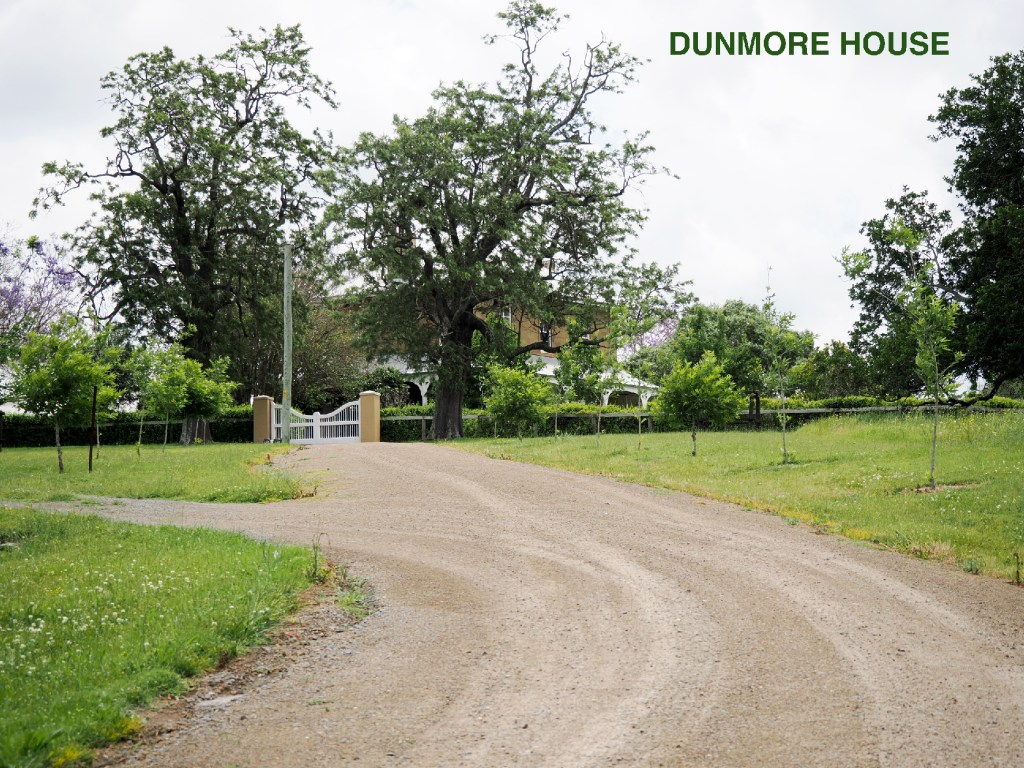
Whilst Waratah house was a smaller dwelling and estate than those mentioned the concept of clearing the land, building the cellars then each of the attached three wings forming the ‘U’ shape of the house being progressed in stages whilst living in the first section would follow the previously described form or progression of building often used up until the 1850’s.
As seen in the previous chapter regarding Charles Simpson leaving Brinkburn Farm we know that he advertised the second lease of the cottages whilst he was still there as the at the end of December 1850. Ben Baker of Newcastle had an unclaimed letter in 31 January 1851 so the most likely progression would be that the three families went ahead, then set up either a temporary dwelling house for the Simpson family, or perhaps managed to complete one wing of the house whilst they worked on the other two wings providing a dwelling space for the family. Both options were used prior to the 1850’s
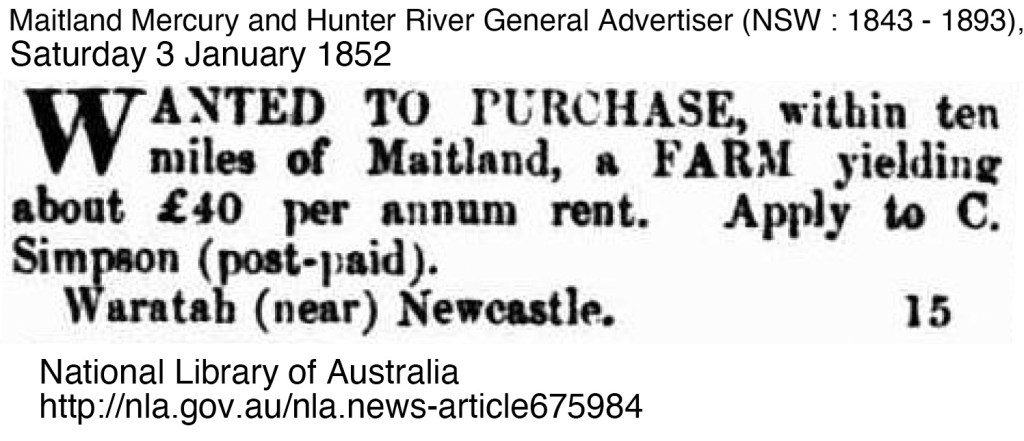
From April 1851 until he advertises for a new farm to purchase in January 1852, Charles Simpson has no references in the local papers.
On 12 October 1852, Charles Simpson purchases 20 acres of Allotment 59 Portion 118 across what is now Bull’s road. This was where two five acre portions were excised, one for Benjamin Baker and the other for Philip Kuhn. It is also where what is currently now as ‘Simpson’s Cottage’ was built by the McNulty’s after 1855.24
It is not until July 1852 that Charles Simpson takes up his new role in the government public service, this time as the Warden of the District Council of Newcastle.
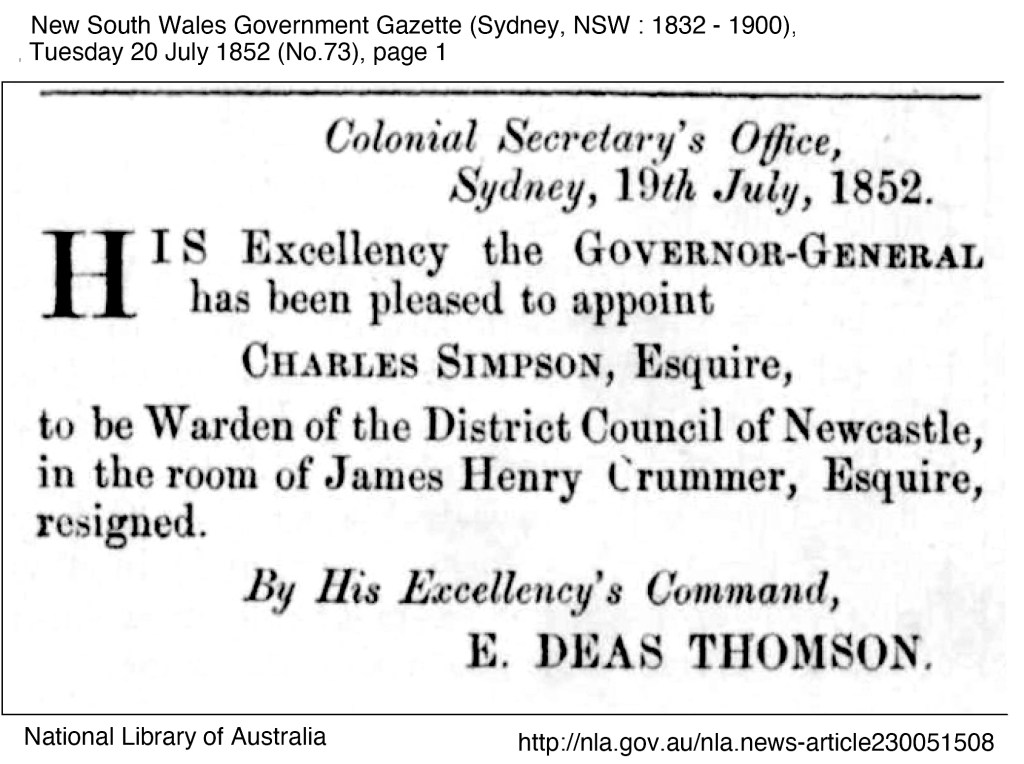
This would have given him sufficient time to not only build Waratah House but to set up the gardens and vineyards before taking on this greater role within the government. A time frame of clearing and preparing from approximately September 1850 until the commencement of his new postion in July 1852 is almost two years.
Gardens and Vineyards
We know that Edmund Bull and his family moved to ‘the folly’ sometime after August 1850 along with George Gray and Ben Baker. His son William was born in the Newcastle district in August 1851. He was a gardener who later set up his own extensive gardens in Charlestown known as ‘Bull’s Gardens’. One can presume that he would have been involved in setting up gardens as along with building the house to live in, the family and staff would need fresh food crops to feed them. It is entirely possible he could have been establishing these food crop gardens prior to April 1851 when it is likely Charles Simpson, his family and servants came to live on the property.
Edmund Bull’s son Sydney recalled: ”Bulls-street, Mayfield, was named after my father. A retired squatter took up some land, and as payment for clearing the land to establish a vineyard, father was given seven acres, which he planted as a garden. As was the custom with many well-to-do people in those days, the squatter planted a vineyard to produce wine for his own use.’ 25
Two German settlers from Weisbaden, Nassau, Germany who came on the same ship the ‘Parland’ in 1849 also feature in the story of Waratah House, and in particular the gardens and vineyards. Peter Crebert and Philip Kuhn like George Gray, Edmund Bull and Ben Baker were a beneficiaries of Simpson’s small land grants and were also likely employed by Simpson.
Peter Crebert was a ‘vine dresser’ from so experienced in setting up and tending to vineyards. We know he arrived in 1849 with his wife Maria Louisa and originally worked in Newcastle the only work available was in a factory. Peter Crebert worked for Dr Mitchell in his small orchard. In July 1851 the adjoining factory and orchard burnt down leaving him unemployed. The fire and loss of his employment aligns with the time frame that Charles Simpson would have needed an experienced vine dresser to set up his new vineyard at Waratah House. In his recollections recored in the newspaper in 1936, Peter Crebert’s son Joseph Franz Crebert recalls the ‘finger board nailed to a stringy bark tree that George Abner Gray also noted : ‘Clear in his memory is building which the was demolished recently in the vicinity, and of a board which was nailed to a stringy-bark tree in the paddock indicating the direction through the scrub to the railway station.Mr Crebert is of the impression that his father settled on ‘The folly’ in the year 1850, having brought five acres of land from a Mr Bolton.’ Like any recollections made later in life the overall picture may be correct but the small details slightly missed.
Philip Kuhn’s occupation listed on his immigration, naturalisation and land purchase records was a ‘cordwainer’. A cordwainer is a step above what was a bootmaker who could only repair shoes, a cordwainer could also make shoes. Given the fact both he and Peter Crebert came from the same town, on the same ship ending up both in Newcastle, it is highly likely they would work together.
Taking this a step further, Peter Crebert in setting up a new vineyard for Charles Simpson and seeing his friend Philip Kuhn also unemployed after the factory fire, it is likely that he brought Kuhn with him to help with the vineyard. In later records Philip Kuhn’s occupation was recorded as ‘Gardener’. In court in a dispute with his wife in December 1864, the record states: ‘Philip Kuhn, gardener of Waratah’ 25
Waratah House – the house plan
Professor Ross Deamer – Newcastle University

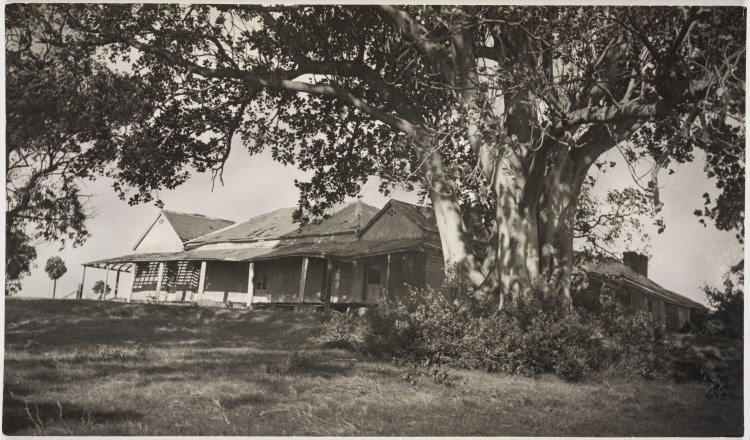
Ross Deamer’s thesis gives a description of the house the source being ‘From examination of an etching held by the Newcastle Reference Library and a photograph held by the Mitchell Library.26
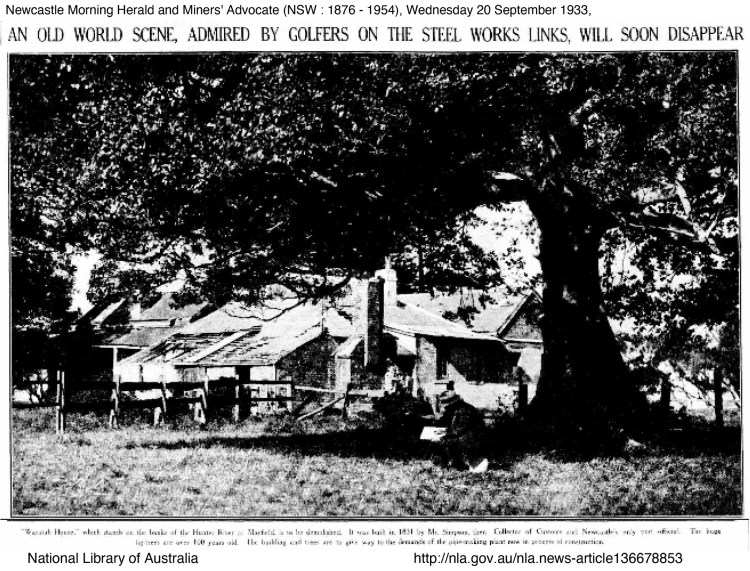
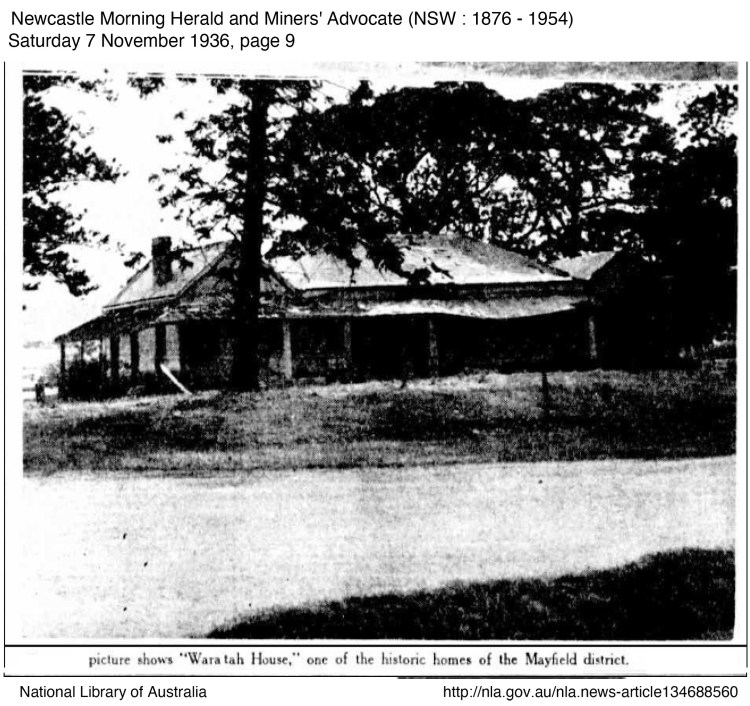
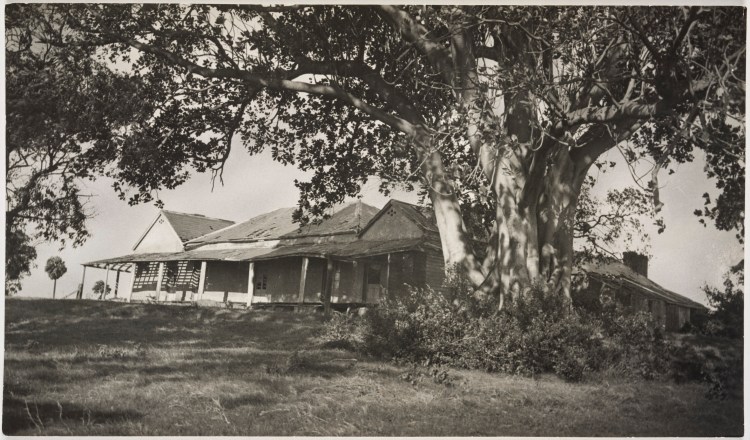
There are three additional photographs of Waratah House: Two are in the Newcastle Herald newspaper above and a third is on the Hunter living Histories website there is a a photograph of ‘Waratah House’ reproduced from a 35mm slide taken by the late Dr John Turner (1933 – 1998), local historian and lecturer. The notes say: built by Charles Simpson, later added to by Thomas Tourle, Mayfield, NSW, [1930s] Source: Hunter Living Histories, University of Newcastle
Ross Deamer’s description of Waratah House : The house was “U” shaped in plan, the form being derived from a main central block consisting of four rooms two on each side of centrally placed hall. The main house block was roofed with shingles fixed to a framed hipped roof. This main portion was flanked by two service wings which appear to have had additions made particularly those sections adjacent to the main house which are roofed with a gable type roof.
The majority of walls in the house were of brick, but it will be noticed in the accompanying photograph, that the side walls of that portion of the wing adjacent to the main house were of weatherboard, so that this seems to suggest that these sections were additions and that originally the form of the house was composed of the main central portion surrounded by a verandah, linked by this device to the two wings at the rear. In support of this argument it may be also noted that the doors from the verandah to the sections concerned did not match those of the main section nor were they akin to any known examples of the 1830-1840 period. Similarly the posts supporting the verandah vary along its length, the corner post on the left of the verandah and those next to it are square in section, the other five in front of the central portion of the house are rectangular and their spacing is such, as to allow a return of the verandah on their module. Consequently when additions were made the verandah was extended to encompass the additions.
By taking into account the size of the chimney at the rear of the wing, on the right of the photograph, the assumption could be made that this section contained the kitchen, stores and other ancillary rooms of the household and that the other wing contained bedrooms for the family and guests. The main block possibly would then have contained the drawing rooms, dining room, and perhaps the master bedroom or library. This distribution of rooms within the plan form would then allow full advantage to be taken of the view across the river delta and its islands, as the main axis of the house was approximately in a north-south direction which would also allow the bedrooms the privilege of the morning sunshine.
Gardens and lawns stretched from the house to the river, and from the verandah of the house, framed by the great figs and elevated on its knoll, must have presented a most impressive sight.
Beneath the house, cellars were built mainly to store the wine which was produced on the property.
The house was said to have been known as “Simpson’s Folly” because of the distance it was located from Newcastle and Simpson’s habit of commuting by boat. In those times it was a considerable distance for a man of business to remove himself from his base of operations, for as late as 1880, men of substance were erecting country houses, on the hills around the Newcastle basin and having town houses to accommodate their families through the week.
“Waratah House” was demolished in 1933 to allow The Broken Hill Proprietary Co. Ltd. to erect a pipe mill.27
Cellars – beneath the house
In breaking down the elements described by Deamer and looking at the photographs alongside building practices, the first area that would need to be built would be the underground cellars. The beginning of which would have involved some ground excavation works needing labourers … ‘Beneath the house, cellars were built mainly to store the wine which was produced on the property.‘
Three Building Wings of Waratah House
In the case of Waratah House we have Deamer’s description indicating two sections : ‘The house was “U” shaped in plan, the form being derived from a main central block consisting of four rooms two on each side of centrally placed hall …
Living Rooms Wing: ‘… the form being derived from a main central block consisting of four rooms two on each side of centrally placed hall … The main block possibly would then have contained the drawing rooms, dining room, and perhaps the master bedroom or library.‘
Utility Wing: the assumption could be made that [one] section contained the kitchen, stores and other ancillary rooms of the household
Bedroom Wing: and that the other wing contained bedrooms for the family and guests.
Ross Deamer – Thesis Errors
Unfortunately Professor Ross Deamer based the date of the purchase of the land where Waratah House was built by Charles Simpson and the construction date of the house from only one newspaper article ‘”SIMPSON’S FOLLY” Historic Waratah House TO GIVE WAY TO INDUSTRY’ published on 20 September 193328 which has now been established contains errors.
It is now resolved that Charles Simpson Esq did not arrive in the colony until 1841 and that in 1831 he was still in England aged just 15 years.
The reference by Ross Deamer to the ‘doors from the verandah to the sections concerned did not match those of the main section nor were they akin to any known examples of the 1830-1840 period‘ may be simply because the actual build date of the building and surrounds is 1850-1853. As George Gray was a stonemason and builder, the use of bricks would be an obvious material for him to have used.
The Newcastle Morning Herald article he references also errs in regards to the sale of Waratah House saying that Major Charles Bolton ‘bought the property, when it was sold after Mr Simpson’s death, and cut up a portion of the estate. The land was sold to families whose names are well-known in the district … the Creberts, Kuhns, McNulty’s, Crowthers and Williams. Late in 1860 Major Bolton sold his property to Mr T Tourle’. 29
As is clear in the Land Title Indenture records, all of Charles Simpson’s land at The Folly, Waratah, was purchased by ‘William Henry Morse of Abington New England in the said Colony Esquire George Phillips Morse of the same place Esquire and Thomas Tourle Esquire of the other part. For the amount of four thousand five hundred pounds sterling.’ 30
This was with the exception of the small portions of land contained within the larger portions which he sold to George Gray, Edmund Bull, Philip Kuhn, Benjamin Baker and Peter Crebert. Whilst Charles Bolton owned land nearby there are no records he purchased any land from Charles Simpson. As has also been established, Charles Simpson did not die in New South Wales, but returned to England in January 1855 where he died in Chilwirth, Southampton in December 1899.
Watercolour Painting by M G Arnold – Newcastle Council
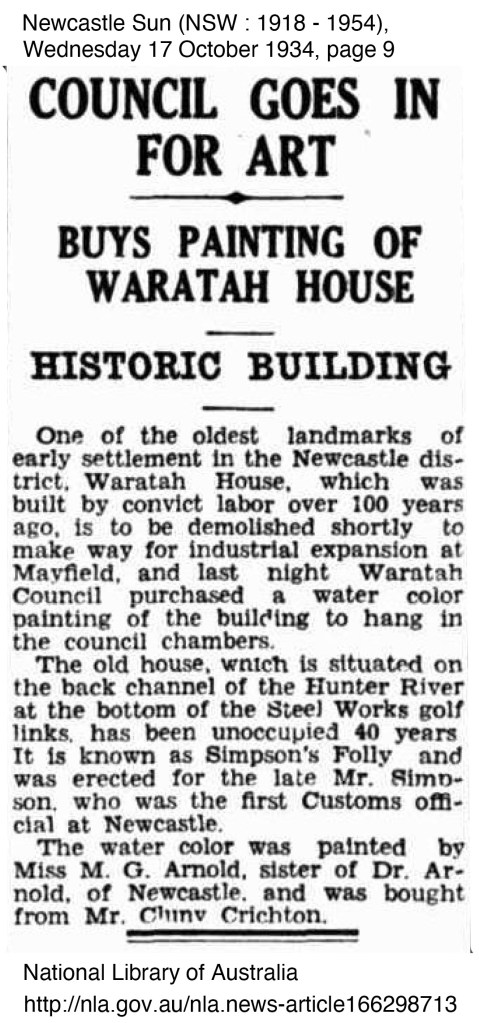
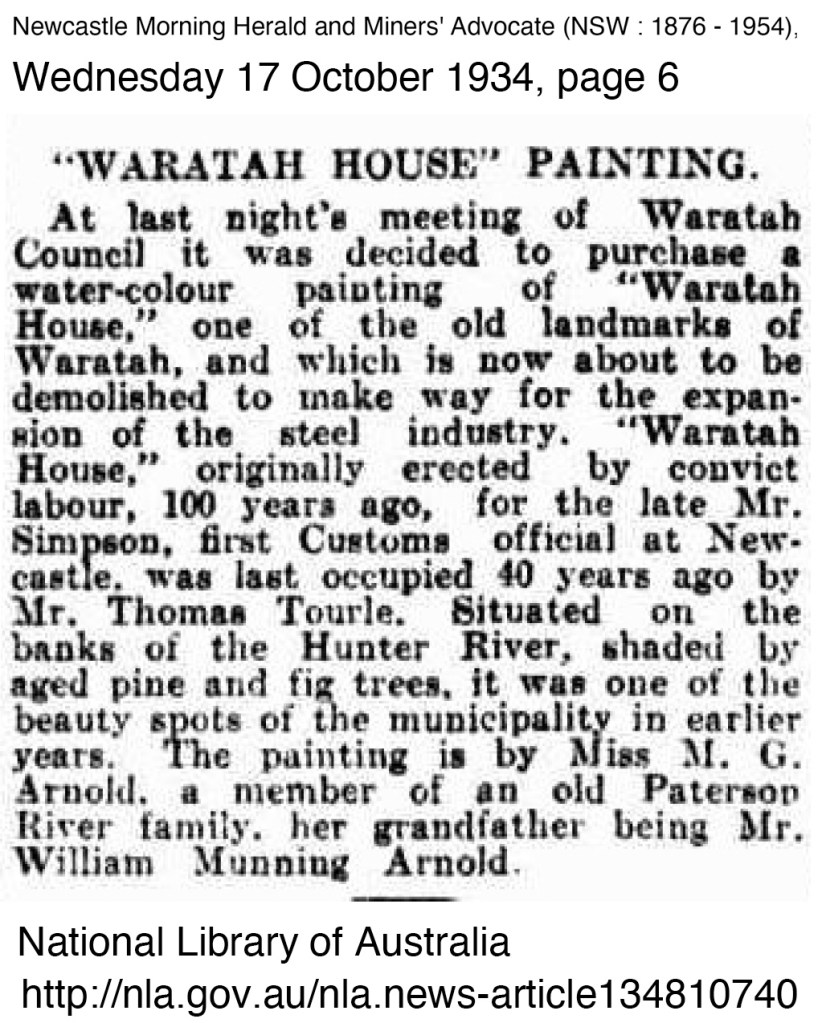
Of interest is that the local newspapers reported that a watercolour painting by ‘Miss M G Arnold’ of Waratah House was purchased by the Waratah Council in 1934.31 After consulting the Newcastle City Library Archives and the Hunter Living Histories, they have no record of where the watercolour painting may be now or if it still exists.
References
- NSW State Library – WARATAH HOUSE – Mitchell Library – Harold Cazneaux / photographs chiefly of domestic architecture and gardens – SLNSW_FL11228
- Living Histories University of Newcastle – Thesis by Ross M Deamer – Submitted to the Faculty of Architecture, the University of Newcastle, 1971, for the degree of Master of Architecture. Pages 92-93 Houses erected on original land grants in the Lower Hunter, Paterson and Williams River Valleys between 1800-1850 by Deamer, Ross M. https://livinghistories.newcastle.edu.au/nodes/view/94325?keywords=waratah%20house%20ross%20deamer&highlights=eyIwIjoiXCJ3YXJhdGFoIiwiMSI6ImhvdXNlXCIiLCI0Ijoifm91c2UiLCI2IjoiZGVhbWVyLCIsIjciOiJyb3NzIiwiOCI6ImhvdXNlIiwiOSI6Im9zcyIsIjEwIjoiaG91cyIsIjExIjoiaG91c2VzIn0=&lsk=2e70a59cd3aab7eff3b2a10bd81f39dc
- Living Histories University of Newcastle – Thesis by Ross M Deamer – Submitted to the Faculty of Architecture, the University of Newcastle, 1971, for the degree of Master of Architecture. Pages 92 Houses erected on original land grants in the Lower Hunter, Paterson and Williams River Valleys between 1800-1850 by Deamer, Ross M. https://livinghistories.newcastle.edu.au/nodes/view/94325?keywords=waratah%20house%20ross%20deamer&highlights=eyIwIjoiXCJ3YXJhdGFoIiwiMSI6ImhvdXNlXCIiLCI0Ijoifm91c2UiLCI2IjoiZGVhbWVyLCIsIjciOiJyb3NzIiwiOCI6ImhvdXNlIiwiOSI6Im9zcyIsIjEwIjoiaG91cyIsIjExIjoiaG91c2VzIn0=&lsk=2e70a59cd3aab7eff3b2a10bd81f39dc
- An Historical and Statistical Account of New South Wales, Both as a Penal Settlement and as a British Colony Volume 2 – by by John Dunmore Lang p 90-91 dated 1834
- History of Waratah written for an address to the Historical Society on 1 October 1936 page 2
- Plan of the River Hunter from Port Hunter to the falls at West Maitland [cartographic material] – G B White surveyor J Allan lithographer NSW STATE LIBRARY https://collection.sl.nsw.gov.au/record/74Vv34eqpy8Z
- History of Waratah written for an address to the Historical Society on 1 October 1936 page 17
- Northern Times (Newcastle, NSW : 1857 – 1918), Friday 13 October 1916, page 4 “THE FOLLY.”
- Newcastle Sun (NSW: 1918 – 1954), Friday 14 December 1923, page 4 MAYFIELD Name of Folly Century of History by A.B.
- Newcastle Morning Herald and Miners’ Advocate (NSW : 1876 – 1954), Wednesday 20 September 1933, page 5 “SIMPSON’S FOLLY” Historic Waratah House TO GIVE WAY TO INDUSTRY
- Newcastle Morning Herald and Miners’ Advocate (NSW Thursday 25 May 1950, page 2 SIGNPOSTS by W B McDONALD – WARATAH
- Newcastle Sun (NSW : 1918 – 1954), Monday 28 March 1932, page 4 WARATAH 80 YEARS AGO REMINISCENCES OF A PIONEER VETERINARY George Abner Gray
- Newcastle Morning Herald and Miners’ Advocate (NSW : 1876 – 1954), Wednesday 20 September 1933, page 5 “SIMPSON’S FOLLY” Historic Waratah House TO GIVE WAY TO INDUSTRY
- Important Moments in Newcastle History https://hunterlivinghistories.com/2018/11/05/important-moments-in-newcastle-history/
- Newcastle Gaol – 1818 – 1860 Free Settler or Felon Convict and Colonial History – https://www.freesettlerorfelon.com/newcastle_gaol.html
- The Journal of George Abner Gray 1846 – 1941 from the Original Clarence River Historical Society Grafton Second Edition 1975 page 15
- Newcastle Morning Herald and Miners’ Advocate (NSW : 1876 – 1954), Saturday 4 July, page 5 – Mayfield Was Too Far to Go Home
- Maitland Mercury and Hunter River General Advertiser (NSW : 1843 – 1893), Wednesday 8 January 1851, SHIPPING INTELLIGENCE
- Living Histories University of Newcastle – Thesis by Ross M Deamer – Submitted to the Faculty of Architecture, the University of Newcastle, 1971, for the degree of Master of Architecture. Pages 53 Houses erected on original land grants in the Lower Hunter, Paterson and Williams River Valleys between 1800-1850 by Deamer, Ross M. https://livinghistories.newcastle.edu.au/nodes/view/94325?keywords=waratah%20house%20ross%20deamer&highlights=eyIwIjoiXCJ3YXJhdGFoIiwiMSI6ImhvdXNlXCIiLCI0Ijoifm91c2UiLCI2IjoiZGVhbWVyLCIsIjciOiJyb3NzIiwiOCI6ImhvdXNlIiwiOSI6Im9zcyIsIjEwIjoiaG91cyIsIjExIjoiaG91c2VzIn0=&lsk=2e70a59cd3aab7eff3b2a10bd81f39dc
- Newcastle Sun (NSW : 1918 – 1954), Monday 28 March 1932, page 4 WARATAH 80 YEARS AGO REMINISCENCES OF A PIONEER VETERINARY George Abner Gray
- Living Histories University of Newcastle – Thesis by Ross M Deamer – Submitted to the Faculty of Architecture, the University of Newcastle, 1971, for the degree of Master of Architecture. Pages 53 Houses erected on original land grants in the Lower Hunter, Paterson and Williams River Valleys between 1800-1850 by Deamer, Ross M. https://livinghistories.newcastle.edu.au/nodes/view/94325?keywords=waratah%20house%20ross%20deamer&highlights=eyIwIjoiXCJ3YXJhdGFoIiwiMSI6ImhvdXNlXCIiLCI0Ijoifm91c2UiLCI2IjoiZGVhbWVyLCIsIjciOiJyb3NzIiwiOCI6ImhvdXNlIiwiOSI6Im9zcyIsIjEwIjoiaG91cyIsIjExIjoiaG91c2VzIn0=&lsk=2e70a59cd3aab7eff3b2a10bd81f39dc
- An Historical and Statistical Account of New South Wales, Both as a Penal Settlement and as a British Colony Volume 2 – by by John Dunmore Lang p 123 – 124 dated 1834
- Living Histories University of Newcastle – Thesis by Ross M Deamer – Submitted to the Faculty of Architecture, the University of Newcastle, 1971, for the degree of Master of Architecture. Pages 54 Houses erected on original land grants in the Lower Hunter, Paterson and Williams River Valleys between 1800-1850 by Deamer, Ross M. https://livinghistories.newcastle.edu.au/nodes/view/94325?keywords=waratah%20house%20ross%20deamer&highlights=eyIwIjoiXCJ3YXJhdGFoIiwiMSI6ImhvdXNlXCIiLCI0Ijoifm91c2UiLCI2IjoiZGVhbWVyLCIsIjciOiJyb3NzIiwiOCI6ImhvdXNlIiwiOSI6Im9zcyIsIjEwIjoiaG91cyIsIjExIjoiaG91c2VzIn0=&lsk=2e70a59cd3aab7eff3b2a10bd81f39dc
- McNulty’s Cottage [Simpson’s] https://georgegraybuilderwaratah.com/2024/08/05/mcnultys-cottage-simpsons/
- LOOKING BACK Mayfield Early Days BULL’S FAMOUS GARDENS – Sydney BULL Newcastle Morning Herald and Miners’ Advocate (NSW : 1876 – 1954), Saturday 17 January 1936, page 9
- Trove Newsappers – Newcastle Chronicle and Hunter River District News (NSW : 1859 – 1866), MONDAY, DECEMBER 12. Wednesday 14 December 1864 POLICE INTELLIGENCE Monday, December 12
- Living Histories University of Newcastle – Thesis by Ross M Deamer – Submitted to the Faculty of Architecture, the University of Newcastle, 1971, for the degree of Master of Architecture. Page 92 footnote (2) Houses erected on original land grants in the Lower Hunter, Paterson and Williams River Valleys between 1800-1850 by Deamer, Ross M. https://livinghistories.newcastle.edu.au/nodes/view/94325?keywords=waratah%20house%20ross%20deamer&highlights=eyIwIjoiXCJ3YXJhdGFoIiwiMSI6ImhvdXNlXCIiLCI0Ijoifm91c2UiLCI2IjoiZGVhbWVyLCIsIjciOiJyb3NzIiwiOCI6ImhvdXNlIiwiOSI6Im9zcyIsIjEwIjoiaG91cyIsIjExIjoiaG91c2VzIn0=&lsk=2e70a59cd3aab7eff3b2a10bd81f39dc
- Newcastle Morning Herald and Miners’ Advocate (NSW : 1876 – 1954), Wednesday 20 September 1933, page 5 “SIMPSON’S FOLLY” Historic Waratah House TO GIVE WAY TO INDUSTRY
- Newcastle Morning Herald and Miners’ Advocate (NSW : 1876 – 1954), Wednesday 20 September 1933, page 5 “SIMPSON’S FOLLY” Historic Waratah House TO GIVE WAY TO INDUSTRY
- Newcastle Morning Herald and Miners’ Advocate (NSW : 1876 – 1954), Wednesday 20 September 1933, page 5 “SIMPSON’S FOLLY” Historic Waratah House TO GIVE WAY TO INDUSTRY
- NSW Land Titles Indenture Record – Between Charles Simpson of Waratah near Newcastle in the County of Northumberland in the Colony of New South Wales Esquire of the on part and William Henry Morse of Abington New England in the said Colony Esquire George Phillips Moore of the same place Esquire and Thomas Tourle Esquire of the other part. 17 July 1854 Book 33 Volume 535 – See RPA Vol 2752 Fols 9 & 10 (Application 16309)
- Newcastle Morning Herald and Miners’ Advocate (NSW : 1876 – 1954), Wednesday 17 October 1934, page 6 “WARATAH HOUSE” PAINTING
NSW State Archives SIMPSON Charles Colonial Secretary’s Letters relating to Land 1826-56 Item No: 2/7971 | Reel No: 1182 | Start Date: 1846 Index: INX-14-3150
NSW State Archives SIMPSON Charles Colonial Secretary’s Letters relating to Land 1826-56 Item No: 2/7971 | Reel No: 1182 | Start Date: 1846 Index: INX-14-3150
NSW Land Titles BOOK 33 Volume 535 INDENTURE See RPA Vol 2752 Fols 9 & 10 (Application 16309)
 George Gray - Stonemason & Builder