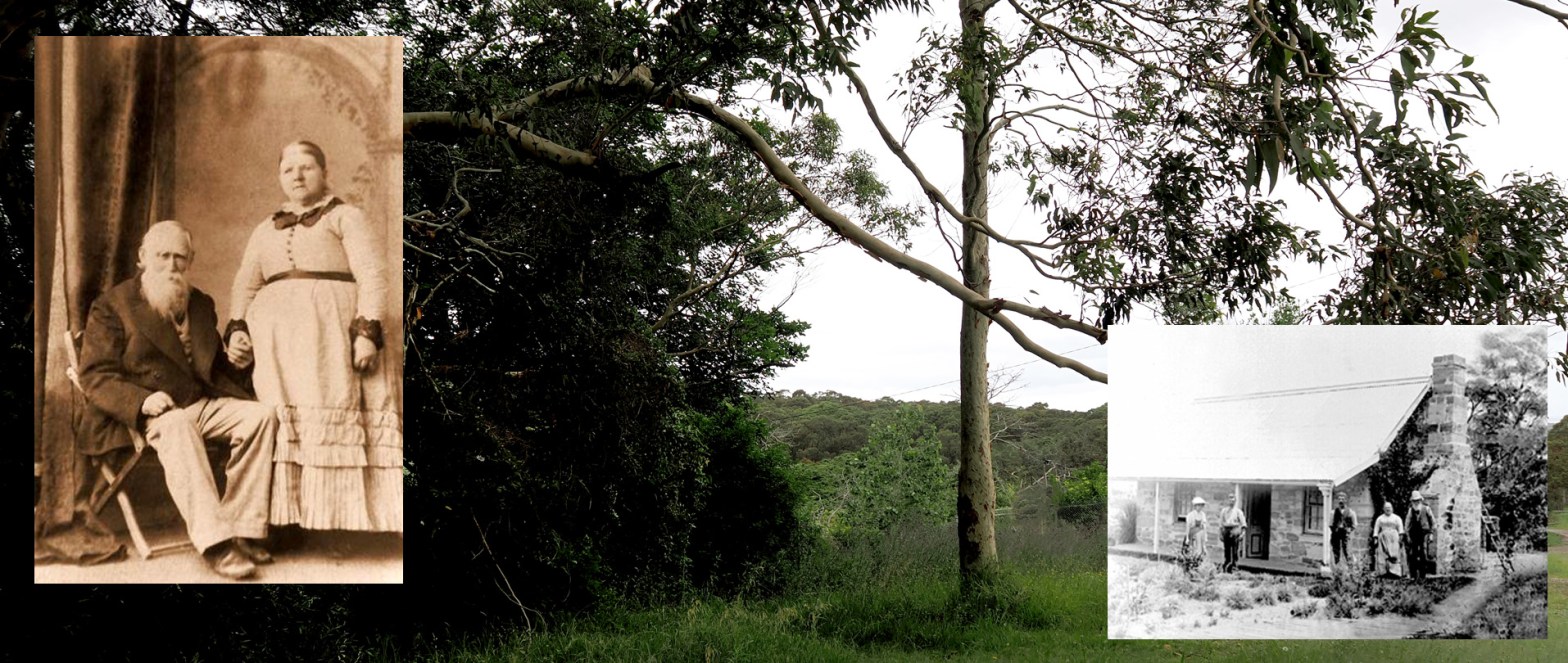
Edmund Bull – Family recollections of Waratah
With the close ties between Edmund Bull and George Gray and their families, it is relevant to look the story of Edmund Bull and his family at Waratah and finally at ‘Glen Eureka’ known as Bull’s Gardens at Whitebridge south of the town centre of Newcastle.
Sydney Bull, son of Edmund and Mary recorded his reminiscences of his father’s property, his family and lives in a newspaper article in 1936. So this is a starting point to cross reference with the actual data of land titles and archival material.
Syd Bull begins : ‘”Bulls-street, Mayfield, was named after my father. A retired squatter took up some land, and as payment for clearing the land to establish a vineyard, father was given seven acres, which he planted as a garden. As was the custom with many well-to-do people in those days, the squatter planted a vineyard to produce wine for his own use.’ 1
As noted in the previous chapter regarding the purchase of small allotments by Charles Simpson’s employees, Edmund Bull purchased his seven acres from Charles Simpson recorded is the Indenture in Number 637 Book 35 and is dated 18 December, 1854. The ‘squatter’ who planted a vineyard was originally Charles Simpson and likely helped in that venture by Peter Crebert, Edmund Bull and Philip Kuhn. Cellars were built below Waratah House to store amongst other things, wine so the intent to have a vineyard in present within the structure of the house. This venture was carried forward by Thomas Tourle who purchased Waratah House from Charles Simpson also in 1854.
As with George Abner Gray and his niece who both spoke of their father building Waratah House, Syd Bull spoke of his father Edmund Bull also building the house: ‘“My father was one of the men who built the old house known as ‘The Follies,'” It is at this point his wife Elizabeth adds: Mrs Bull interposed. “The old place which was demolished recently was generally supposed to have been built by convicts. But this is not so. My father, Josiah Hughes, was a stonemason and slater.’ 2
The previous chapters on Waratah House outlines the involvement of George Gray, Edmund Bull and Benjamin Baker in the building of Waratah House for Charles Simpson Esquire. Although many claimed to have been involved it is only a few who can be traced living at the folly and having the skills need to build Waratah house at the time it was built by tracing records.
Elizabeth Bull’s parents, Josiah and Elizabeth Hughes both came from Wales, England to New South Wales after the dates when Waratah was being built from about 1851 – 1853. They are recorded on the Census still in Wales at this time. It was in February 1855 that the first record appears for them at Waratah when their daughter Maria was born at ‘the folly’. This excludes Josiah Hughes from being part of the original building of Waratah House. He could however, have helped with the additions undertaken by Thomas Tourle after he purchased the house.
Syd and Elizabeth Bull give further insights into growing up at the folly: ‘“It was the bush, sure enough,” said Mr Bull. “Mayfield was a scrub of dense ti-tree that was more or less a swamp in winter … People were easy going and contented. They never considered their lot hard: although it certainly was, compared to modern standards of comfort. With long intervals between, we enjoyed magic lantern concerts. We killed our own meat and from the tallow we made our own soap and candles. I was a big boy before I saw a kerosene lamp. Home-made tallow candles and a slush lamp, consisting of a tin of tallow and a piece of cloth for a week, were the means of illumination in general use. Travelling was by horse or bullock dray. Spring carts came later, and we thought them wonderfully comfortable compared to the drays. A doctor in Waratah imported a four-wheeled buggy, the first we saw, and it was greatly admired by everyone. A few of the well-to-do in Newcastle rode ‘penny farthing’ bicycles … “My father bought a dray, and we travelled to and from Newcastle over along bridge at Tighe’s Hill, that was submerged at high tide. Following rain, we frequently had to spend a night in the dray waiting for the flood waters to go down sufficiently to cross the bridge in safety.”‘ 3
As noted in the chapter about Waratah House, Edmund Bull was most likely responsible for developing the gardens around Charles Simpson’s ‘Waratah House’, on his own allotment of 7 acres of land he set up a market garden and would sell their produce in Newcastle.
In an interview with the Newcastle Herald published 17th January 1936, Edmund’s son Sydney gives a picture of the earliest days in Waratah; ‘father obtained a livelihood shooting game on the river and catching fish, which he hawked by boat to Newcastle and sold. I believe he grew the first bananas in Newcastle, but nobody would buy them as the majority of the people had never seen such fruit previously, and were suspicious of their taste and worth.‘ 4
The Gray’s living next door to the Bull’s also had a garden with George Abner talking of his early work; ‘We had a garden of fruit & I used to go round the mines with our dray selling fruit. I used to do well and liked the job. A Mrs McNultie, a neighbour, had vegetables and she used to go with me in the dray.’ 5
On 23 March 1857 Edmund Bull took out a mortgage over his 7 acres of land at Waratah. The indenture record is contained in the land titled records Book 40 Number 253 which states : Be it remembered that on the 23rd day of March in the year of our Lord 1857 the conveyance here unto annexed was delivered by Edmund Bull of Waratah in the district of Newcastle Settler to Charles Boscawen Ranclaud his executors administrators and assigns the repayment of the sum of £70 this day … And delivered on the 23rd day of March which will be in the year of our Lord 1859 and interest for the same sum thereafter £10 for £100 by the year by equal half yearly payments in the meantime and until payment of the principal and by which conveyance dated the 18th Day of December 1854 7 acres of land formally part of suburban allotment number 50 in the district of Newcastle at Waratah were conveyed by Charles Simpson Esquire to the said Edmund Bull 6
In 1871 there appears to be a change of direction for Edmund Bull and his land at Waratah. He advertised on 18 February 1871 his seven acres of land for sale. There is a description contained within the advertisement stating a ‘never failing supply of good water and perfect immunity from floods.’ The garden was extensive indicating Edmund had planted five acres including more exotic crops like plantains, bananas, custard apples, guavas and pineapples.
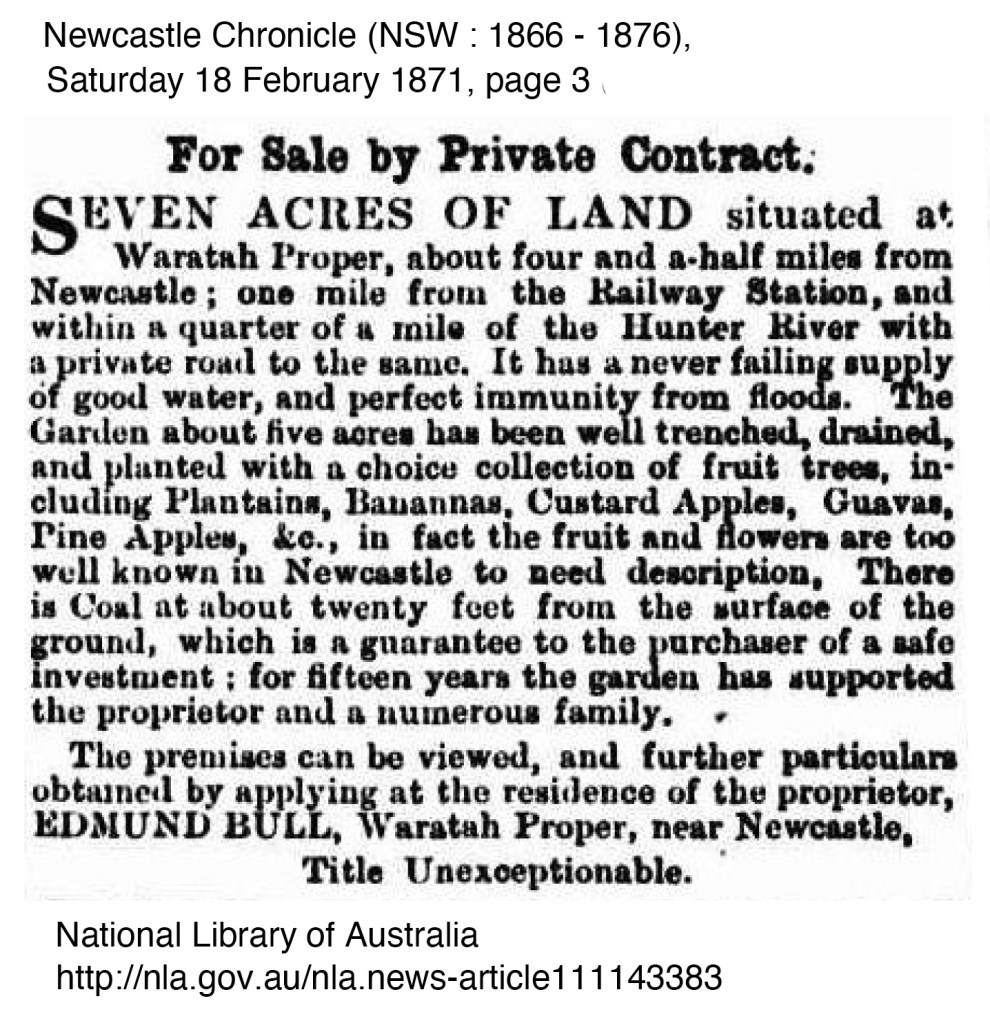
There are four advertisements for the sale of his property at Waratah from 18th February until 30 March 1871, however the land was not sold at this time. In fact Edmund Bull remained active in the Waratah community.
Edmund took Sunday School classes held at the local school, was involved in the school committee and plans to build a new school and nominated others for the position of Alderman on the Council as recorded in the newspapers of the time.
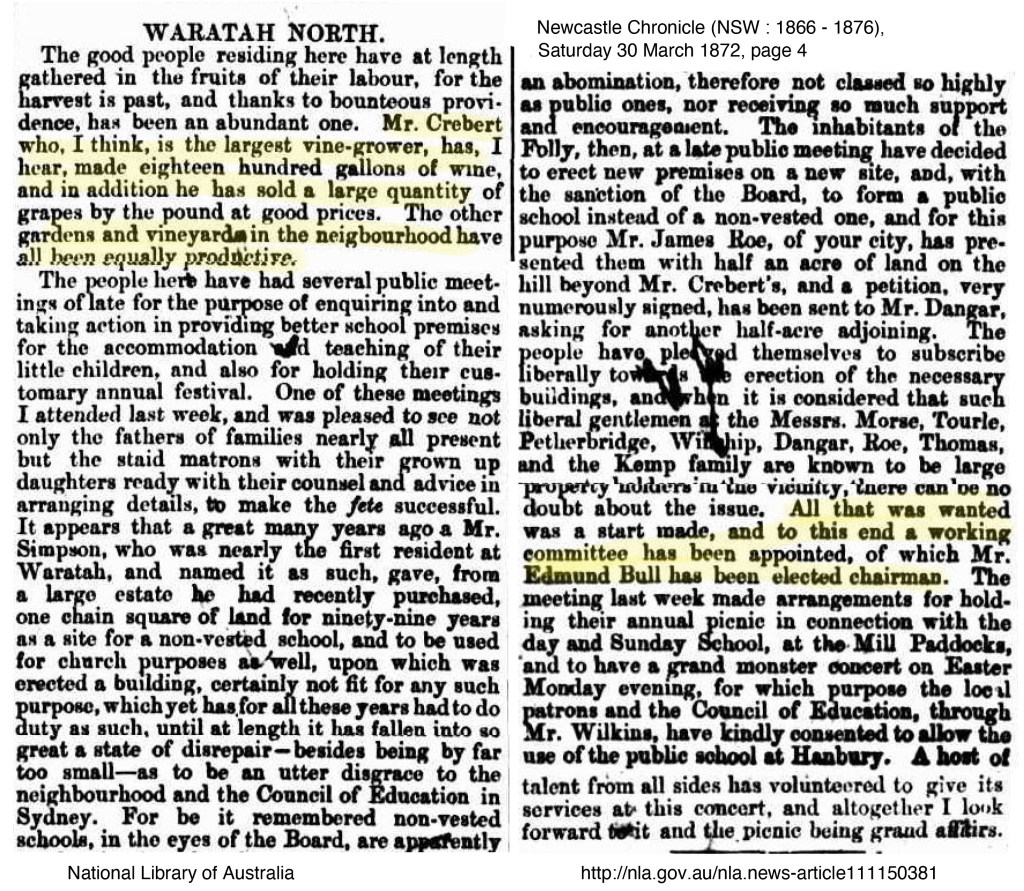
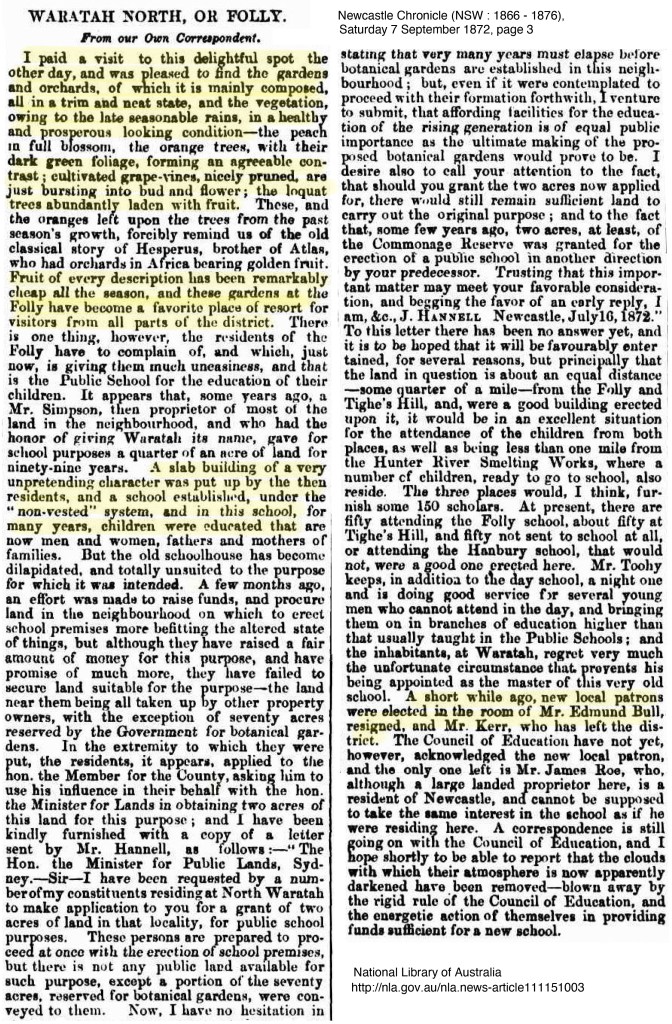
It appears Edmund must have also had some strong views on religion given this response to a letter to the local newspaper who refused to print the letter for fear of “causing a religious controversy, which we don’t care for having in these columns”. It does make one wish to see the letter!
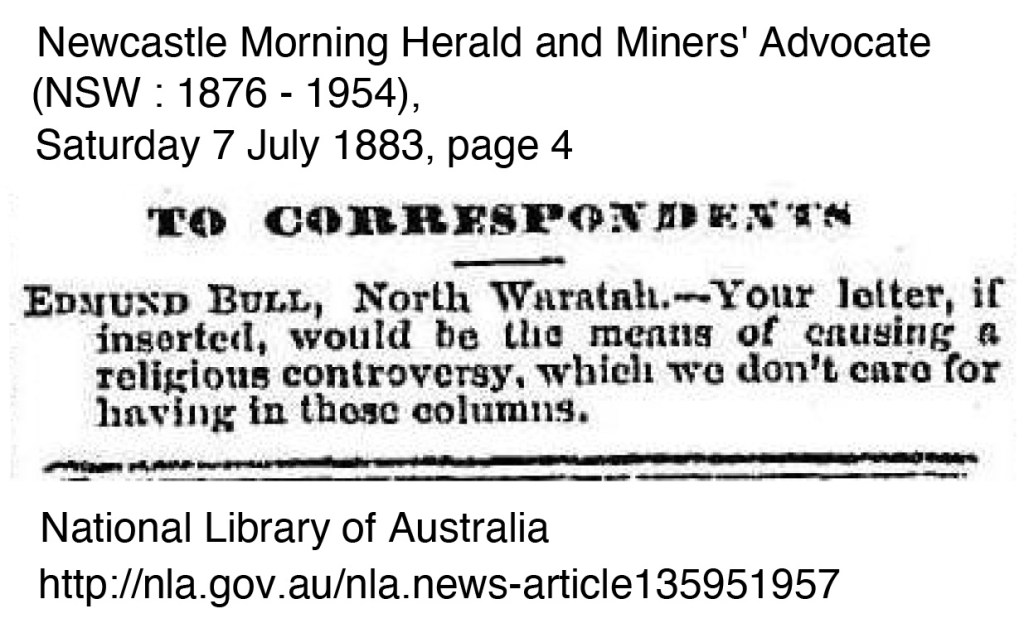
Syd Bull can again give some insight into his father Edmund’s religious life and views: ‘”You remember the little old slab school in the bush – what is now Crebert’s-street that we attended as children.” Mrs Bull reminded her husband. “Yes, My father conducted a Sunday School there, with an attendance of 60 scholars. It was non-denominational. He was not a member of any particular Church, but sought to teach Christian principles and the ethics of the Bible.” Mr Bull explained. “In this days there were no churches or ministers in what was considered the bush.” Mrs Bull said. “People gathered together on Sundays at one another’s homes and held divine service in their own manner, led by anyone of their number able to preach.” 7
Whitebridge – purchase of 60 acres land in 1874
The purchase registration record of the 60 acres of the mineral rights for his land at what was then Charlestown is dated 25 October 1890, it is found in Vol-991 Fol-221 of the NSW Land Titles. Edmund Bull paid £120 but it was not a land title for the land, it is for the rights to royalties to the coal under the land as seen in the title: ‘Grant of Land Conditionally Purchased For the Purpose of Mining other than Gold Mining’.
The Waratah Coal Company had started mining this area in 1873 and Edmund Bull was now speculating that mining for coal would eventually occur under his 60 acres of land. Although he purchased these rights in 1890 for £120 it would take until 1957, well after his death, for those royalties to be realised but the gain as outlined later, was to far exceeded his investment.
This land title record states: ‘WHEREAS in conformity with the provisions of the Crown Lands Alienation Act of 1861, the Lands hereinafter described were duly Conditionally purchased for the purpose of Mining other than Gold Mining, and all and every the conditions upon the performance and fulfilment of which the person in possession of the said Lands under the said Conditional Purchase is entitled to become the purchaser pf the fee simple and to have a Grant thereof made to him without reservation of Minerals other than Gold, on paying for the said Lands at and after the rate of £2 per acre, have been duly performed and fulfilled.’
So this land title document tells us under what terms Edmund Bull originally settled his 60 acres of land at Whitebridge, as a ‘Conditional Purchase’.
The Lands Department was established in New South Wales on 30 September 1859 and by 1861 they introduced the Crown Lands Alienation Act 1861 dealt with the sale of land and the Crown Lands Occupation Act 1861 allowed for the leasing of Crown Land.8
But this is the final record in the purchase of Edmund’s Bull’s land, the story begins further back to the 1861 Land Act allowing greater access for all to be able to settle and purchase land enabling Edmund Bull to make a claim and settle on his land at Whitebridge. As explained later by his son Sid, by paying £2 per acre, Edmund paid a total of £120 for his land.
As yet it has been difficult to find the original paperwork and land titles for Edmund Bull’s purchase as the Mineral Grant Vol-Fol 661-221 does not record the previous Book or Folio number. However Syd Bull’s account coupled with the right to make a claim on the land under the Land Act would have been the starting point and can be followed through with Syd Bull’s recollections, research and other land records relating to Edmund Bull.
The Musuems of History website explains the change in purchasing land which gave opportunities to everyone to purchase or lease to purchase land: Previously land in settled districts had been sold by auction while vast areas of unsettled grazing lands were leased and licensed to mainly pastoralists. The new legislation made all leasehold land in the Colony available for selection and sale.
The legislation also abolished land distinctions used in the Colony, such as settled and unsettled districts, and introduced new land divisions, such as town land, suburban land, first class settled districts and second class settled districts.9
This 60 acres of land at Whitebridge would have been purchased under the Crown Lands Occupation Act 1861 and subsequent acts, allowing Edmund Bull to lease to purchase his 60 acres of land.
This would align with Syd Bull’s recollections of his father’s 60 acre plot: ‘Over 60 years ago, my father, under the Free Selection Act, acquired 60 acres of land in the bush, now in the town of Whitebridge. The ruling price was 1 pound an acre, and the purchaser was entitled to the surface rights plus half the royalty on coal mind beneath the surface. The government took the other half. However, for rights to the coal could be obtained on payment of another 1 pound an acre. That act has long since been superseded by one that invest the whole of the minimum rights to the crown.‘ 10
Below is a map of the area showing the purchase dates of land mourned the Whitebridge and Dudley areas.
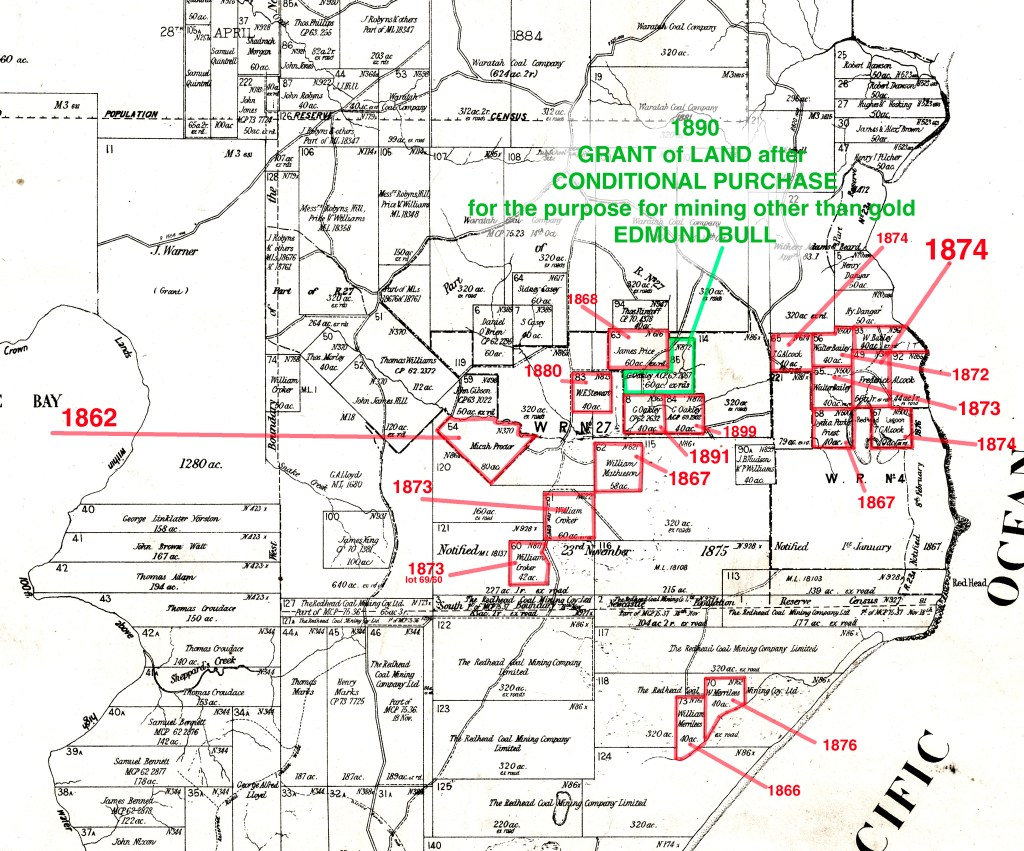
Although the actual final purchase the original Conditional Grant was recorded on the Title Deed in 1890 we know Edmund and Mary Bull were working on this land on what was called ‘Bull’s Gardens’ from the 1874.
“From our house at ’The Folly,’ over a rough track, we travelled by dray or horseback, starting at daylight to reach the selection at dark. Where Charlestown is now was a small wine shanty, the only habitation on the route. In what was known as Raspberry Gully, the Waratah colliery was opened the year after we took up the selection. I was 14 years of age: my brother Alf was older with the supply of corn beef, tea, flour, and sugar, father carted us out in the dray. He returned home next day. Alf and I were left alone in the bush for two weeks clearing the land. At the end of that period, father returned with two others of my six brothers, who intern worked a fortnight on the land, while Alf and I went home. So we alternated spells at home with work in the bush until the land was cleared, and a dwelling erected for all the family to dwelling.
Our bread was damper cooked in the ashes of a gum log. When provisions were short we caught groper and flathead from the beach. Wonga pigeons, pheasants, parrots and bandicoots were also plentiful, so the tucker box was never empty. Wallabies, koala bears and opossums roamed the scrub, and at night the dismal howls of packs of dingoes were heard as they stalked our young cattle, some of which would by morning be without their tails.‘ 11
Tying back again to Syd Bulls’ recollection that his father purchased the land the year after they took up the selection places the time again around 1874 as the ‘Raspberry Gully’ Colliery also known as the South Waratah Colliery had opened the in 1873. In 1972 a memorial sculpture was erected to the coal miners and states: The Waratah Coal Company was formed in 1862 to mine in the Waratah district. It bought another 2,600 acres to the south and began sinking a shaft in Raspberry Gully in 1873.12
There were some conditions to the purchase of land which began from 1861 so it was a more ordered process with regulations. The Museums of NSW again explains this process:
A Conditional purchase was a way of obtaining a Crown Grant for land before it was surveyed. Established in 1861, the grant was dependent on a set of conditions being met. The purchase was conditional on:
- the area being limited to 40 to 320 acres at £1 per acre
- paying a deposit of one quarter of the purchase price
- adding improvements to the value of £1 per acre
- the selector residing on the land, and
- occupying the land for three years
What land was available for conditional purchase?
The land available for purchase had to be a specified distance from populated areas. In effect Crown land was not available for conditional purchase if it was town or suburban land, within a proclaimed gold field, under lease to another person for mining purposes, or reserved for the site of a town, village or for water supply.
In addition, to protect the public estate, both the Lands Department and Survey Office could proclaim areas as reserves. The majority of requests for reserves, which effectively quarantined the land from purchase, came from pastoralists. Reserves were proclaimed and gazetted before they were marked out and charted.
Between 1861 and 1883 there were three separate validating Acts assisting selectors who had unwittingly settled on reserves and other lands not open to purchase.
Where more than one purchaser selected the same land the Act provided mechanisms including arbitration to settle ownership. Crown Land bought by conditional purchase and abandoned in less than 3 years after purchase was declared forfeited in the Government Gazette and sold at auction.13
At the end of December 1873 Edmund Bull acquired a mortgage for £350, a considerable amount of money. This lends weight to him seeking to acquire the land at Whitebridge in 1874.
The land title record for the mortgage over the land at Waratah aligns with Syd Bull’s recollections, with a mortgage being taken out by Edmund Bull on 23 December 1873 it is contained in Book 139 – Number 661. ‘This indenture made the 23rd day of December in the year 1873 between Edmund Bull of Waratah in the colony of New South Wales Gardener hereinafter styled mortgagor of the one part and William Steel of Newcastle in the colony David Watson of Waratah aforesaid and George Kedwau of the Newcastle aforesaid Gentleman the trustees of the Northumberland Building and Investment society hereinafter styled mortgagee of the other part, whereas the mortgage being seized in fee or otherwise well entitled to the hereditaments and premises hereafter derived hathe applied to and requested the said mortgagees to rent an advance to lease out of the funds of the said Society the sum of £350 which they said mortgagees lease agreed to do upon leaving the repayment thereof with interest occurred in manor hereinafter mentioned.‘14
The mortgage over the property is described as: all that piece or parcel of land in the territory of New South Wales containing by admeasurement seven acres be the same more of the situate in the county of Northumberland parish of Newcastle near Newcastle being part of suburban allotment number 50 and bounded on the road by Mr Dangar’s … now and for sometime past his been in the occupation of the said purchaser together with a rate of footway to and from the seven acres of land here by released to the said purchaser. 15
The repayment time frame is set at: ‘the said sum of three hundred and fifty pounds on the first day of December one thousand eight hundred and seventy five and in the meantime interest for the same after the rate of eight pounds per century per annum such interest to be paid in equal proportion half yearly on the first day June and the first day December in each and every year without any deduction or abatement whatsoever’.16
Below is the full newspaper article with Edmund BUll’s son Sydney Bull and his wife Elizabeth Bull nee to Hughes.
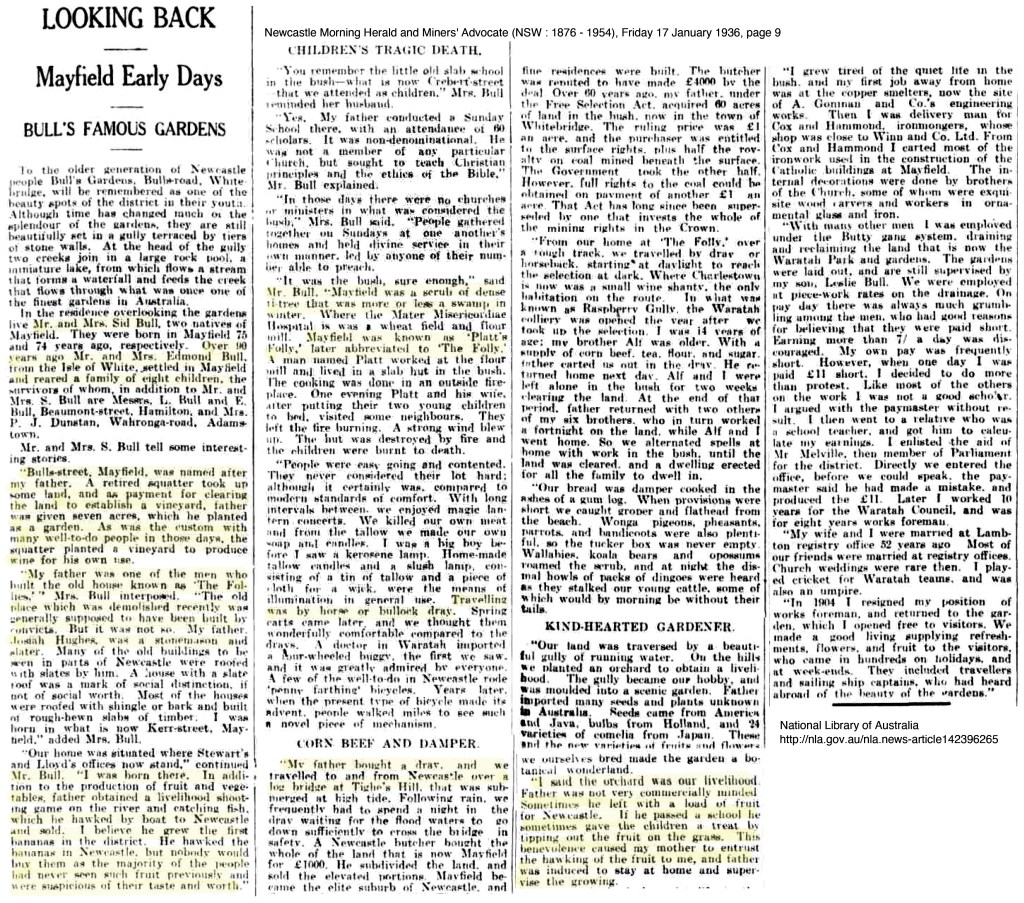
Edmund Bull would have been required to declare improvements had been made to the land and pay for the land within three years of taking up the conditional purchase, we can trace his settlement of his ‘Glen Eureka’ land through newspaper advertisements, family recollections and Land Title records.
The next newspaper advertisement indicates how much work the Bull family had been able to achieve in under two years to enable Edmund to keep the land under the Act which was to equate to £1 per acre.
It is described as: “one of the PRETTIEST ESTATES in this District, containing sixty acres of splendid cultivation LAND, and an eight foot seam of COAL, equal to any in the district …. cultivated with all the choicest fruit trees this country can produce. Its grottos, glens, and ravines, which are natural, are handsome indeed, and must be appreciated.”17
This advertisement for the sale of the sixty acre ‘Glen Eureka’ property at Whitebridge was placed in the newspaper as the due date loomed closer for the scheduled repayment of Edmund Bull’s 1873 mortgage of £350 on 1 December 1975.
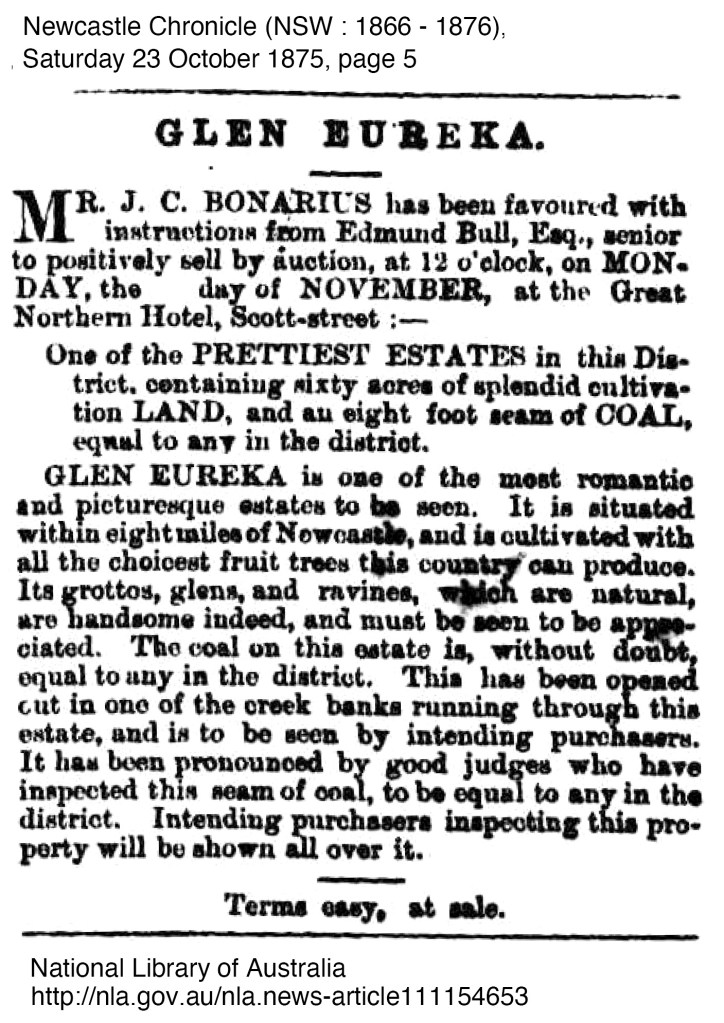
These advertisements for Edmund’s ‘Glen Eureka ran from 23 October until 11 November 1875. The next land title document dated 15 November 1875, provides the answer to how he solved his dilemma, by securing another mortgage to pay out his previous mortgage. The Land Title Book 155 Number 687 states: This indenture made the fifteenth day of November in the year of our Lord one thousand eight hundred and seventy five between Edmund Bull of Waratah near Newcastle in the colony of New South Wales hereinafter styled mortgagor of the one part and Henry Augustus Smith of Newcastle a four said Esquire hereinafter styled Mortgagee of the other part. Witnesseth that inconsideration of the sum £350 now lent by the said mortgagee … all in that piece or parcel of land containing by a measurement seven acres be the same moral less situated in the county of Northumberland parish of Newcastle near Newcastle in the colony of New South Wales being part and parcel of suburban allotment number 50 and bounded on the east by Mr. Dangar’s purchased land… Together with a right of footway or road to and from the seven acres to the set mortgage his heirs and assigns.18
Henry Augustus Smith was a Magistrate and ‘Gentleman’ in Newcastle who it seems dabbled in land with a number of court cases where he was taking to Court mortgagor’s who did not complete their payments due to him.
It seems Edmund Bull managed to keep to the terms of his mortgage as the next Land Title document is for the sale in 1885 of his original seven acres purchased from Charles Simpson in 1854.
1885 – Sale of Edmund Bull’s 7 acres at Waratah
On 10 June 1885 Edmund Bull finally left his original home and land in Waratah selling his property to two Wine Merchants and Land Speculators.
The Land Title is found on Book 313 Number 240 with the first part referring to the original purchase made by Edmund Bull from his employer Charles Simpson Esquire: This indenture made the tenth day of June in the year of our Lord one thousand eight hundred and eight five between Edmund Bull of Waratah in the colony of New South Wales Gardener of the first part and Eric Magnus Meyer and Thomas William Bryant of Waratah in the colony Wine Merchants of the other part whereas by an indenture bearing of date the eighteenth day of September one thousand eight hundred and fifty four and made between Charles Simpson therein described and thereafter called “Vendor” of the one part and the said Edmund Bull therein after called “Purchaser” of the other part.
The next section declares the sale to the two purchasers, Eric Magnus Meyer and Thomas William Bryant: To hold in the same unto and to the uses of the said purchaser is in assigns for ever and whereas the said Edmund Bull hereafter called “Vendor” has contracted and assigned with the said Eric Magnus Meyer and Thomas William Bryant after called “Purchasers” for the absolute sale of this and premises to them for the sum of £1200 free from all encumbrances
The description of the land: All that piece or parcel of land containing by admeasurement seven acres be the same more or less situated within the parish of Newcastle county of Northumberland near Newcastle. In the same colony being part and parcel of situated allotment number fifty and bounded on the west by Dangar’s purchased land… Together with a right of way to and from the said 7 acres to the said purchases their ears and assigns in through over other lands and joining as use here before by the said vender.19
The two Wine and Spirit Merchants, Eric Meyers and Thomas Bryant partnership lasted just three more months when their partnership was dissolved.
Eric Magnus Meyer was from Sweden and had studied chemistry arriving in New South Wales in 1841. His obituary in 1894 stated: ‘through his thorough knowledge of distillation and zealous study in winemaking, he became one of the cleverest in the colonies’.20
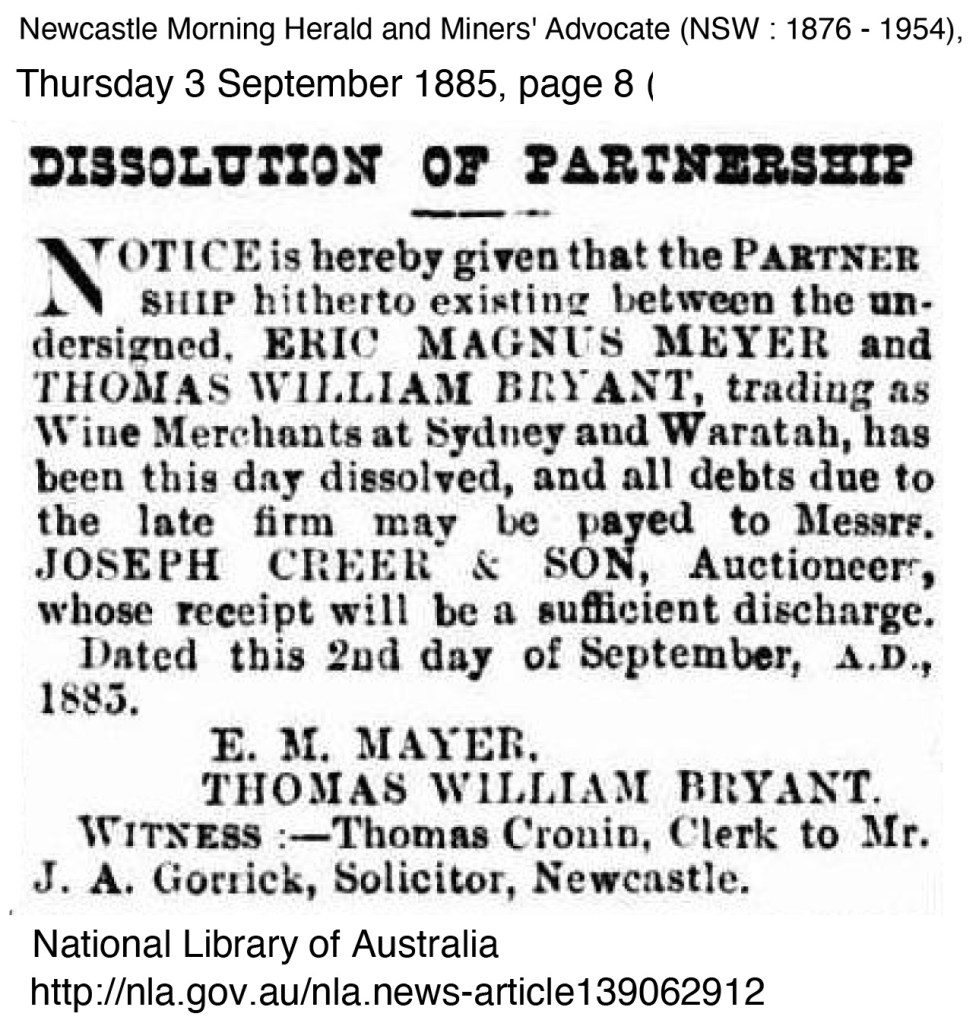
Edmund Bull’s original seven acres, was advertised for sale as part of the partnership dissolution.
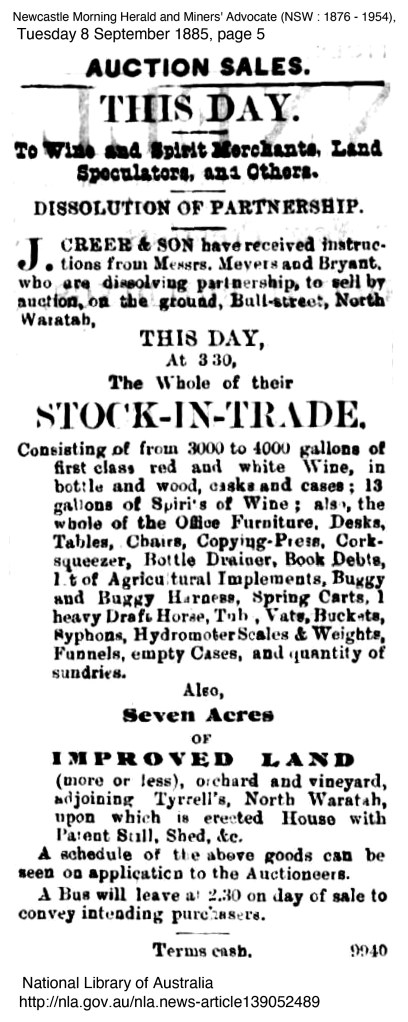
Edmund Bull’s seven acres went through several purchasers until it became part of the Waratah Golf Club and then BHP (Broken Hill Propriety Company Ltd) which still owns the original land of allotment 49 and 50 originally purchased by Charles Simpson, Esquire.
Bull’s Garden – ‘Glen Eureka’ at Whitebridge
Edmund Bull and his family by this time had built his house and established his market gardens and extended gardens that became a tourist attraction known as ‘Bull’s Garden’. The land exists on what is now known as ‘Bulls Garden Road’ just south from the village of Whitebridge.
By taking original maps and overlaying over contemporary google map images we can gain insight into the land.
The two maps below show an overlay of original maps of the grant areas over current maps to gain a knowledge of the approximate position of Edmund Bull’s land and surrounding allotments. Of note is that of ‘G Oakey ACP 69.2059’, ACP is the abbreviation for Additional Conditional Purchase indicating that George Oakey
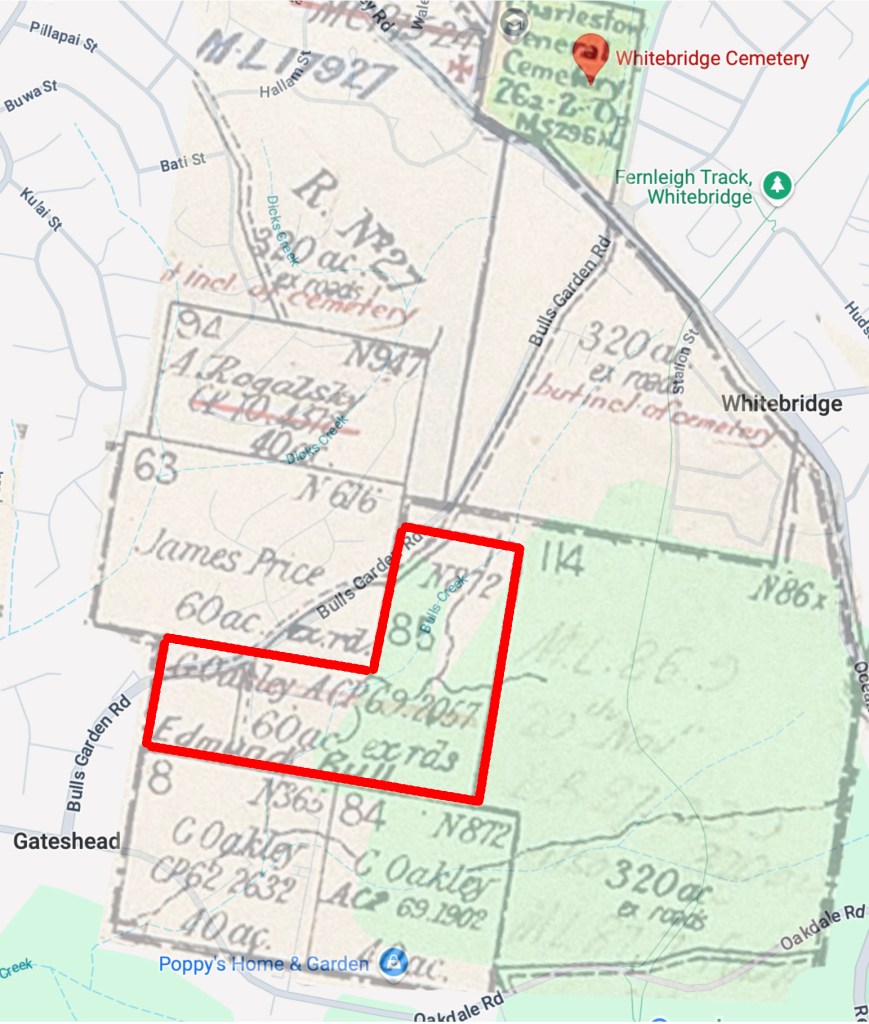
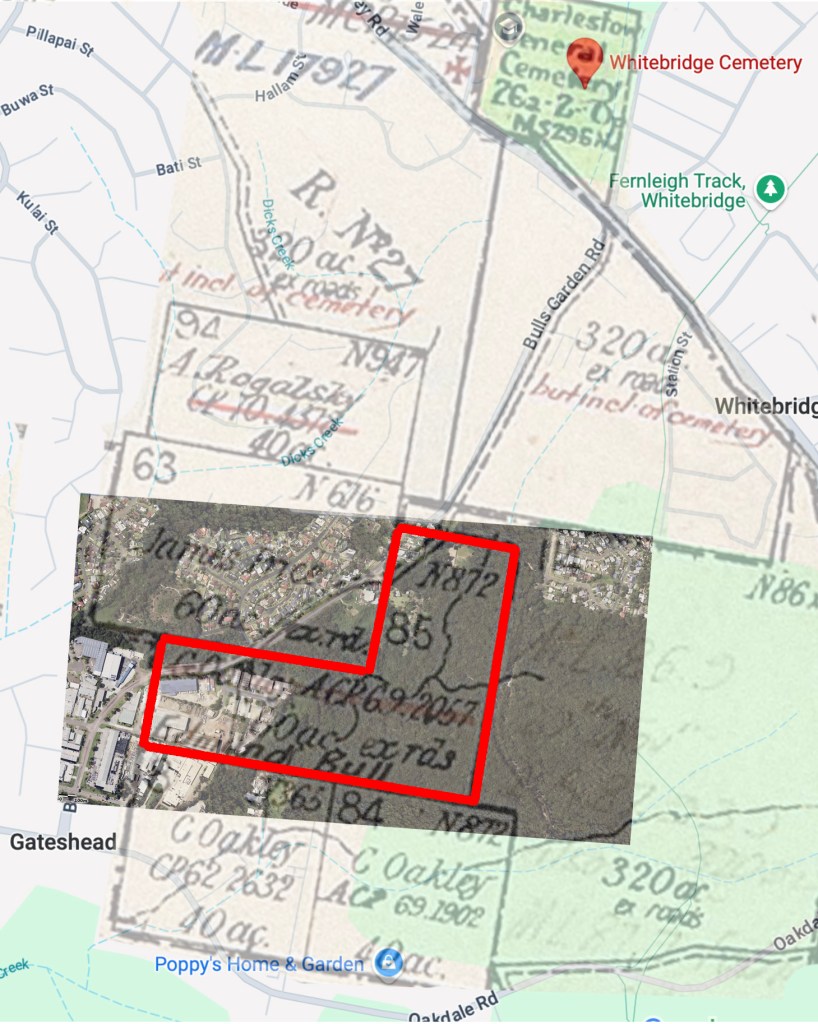
In 2024 little remains of the original gardens that were so well developed and cared for, the original house seems to no longer be there and the house that is there is now are behind large fences with keep out signs. A far vcry from the gentle gardener and his family that welcomed many. The bushland which formed a large section of the land still exists and be seen beyond the current house and buildings.
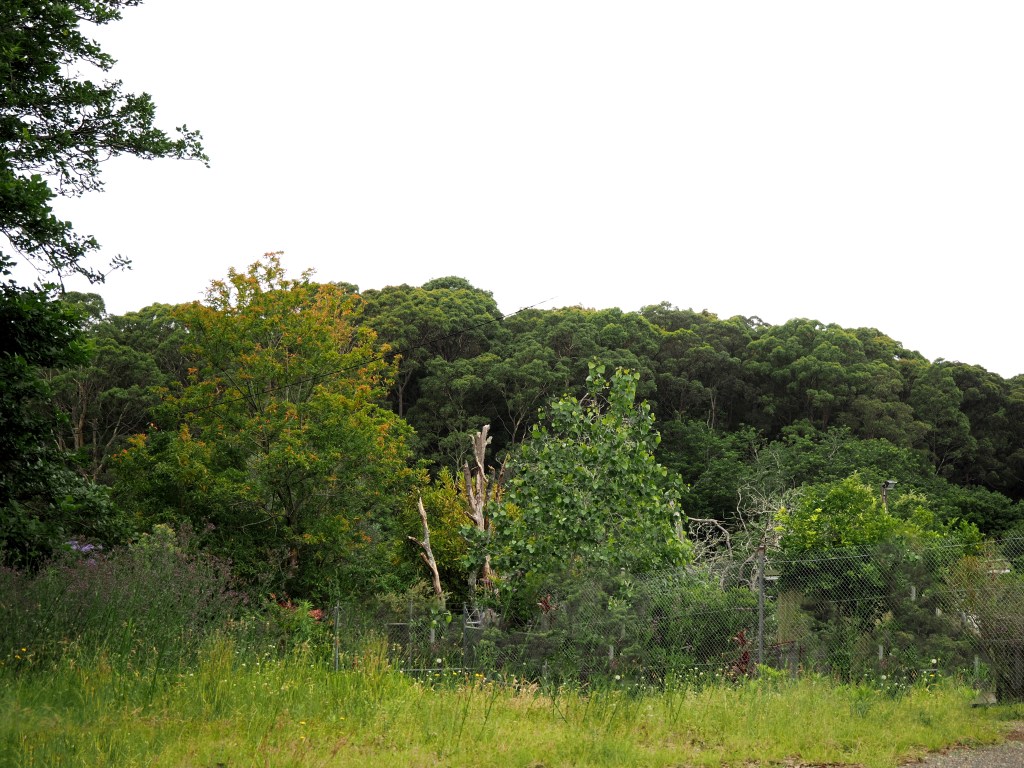
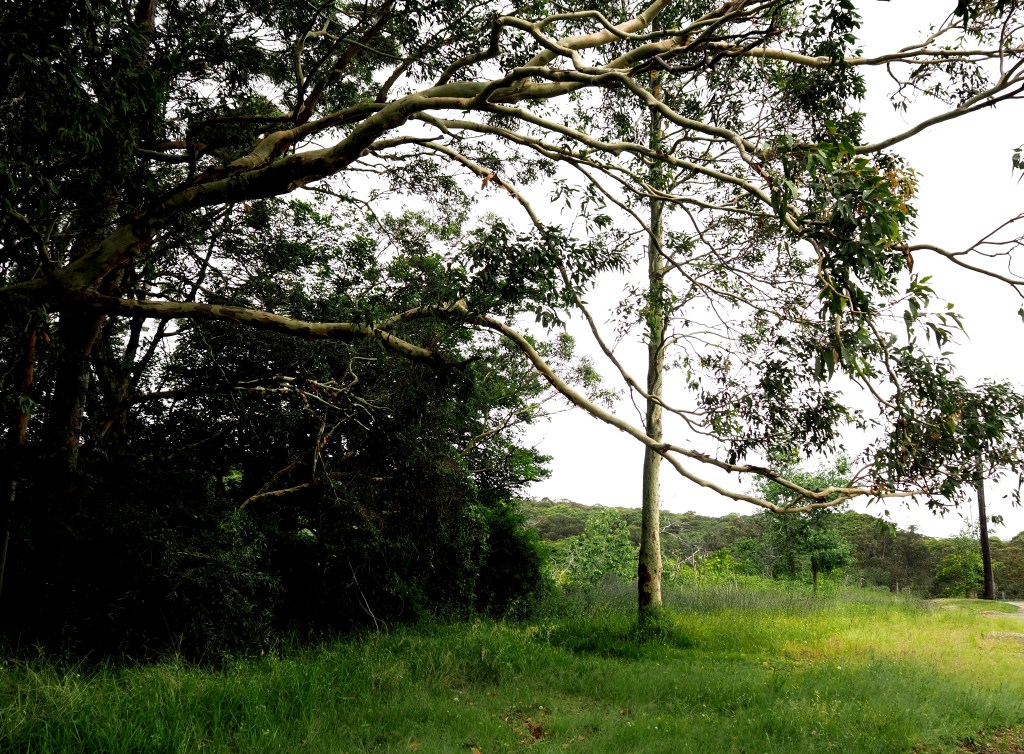
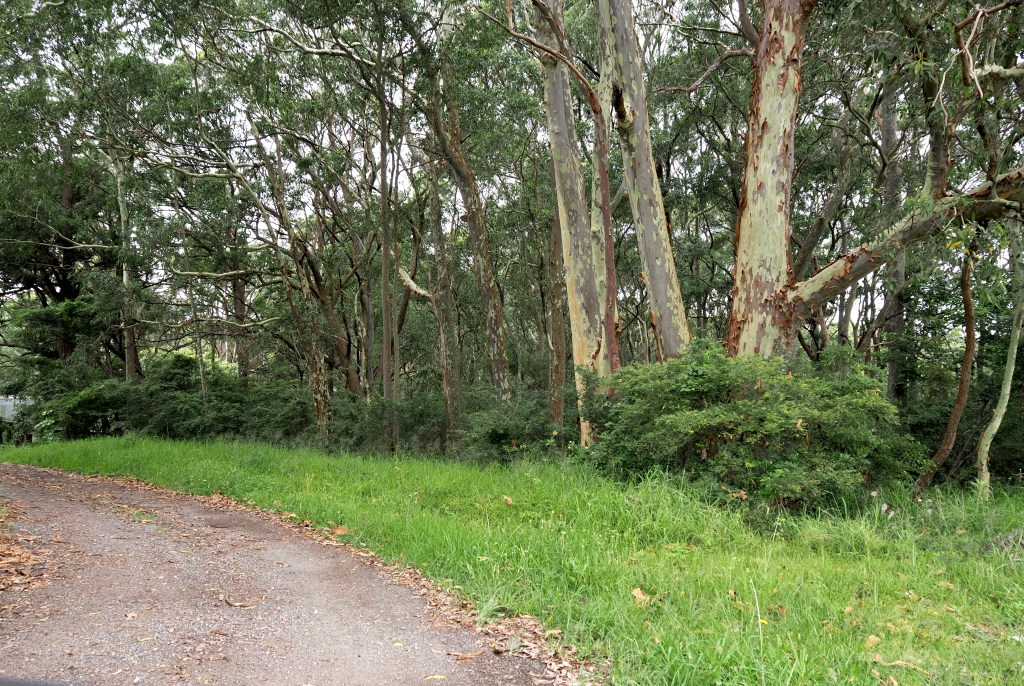
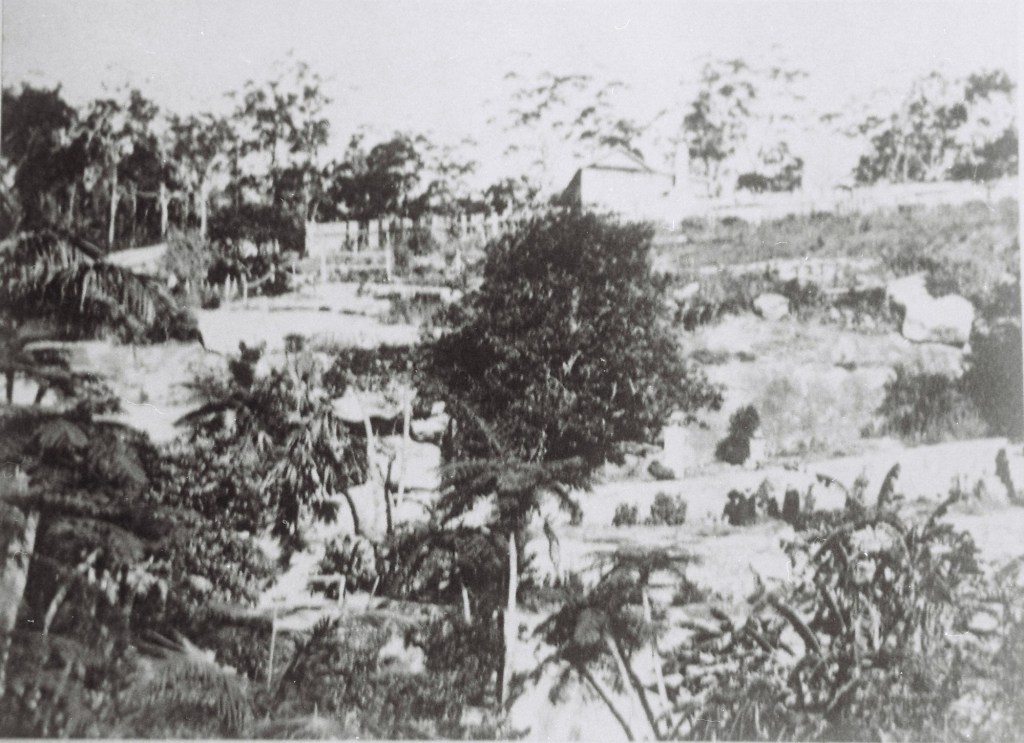
The two photographs below show what seems to be the gully associated with Bull’s Creek which contains rock ledges and outcrops. ‘To the older generation of Newcastle people Bull’s gardens, Bull’s Road, Whitebridge, will be remembered as one of the beauty spots of the district in their youth. Although time has changed much on the splendour of the gardens, they are still beautifully set in a gully terraced by tiers of stone walls. At the head of the gully two creeks joint in a large rock pool, a miniature lake, from which flows stream that forms the waterfall and feeds the creek that flows through what was once one of the finest gardens in Australia.‘ 21
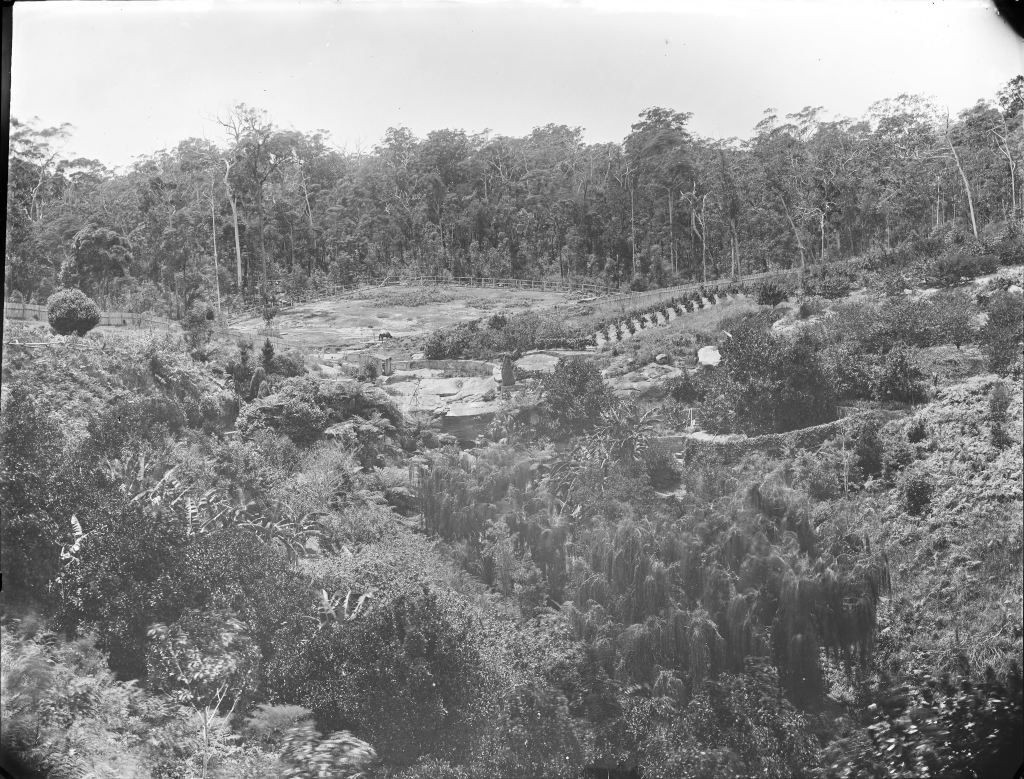
Accession Number 001 002710
Creator Ralph Snowball (1848-1925)
This photo includes Edmund and Mary Jane’s and his first wife Ann Lock’s adult children on the large rock ledges.
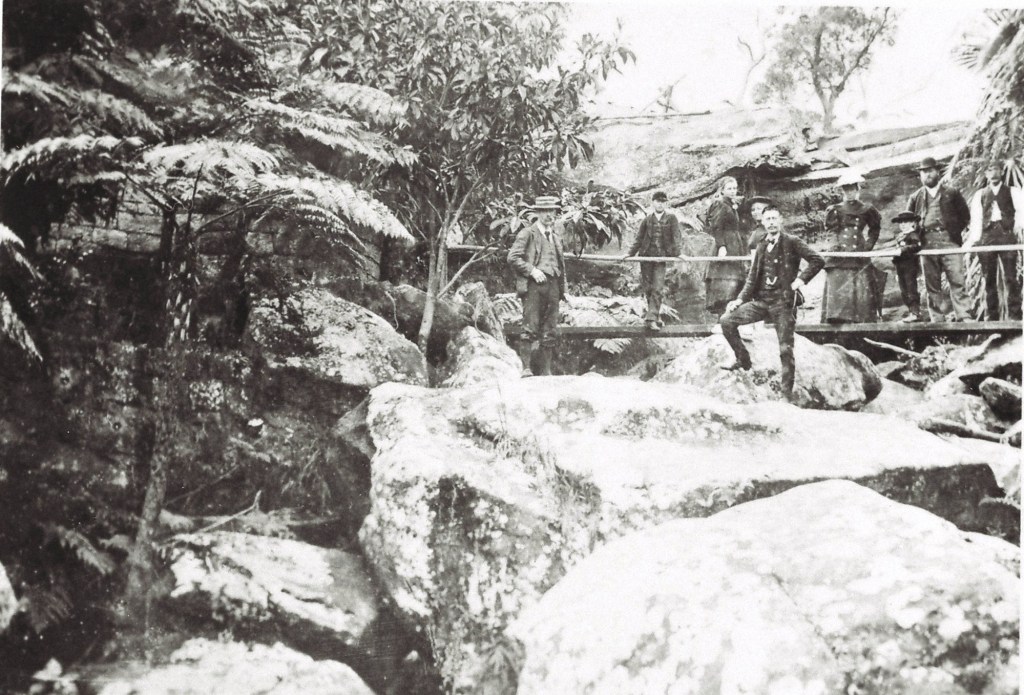
Bull’s Garden in Whitebridge – Hunter Photo Bank – Newcastle Library
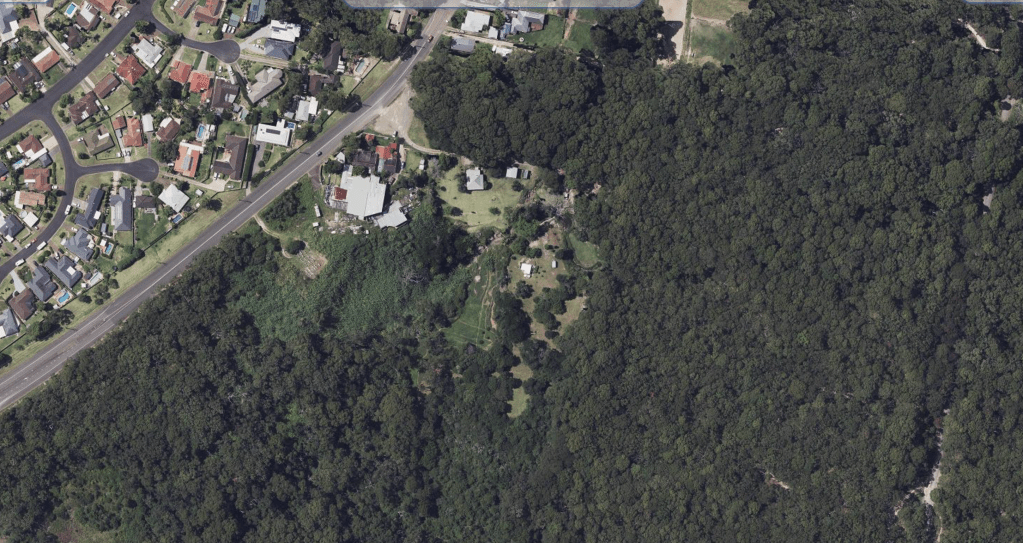
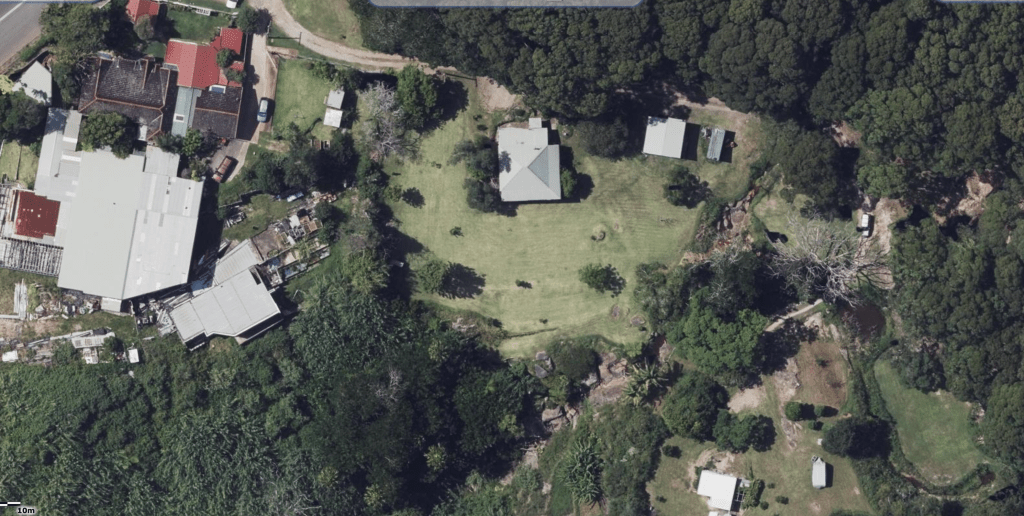
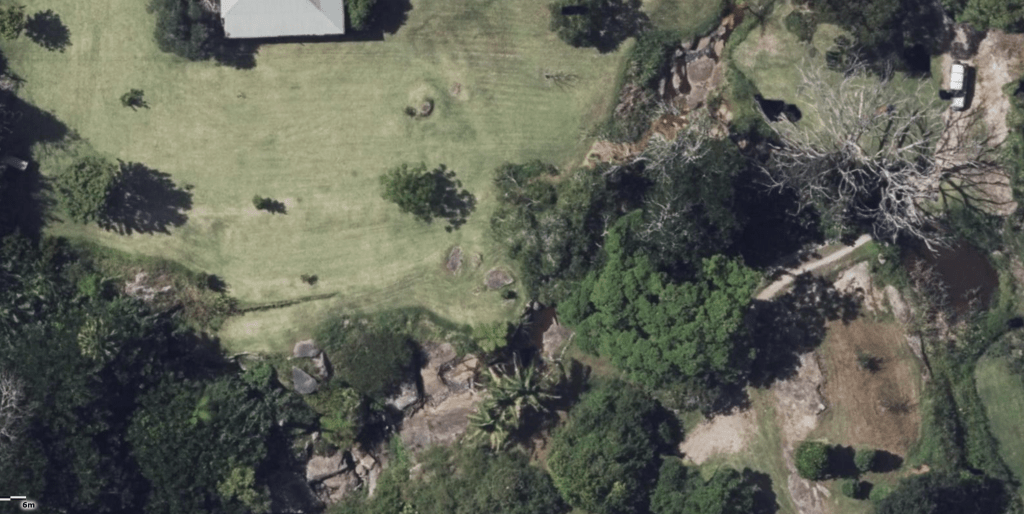
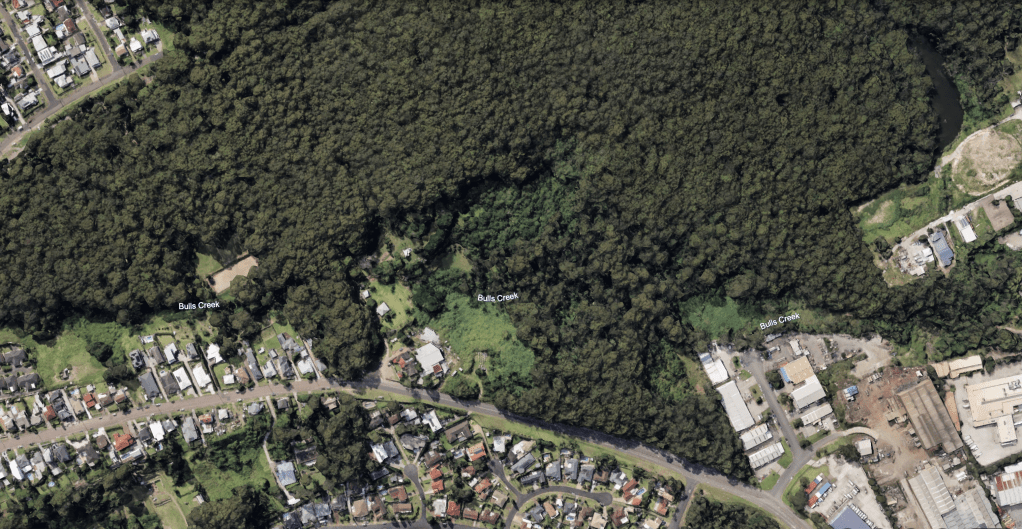
The images below come from using the Six Maps website which can often give a clearer view than google earth. The first shows a large section of Edmund Bull’s and, zoomed down the second one shows where the original stone house would have stood in the space now occupied by the collection of building on the left and the third image on the right shows rocky outcrops along Bull’s Creek.
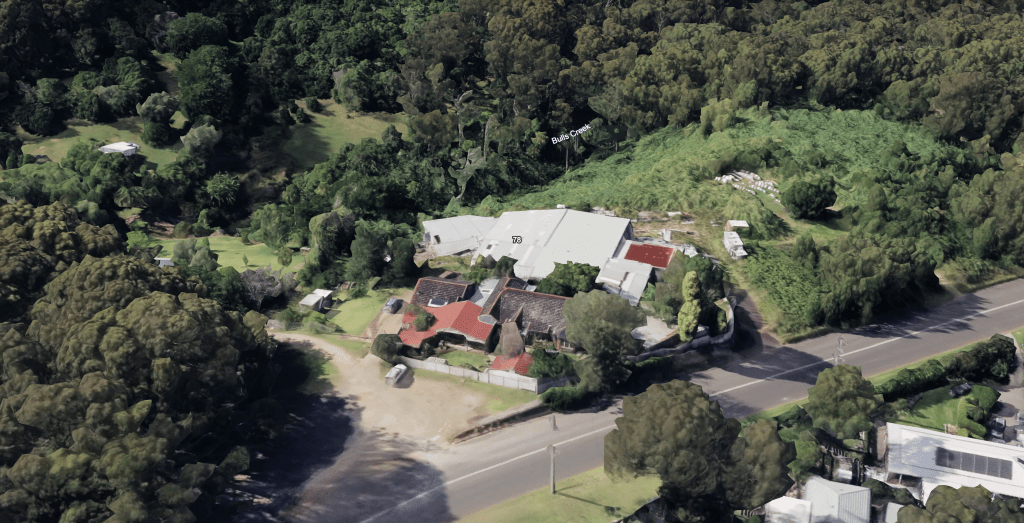
These next two images from Google Earth shows on the left the extent of the land including the small cut-de-sac on the bottom right which was part of the original 60 acres. The image on the right (also Google Earth) shows a 3d image indicating how the land falls away from where the main house would have been down towards the Creek and rock ledges.
Bull’s Garden in Whitebridge – Hunter Photo Bank – Newcastle Library22
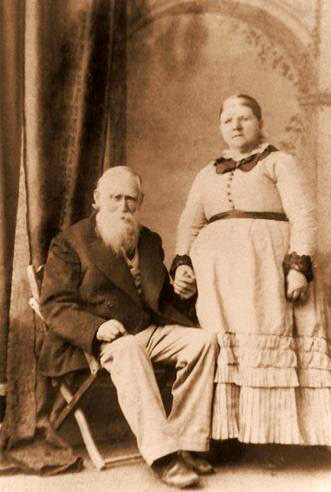
Sid Bull recalls his parents and ‘Glen Eureka’: “Edmund Bull is remembered by his son as a ‘kind hearted gardener’; “Our land was traversed by a beautiful gully of running water. On the hills we planted an orchard to obtain a livelihood. ‘The gully became “our hobby, and was moulded into a scenic garden…I said the orchard was our livelihood. Father was not very commercially minded. Sometimes he left with a load of fruit for Newcastle. If he passed a school he sometimes gave the children a treat by tipping out the fruit on the grass. This benevolence caused my mother to entrust the hawking of the fruit to me, and father was induced to stay at home. and supervise the growing.” 23
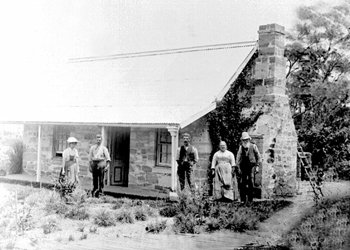
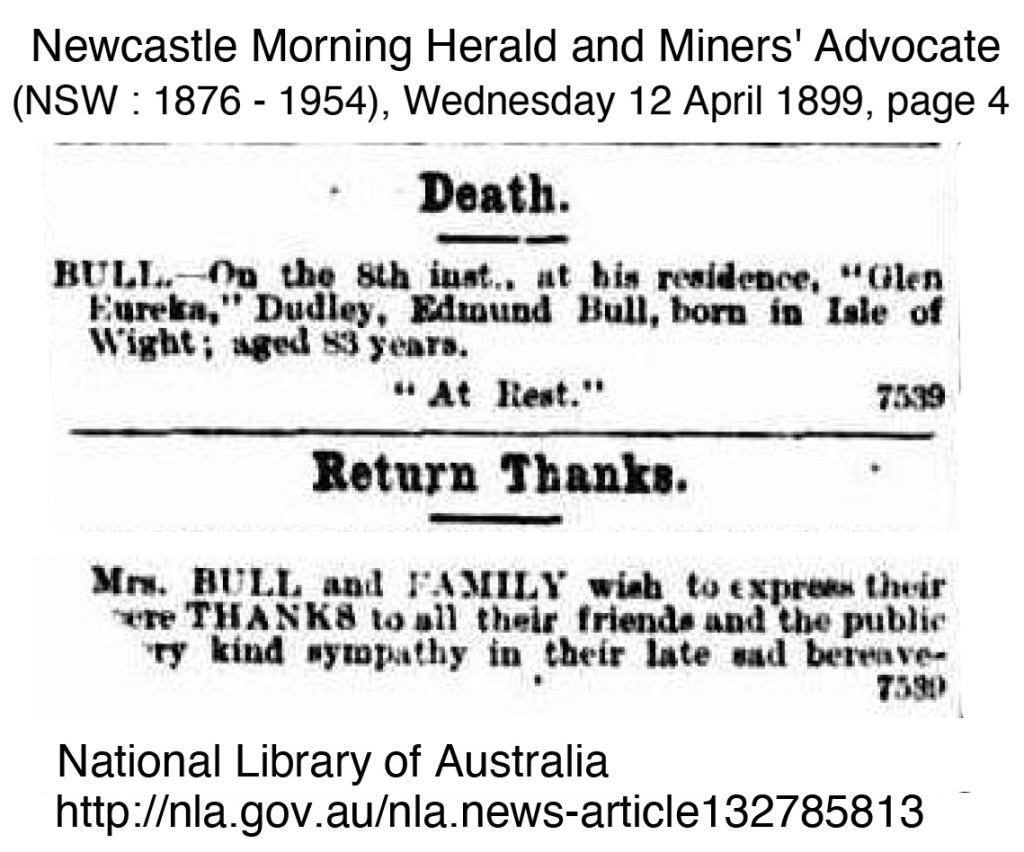
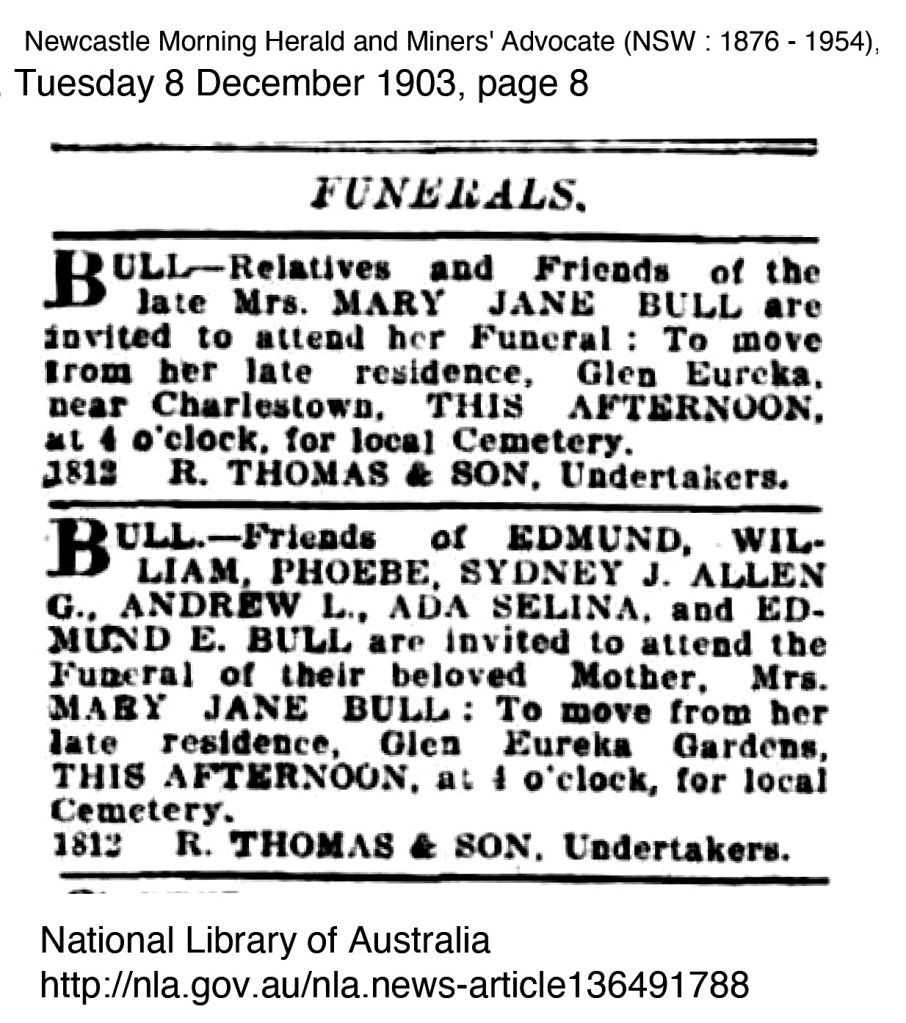
Both Mary Jane and Edmund remained at their “Glen Eureka” the rest of their lives. Edmund Bull continued to work and live on the property until his death on 8 April 1899 at his home,”Glen Eureka” Bulls Garden, Dudley, NSW. His second wife Mary Jane died on 6 December 1903 as with her husband Edmund at their home, “Glen Eureka”.
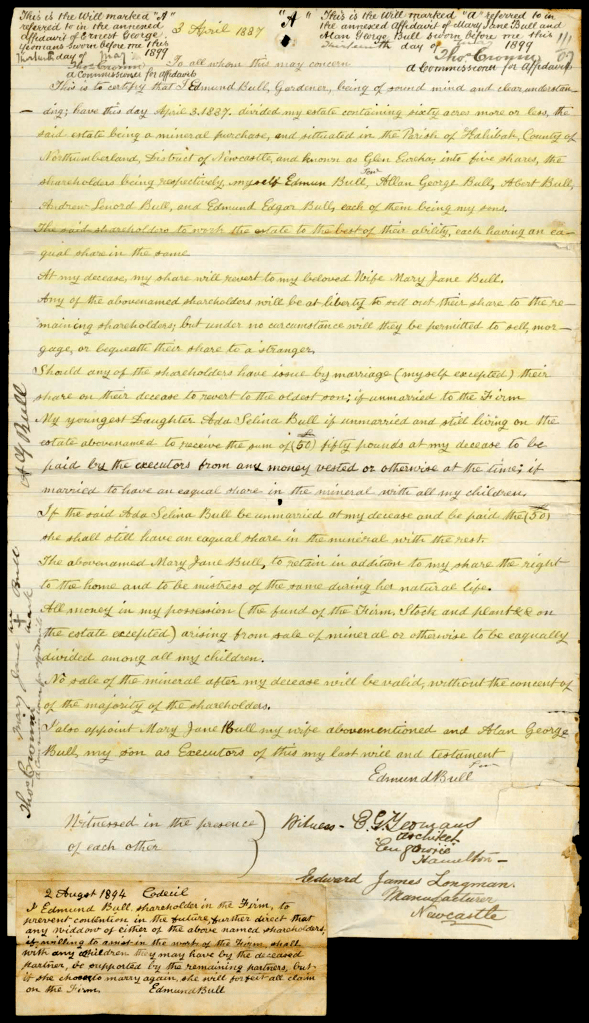
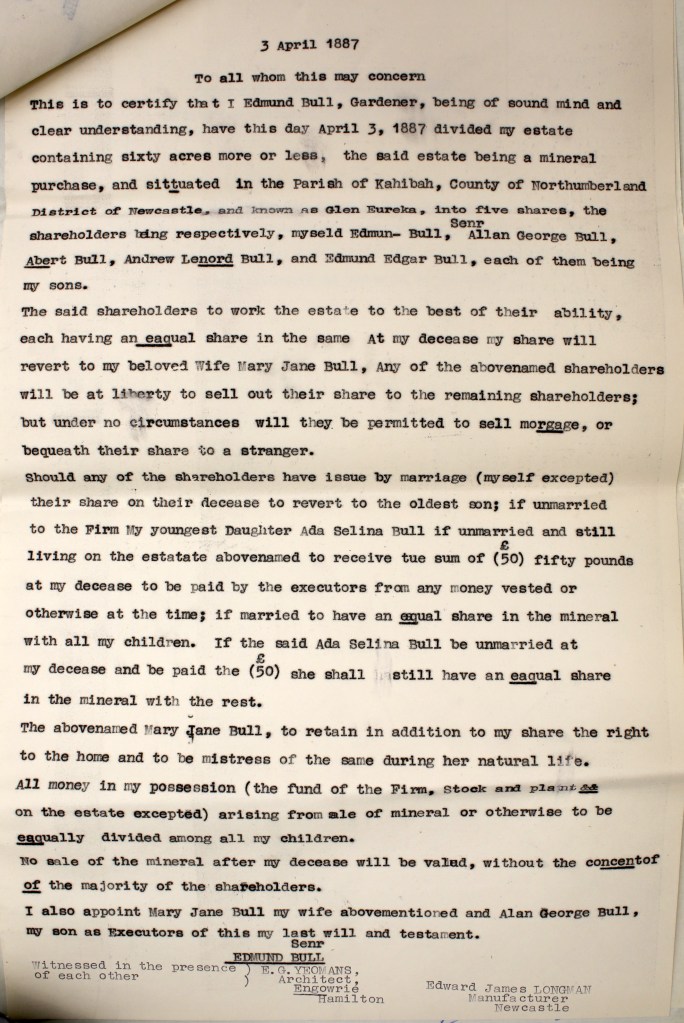
Edmund Bull’s Will drafted 3 April 1887 gives some insight into his business planning in 1887: This is to certify that I Edmund Bull, Gardener, being a sound mind and clear understanding, have this day April 3, 1887 divided my estate containing 60 acres more or less, the set of state being a mineral purchase, and situated in the parish of Kahibah, county of Northumberland District of Newcastle, known as Glen Eureka, into five shares the shareholders being respectively, myself Edmund Bull Snr, Alan George Bull, Albert Bull, Andrew Leonard Bull, and Edmund Edgar Bull, each of them being my sons. The said shareholders to work the estate to the best of their ability, each having an equal share in the same.
He leaves his Estate and the property of 60 acres at Whitebridge to his children but with specific instructions: At my deceased my share will revert to my beloved wife Mary Jane Bell, any of the above name shareholders will be at liberty to sell out their share to the remaining shareholders.; but under no circumstances will they be permitted to sell mortgage, or bequest share to a stranger.
Should any of the shareholders have issued by marriage (myself excepted) their share on their deceased to revert to the oldest; if unmarried to the firm my youngest daughter Ada Selena if unmarried and still living on the estate above name to receive the sum of £50 at my deceased to be paid by the executives from any money vested or otherwise at the; if married to have equal share in the mineral with all my children. If the said Ada Selena ball be unmarried at my disease and be paid the £50 she shall still have an equal share in the mineral with the rest.
The above Anne Marie Jane Bull, to retain in addition to my share the right to the home and to be mistress of them same during her natural life.
Further instructions are in a Codicil to the Will: I Edmund Bull shareholder in the firm, to prevent contention in the future, further direct that any widow of either of the above name shareholders, if willing to assist in the work of the firm, shower with any children they may have by the deceased partner, be supported by the remaining partners, but if she choose to marry again, she will forfeit all claim on the firm.25
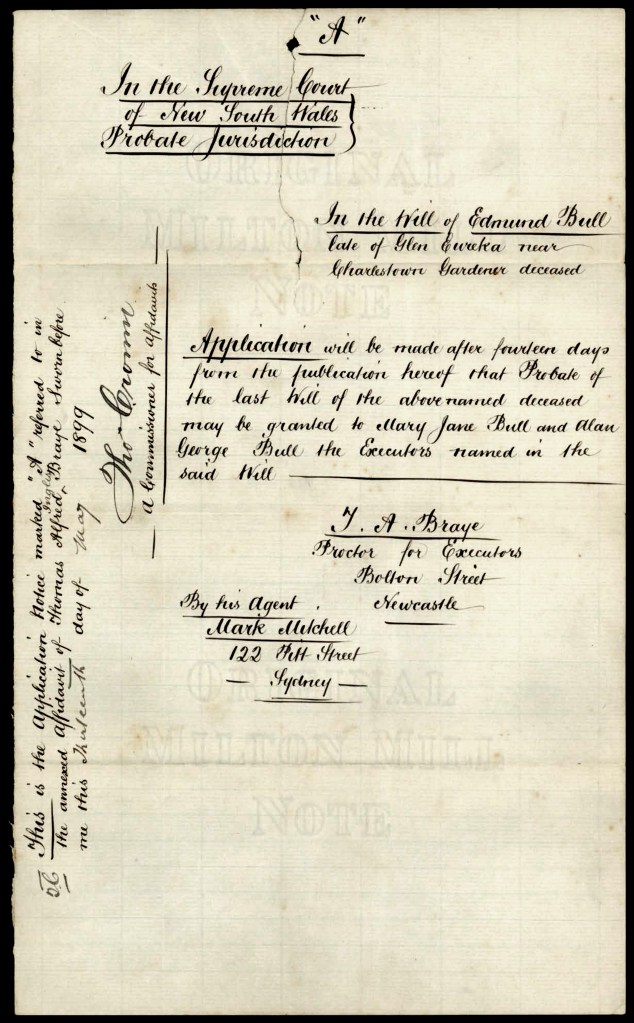
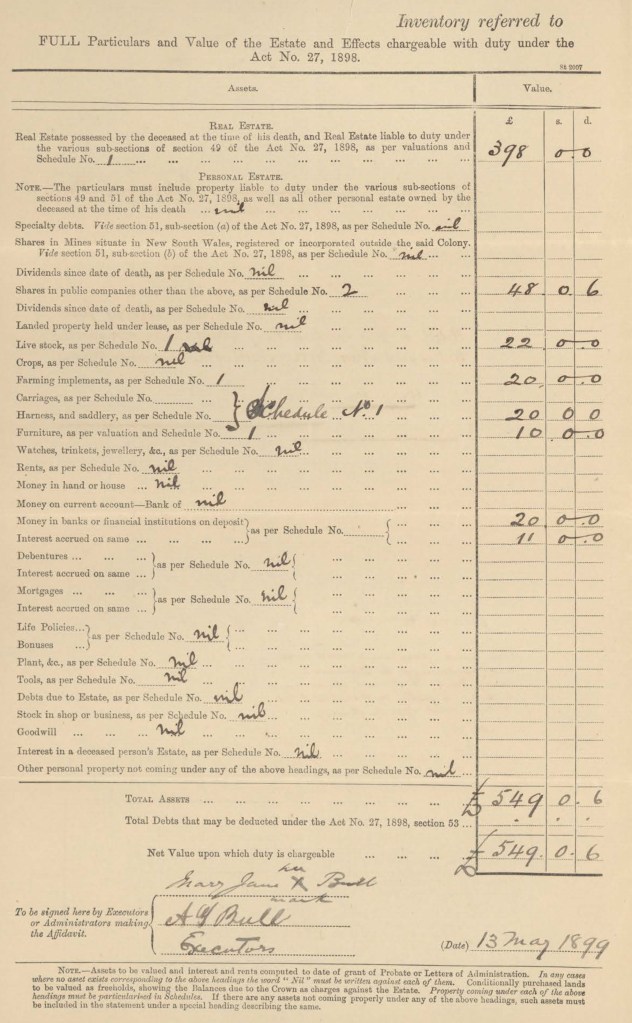
Of interest in the Probate records of Edmund’s Bull Estate is the Inventory of assets the value of his land was recorded as £398 alongside some smaller assets which took his Estate value to £549:0:6. Another record of interest is contained in the Application for Probate jurisdiction, the Proctor for the Executors was non other than T A Braye who went on the research and present papers on the history of Newcastle.
After Edmund and Mary Jane Bull’s death the gardens were managed by two of his sons and a grandson.
‘In 1901, the gardens were described in a Newcastle directory as being a popular outing with fruit trees, little waterfalls, ponds, bird aviary and bushland settings. Around the turn of the century, the gardens received many thousands of visitors. Three of Mary Jane’s sons were gardeners and following her death, son Allan took over property in 1903 and following his death in 1917, his son Norman continued to manage the gardens. The family no longer hold the property, however the road along the perimeter is officially named Bulls Garden Road.‘ 26
Sidney Bull returned in 1904 to help run the gardens with his brother Allan: “In 1904 I resigned my position of works foreman, and return to the garden, which I open free to visitors. We made a good living supplying refreshments, flowers, and fruit to the visitors, who came in hundreds on holidays, and that weekends. They included travellers and sailing ship captains, who had heard abroad of the beauty of the gardens.” 27
In 1947 the local newspaper recorded a fairly extensive description of Bull’s Garden which is worth reading. The final statement of this article says: ‘The valley was musty and cool, I garden of ferns, where creepers infiltrated among the damp rocks, narrow Stone stairways, and trees. Overhanging branches shielded it from the sun, and staghorns, palms and tree ferns flourished in a mass about the waterfall. It was the kind of valley that would make Katoomba snort with envy’.28 There is little doubt Bull’s Garden was spectacular in its time, however the little gully whilst obviously lovely would be hard pressed to compete with the expansive gullies in the Blue Mountains and Katoomba.
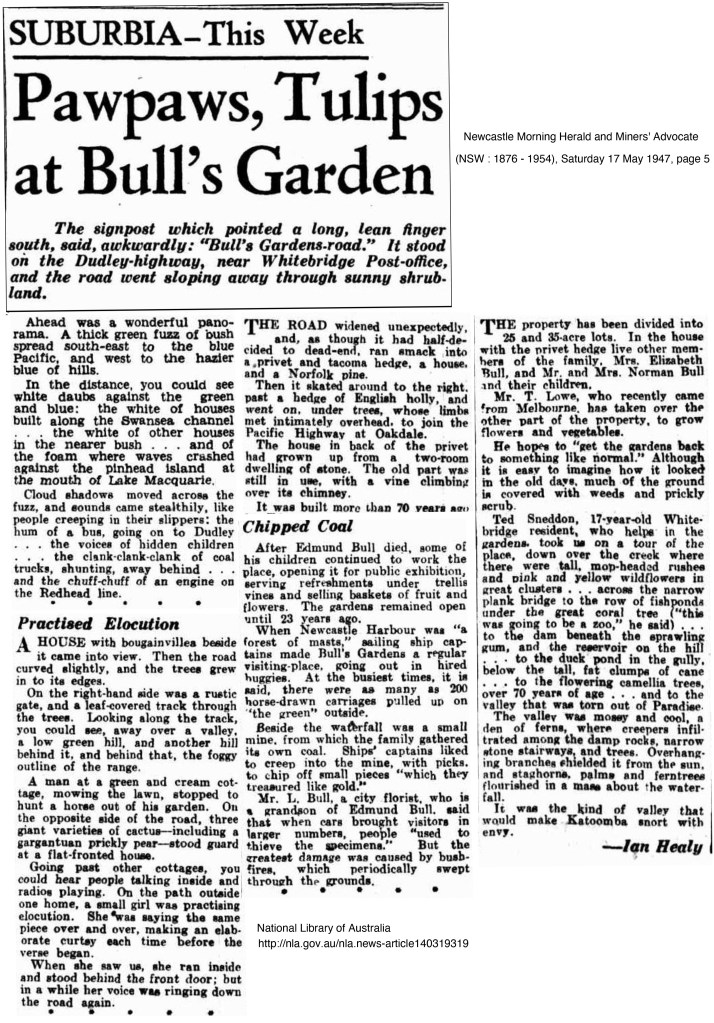
After his mother’s death, the eldest son Alan George Bull, also a Gardener and Executor of his father’s Estate, must have purchased the land from his siblings and transferred the 60 acres of ‘Glen Eureka’ on the Land Title record Vol-Fol 1682-198 on 29 March 1906. This is in line with his father Edmund’s wishes in his Will and confirmed on this land title record by the fact Allan Bull took out a mortgage on 2 October 1905 from James Turner of Moscheto Island Hunter River ‘Farmer’ and became the sole owner of the land.
This Land Title also states that the land title does not refer to any of the coal underneath being removed as by this stage the Waratah Coal Company was mining the coal underneath. So the mineral rights remained with the family ‘Firm’. More of this speculation that Edmund Bull made by purchasing the land with a coal seam is revealed on the death of his son Sydney Bull.
On this same Land Title is the record of the transference of a subdivided portion to his brother Sydney James Bull on 23 November 1907 ‘of part Reserving coals & minerals & Together with a Right of Way’.29
The next Land Title dated 2 May 1908 is created after the transference of a portion to his brother Sydney and then refers to the 24 acres that Allan George Bull retained, it is Vol-Fol 1872-27. This land title follows that section belonging to Allan Bull which on his death on 12 September 1917 remained with his wife Elizabeth (nee Hunter). Allan’s youngest son Norman Allan Bull, just 15 years old when his father died, took over working on the gardens and is recorded on electoral rolls as a ‘Market Gardener’ like his father and grandfather. On 28 September 1948 the land title was transferred to Elizabeth Bull and her son Norma Allan Bull is recorded on the electoral rolls now at 17 Marks St, Charlestown working as a Manager. On 1 June 1949 this portion of Edmund Bull’s ‘Glen Eureka’ was transferred to James John O’Malley and the land no longer belonged to the Bull family.30
The Land Title created when the remaining 35 acres was transferred to Allan’s brother Sydney James Bull ‘Gardener’ is dated 21 January 1908 Vol-Fol 1845-102. This portion of Land remains in Syd Bull’s possession until 16 August 1937 when it is transferred to his eldest son Alfred Sydney Bull of Wallsend ‘Bricklayer’. On 6 December 1946 Alfred sold the land to Charles Robert Backhouse, a Market Gardener. This severs the connection of the Bull family with this portion of Edmund Bull’s land.31
The final records connected to Edmund Bull’s land are in the Probate paperwork for Sydney James Bull. Sydney died on 1 February 1962 at 8 Hedgerow Ave Parkes, New South Wales at his daughter Ruth Jane Baker’s (nee Bull) home.
These records state that in his lifetime Edmund Bull sold the land, which was the reference to him creating the ‘Firm’ consisting of his sons, but he retained the mineral rights which then formed part of his estate:
The public trustee was recently appointed new trustee of the wheel of the above name deceased who died on 8 April 1899 and who is the owner of portion 85 in the parish of Cobar. The late Edmund sold the property during his lifetime but reserved to himself the rights to the minerals there under. Action proceeded recently to mind the minerals under the land and certain royalties have been received to date and further royalties will be safe as a consequence of such mining operations.
The estate of the late Edmund Bull is entitled to royalty on 5/6 of the total tonnage extracted from the land at the rate of one pound per tonne. The total net amount of royalty payable for the these years 1950 and 1951 amount to £6,693.14.2 whilst the net amount of royalty payable during the net amount of royalty during the period of first of January 1952 to 1st of February 1952 was £359.15.10. The valuer general has valued the interest of the owner (Edmund Bull) in the “mines beds veins and seams of coal underline portion 85” as at 1 February 1952 as £12,000. The total gross value of the estate of Edmund Bull as of 1 February, 1952, was therefore, £19,053.10.0. From this figure has to be deducted the public trustee commission at the rate of 5% amount to £952.13.0 net value of £18,100.17.0.32
The schedule to the right lists the beneficiaries of Edmund Bull’s Estate, the portion they were entitled to and the amounts. They align with his original sale to what he called the ‘Firm’ which then was updated after his death to include his daughters.
It was very astute of Edmund Bull to keep the rights to the royalties which he purchased in 1890 on the original Grant of Land Title at that time. For his £120 speculative investment, in fifty years the value became over £19,000 leaving a legacy for his children.
Edmund and Mary Bull are buried nearby their land at Whitebridge Cemetery. Alongside their graves are the graves of his son Allan George Bull and his wife Elizabeth.
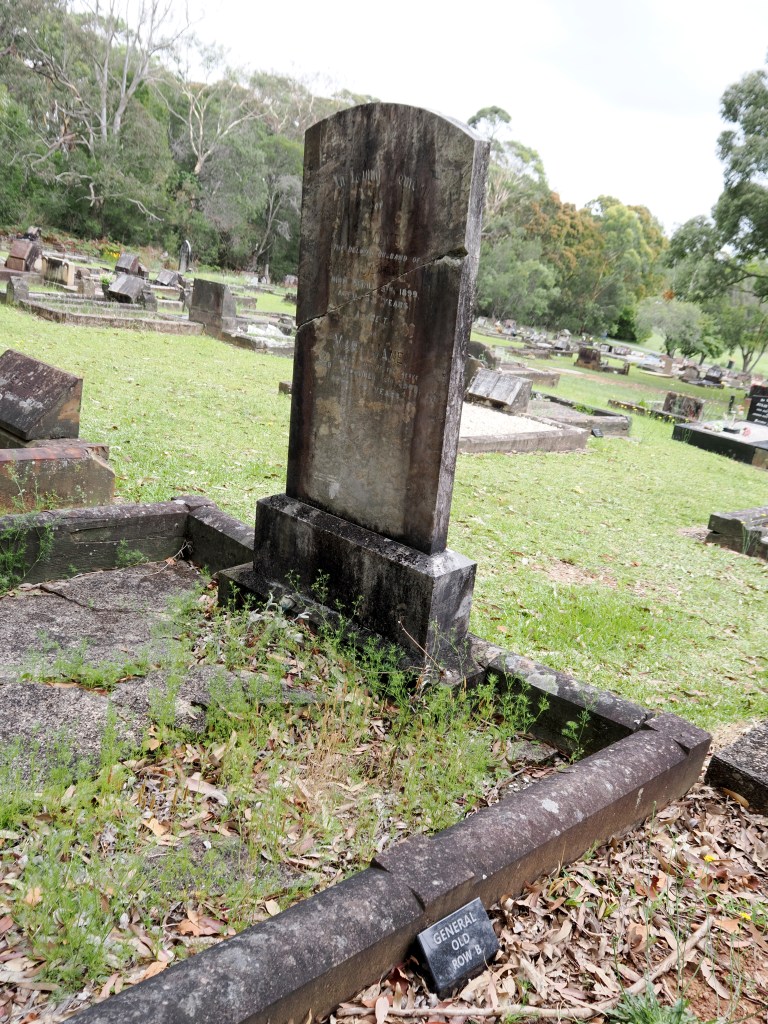
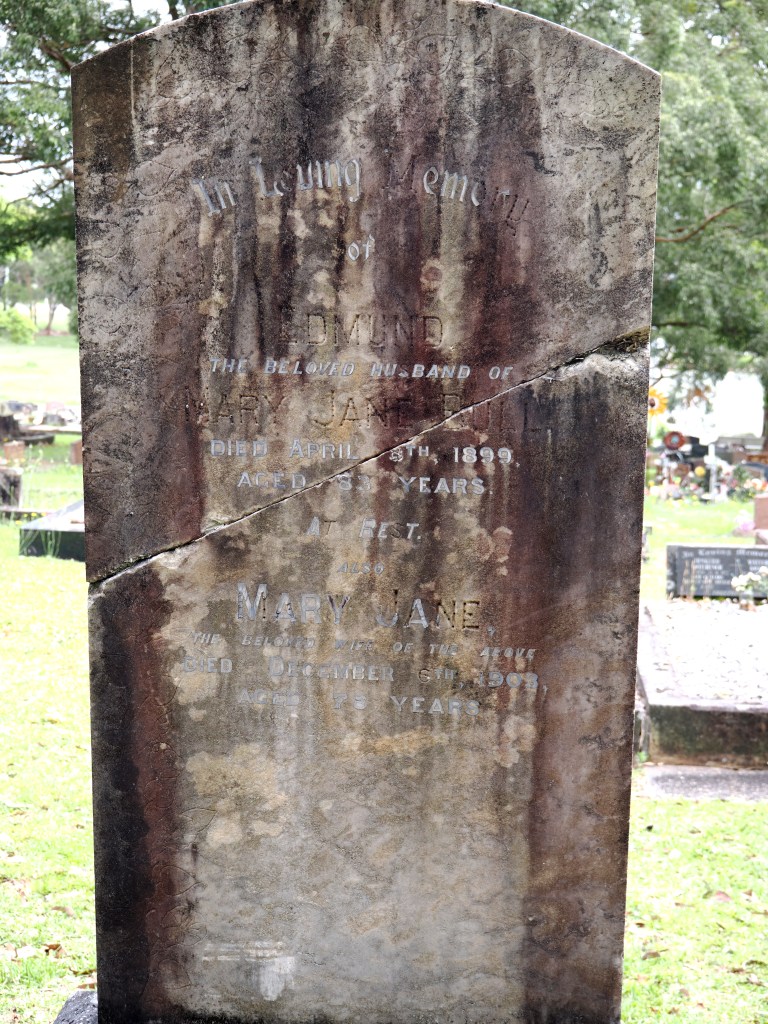
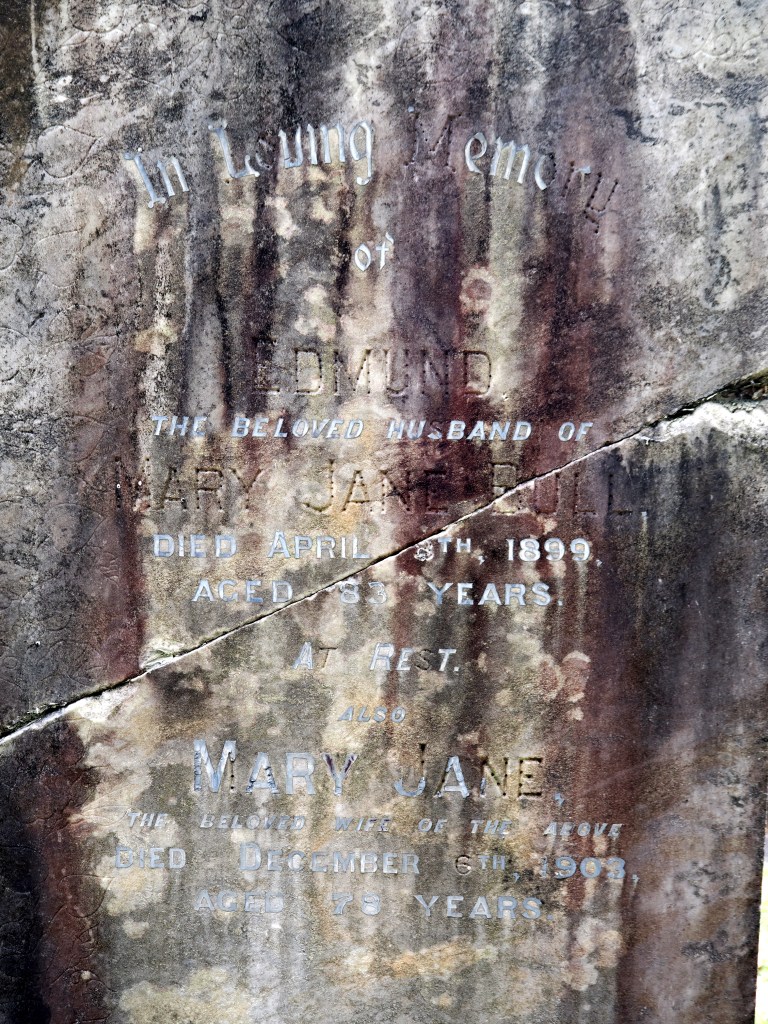
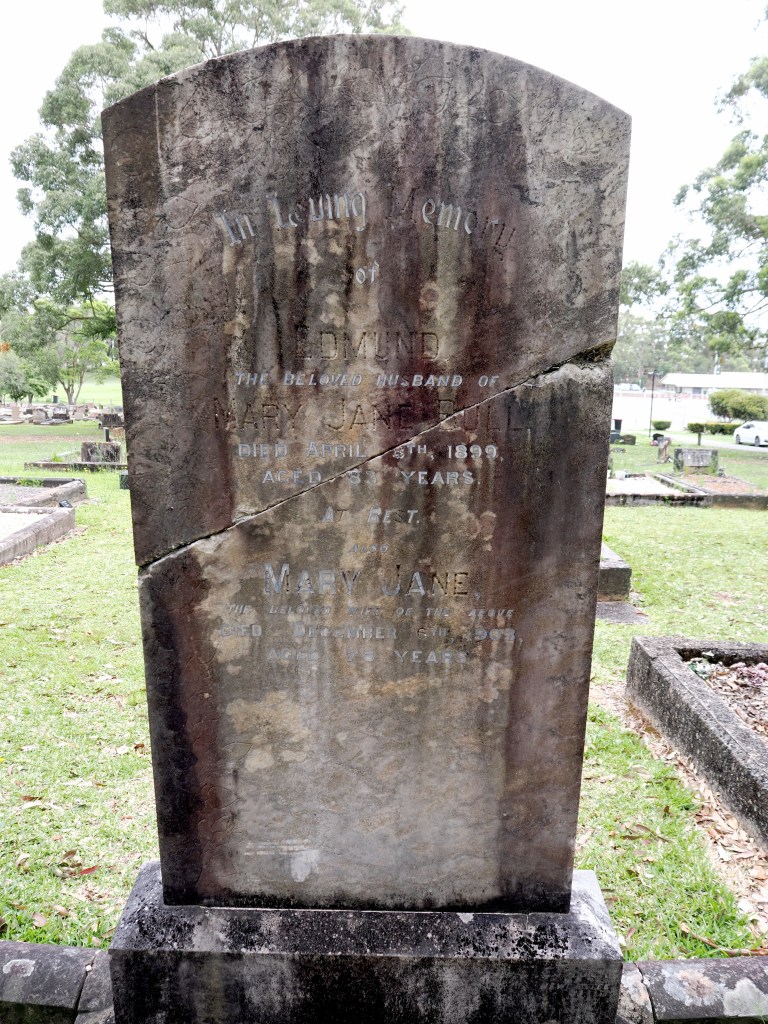
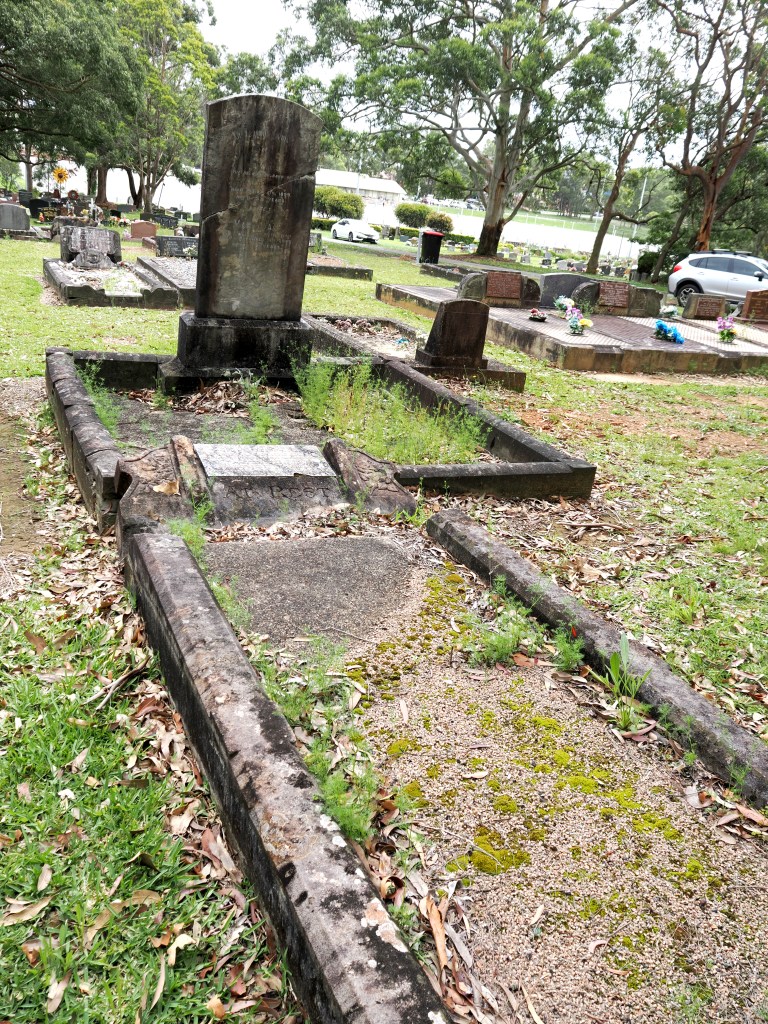
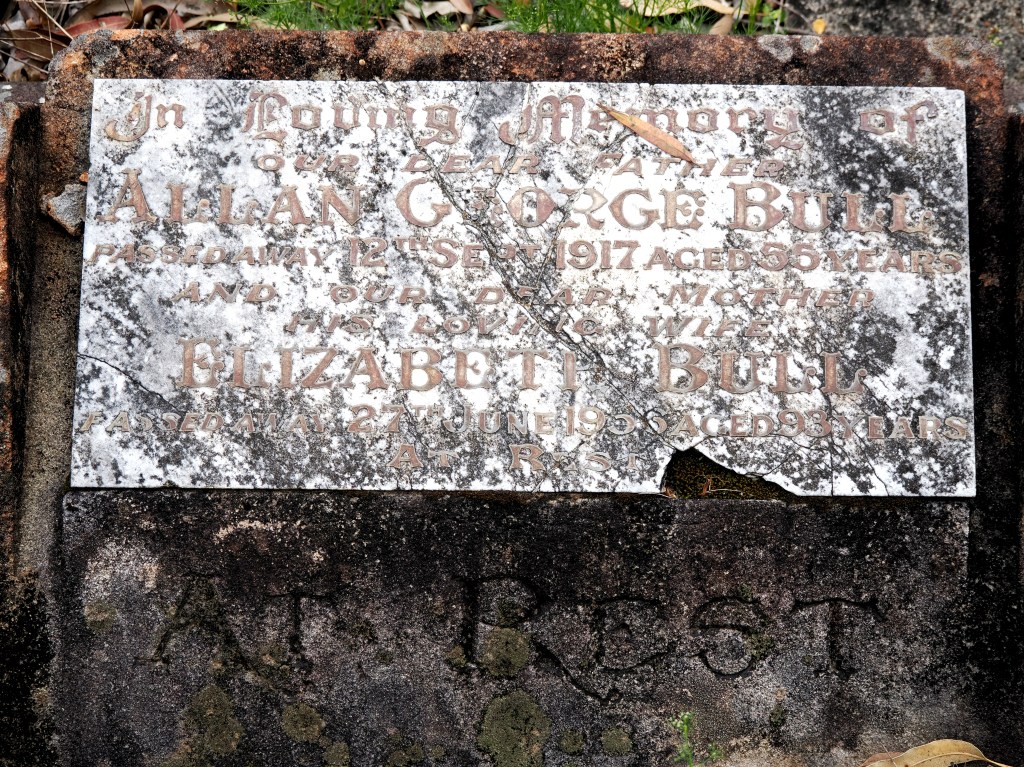
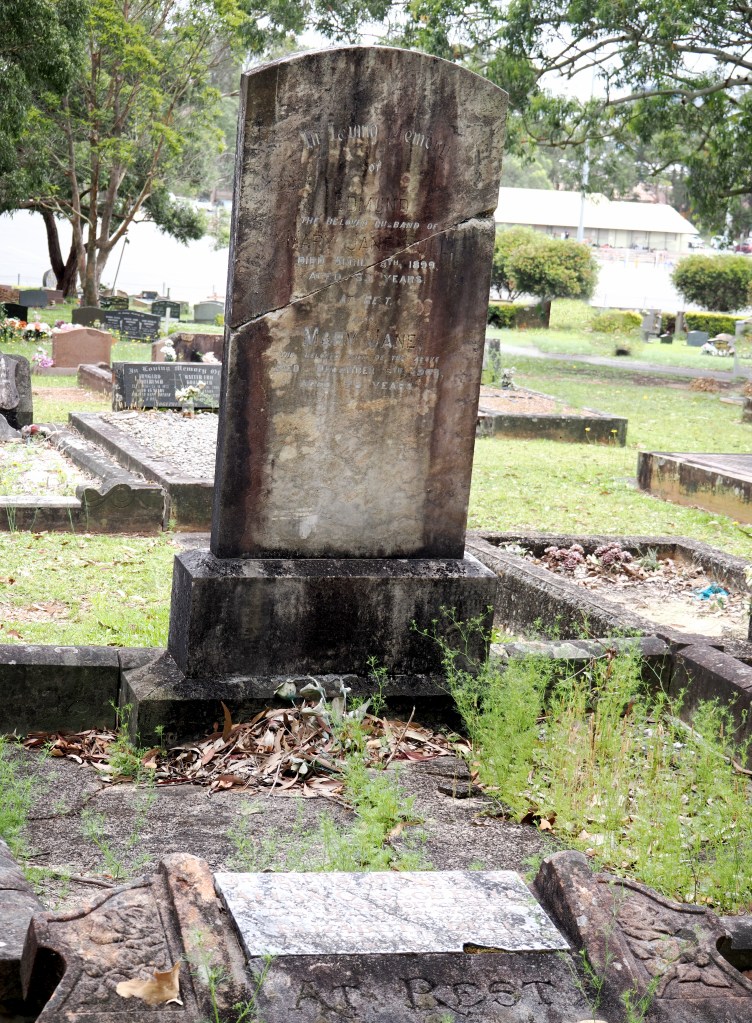
A descendant of Edmund Bull and Frances Lock has recorded some of their history on a wikitree page which can be found here Edmund Bull (1816 – 1899)
References
- LOOKING BACK Mayfield Early Days BULL’S FAMOUS GARDENS – Sydney BULL Newcastle Morning Herald and Miners’ Advocate (NSW : 1876 – 1954), Saturday 17 January 1936, page 9
- LOOKING BACK Mayfield Early Days BULL’S FAMOUS GARDENS – Sydney BULL Newcastle Morning Herald and Miners’ Advocate (NSW : 1876 – 1954), Saturday 17 January 1936, page 9
- LOOKING BACK Mayfield Early Days BULL’S FAMOUS GARDENS – Sydney BULL Newcastle Morning Herald and Miners’ Advocate (NSW : 1876 – 1954), Saturday 17 January 1936, page 9
- LOOKING BACK Mayfield Early Days BULL’S FAMOUS GARDENS – Sydney BULL Newcastle Morning Herald and Miners’ Advocate (NSW : 1876 – 1954), Saturday 17 January 1936, page 9
- The Journal of George Abner Gray 1846 – 1941 from the Original Clarence River Historical Society Grafton Second Edition 1975 page 23
- NSW Land Titles: INDENTURE Edmund BULL land Bk-No 40-253 23 March 1857
- LOOKING BACK Mayfield Early Days BULL’S FAMOUS GARDENS – Sydney BULL Newcastle Morning Herald and Miners’ Advocate (NSW : 1876 – 1954), Saturday 17 January 1936, page 9
- NSW Land Titles: LAND MINERAL RIGHTS PURCHASE – Edmund BULL – Parish of Kahibah – BULLS GARDENS 35 Oct 1890
- Conditional purchase of crown land guide – Museums of History New South Wales https://mhnsw.au/guides/conditional-purchase-crown-land-guide/#How-to-research-conditional-purchases
- LOOKING BACK Mayfield Early Days BULL’S FAMOUS GARDENS – Sydney BULL Newcastle Morning Herald and Miners’ Advocate (NSW : 1876 – 1954), Saturday 17 January 1936, page 9
- LOOKING BACK Mayfield Early Days BULL’S FAMOUS GARDENS – Sydney BULL Newcastle Morning Herald and Miners’ Advocate (NSW : 1876 – 1954), Saturday 17 January 1936, page 9
- Monument Australia – Coal Mining Pioneers https://monumentaustralia.org.au/themes/technology/industry/display/20762-coal-mining-pioneers https://history.lakemac.com.au/narrative/4046
- Conditional purchase of crown land guide – Museums of History New South Wales https://mhnsw.au/guides/conditional-purchase-crown-land-guide/#How-to-research-conditional-purchases
- NSW Land Titles: INDENTURE Edmund Bull land Bk-No 139-66 23 Dec 1873
- NSW Land Titles: INDENTURE Edmund Bull land Bk-No 139-66 23 Dec 1873
- NSW Land Titles: INDENTURE Edmund Bull land Bk-No 139-66 23 Dec 1873
- LOOKING BACK Mayfield Early Days BULL’S FAMOUS GARDENS – Sydney BULL Newcastle Morning Herald and Miners’ Advocate (NSW : 1876 – 1954), Saturday 17 January 1936, page 9
- LOOKING BACK Mayfield Early Days BULL’S FAMOUS GARDENS – Sydney BULL Newcastle Morning Herald and Miners’ Advocate (NSW : 1876 – 1954), Saturday 17 January 1936, page 9
- Trove Newspapers: Newcastle Chronicle (NSW : 1866 – 1876), Saturday 23 October 1875, page 5 SALE ADVERTISEMENT Glen Eureka
- NSW Land Titles: INDENTURE Edmund Bull Bk-No 155-687 15 Nov 1875
- NSW Land Titles: INDENTURE Sale of land EDMUND BULL Waratah Land Bk-No 313-240 10 Jun 1885
- Trove: Evening News (Sydney, NSW : 1869 – 1931)Saturday 27 January 1894 – Page 6 Death of Mr. Eric M. Meyer.
- LOOKING BACK Mayfield Early Days BULL’S FAMOUS GARDENS – Sydney BULL Newcastle Morning Herald and Miners’ Advocate (NSW : 1876 – 1954), Saturday 17 January 1936, page 9
- Bull’s Garden in Whitebridge – Hunter Photo Bank – Newcastle Library
- LOOKING BACK Mayfield Early Days BULL’S FAMOUS GARDENS – Sydney BULL Newcastle Morning Herald and Miners’ Advocate (NSW : 1876 – 1954), Saturday 17 January 1936, page 9
- Orphan Profile:Mary Jane Sands from Banbridge, Co. Down – The Great Irish Famine Commemoration Committee – Written By: Karen Semken with kind research assistance from Lynn Goll in Jan 2013.
- NSW State Archives: PROBATE Edmund Bull – Date of Death 08 Apr 1899, Place of residence Euroka [sic] NRS-13660-4-740-Series 4_18087
- Trove: Newcastle Morning Herald and Miners’ Advocate (NSW : 1876 – 1954)Saturday 17 May 1947 SUBURBIA—This Week Pawpaws, Tulips at Bull’s Garden
- LOOKING BACK Mayfield Early Days BULL’S FAMOUS GARDENS – Sydney BULL Newcastle Morning Herald and Miners’ Advocate (NSW : 1876 – 1954), Saturday 17 January 1936, page 9
- Trove: Newcastle Morning Herald and Miners’ Advocate (NSW : 1876 – 1954)Saturday 17 May 1947 SUBURBIA—This Week Pawpaws, Tulips at Bull’s Garden
- NSW Land Titles: LAND TITLE Bull’s Garden – ALAN GEORGE BULL Vol-Fol 1682-198 29 Mar 1906
- NSW Land Titles: LAND TITLE Bull’s Garden – ALAN GEORGE BULL Vol-Fol 1872-27 2 May 1908
- NSW Land Titles: LAND TITLE Bull’s Garden SYDNEY JAMES BULL Glen Eureka 35acres Vol-Fol 1845-102 21 Jan 1908
- NSW State Archives: PROBATE Sydney James Bull – Date of Death 01/02/1952, Granted on 31/07/1956 NRS-13660-35-13023-Series 4_448594
 George Gray - Stonemason & Builder