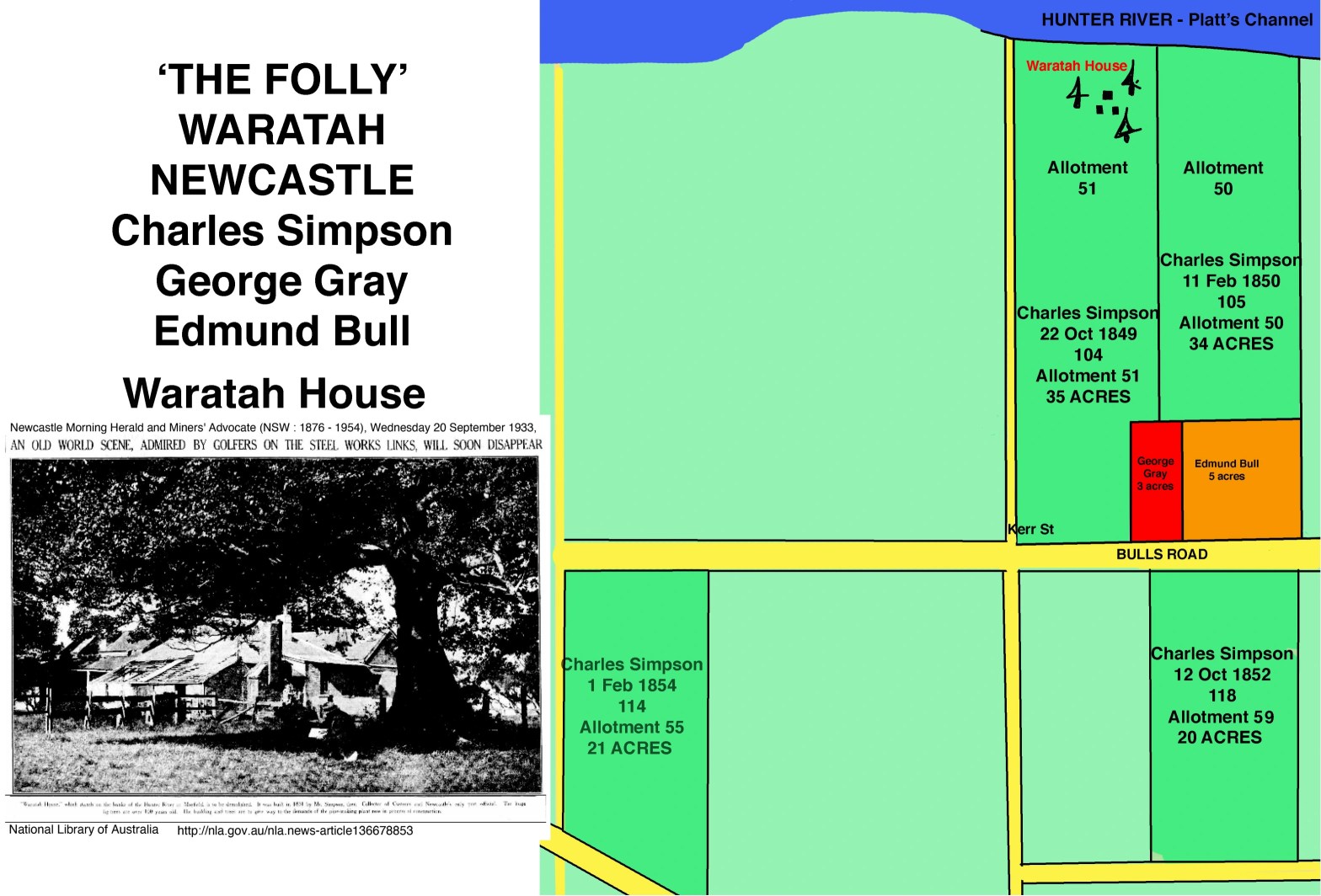
Waratah House
George Gray ‘Builder & Stonemason’ – Edmund Bull ‘Labourer & Gardener’ – Ben Baker ‘Carpenter & Timber Merchant’
There are multiple references both from family as well as newspaper articles, and early historians that give the source of the name of the builder of Waratah House as being George Gray along with a reference to Edmund Bull. George Gray’s insolvency records from the Isle of Wight list his occupation as both a stonemason and builder. 1
The Mayfield 1900-1950 Jubilee Celebration‘ by W J Goold recalls: Waratah House. In 1854, Simpson disposed of his property to Mr. Thomas Tourle, a wealthy squatter, who had made a fortune on his station, “Bellata,” [Belala] in the New England district. He was a son-in-law of the Rev. Charles Mose, [Morse] for many years chaplain of Scone. Tourle made considerable additions to Waratah House. He laid out the grounds, planted vineyards, an orchard, etc. He lived at Waratah House until his death in1899, at the great age of 93 years. He is described by old residents as being a fine old gentleman, who lived the life of the typical English squire.2
Contained within George Abner Gray’s journal is a reference to his father George’s work; ‘My father used to employ the X-convicts to do contract work’ 3 which implies that George Gray who is referenced as a ‘Builder’ in records on the Isle of Wight and in his indenture documents of 1854, is likely the ‘P Gray’ the contractor who built the house known as ‘Waratah House’. It also seems likely that the grants of land to ‘the builder and his labourer’ contained in the 1932 article below by George Gray’s son, George Abner Gray, are in fact George Gray and Edmund Bull who in fact purchased their land in 1854 from Charles Simpson.
George Abner Gray wrote his reminiscences for the Newcastle Sun newspaper of the beginnings of ‘Waratah’ and Newcastle area. It is where George Abner grew up and his journal entries have generally been very reliable when compared to archival information.
He writes: “Mr. Charles Simpson purchased an estate previously called The Folly, and he named it Waratah,” writes Mr. Gray. “At that time there was no other settler within miles. The first who came were in Mr. Simpson’s interest. He had a brick house built and soon made wonderful improvements. The two sawyers who cut the necessary timber for the house were Ben Baker and Harry Crouthers, while the builder’s name was Gray. The gardiner was Mr. Bull, the grandfather of Dick Tressider, the boat puller.” 4
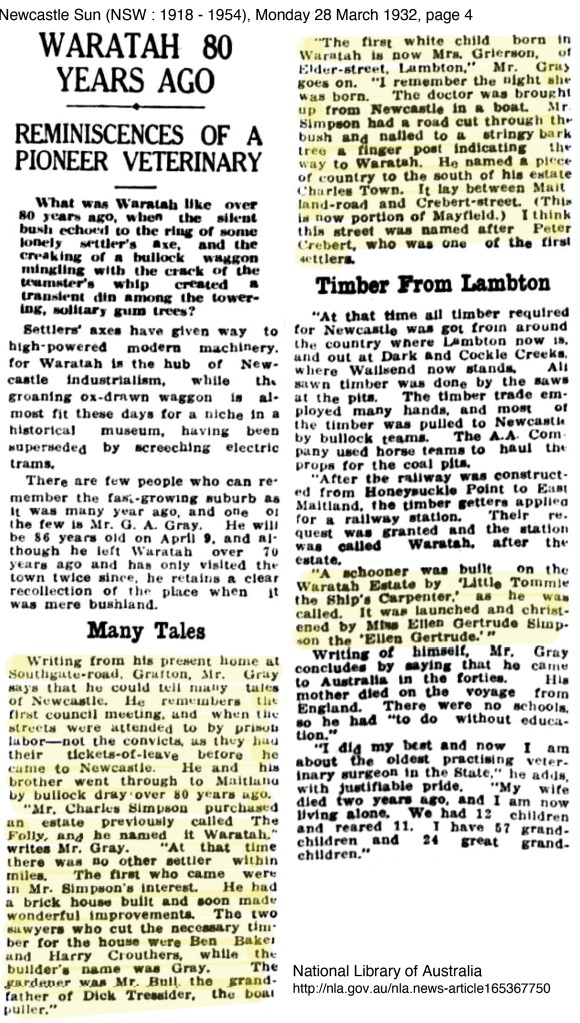
In a newspaper interview recorded on 17 January 1936, Edmund Bull’s son Sydney James Bull spoke of his father Edmund Bull also building the house: ‘“My father was one of the men who built the old house known as ‘The Follies’.” Although Syd’s wife Elizabeth also claimed her father Josiah Hughes was also involved in building Waratah House, he had not yet arrived in the new colony when it was built.
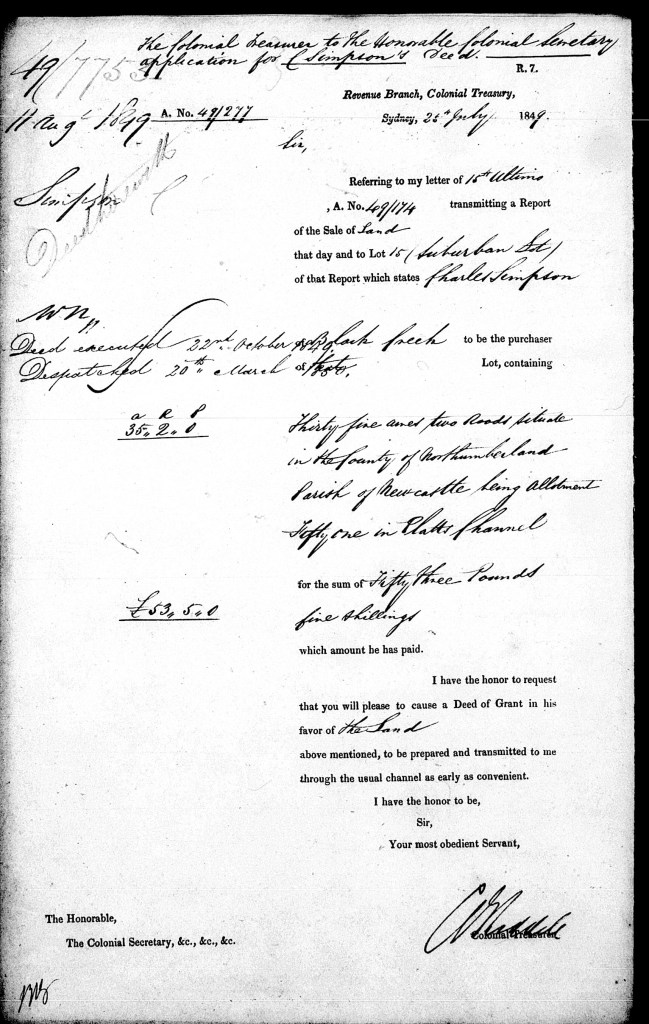
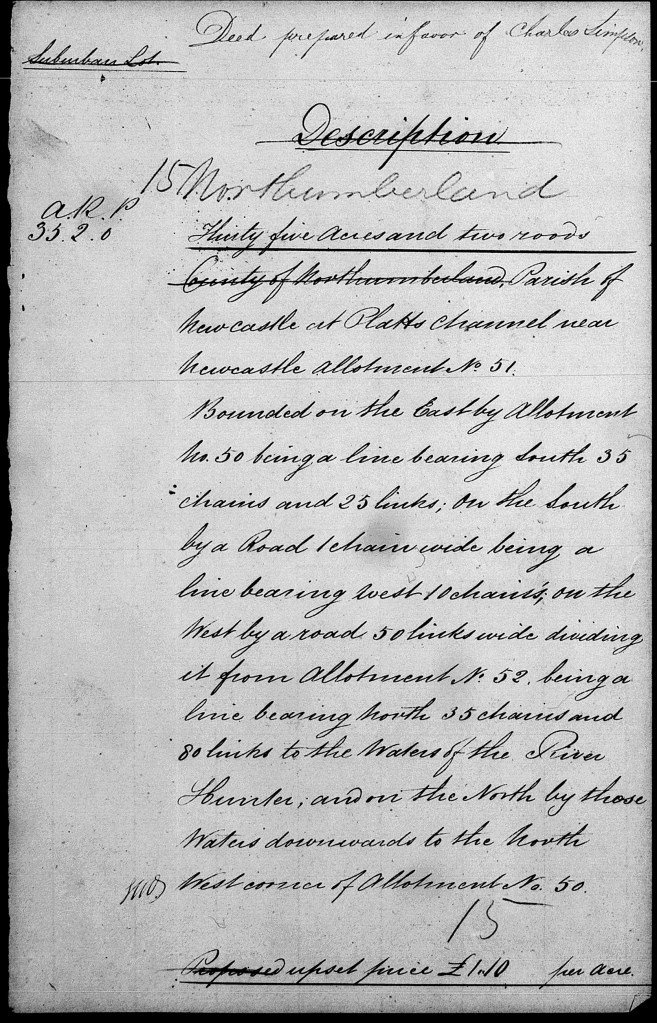
1849 – 25 Jul – PLATTS CHANNEL – ALLOTMENT 51 LOT 15 – 35 acres – Charles Simpson
These are images from the original documents from the Colonial Secretary regarding Allotment 51 where Waratah House was built. Index: INX-14-3150 NSW State Archives 5
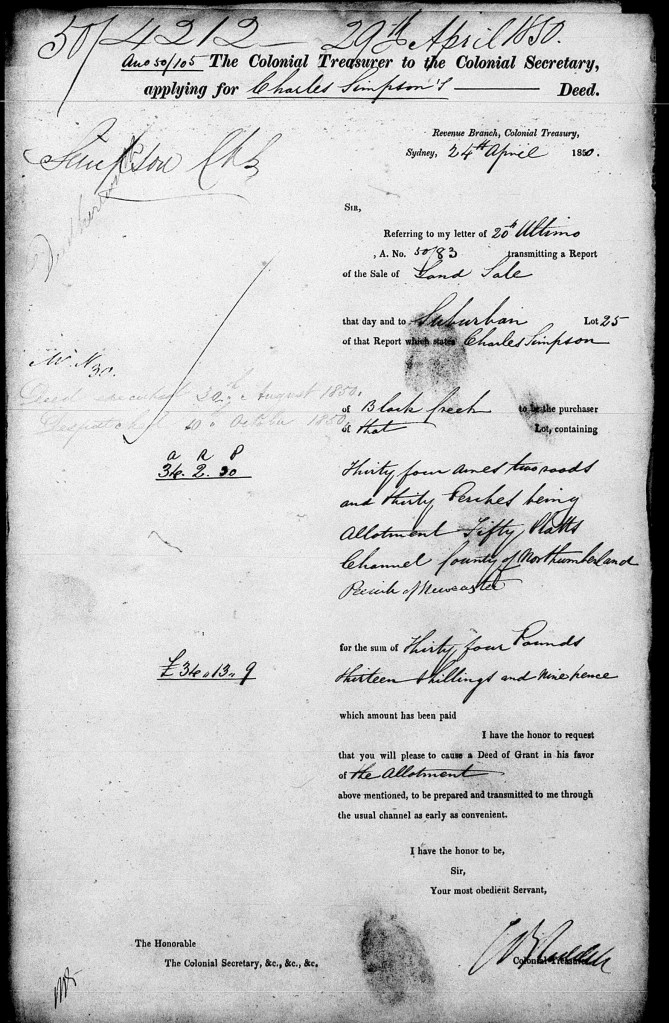
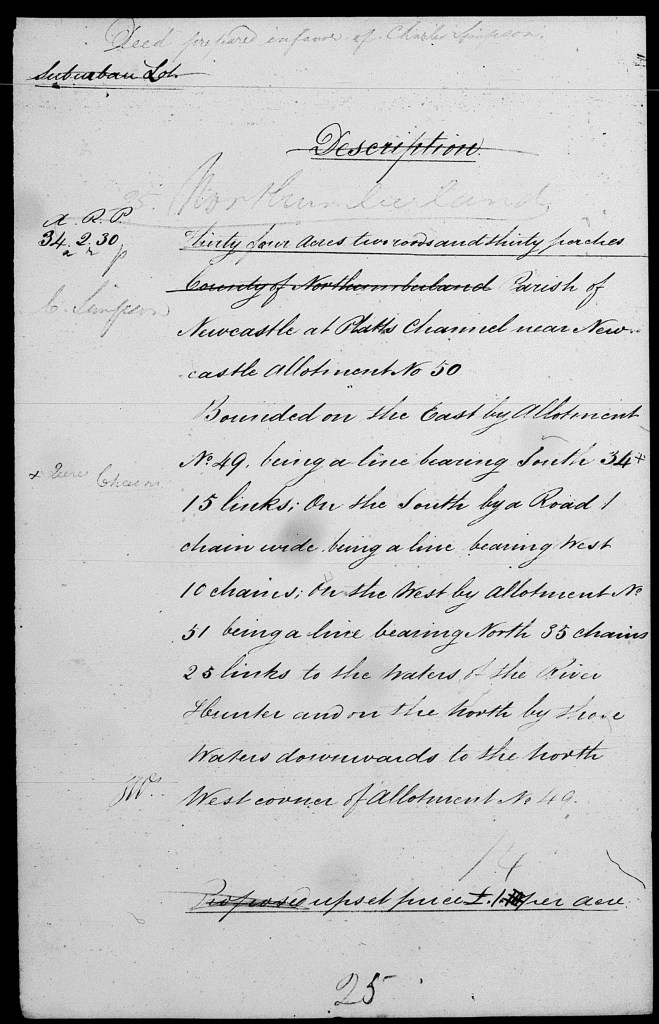
1850 – 24 Apr – ALLOTMENT 50 – 34 acres – PLATTS CHANNEL County of Northumberland Parish of Newcastle – Charles Simpson
These are images from the original documents from the Colonial Secretary regarding Allotment 50 the adjoining land to where Waratah House was built. Index: INX-14-3150 NSW State Archives 6
NSW STATE ARCHIVES
Waratah House
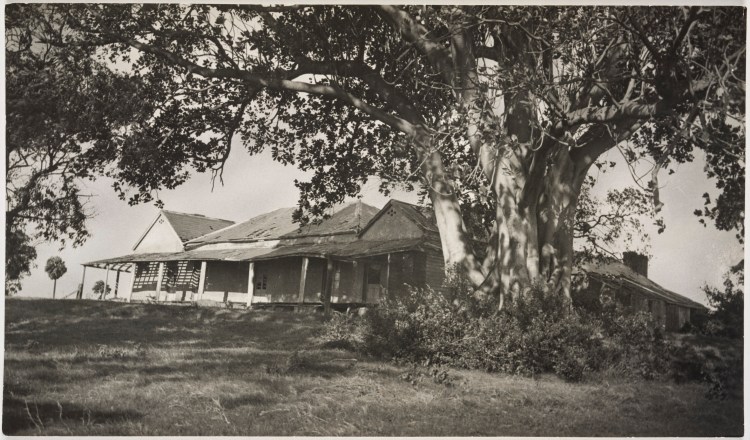
‘Waratah House’, built by Charles Simpson, later added to by Thomas Tourle, Mayfield, NSW, [1930s] Source: Hunter Living Histories, University of Newcastle
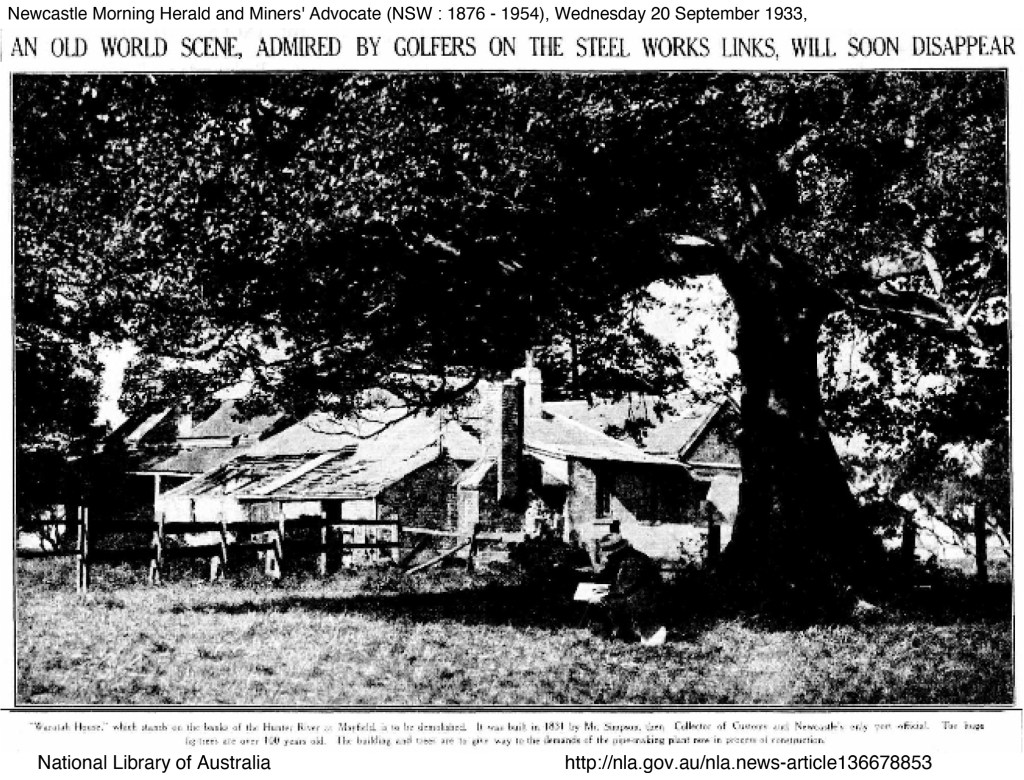
Unfortunately the accompanying article to the above photograph in the Newcastle Morning Herald, 20th September, 1933 which he references on pages 92 -94 contains misinformation.
No author nor sources are given for the article but its publication comes after that of the 1932 George Abner Gray article.

The caption for accompanying photo reads: ‘AN OLD WORLD SCENE, ADMIRED BY GOLFERS ON THE STEEL WORKS LINKS, WILL SOON DISAPPEAR “Waratah House,” which stands on the banks of the Hunter River at Mayfield, is to be demolished. It was built in 1831 by Mr. Simpson, then Collector of Customs and Newcastle’s only port official. The huge fig-trees are over 100 years old. The building and trees are to give way to the demands of the pipe-making plant now in process of construction.‘ 8
The well known artist Sydney Long produced sketches and an etching of Waratah House which are part of the Newcastle Libraries Hunter Photo Bank. They can be see by clicking the links below.
Waratah House, Mayfield – Etching by Sydney Long – Hunter Photo Bank 345 000217
Waratah House, Mayfield – Etching by Sydney Long – Hunter Photo Bank 163 001739
Waratah Golf Club
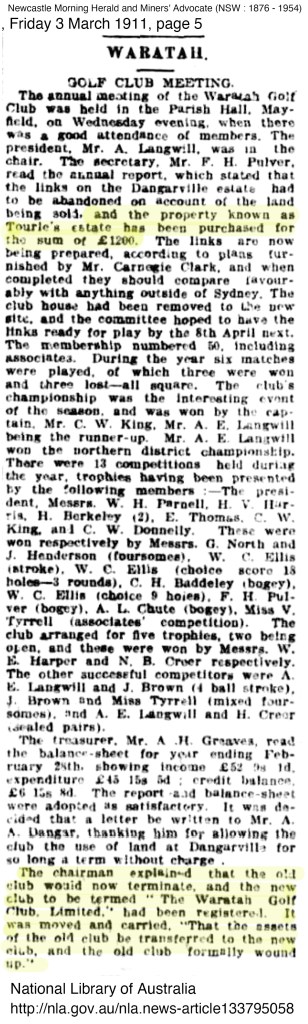
Thomas Tourle lived at Waratah House until his death in 1899 with the house being sold in 1911 to the Waratah Golf Club.
As seen in this article dated 3 March 1911, the Waratah Golf Club purchased ‘Tourle’s Estate’ which included Waratah House for £1200 which at the time caused quite a stir.
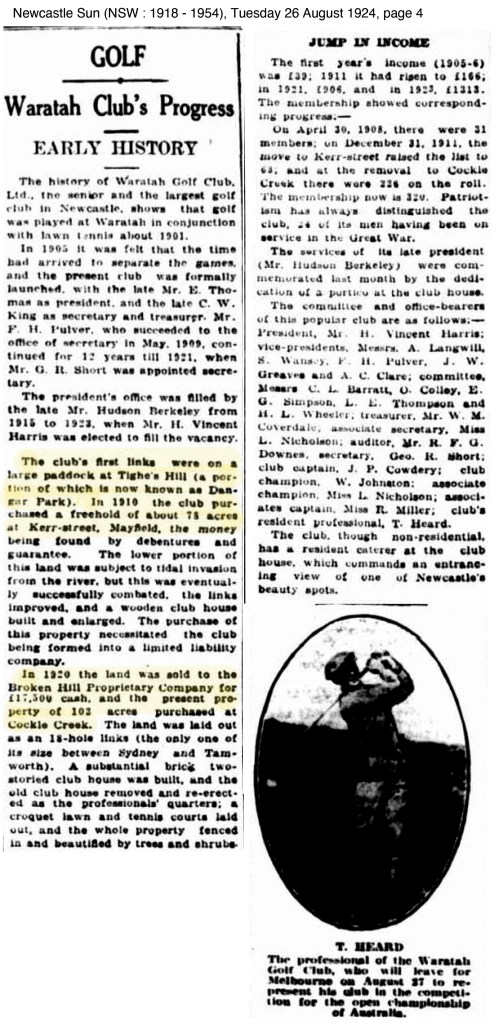
In 1924 a little about the early history of the Waratah Golf Club with the additional information the land was in 1920 sold to BHP, the Broken Hill Proprietary Company.
It appears the 1911 Club Committee were vindicated with their purchase price of £1200 as BHP paid the club ‘£17,500 cash’. 9
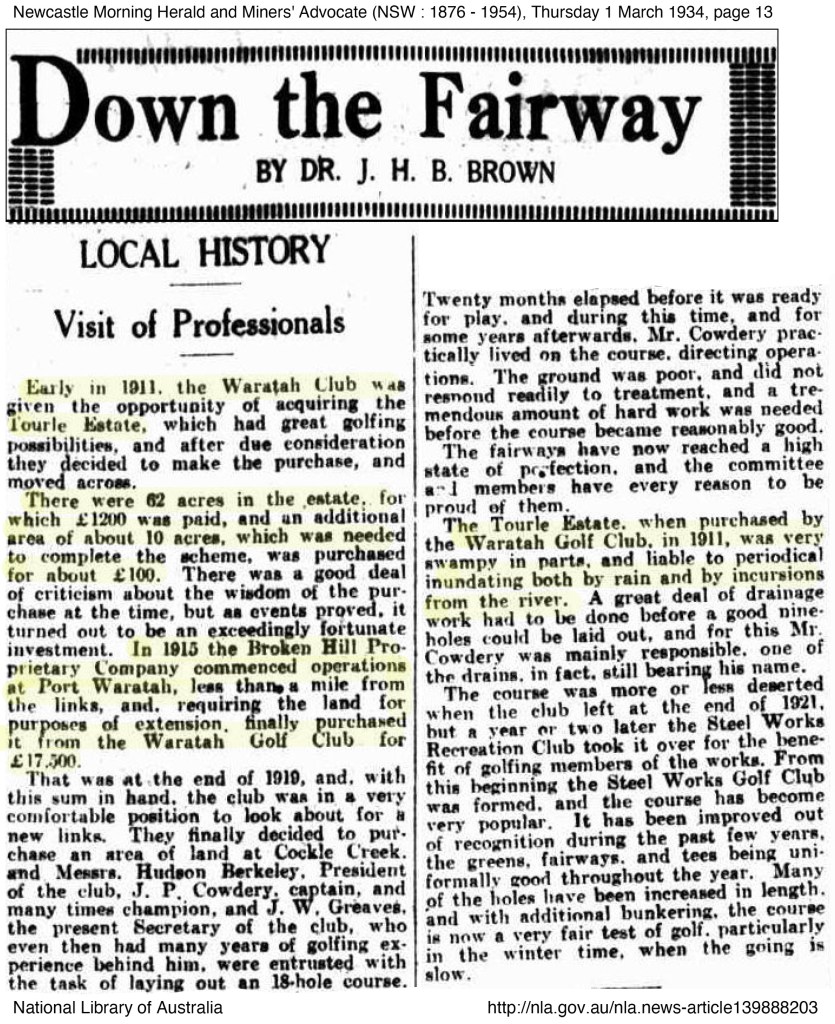
After the sale of the land the previous Golf Course and Waratah House were left unused but a little while afetr it was sold, the Golf Course became the BHP ‘Steel Works Recreation Club’.
The recreation club continued to improve the course and the used Waratah House as a kind of rest area.
This article notes that the land ‘was very swampy in parts, and liable to periodical inundating both by rain and by incursions from the river.’ 10
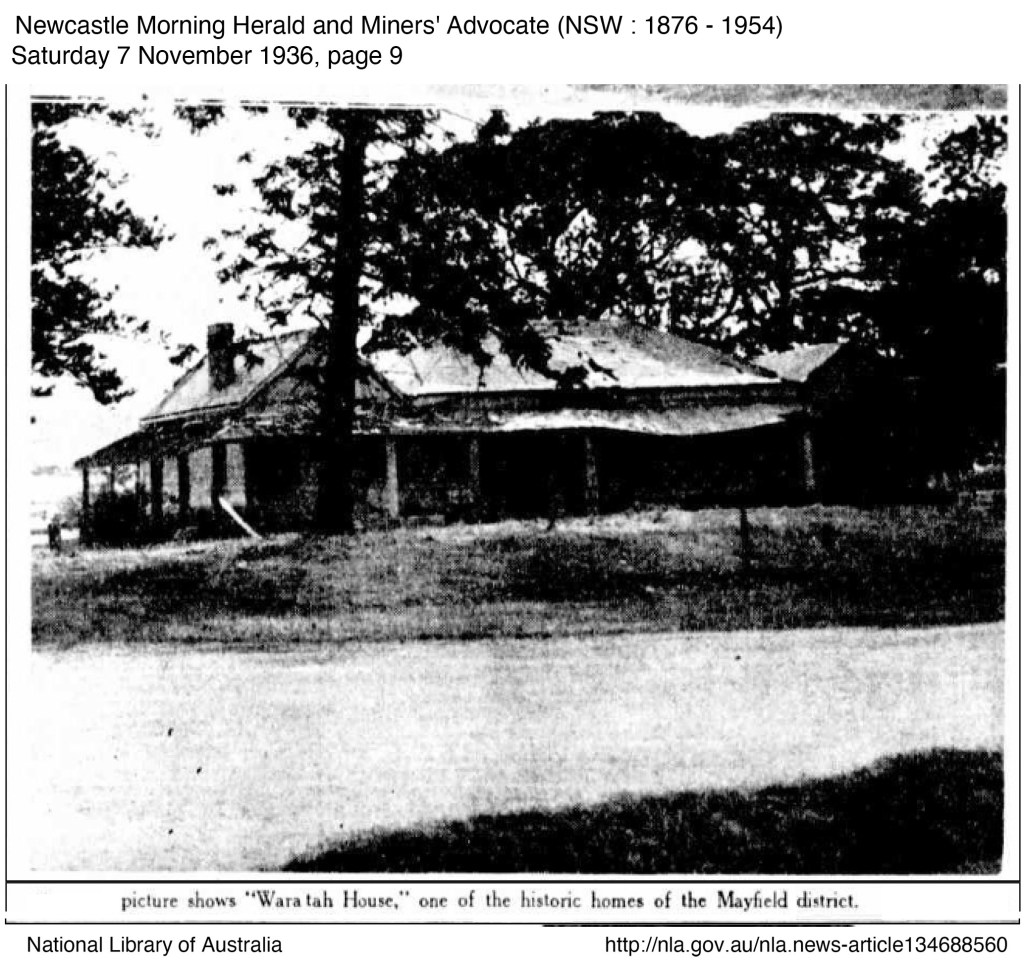
The Newcastle Morning Herald on Saturday 7 November 1936, announced the final stage in the story of Waratah House, links to Charles Simpson, his land and the early story of the beginnings of the settlement of this area known as ‘the folly’, Waratah and now Mayfield North. It like many articles before repeats the incorrect date of construction and Charles Simpson’s occupation but it does provide the closing details for Waratah House.
The demolition of Waratah House
The article announces that ‘Time marches on, and has no place for sentiment’ with the end of the recreation golf club and imminent demolition of Waratah House which would have been about 85 years old. The writer pays tribute to Waratah House : ‘Another landmark, as much a part of the course as the grass itself, is Waratah House. Often threatened, it is to go at last. To those who do not know of its presence, Waratah House comes as a pleasant surprise. It presents a beautiful old world scene set almost in the centre of a hive of mechanical industry. It is the oldest home and residence in the district. Erected in 1831 for Mr Simpson, Collector of Customs and the only port official of whom Newcastle could boast then. It has been “half-way house” for golfers for many years. It has been a shelter from sun and rain. But the once magnificent home, shaded by the foliage of huge trees which make for it a perfect setting, will soon be no more. The spot was once known as Simpson’s Folly, for it was of his folly to go so far from town. But it, too, will soon be no more.’ 11

On Saturday 13 February 1937 James W Cowie reports the final passing of the old house. Although of a more poetic vein of reporting it gives a sense of history lost : ‘ONCE A GRAND home on the bank of the Hunter at Mayfield, Waratah House is now a pile of stone, bricks, and mortar. Progress, with its demands for expansion, must be sated, and so Waratah House is no more. It was demolished in the past month or so. It was in 1848. The bank of the Hun er was covered with dense shrub and trees. It was infested with mosquitoes, and the land around was a wilderness.
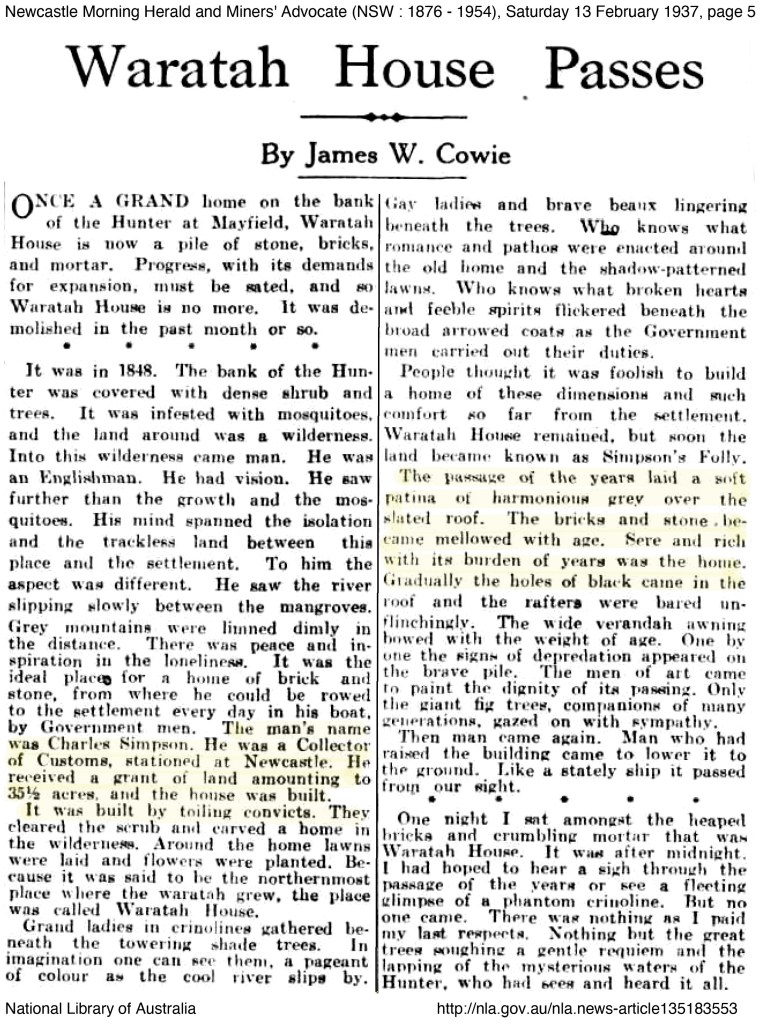
Into this wilderness came man. He was an Englishman. He had vision. He saw further than the growth and the mosquitoes. His mind spanned the isolation and the trackless land between this place and the settlement. To him the aspect was different. He saw the river slipping slowly between the mangroves. Grey mountains were linned dimly in the distance. There was peace and inspiration in the loneliness. It was the ideal place for a home of brick and stone, from where he could be rowed to the settlement every day in his boat, by Government men. The man’s name was Charles Simpson. He was a Collector of Customs, stationed at Newcastle. He received a grant of land amounting to 35½ acres, and the house was built. It was built by toiling convicts. They cleared the scrub land carved a home in the wilderness. Around the home lawns were laid and flowers were planted. Be cause it was said to be the northermost place where the waratah grew, the place was called Waratah House. Grand ladies in crinolines gathered be neath the towering shade trees. In imagination one can see them, a pageant of colour as the cool river slips by.
Gay ladies and brave beaux lingering beneath the trees. Who knows what romance and pathos were enacted around the old home and the shadow-patterned lawns. Who knows what broken hearts and feeble spirits flickered beneath the broad arrowed coats as the Government men carried out their duties. People thought it was foolish to build a home of these dimensions and such comfort so far from the settlement. Waratah House remained, but soon the land became known as Simpson’s Folly. The passage of the years laid a soft patina of harmonious grey over the slated roof. The bricks and stone be came mellowed with age. Sere and rich with its burden of years was the home. Gradually the holes of black came in the roof and the rafters were bared un flinchingly. The wide verandah awning bowed with the weight of age. One by one the signs of depreciation appeared on the brave pile. The men of art came o paint the dignity of its passing. Only the giant fig trees, companions of many generations, gazed on with sympathy. Then man came again. Man who had raised the building came to lower it to the ground. Like a stately ship it passed from our sight. One night I sat amongst the heaped bricks and crumbling mortar that was Waratah House. It was after midnight. I had hoped to hear a sigh through tile passage of the years or see a fleeting glimpse of a phantom crinoline. But no one came. There was nothing as I paid my last respects. Nothing but the great trees sloughing a gentle requiem and the lapping of time mysterious waters of the Hunter, who had sees and heard it all.‘ 12
It is a great shame that George Gray as the likely builder of Waratah House alongside Edmund Bull his brother in law and labourer as well as the gardener, have never been recognised. It is also likely that Ben Baker was involved with the building of the house. Peter Crebert and Philip Kuhn were likely to have been involved with Charles Simpson just based on his benevolence in selling these handful of men who worked with or for him, their small parcels of land in 1854. Based on all the available evidence including the timelines of the Gray and Bull families arriving at ‘the folly’ alongside the fact that they would most likely have crossed paths with Charles Simpson as a colleague of McDouall at New Freugh, there seems to be enough evidence of a likely connection in such a small community in those times. Some of this lack of acknowledgement may also be related to the fact that George Gray died a relatively young man of 43 years in 1861 which did not allow time for his legacy to be fully recorded so that his name was associated alongside the widely known Peter Crebert, Ben Baker, Philip Kuhn and Edmund Bull.
References
- The London Gazette, Part 1 p869 – 1870 – 29 March 1844 – INSOLVENT – George Gray ‘Builder’
- ‘Mayfield 1900-1950 Jubilee Celebration‘ with W J Goold, President of Newcastle and Hunter District Historical Society Souvenir Booklet Page 2 chrome-extension://efaidnbmnnnibpcajpcglclefindmkaj/https://www.mayfieldsanc.catholic.edu.au/media/81800/1950-mayfield-jubilee.pdf
- The Journal of George Abner Gray 1846 – 1941 from the Original Clarence River Historical Society Grafton Second Edition 1975 page 14
- Newcastle Sun (NSW : 1918 – 1954), Monday 28 March 1932, page 4 WARATAH 80 YEARS AGO REMINISCENCES OF A PIONEER VETERINARY George Abner Gray
- NSW State Archives SIMPSON Charles Colonial Secretary’s Letters relating to Land 1826-56 Item No: 2/7971 | Reel No: 1182 | Start Date: 1846 Index: INX-14-3150
- NSW State Archives SIMPSON Charles Colonial Secretary’s Letters relating to Land 1826-56 Item No: 2/7971 | Reel No: 1182 | Start Date: 1846 Index: INX-14-3150
- NSW State Library – WARATAH HOUSE – Mitchell Library – Harold Cazneaux / photographs chiefly of domestic architecture and gardens – SLNSW_FL11228
- Newcastle Morning Herald and Miners’ Advocate (NSW : 1876 – 1954), Wednesday 20 September 1933, page 5 AN OLD WORLD SCENE, ADMIRED BY GOLFERS ON THE STEEL WORKS LINKS, WILL SOON DISAPPEAR
- Newcastle Sun (NSW : 1918 – 1954), Tuesday 26 August 1924, page 4 GOLF Waratah Club’s Progress EARLY HISTORY’
- Newcastle Morning Herald and Miners’ Advocate (NSW : 1876 – 1954), Thursday 1 March 1934, page 13 Down the Fairway BY DR. J. H. B. BROWN LOCAL HISTORY Visit of Professionals
- Newcastle Morning Herald and Miners’ Advocate (NSW : 1876 – 1954), Saturday 7 November 1936, page 9 AFTER 25 YEARS Golf Links to Close . INDUSTRY’S DEMAND
- Newcastle Morning Herald and Miners’ Advocate (NSW : 1876 – 1954), Saturday 13 February 1937, page 5 Waratah House Passes By James W. Cowie
 George Gray - Stonemason & Builder