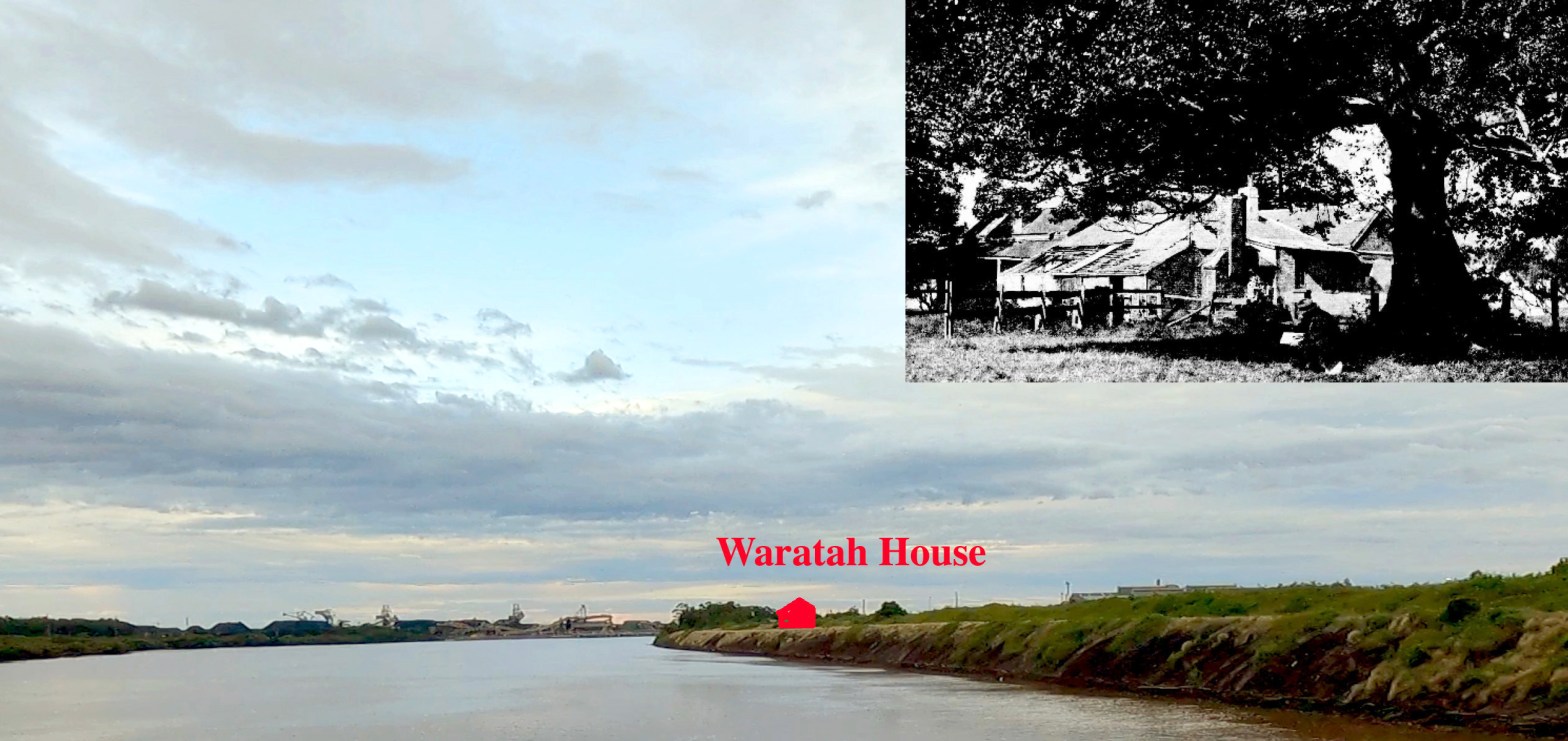
‘The Folly’ 1849 – 1854
As a starting point for the time frames for George Gray, Edmund Bull and Benjamin Baker arriving as the first settlers on Charles Simpson’s land at ‘the folly’, it can noted that Charles Simpson Title Deeds for allotment 50 are dated 22 October 1849 and for allotment 50 are dated 11 February 1850. This means that numerous newspaper articles and reports recounting the history of the folly, Waratah and Mayfield areas that date the building of Charles Simpson Waratah House as anytime between 1821 and 1848 are not correct.
The Gray and Bull families were very close with them both moving to the folly together at the same time. Edmund Bull married Mary Jane Sands on 15 May 1849 with George Abner Gray recalling he was ‘only about 5 years old’ when his father married Emma Dyer. Their marriage is recorded as 29 Jul 1850, he was 4 1/2yrs of age. After he recalls the wedding in his journal he states: ‘Shortly after we all, excepting my sister, went to the cost [sic].’ 1 Benjamin Baker was recorded as living in New Freugh and ‘Mrs Baker/ is mentioned in George Abner Gray’s journal.2
Family records state that in June/July 1851 George and Emma’s first child Georgina Johanna Gray was born with her birth being described by George Abner Gray in his 1932 newspaper article. His story of her birth clearly indicates that George Gray and his family had left New Freugh and were by this time living at ‘The Folly’; ‘“The first white child born in Waratah is now Mrs. Grierson, of Elder-street, Lambton,” Mr. Gray goes on. “I remember the night she was born. The doctor was brought up from Newcastle in a boat. Mr. Simpson had a road cut through the bush and nailed to a stringy bark tree a finger post indicating the way to Waratah.’ 3 Fact checking of George Abner Gray’s journal has shown much of what he wrote can often be corroborated with documents and other sources.
Whilst there is no certificate to be found on the NSW BDM registry for Georgina Gray’s birth, there is a certificate for the baptism of the first child of Edmund and Mary Bull. William Bull is recorded on the NSW BDM Register – Vol: 56 No: 366, as being baptised on the ‘Hunter River Circuit’ on 12 Aug 1851 and recording his birth as 10 Aug 1851 and abode as ‘Newcastle’. 4
Taken together, these snippets of information clearly place the Gray and Bull families at Charles Simpson’s land at the folly between not long after 29 July 1850 and before June or July 1851.
‘The Folly’ – tracing the myths and facts
References to ‘the Folly’ near Newcastle most likely come from ‘Platt’s Folly’.
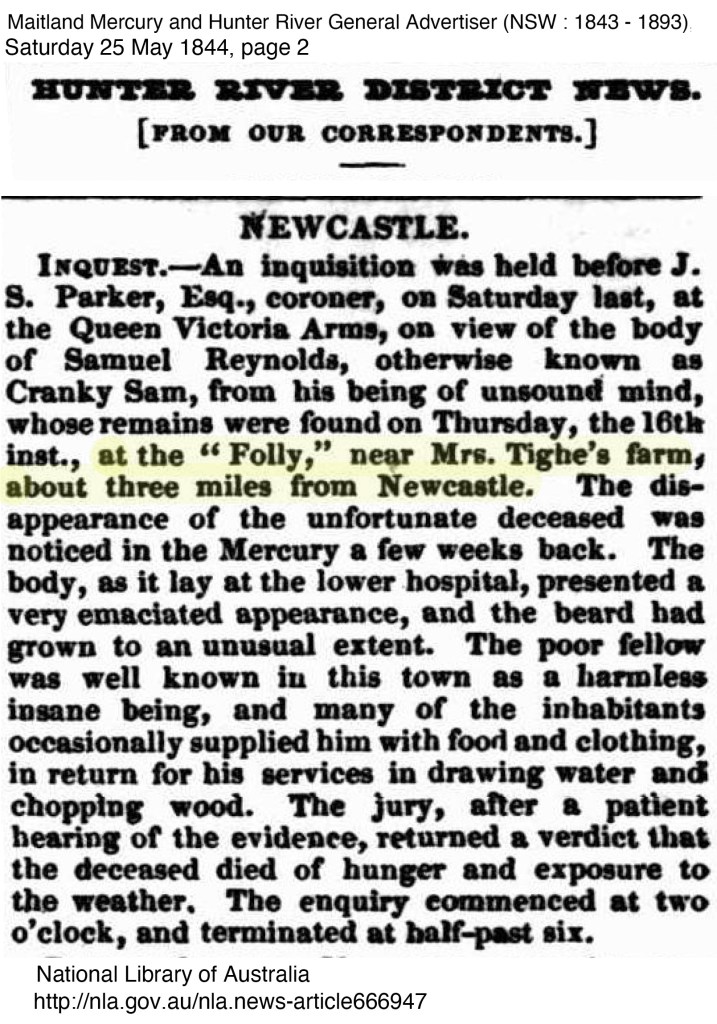
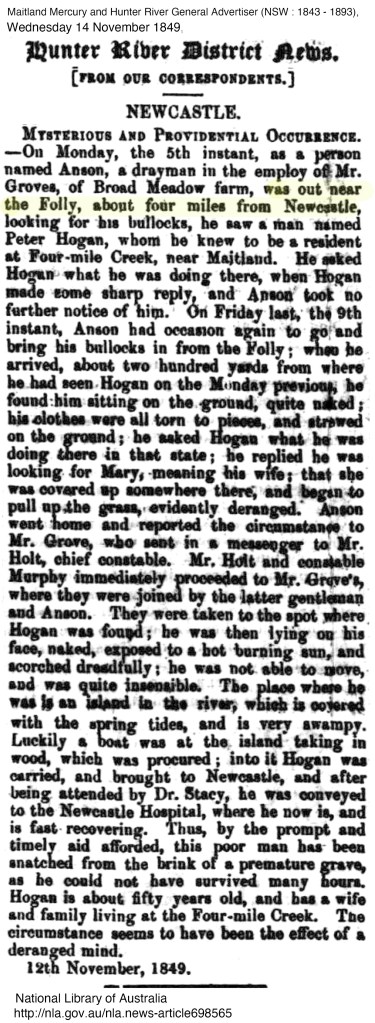
This is supported by earlier newspaper references as far back as 1844 and 1849.
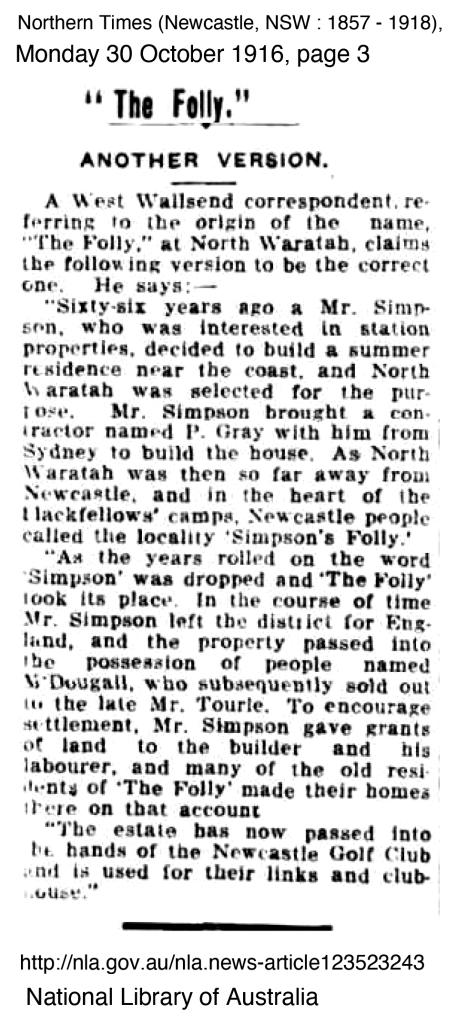
In 1916 an unusual version of the origins of the name ‘the folly’ came about.
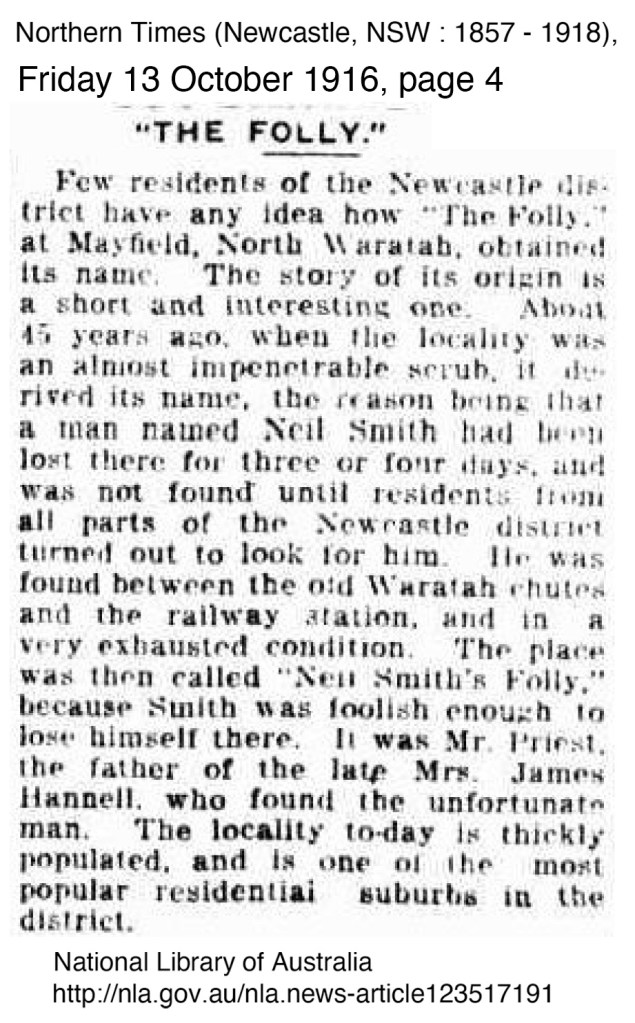
In response a ‘Wallsend correspondent’ wrote to the newspaper in 1916, with the statement: ‘Mr Simpson brought a contractor named P Gray with him from Sydney to build the house’. Although it can be seen from previous research that the reference of Mr Simpson coming from Sydney is incorrect, as Charles Simpson came from the Scone and Black Creek regions west of Newcastle. The contractor was likely not ‘P Gray’ but George Gray.
The Northern Times newspaper 1916 gives ‘another version’ of the history of ‘the folly’ and the building of Charles Simpson’s home ‘Waratah’ on the land. The time of ‘sixty-six years ago’ dates the arrival as about 1850 and the statement ‘In the course of time Mr Simpson left the district for England’ is correct. 5
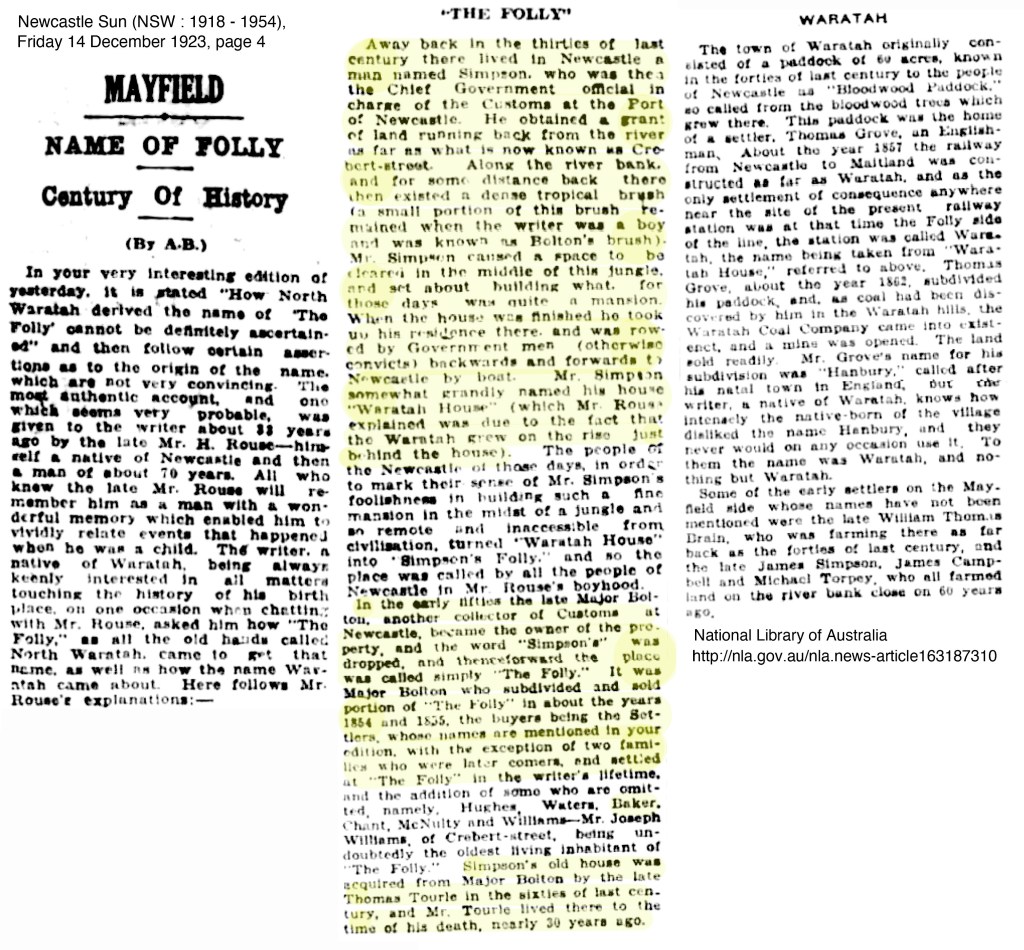
In 1923 another attempt to tell the story of ‘the folly’ was made by ‘A.B.’, again it tells the often repeated story of Charles Simpson the ‘Customs officer’ in the ‘1930’s’ adding the twist later repeated, that the land at ‘the folly’ was sold to Major Charles Bolton, who in fact was the Customs Officer. As seen in the previous records as to the sale of Charles Simpson’s land, this is not correct, it was Charles Simpson who directly sold the majority of his land to the Morse brothers and Thomas Tourle aside with the small portions contained in the larger allotments. The report was written in response to an article in the same newspaper the day before which stated: ‘ How North Waratah. derived the name of ‘The Folly’ cannot be definitely ascertained. Some people assert that it was owing to a man walking from Waratah towards the river getting lost in the scrub. Another version is that the knowing ones said that it was folly for anyone to settle down there, while a third reason is that sailors were guilty of folly in looking upon the wine too often. Whatever is the correct reason, few will charge the present holders of the land with being guilty of foolishness in having acquired their interests.’ 6
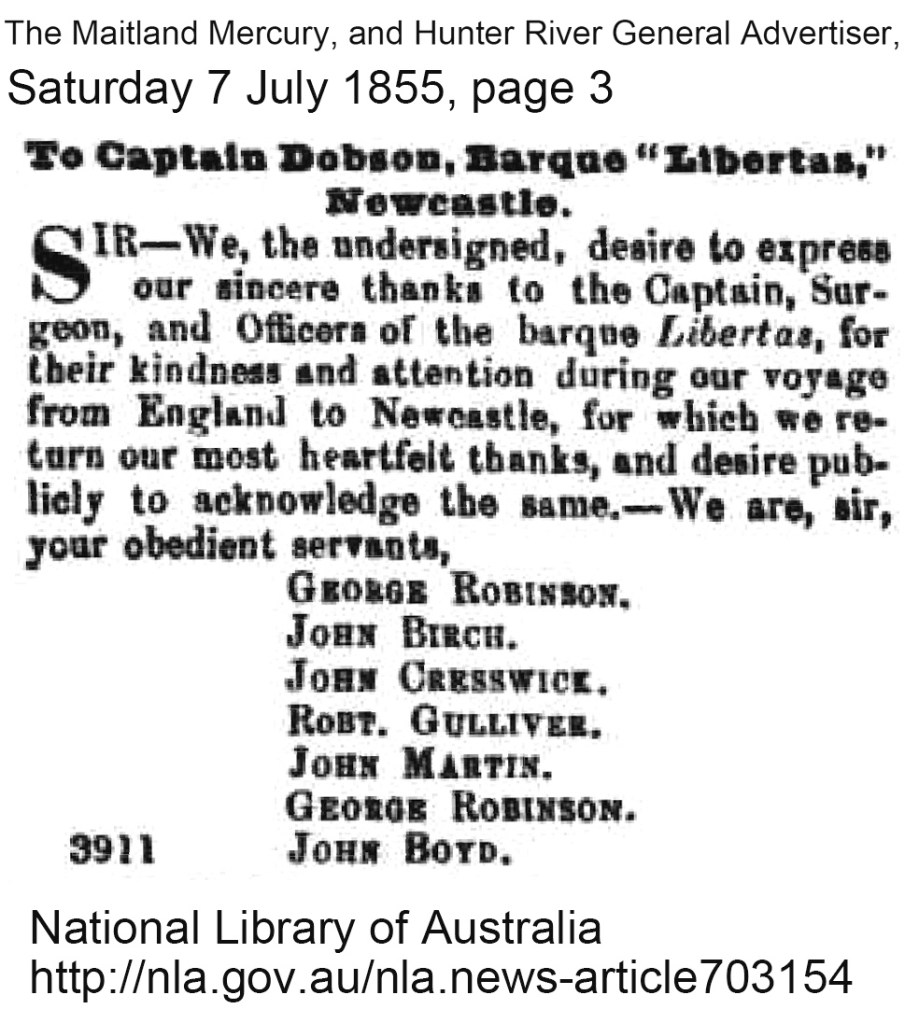
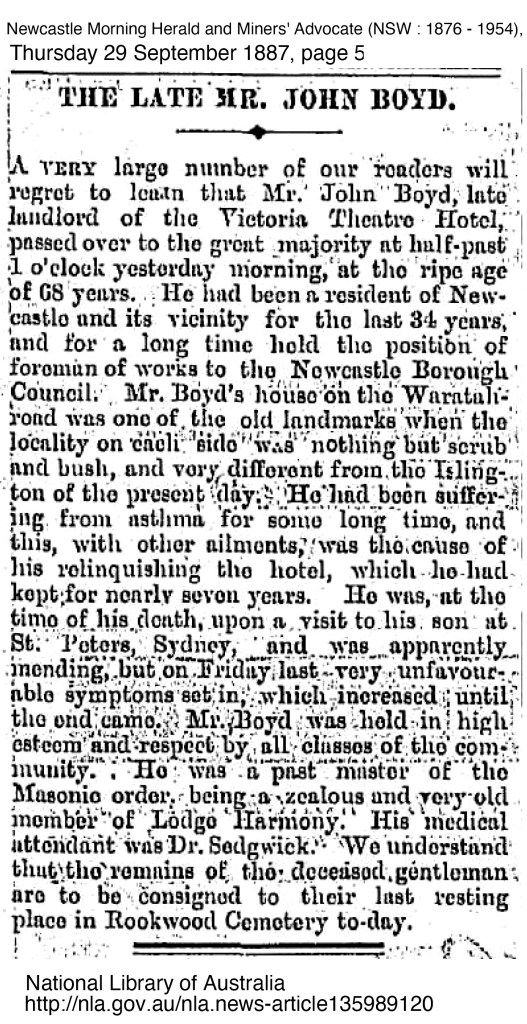
It is possible that ‘A.B.’ was Albert Fullerton Boyd who wrote to the Newcastle Herald in 1936 claiming his father ‘John Boyd, was the first settler in Mayfield’. Unfortunately for Albert and his letter writing, his father was not the ‘first settler’ but one of the early settlers having arrived in Newcastle in 1855 on the ‘Libertas’. The first settlers were however the father’s of Sid Bull and Peter Crebert who both purchased the original land from Charles Simpson in 1854 a year before John Boyd arrived. John Boyd, like George Gray was also a stonemason.

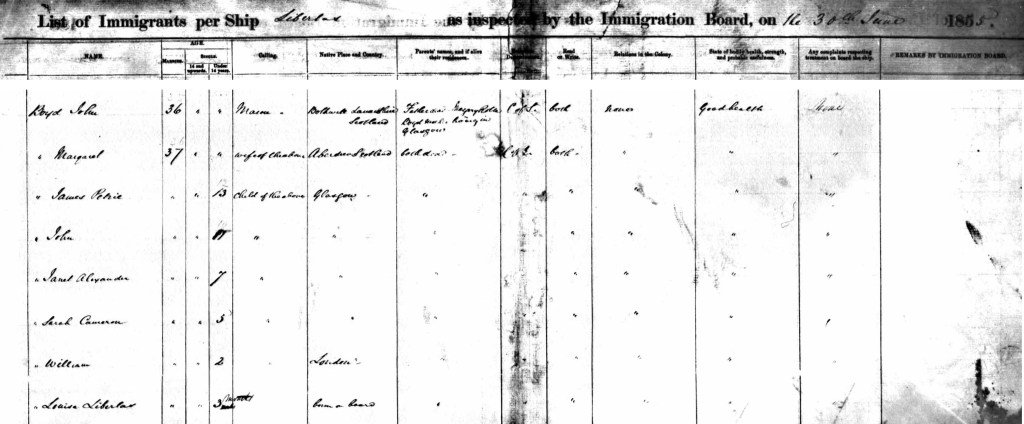
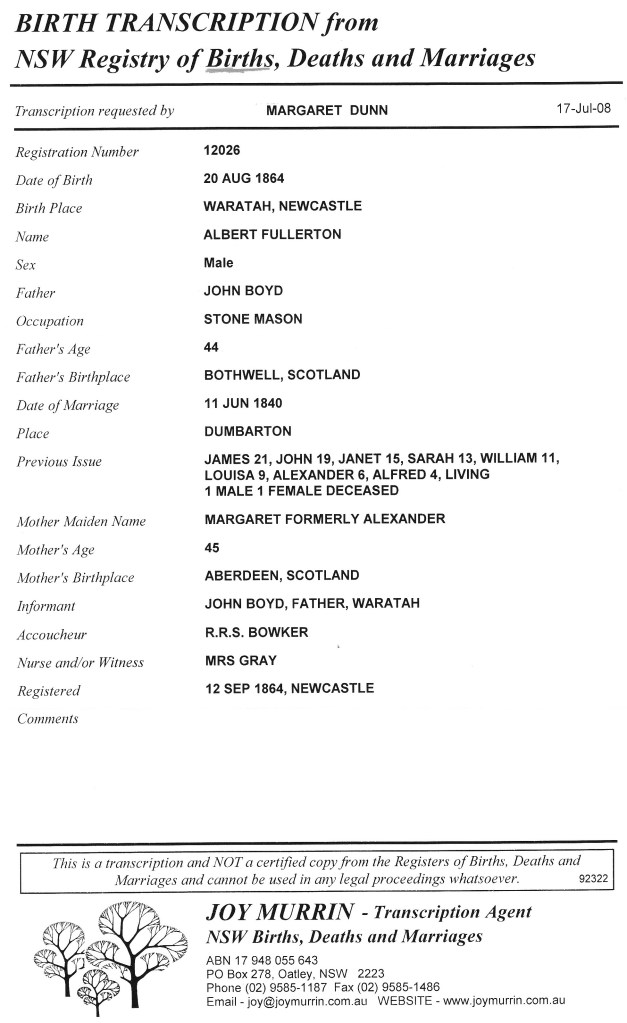
Of interest to the story of George and Emma Gray is Albert Boyd’s birth certificate.
Albert was born on 20 August 1864 at Waratah, the doctor was Dr Bowker and the nurse or witness to the birth was ‘Mrs Gray’.
George Gray had died in 1861 and Emma did not remarry until 1865 which makes it highly likely that ‘Mrs Gray’ is in fact ‘Emma Gray’ the widow of George who perhaps could have been working as a midwife for the local women at Waratah.
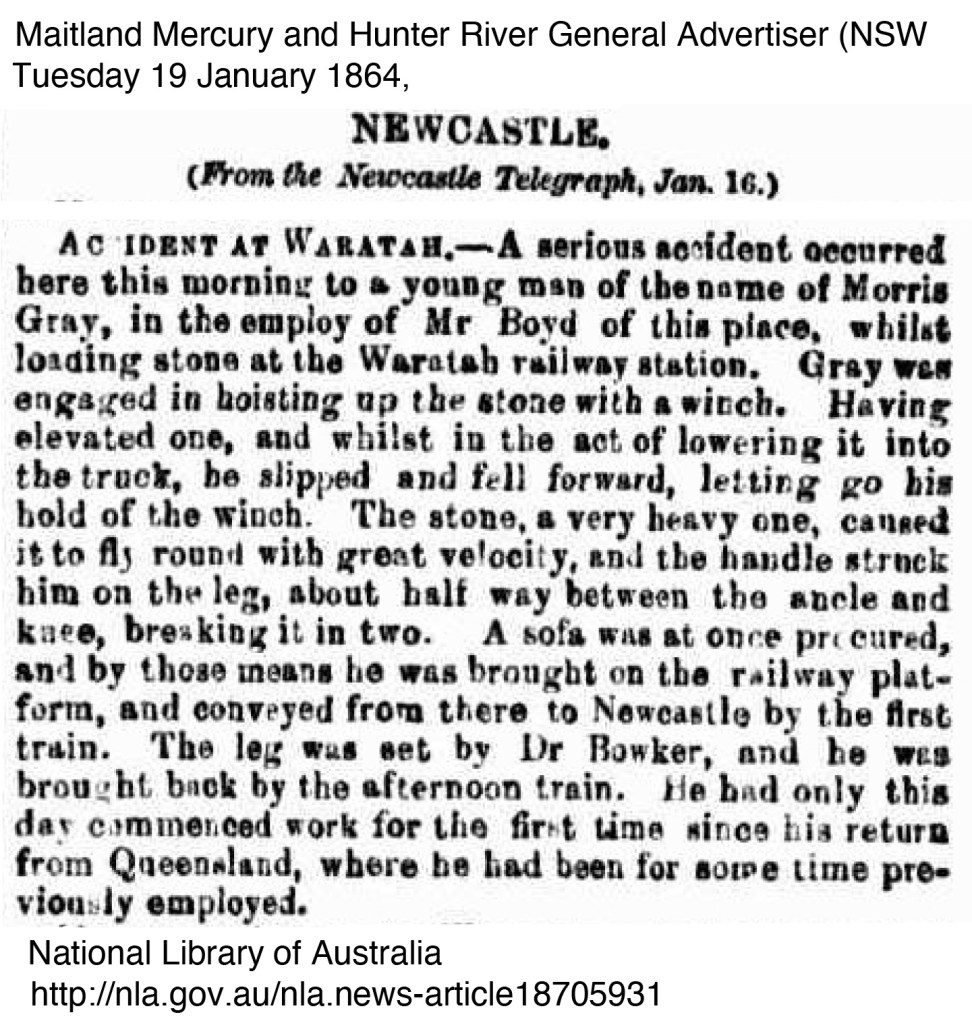
Another link between the Gray’s and the Boyd’s can be seen in the report of an accident involving Morris (Maurice) Gray in 1864.
Maurice was ‘in the employ of Mr Boyd of this place’ sustaining a broken leg which was set by Dr Bowker.
The name ‘the folly’ extends back to John Laurio Platt’s original grant that he took up and all the troubles he encountered, not least of which was that the land he chose was not of a quality to produce substantial crops. In 1950 a ‘Mayfield 1900-1950 Jubilee Celebration‘ with W J Goold, President of Newcastle and Hunter District Historical Society contributed to a souvenir booklet with an article ‘The Early Days’. He identifies: The old mill stood for many years and gave to that area the title of the “Mill Paddock,” so well known to old residents as the site for picnics and other outings.‘ He correctly identifies that Charles Simpson purchase of the land in 1848 (1849) : “Platt’s Folly.” The old pioneer’s ill-starred and tragic attempt to establish himself as a settler in a new country was referred to by other settlers along the Hunter River as “Platt’s Folly,” a title which eventually was the reason that all the land along the river front from the “Mill Paddock” to Port Waratah was called “the Folly.” One of the first to purchase land on “the Folly”was Charles Simpson, who in 1848 secured three allotments, and upon one of 36 acres on the river front he erected a substantial homestead. He named his residence “Waratah House,” from the fact that in the brush at the rear of his allotment the Waratah flower grew, and this is stated to have been the most northerly spot in which that particular flora existed. Simpson was an official of the Newcastle Customs house under Mr. Charles Bolton, the Sub-collector of Customs, who also had purchased several allotments of land at the “Folly,” portion of which was known locally as “Bolton’s Brush.” 7
George Abner Gray in his journal recalls the origins of ‘the folly’ name: ‘The name given to an estate bought by a man named Charles Simpson, it was situated near the Old Mill paddock which was a government grant to a man named Platt.’ 8
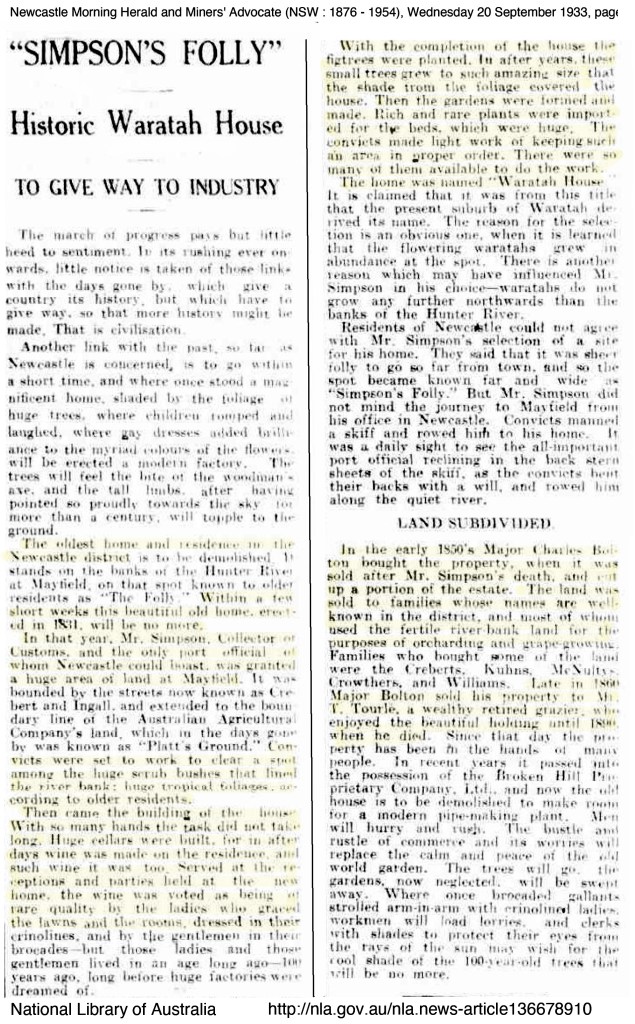
In another newspaper reference in 1933 the story of ‘Simpson’s Folly’ was again retold. Like other reports there are elements that are correct and incorrect.
‘beautiful old home [Waratah House] erected in 1831, will be no more. In that last year, Mr Simpson, Collector of Customs, and the only port official of whom Newcastle could boast, was granted a huge area of land at Mayfield. It was bounded by the streets now known as Crebert and Ingall, and extended to the boundary line of the Australian Agricultural Company’s land, which in the days gone by was known as “Platt’s Ground.”‘ … ‘In the early 1850’s Major Charles Bolton bought the property, when it was sold after Mr Simpson’s death, and cut up a portion of the estate. The ladn was sold to families whose names are well known in the district … Late in 1960 Major Bolton sold his property to Mr T. Tourle, a wealthy retired grazier, who enjoyed the beautiful holding until 1899 when he died.’ 9
As noted previously, even well known local historians like Thomas Braye (T. A. Braye) repeated elements of the stories again in 1936: ‘The next settler of note was Charles Simpson. He was a collector of Customs in Newcastle in the early ’40’s, and to him must be ascribed the honour of giving the name of Waratah to the district … In 1854, with Mr Charles Bolton, another grantee, Simpson cut up grants on the southern side of what was now Bull-street, and sold it in five acre blocks.‘ 10
In the newspaper in 1937 James W. Cowie describes lyrically Charles Simpson: ‘The man’s name was Charles Simpson. He was a Collector of Customs, stationed at Newcastle. He received a grant of land amounting to 35 ½ acres’11
Again in 1950 ‘W. B. McDonald’ repeats Charles Simpson’s ‘story’ of being a ‘Collector of Customs’ but at least the 1848 aligns with the purchase of the land by Charles Simpson.
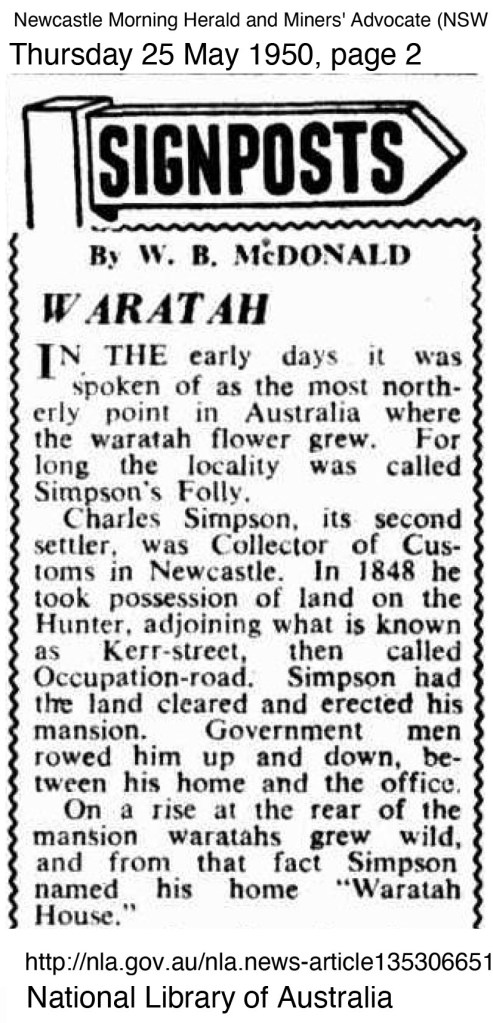
Whilst newspaper references can be invaluable it is always good practice to check the reports in them against evidence. By tracing the repeated stories it can be seen how the stories repeated often enough, become seen as facts when they are not. It is only by going back to original documents, sources such as government gazette notices, land titles, land documents and letters, that the true story of Charles Simpson was able to be found. The same is for the name of ‘the folly’ when later stories arise of its origins it can be seen that even before ‘the folly’ was settled by Charles Simpson and his workers including George Gray and Edmund Bull, it was known as ‘the folly’ linking it back to John Laurio Platt.
References
- The Journal of George Abner Gray 1846 – 1941 from the Original Clarence River Historical Society Grafton Second Edition 1975 page 14
- The Journal of George Abner Gray 1846 – 1941 from the Original Clarence River Historical Society Grafton Second Edition 1975 page 10
- Newcastle Morning Herald and Miners’ Advocate (NSW : 1876 – 1954), Saturday 4 July, page 5 – Mayfield Was Too Far to Go Home
- NSW BDM – NSW Old Register William Bull Vol: 56 No: 366 son of Edmund & Mary Jane Bull Methodist Baptisms in the Hunter River Circuit in the County of Northumberland from the ninth day of July 1851 to the 12th day of January 1852
- Northern Times (Newcastle, NSW : 1857 – 1918), Monday 30 October 1916, page 3 “The Folly” Another Version
- Newcastle Sun (NSW : 1918 – 1954), Thursday 13 December 1923, page 19 GREEN FIELDS GIVE WAY TO SMOKY INDUSTRY
- Newcastle Sun (NSW : 1918 – 1954), Friday 14 December 1923, page 4 MAYFIELD NAME OF FOLLY Century of History (by A.B.)
- The Journal of George Abner Gray 1846 – 1941 from the Original Clarence River Historical Society Grafton Second Edition 1975 page 14
- Newcastle Morning Herald and Miners’ Advocate (NSW : 1876 – 1954), Wednesday 20 September 1933, page 5 “SIMPSON’S FOLLY” Historic Waratah House TO GIVE WAY TO INDUSTRY
- Newcastle Morning Herald and Miners’ Advocate (NSW : 1876 – 1954), Saturday 3 October 1936, page 5 WARATAH’S FIRST SETTLERS Mr. Braye Reviews Early History
- Newcastle Morning Herald and Miners’ Advocate (NSW : 1876 – 1954), Saturday 13 February 1937, page 5 Waratah House Passes By James W. Cowie
 George Gray - Stonemason & Builder