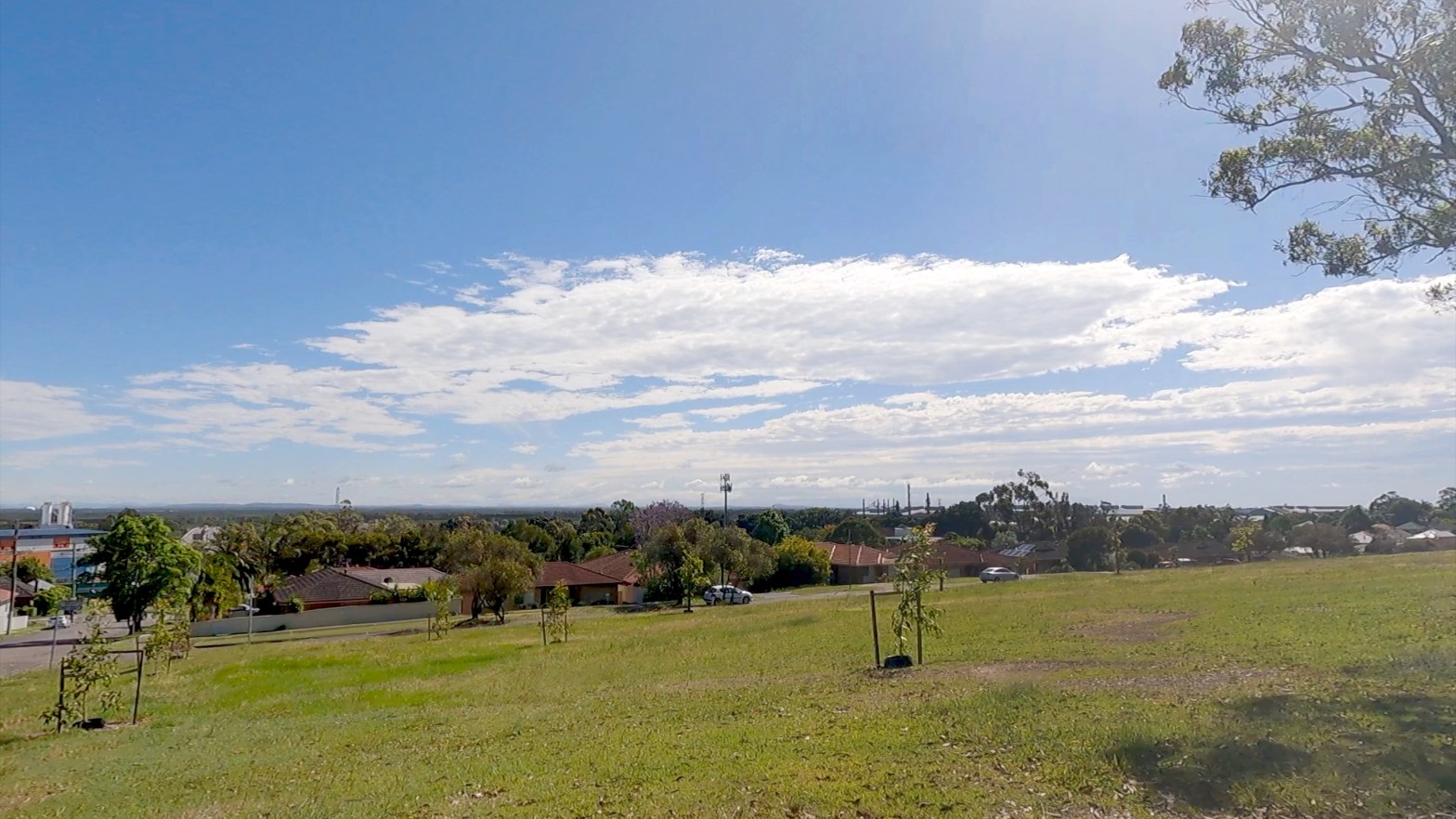
The question posed in the chapter about Simpson’s sale of small portions of between three and five acres back in the chapter Charles Simpson – Small Portions Sale of Land at The Folly, Waratah, was why would Charles Simpson carve out these five small portions when he was selling the bulk of all his land to Thomas Tourle and the Morse brothers on 17 July 1854.
There is perhaps a clue in Charles Simpson’s final Will and Codicil a copy of which is found in the NSW State Archives.1
Within the beneficiaries of his Estate Charles Simpson makes some interesting smaller bequests: ‘I give to each of my servants living with me at the time of my death, the sum of fifty pounds. I give to each of my Executors and Trustees hereinafter appointed the sum of Two hundred pounds each for their trouble improving my Will and acting in the trust thereof ‘.2
Clearly Charles Simpson Esq valued those people who helped him and responded to that help by such gestures. It is noted in other chapters, that the beneficiaries of these allotments were those that were involved in the building of his Waratah House or helped with the vineyard and gardens. Although the recollections vary a little overall there was an understanding of Charles Simpson’s generosity.
‘In the course of time Mr. Simpson left the district for England … To encourage settlement, Mr. Simpson gave grants of land to the builder and his labourer, and many of the old residents of “The Folly’ made their homes there on that account.’ 3
Edmund and Mary Jane Bull
Sid Bull in recalling his father’s allotment stated: ‘Bulls-Street, Mayfield was named after my father. A retired squatter took come land and as payment for clearing the land to establish a vineyard father was given seven acres, which he planted as a garden. As the custom with many well-to-do people in those days, the squatter planted vineyard to produce wine for his own use.’ 4
George and Emma Gray
George Gray’s granddaughter, the daughter of George and Emma Gray recalled in 1953: ‘When it had been struck by its isolation. It was too lonely for his family, so he prevailed on Mr. Gray and his workmen to buy some of the 36 acres he owned around i and build their own homes. The land was offered at £1 an acre. Mr Gray spent £3/10 built himself a house, planted grapes, oranges vegetables, and settled with his wife there and family.’ 5
Benjamin and Elizabeth Baker
Thomas Braye the historian stated that until 1857 there were only a few settlers on the land of what was then Waratah with the bulk of the settlement occurring from 1857. ‘The settlers who acquired the land cultivated it as vineyards and orchards. Among the notable families that settled there was Mr. Peter Crebert (after whom Crebert Street is named), who was one of the purchasers in 1854, and planted vineyards on his block, and made wine there for many years afterwards. Another was Phillip Kuhn, and other purchasers were Crowther, Walters or Waters, Robertson, Russell, Bull, Gray and Baker, and these settlers can be taken as the first of the early settlers in the area in 1854.’ 6
As seen in the previous chapter Charles Simpson – Small Portions Sale of Land at The Folly, Waratah there were five families that benefited from Charles Simpson’s generosity. Three are discussed in other chapters: George Gray, Edmund Bull and Benjamin Baker. The other two were Philip Kuhn and Peter Crebert.
Philip and Anna Maria Kuhn
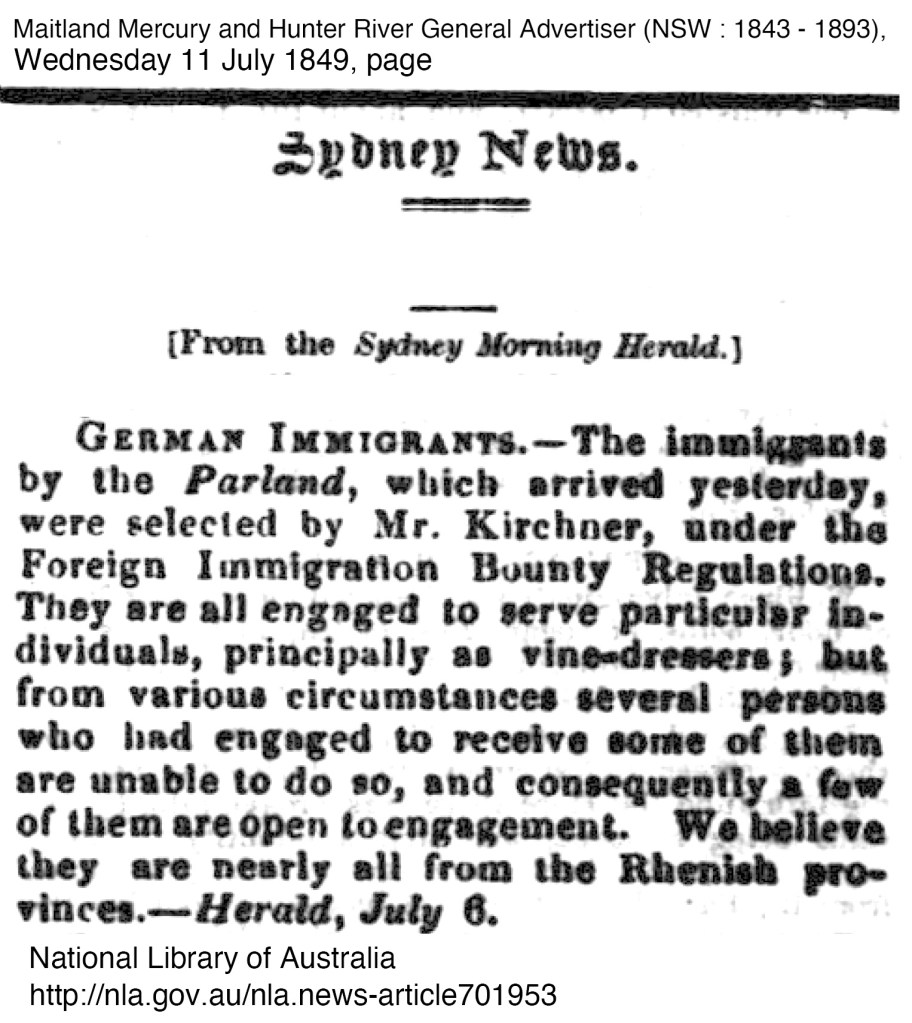
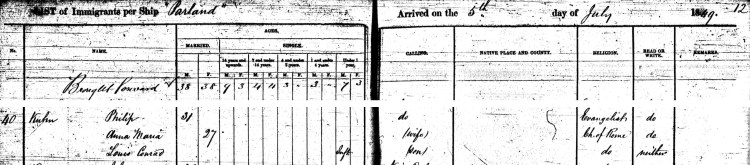
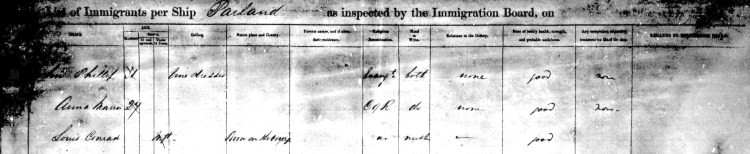
Philip Kuhn and his wife Anna Maria nee Diefenbach and their baby son Louis Conrad, arrived on the ship the ‘Parland’ on 5 July 1840. They along with Peter Crebert were vinedressers selected by ‘Mr Kirchner’ as part of the Bounty Immigration scheme.7
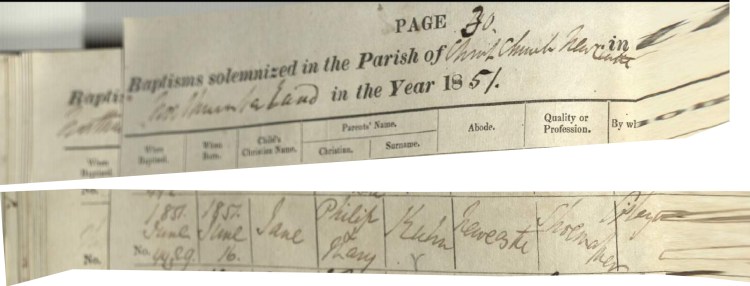
The 1851 Baptismal register shows that Philip and Mary’s daughter Jane was born on 16 June 1851. Their Abode is listed as Newcastle and Philip Kuhn’s profession as ‘shoemaker’.8
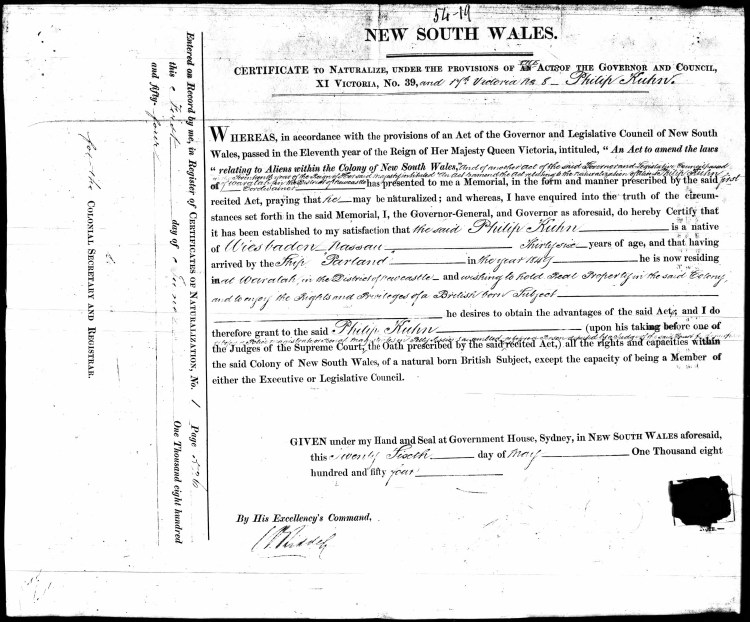
On 25 May 1854 Philip Kuhn became a naturalised citizen of the new colony of New South Wales.10 His certificate tells us he was born in Weisbaden, Nassau, Germany stating his occupation as a Cordwainer. A cordwainer was a step up from a shoe repairer as they were allowed to make new shoes from new leather rather than just repair shoes as a cobbler would.
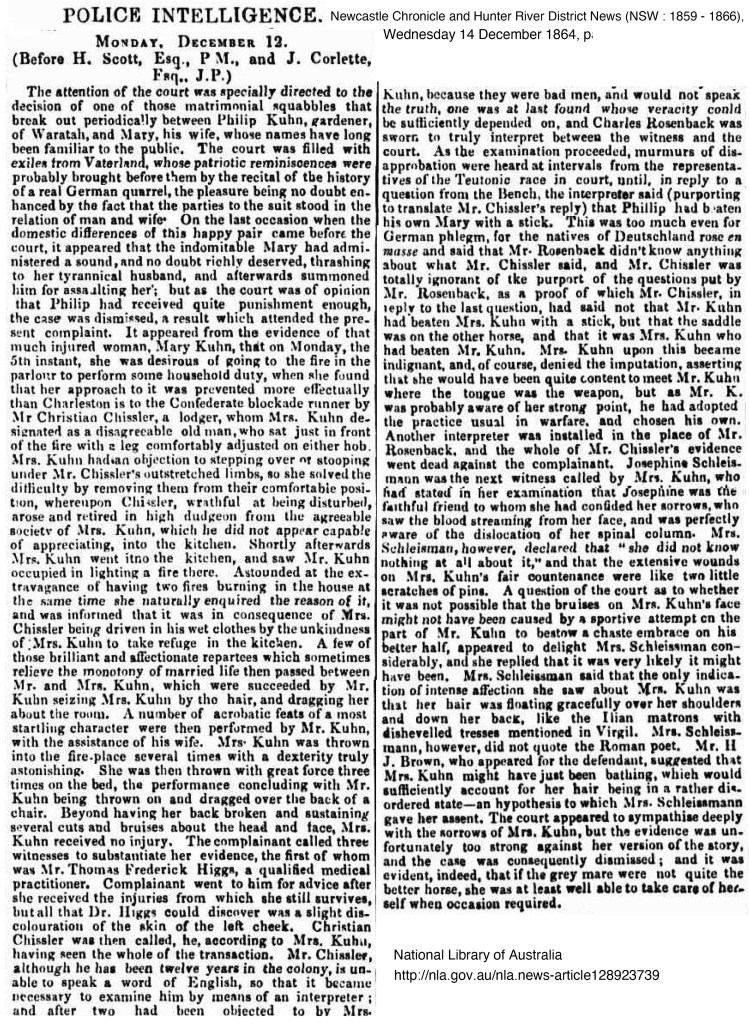
It appears that Philip and Anna Maria Kuhn had a rather tumultuous relationship, of which one episode in court was recorded in the local newspaper.
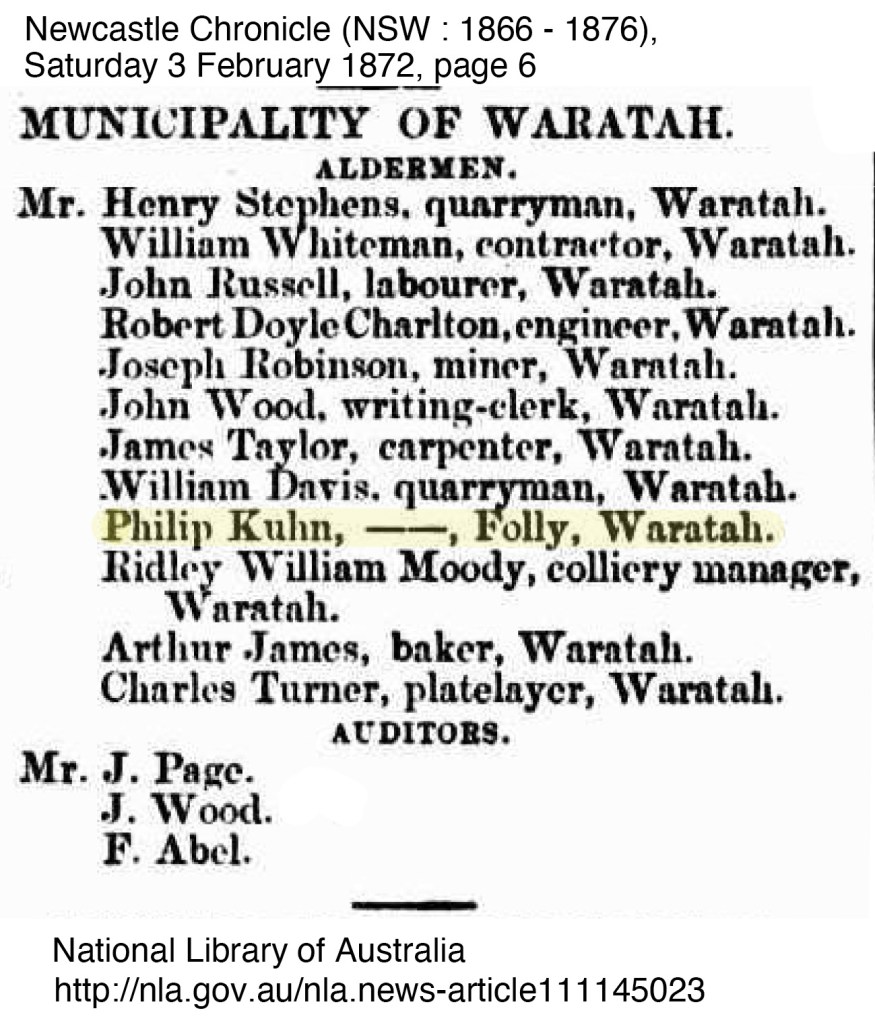
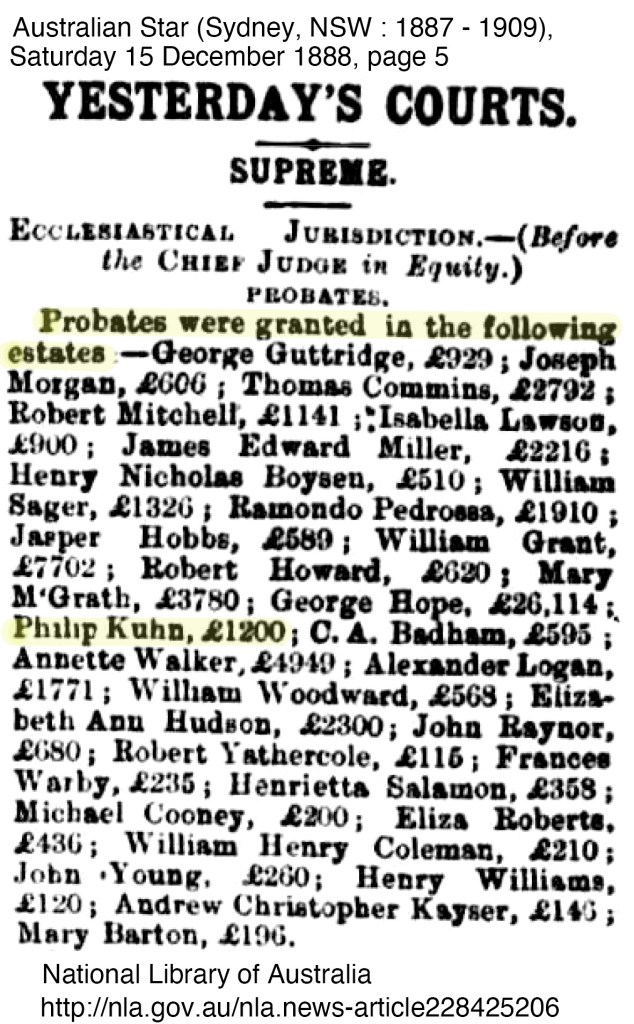
Philip Kuhn was also an Alderman on the local Council.
Peter and Maria Louisa Crebert
Peter and Maria Louisa Crebert arrived in Sydney on 5 July 1849 on the ‘Parland’ along with the Kuhn family. Like Philip Kuhn, Peter Crebert’s ‘calling’ was as a ‘Vine Dresser’. Peter was 25 years and his wife Maria was 21 years.11

A report in the Newcastle & Hunter District Historical Society in 1948 states: ‘When seventeen years of age, he had been apprenticed to a nursery at Wiesbaden, where he learned his trade, and where he remained until he left his homeland with a party of vine dressers bound for Australia.‘ 12
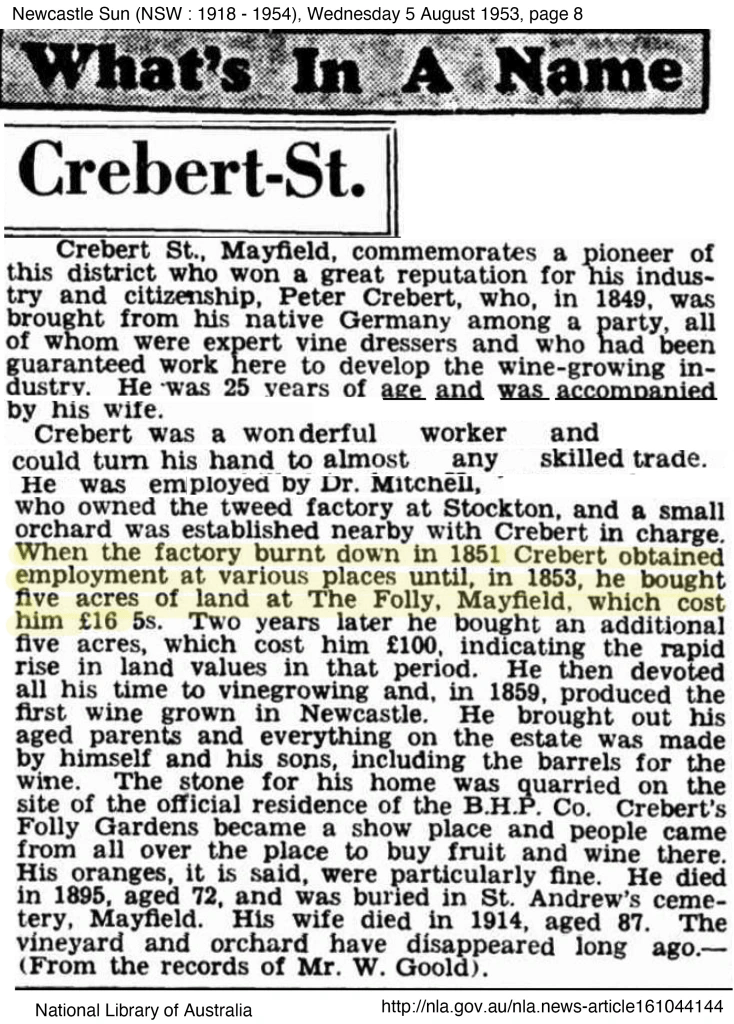
As reported in the article about Crebert St, Peter Crebert originally worked for Dr Mitchell in his Tweed factory and orchard/vineyard. It burnt down in 1851 so he ‘worked at various places until in 1853 he bought five acres of land at The Folly, Mayfield’. The date of purchase was incorrect as he was not naturalized at this time, as were other reports indicating he purchased the land from Charles Bolton.
W J Goold of the Newcastle & Hunter District Historical Society states: ‘Work in the vineyard was abandoned, and for a time Crebert, who was a handy man and a good rough carpenter, was employed by the Doctor at Burwood (Merewether). He cut and squared the girders in the tunnel that led to the smelting works, and other jobs of a similar nature on the Burwood Estate.‘ 13
Like Philip Kuhn, Peter Crebert was also naturalized into the colony of New South Wales on 25 May 1854. His occupation was listed as a ‘Gardener’.14
The document also reveals he came from Kederick, Nassau, Germany.
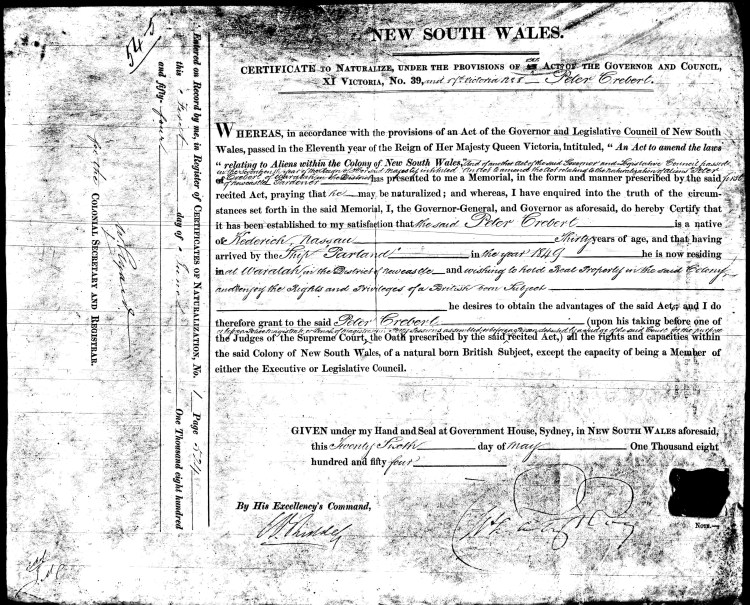
The significance of naturalization from an ‘alien’, (a non British subject), was required if that person wished to vote or own land but it required that you needed to be a resident of New South Wales for five years.15
Philip Kuhn had fulfilled the 5 years residency and become naturalized enabling the land purchase to be made. Peter Crebert paid ‘the sum of sixteen pounds and five shillings‘ for his five acres ‘of land hereby released are part and parcel of land and situated at the South East corner of twenty acres of land allotment Number fifty nine’. It was dated, the 6th June 1854. The witness for the Indenture record was Benjamin Baker. This was land originally purchased by Charles Simpson on 12 October 1852.16
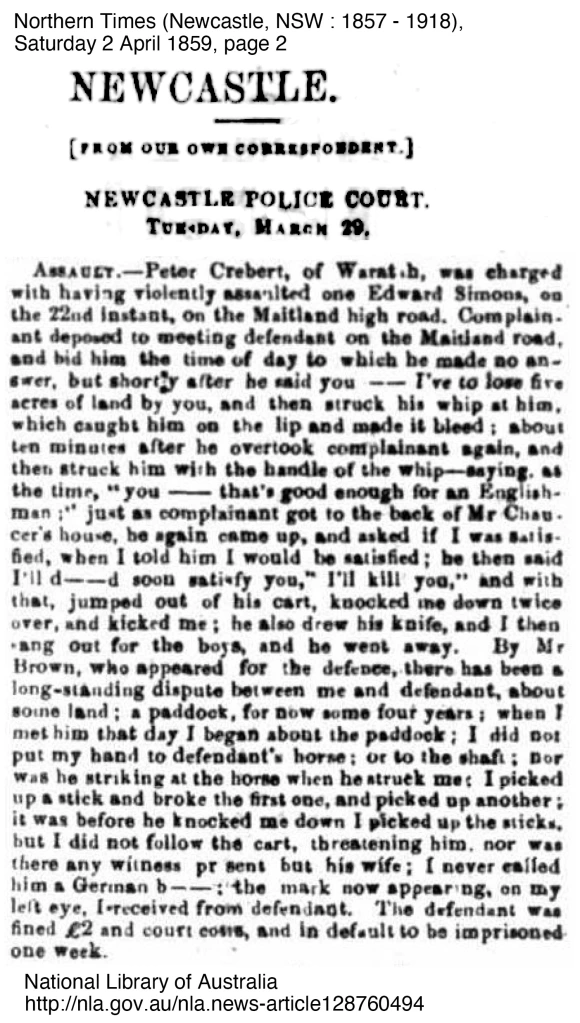
Like many of this time, violence was not an uncommon encounter nor action.
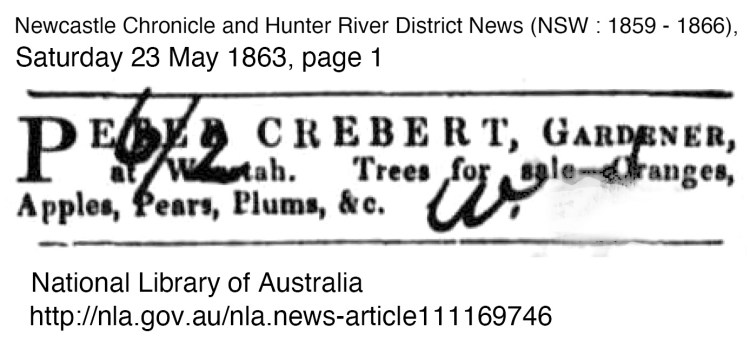
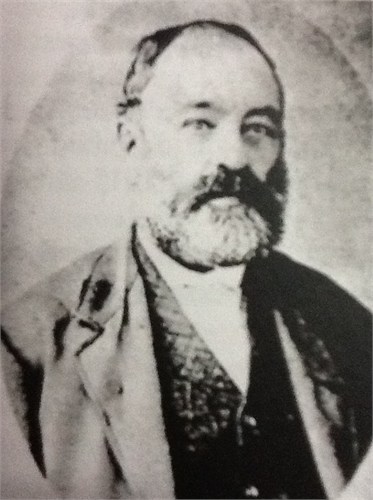
Much has been written about Peter Crebert, his garden, vineyard and life at The Folly, with ‘Crebert Street’ remaining as a record of his life and work. These are three articles written for the local newspapers including information about the early settlers including peter Crebert, some of which is correct and some incorrect.
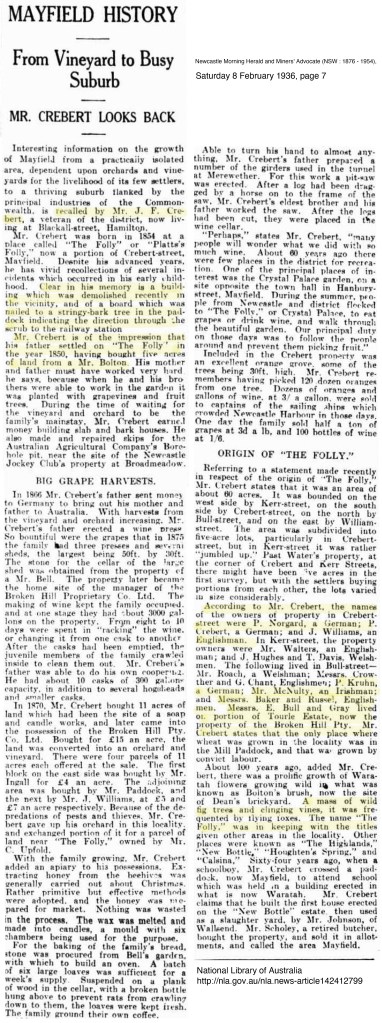
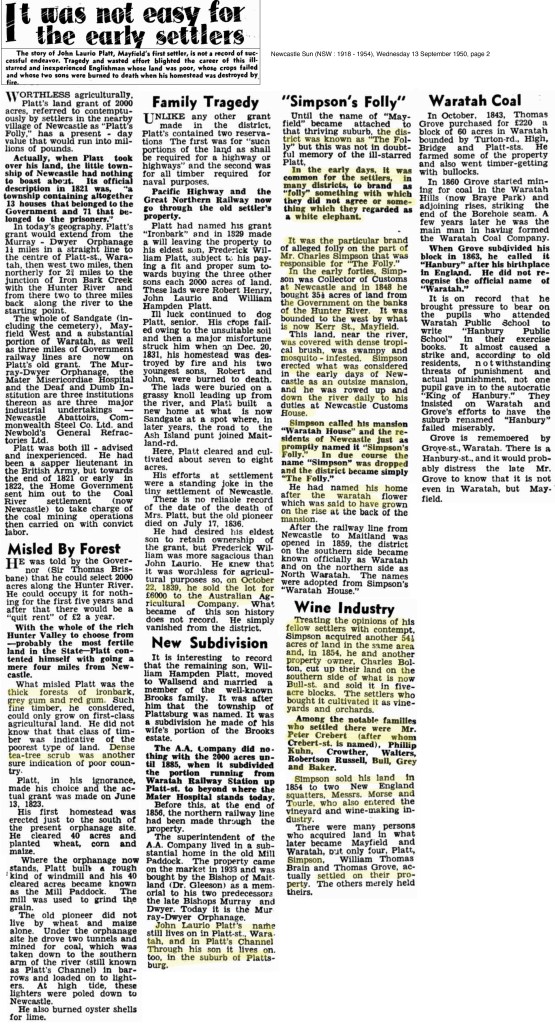
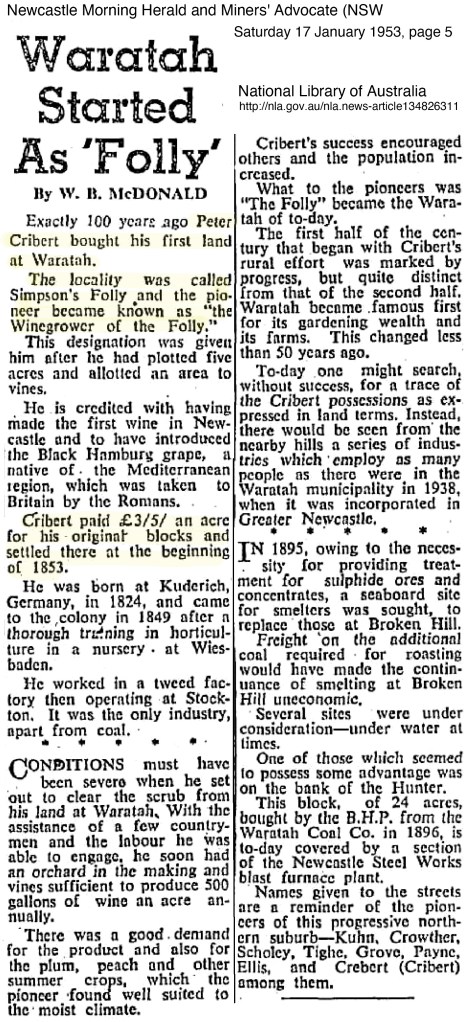
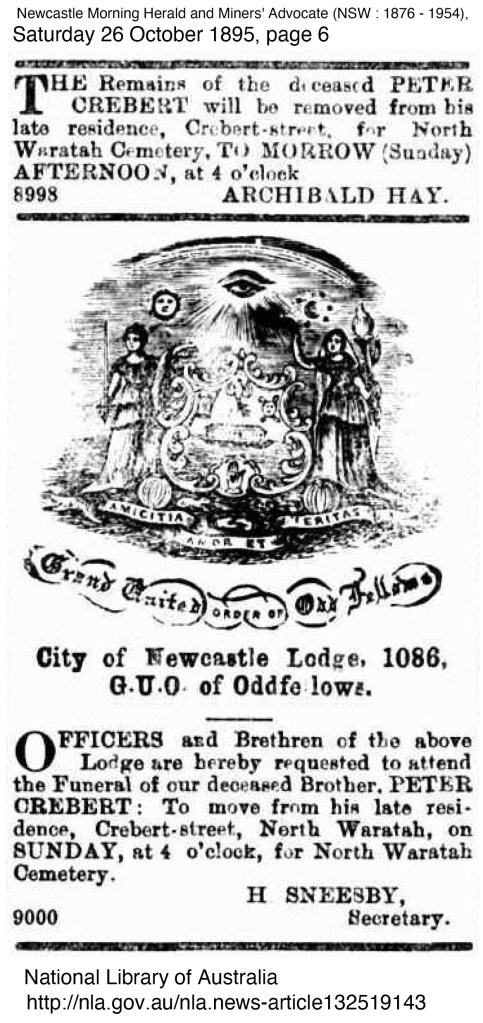
Peter Crebert died on 25 October 1895 at his property on Crebert Street.
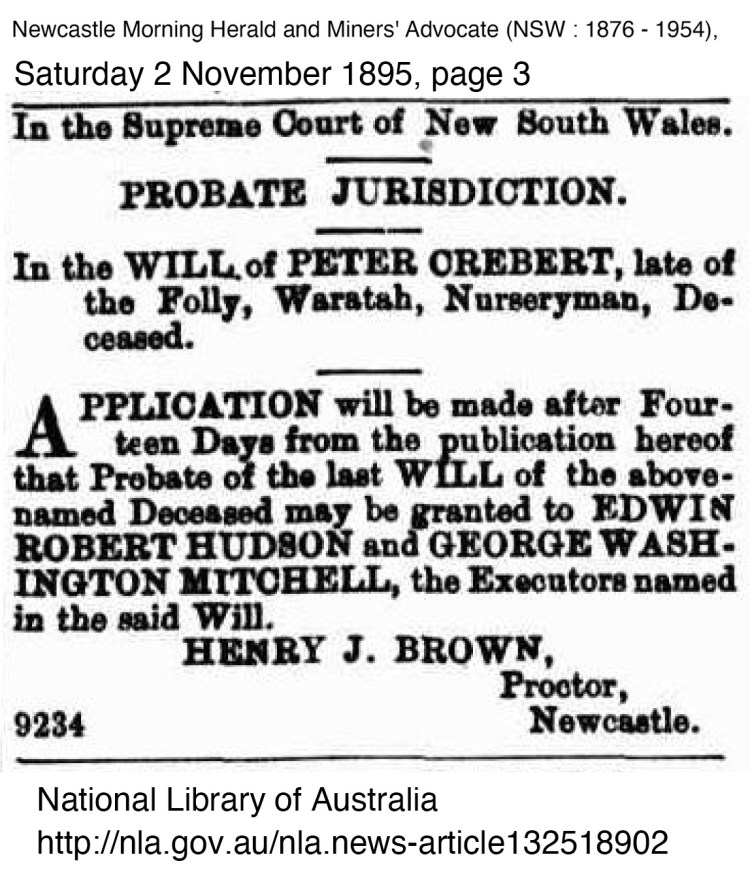
Probate was applied for in November 1895.
References
- NSW State Archives NRS-13660-5-89-Series 4_21908 | Charles Simpson – Date of Death 07/12/1899, Place of residence Southampton
- Will and Codicil of Charles Simpson – NSW State Archives NRS-13660-5-89-Series 4_21908 | Charles Simpson – Date of Death 07/12/1899, Place of residence Southampton
- Trove Newspapers – Northern Times (Newcastle, NSW : 1857 – 1918) Mon 30 October 1916 page 3 ‘The Folly, Another Version’
- Trove Newspapers: Northern Times (Newcastle, NSW : 1857 – 1918), Monday 30 October 1916, page 3
- Trove Newspapers: Newcastle Morning Herald and Miners’ Advocate (NSW : 1876 – 1954), Saturday 4 July 1953, page 5
- T A BRAYE
- Charles Simpson – Small Portions Sale of Land at The Folly, Waratah https://georgegraybuilderwaratah.com/2023/06/26/charles-simpson-small-portions-sale-of-land-at-the-folly-waratah/
- NSW State Archives Index INX-9-195127 – KUHN, Philip – Assisted Immigrants Index 1839-1896 Age: 31 | Ship: Parland | Year: 1849 | Copy: Reel 2459, [4/4912]; Fiche 851
- NSW BDM
- NSW State Archives Index INX-30-2573 – KUHN, Philip – Naturalization Index 1834-1903 Item No: [4/1200] | Page No: 526 | Reel No: 129
- NSW State Archives Index INX-9-165846 GREBERT PeterAssisted Immigrants Index 1839-1896 Age: 25 | Ship: Parland | Year: 1849 | Copy: Reel 2459, [4/4912]; Fiche 851& Index INX-9-1658459 GREBERT Maria Louisa Assisted Immigrants Index 1839-1896 Age: 21 | Ship: Parland | Year: 1849 | Copy: Reel 2459, [4/4912]; Fiche 851
- Peter Crebert by W.J. Goold – Newcastle & Hunter District Historical Society Vol.2 August 1948, part XI p.161-164
- Peter Crebert by W.J. Goold (Reprinted from Newcastle & Hunter District Historical Society Vol.2 August 1948, part XI p.161-164.)
- NSW State Archives Index INX-30-3064 CREBERT Peter Naturalization Index 1834-1903 Item No: [4/1200] | Page No: 524 | Reel No: 129
- NSW State Archives Naturalization / Citizenship Guide – NSW Archives https://www.records.nsw.gov.au/archives/collections-and-research/guides-and-indexes/naturalization-citizenship-guide#:~:text=There%20was%20no%20law%20covering,the%20right%20to%20own%20land.
- NSW Land Titles Indenture Records – 1854 9 June – Peter Crebert & Charles Simpson – Book 32 Number 539
 George Gray - Stonemason & Builder