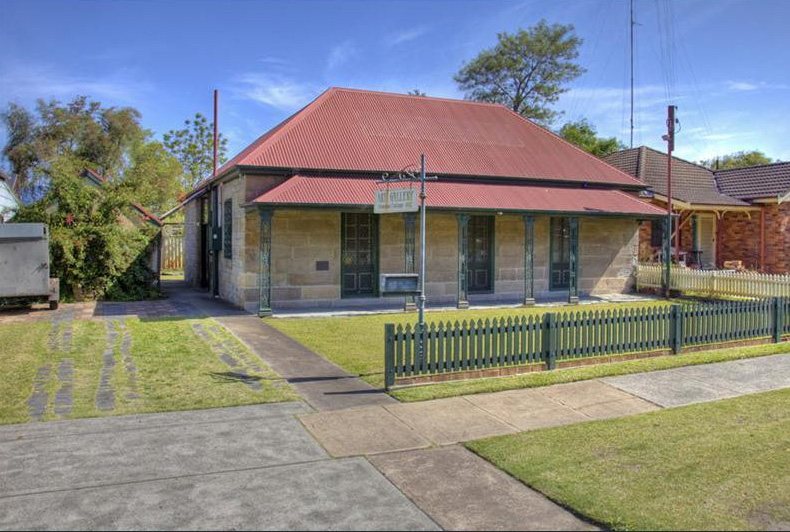
In finalising the research regarding Charles Simpson it became important to look a little further afield at an old stone cottage known as ‘Simpson’s Cottage’ at 64 Industrial Drive, Mayfield which was previously known as Bull’s Road, Waratah before the change of the area from Waratah to Mayfield North.
There are conflicting accounts around the date it was built, and of the source of both the name, and the reason it was built. By consulting land titles, map records and other accounts it provides a clearer picture of this cottage which in fact should be called ‘McNulty’s Cottage’. The McNulty’s were in fact the owners of the land, the builders and indeed the occupants of this old stone cottage which they built for their family.
There is very little evidence, and as with other myths about Charles Simpson the Magistrate and Warden of Newcastle1 who was never a Customs Officer, it is important to revise and correct the record in regards to this cottage which is said to have been built for Charles Simpson.
‘Simpson’s Cottage’ in fact should be known as ‘McNulty’s Cottage’, the reasons for which are outlined below.
Stone Cottage – 64 Industrial Drive, Mayfield
In starting with the current address of 64 Industrial Drive, Mayfield we find the most recent title reference is the prior title reference Vol-Fol 9714-85. This reference is however, not available online in the historical viewer on the NSW Land Titles website. It is possible in these cases that nearby allotments with available online records could have been used in order to work backwards to find the original land titles. However, given the previous research which I have undertaken on Charles Simpsons and his land at The Folly, it allows in this case to begin researching the stone cottage at the original land purchases by Charles Simpson and their land titles then work forwards.
There is a guide to looking at property and land title records which can be seen on the NSW Archives House & Property Guide on their website.
Charles Simpson – Allotment 59
To recap regarding Charles Simpson Esq at The Folly also known as Waratah and now Mayfield, the original Portion 118 Allotment 59 was purchased by Charles Simpson, Magistrate and later Warden of the Council of Newcastle.
Charles Simpson came to New South Wales as a public servant likely in 1841, first living and working in Scone, New South Wales where he married Eliza Harriet Darby nee Browne in 1844. He worked there as a Magistrate leaving in 1851, purchasing land Black Creek and working at the surrounding areas as a Magistrate before in 1852 he became the Warden of the District Council of Newcastle until approximately 1854.2
Charles Simpson purchased land at ‘the Folly’ from 1848, commissioning what is known as ‘Waratah House’ which was built by George Baker, builder and stonemason, his brother in law Edmund Bull, likely using a crew of ex convicts who George Gray was known to employ. As recalled by his son George Abner Gray the sawyers who suppled the timber for Waratah House were Benjamin Baker and Henry Crowther.3 Philip Kuhn was another employee of his along with Peter Crebert who likely worked with vineyards and gardens alongside Edmund Bull, also a gardener.
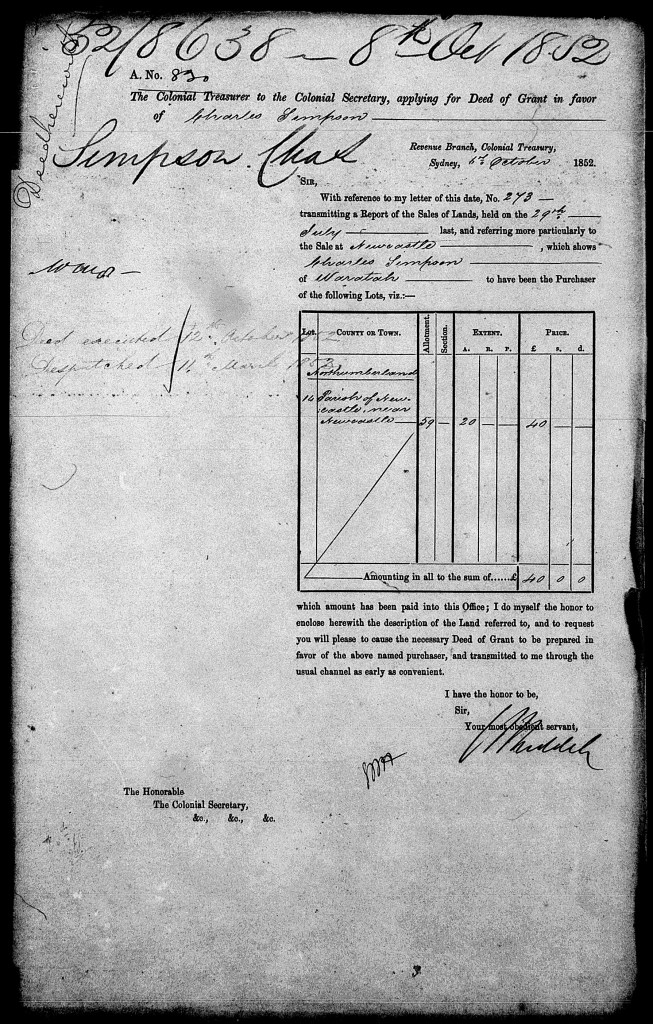
As this record from the NSW State Archives from the Colonial Secretary’s Papers regarding Charles Simpson’s purchase of Allotment 59 shows, the Deed was executed on 8th October 1852 and despatched on 11th March, 1853.
Charles Simpson of Waratah purchased 20 acres pf Allotment 59 in the County of Northumberland, Parish of Newcastle near Newcastle. He paid £40 for the 20 acres. So £2 per acre.
It can be noted that he sold a 5 Acre section of this allotment 59 to Benjamin Baker for £15 on 9 June 1854, which was £3 per acre.
Documented in the previous chapter Charles Simpson Land Purchases – The Folly, Waratah, the full account of Charles Simpson Esquire, Magistrate and Justice of the Peace, his purchase of land and life at Waratah can be seen in full.
It is on this allotment 59 that the stone cottage currently known as ‘Simpson’s Cottage’ still stands.
However, William McNulty and his family did not arrive in New South Wales from England until March 1853. The small 5 acres from allotment 59 was sold by Charles Simpson to Benjamin Baker in 1854 before it was then sold to William McNulty in 1855.

Establishing the historical Land Titles for McNulty’s Cottage
The maps below allow for the establishment of what is now known as ‘Simpson’s Cottage’ to be seen as part of Charles Simpson’s allotment 118 and not Charles Bolton’s allotment 117. Another reference point used in matching an overlay of a current map with the old maps and plans for this area is Mayfield Park which is the marked red rectangular section in allotment 117 in the larger overlay map.
Using this method and cross referencing land titles and maps an sequence of ownership for this property can be established starting with the sale of this land in 1854 by Charles Simpson when he divulged all his property at Waratah and moved into Newcastle where he was then working as the Newcastle Council Warden.
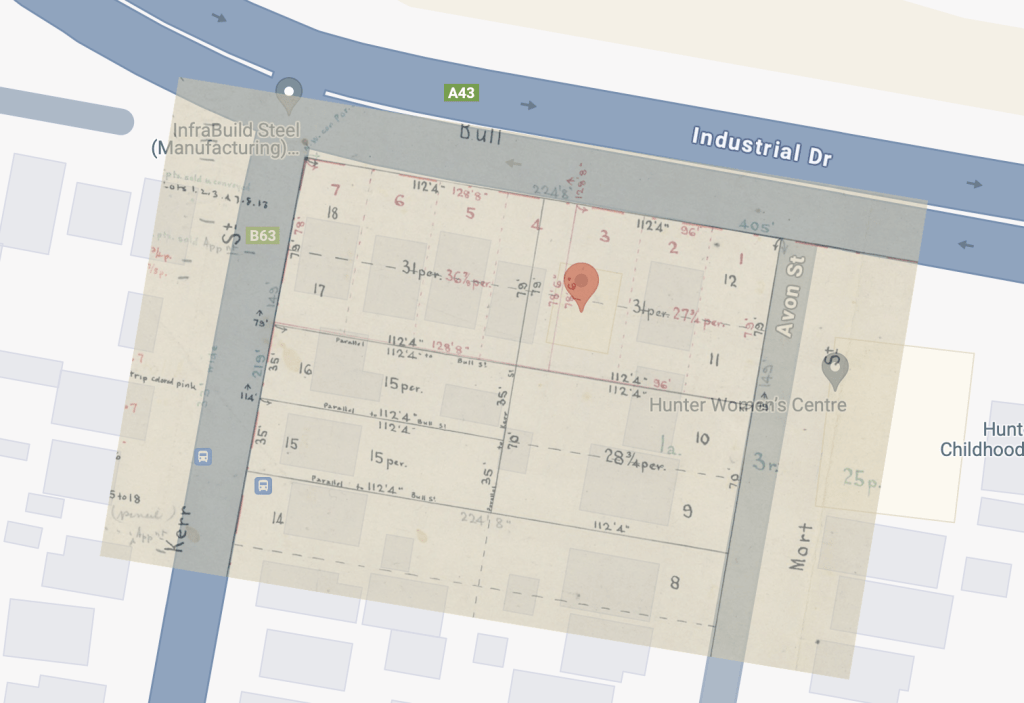
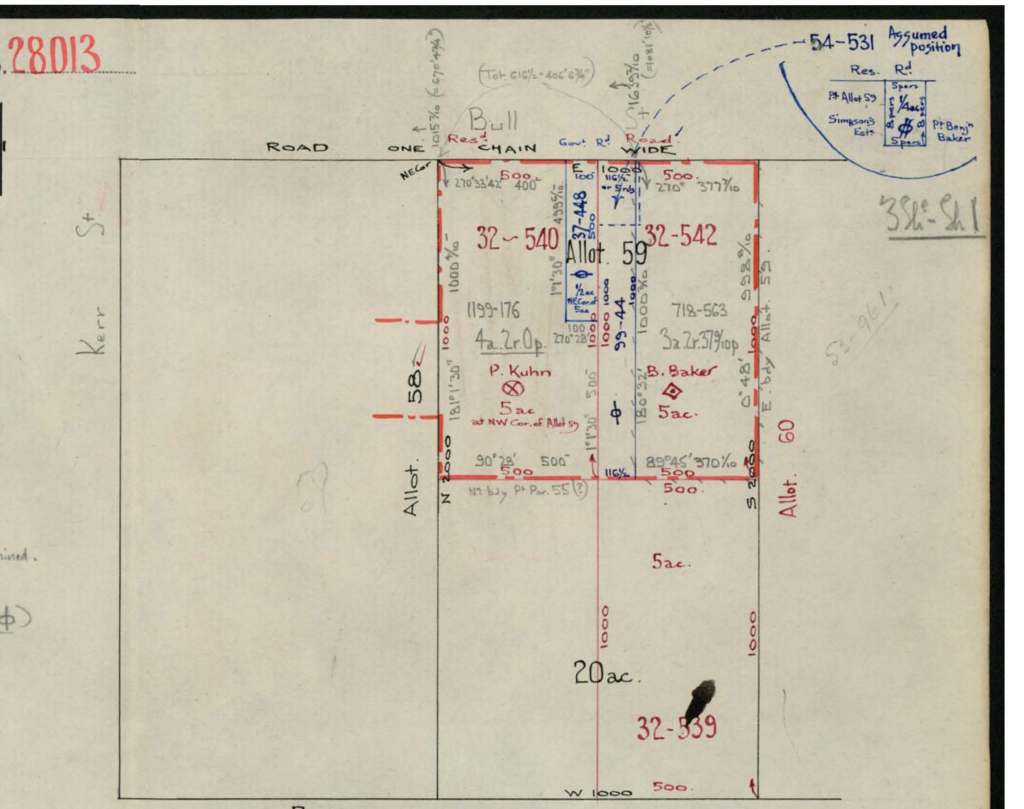
The map on the left overlayed on a google map image establishes the position of 64 Industrial Drive Mayfield, or ‘Simpson’s Cottage’ with the red drop point. Set alongside the map on the right from the Primary Application 28013 for Lysaght’s development, the two five acre land allotments sold by Charles Simpson can be seen with on the left to Philip Kuhn and the right, Benjamin Baker purchases each five acres. This map is excerpt of a map in the Primary Application 28013 in the NSW Land Titles for the Lysaght’s ‘Pommy town’ development.

Looking in more detail at the map overlays above, it can be seen that the current position of 64 Industrial Drive is within the land of Portion 118 Allotment 59 purchased first by Charles Simpson on 8 October 1852 consisting of 20 acres. It can also be seen that the current position of the stone cottage aligns with Benjamin Baker’s five acres of land.
On 9 June 1854 Charles Simpson sold his land at what was then Waratah (The Folly) and as part of those sales he sold 5 acres of allotment 59 to Benjamin Baker ‘Settler’ and 5 acres to Philip Kuhn ‘Cordwainer’ NSW Land Titles – Book-Number 32-540.
Philip Kuhn
It was then Philip Kuhn who was also a ‘Gardener’ on 2 March 1855 – NSW Land Titles – Book-Number 37-448, sold one half an acre to William Coleman ‘Settler’.
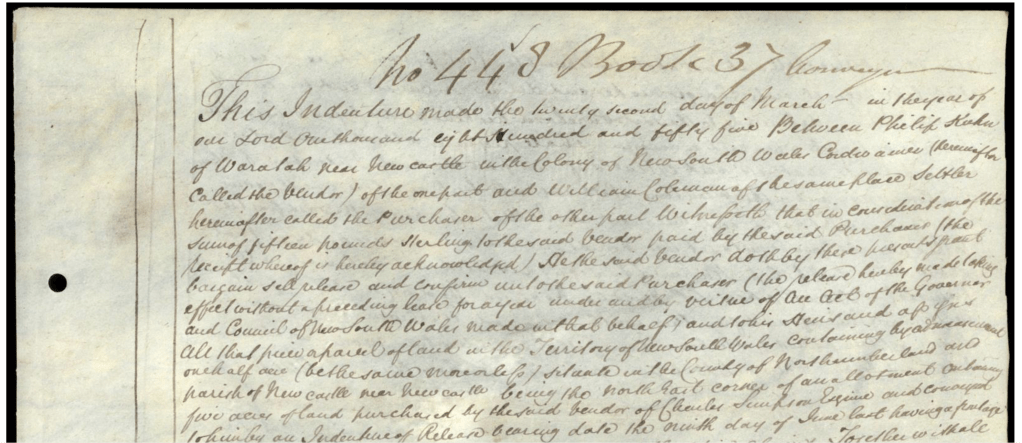
On the 4 January 1858 William Coleman ‘Settler’ sold this one half acre to William McNulty ‘Labourer’ – NSW Land Titles – Book-Number – 53-570.
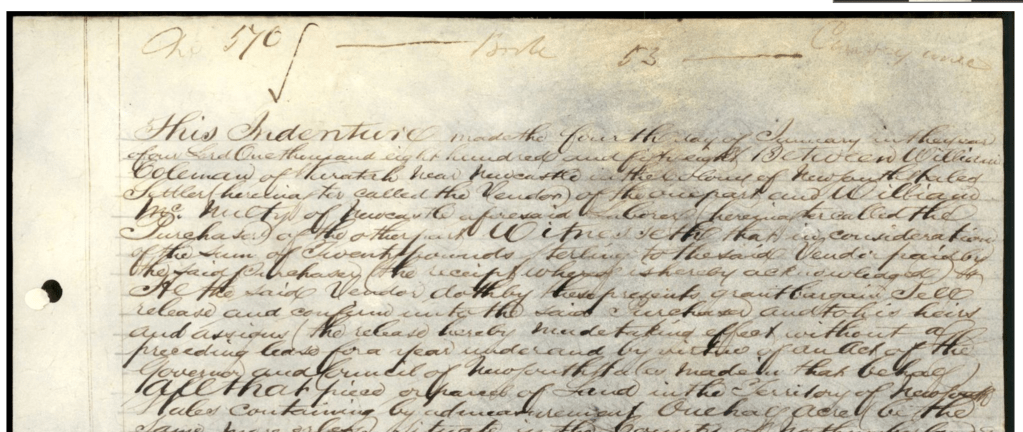
NSW Land Titles – Book-Number: 53-570 INDENTURE: William Coleman to William McNulty – ½ acre allotment 59 EXCERPT
Looking at the above overlay map of 64 Industrial Drive, Mayfield it can be seen by the placement of the yellow line in the overlay map showing the two original 5 acre allotments to Baker and Kuhn, that the land owned by Kuhn then Coleman is not the land on which the stone cottage was built but adjoining the cottage lot owned by Benjamin Baker. It should be acknowledged that if you access and read many of these land title records, that these men were often witnesses for each other in these transactions, Benjamin Baker in particular, was frequently a signatory or witness.
William McNulty and Benjamin Baker
This excerpt from the indenture shown on the right between Benjamin Baker ‘Settler’ and William McNulty ‘Labourer’ of Waratah, can be found in Book-Number 54-531it establishes that the purchase of 1/4 acres occurred on 10 March 1855.
William McNulty paid £7 ½ pounds for the 1/4 acre which was £30 per acre, this shows the increase of the value of land in this area as more settlers and services came to the area.
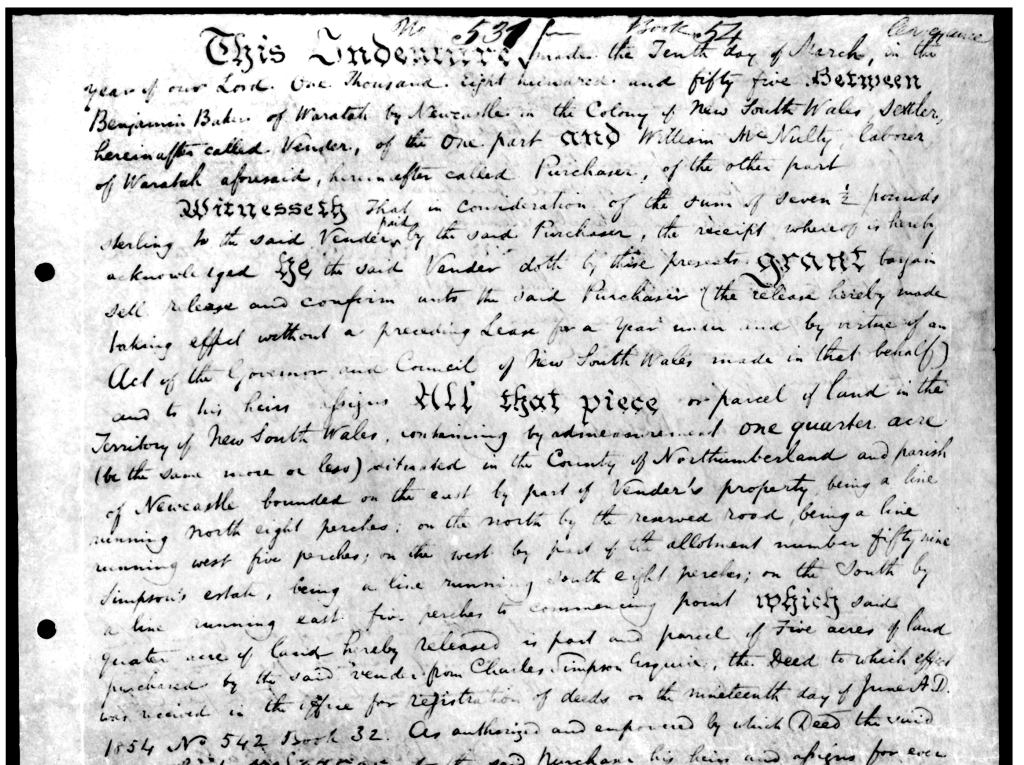
This full two page indenture record between Benjamin Baker and William McNulty in 1854, describes only the land with no mention of improvements such as a ‘stone cottage’ which is typical for a land title record.
William McNulty and the stone cottage
In looking further afield than land purchases, there would be a need to consider a number of factors two of which are important: capacity to build a stone cottage and availability of materials.
William McNulty from ‘Smith’ to ‘Stonemason’
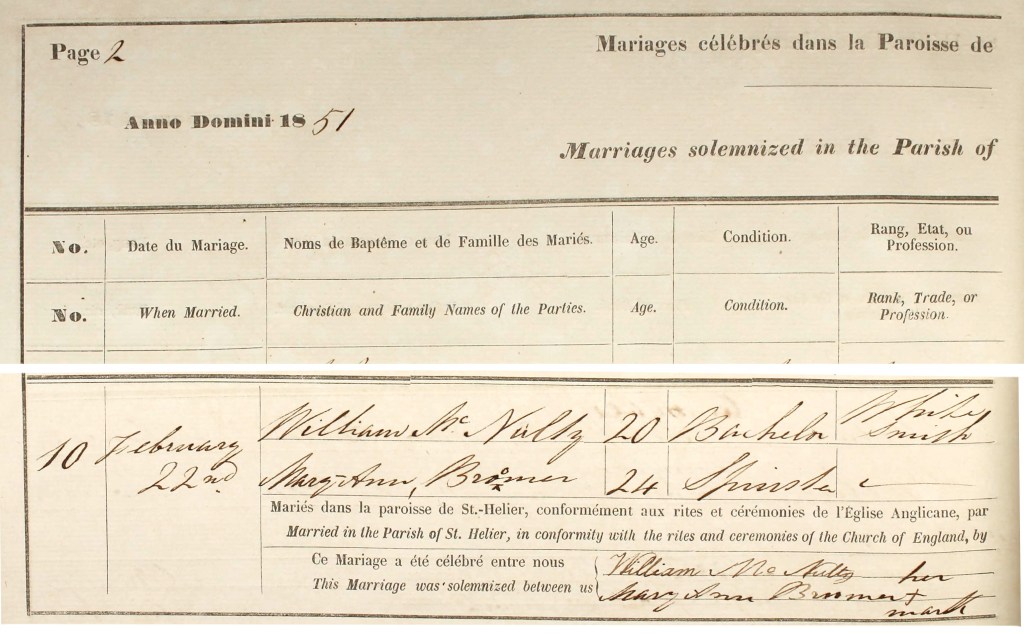
The records below are what is known of William McNulty’s occupation from when he married Mary Broomer in St. Helier, Jersey, Channel Islands, England on 22 February 1851, where he noted his profession as a ‘White Smith’ and agin on the baptism record of his daughter Ann in 1852. A whitesmith was a metalworker who does finishing work on iron and steel such as filing, lathing, burnishing or polishing including making such things as cooking pots, pans and items such as internal pull bell systems from tin plate. The 1851 census his occupation was ‘Grate Fetter’ likely someone who perhaps secured grates in place, again with metal so within the scope of someone who was also a whitesmith.
In 1853 William and ‘Margaret’ actually Mary Ann McNulty, immigrated to New South Wales on the ‘Agricola’ with their daughter Mary Ann. William was born in Gibralter and Mary Ann on the Jersey Islands. This corroborates George Abner’s journal in that they speak French and English on the Islands which are off the coast of France.
On his arrival in Brisbane in in 1853 he occupation was also a ‘Smith’. So William McNulty’s skills do not appear at this time to encompass building and stonemasonry. When he purchased his land first from Benjamin Baker in 1855 and then William Coleman in 1858 he listed his occupation as a ‘labourer’.
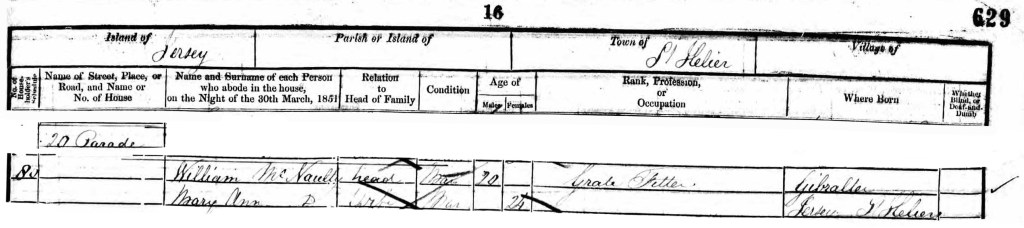
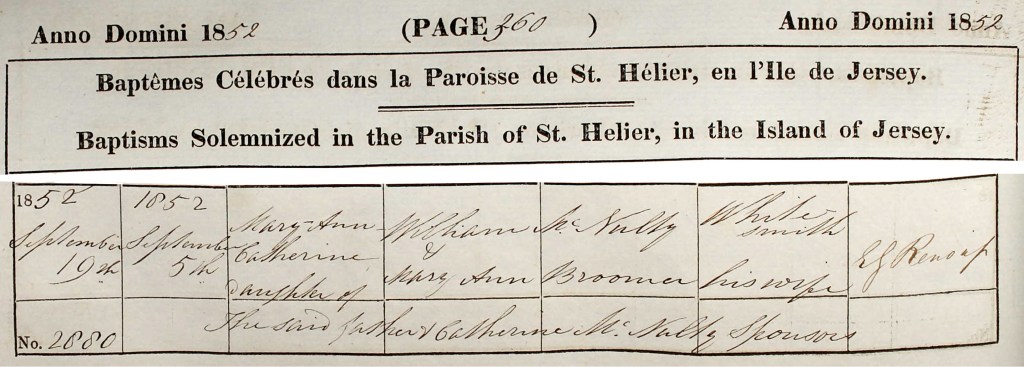
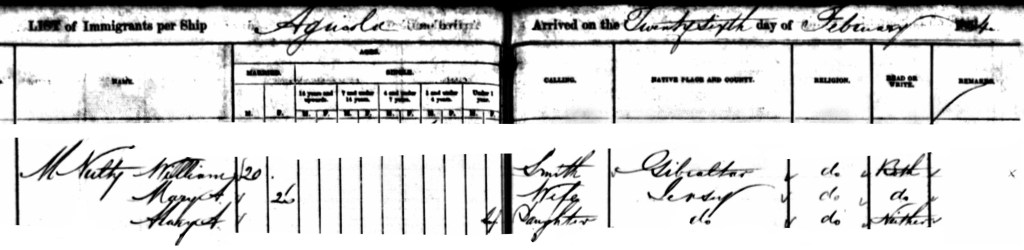
In 1853 William and ‘Margaret’ actually Mary Ann McNulty, immigrated to New South Wales on the ‘Agricola’ with their daughter Mary Ann. William was born in Gibralter and Mary Ann on the Jersey Islands. This corroborates George Abner’s journal in that they speak French and English on the Islands which are off the coast of France.
It was not until he purchased his second parcel of land eight years later from Benjamin Baker on 2 July 1866, that he listed his occupation as a ‘Mason’.
Stone Quarry at Waratah
In order to build stone dwellings in the Waratah area there would need to be the materials available within the nearby area. There is little evidence that a stone quarry was in the Waratah area until 1857.
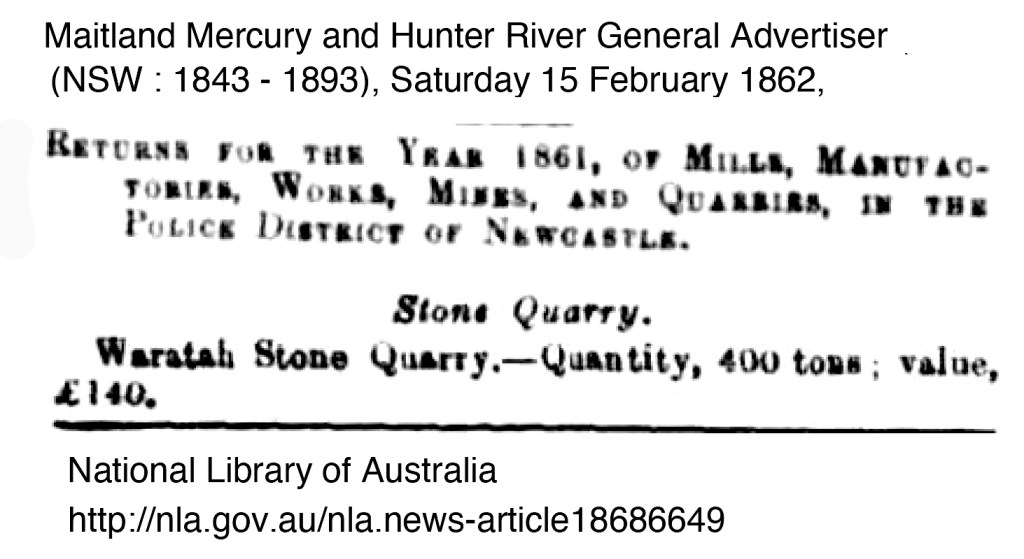
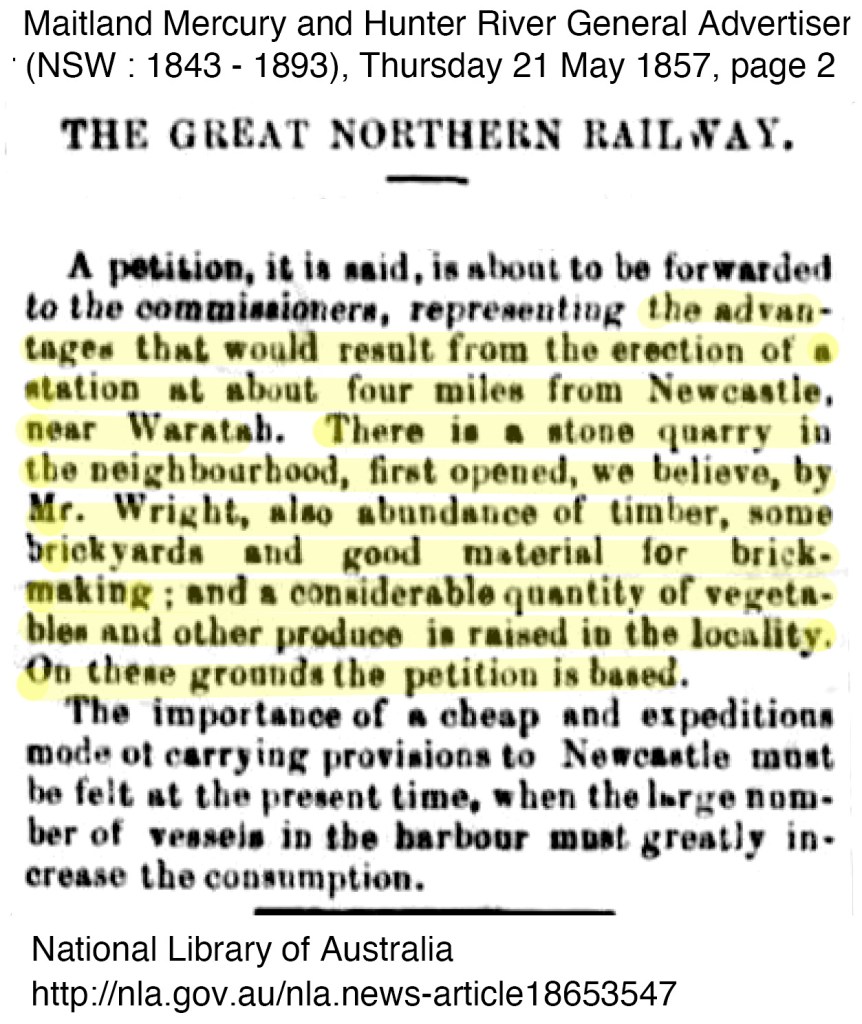
A Newspaper article in May 1857 about a petition to erect a new station at Waratah states: ‘about four miles from Newcastle’ when it mentions ‘There is a stone quarry in the neighbourhood, first opened, we believe, by Mr Wright, also an abundance of timbers, some brickyard’s’. In 1862 it is noted in the returns to the colony there was a Waratah Stone Quarry.
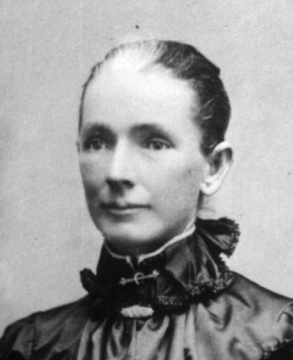
William & Mary Ann McNulty – St Andrew’s Stone Church, Mayfield
The original old St Andrew’s stone church at Waratah was built between 1860 -1861 and there are reports that the contractor was William McNulty. Many of the names associated with the early years at the folly were linked to this church including Thomas Tourle. A photograph of the old St. Andrew’s Church of England, Mayfield, NSW, build in 1861, [early 1900s] may be seen at Hunter Living Histories – Identifier image: C918-0382
The history of St Andrew’s church and its construction was recorded in the Newcastle Morning Herald and Miners’ Advocate in 1924: ‘Waratah at that time was Part of St. John’s parish, Newcastle, and the rector was the Rev. B. E. Shaw. The contractor was Mr. William McNulty. He was sexton at the time, and his wife acted as voluntary caretaker of the church. Mrs. McNulty helped her husband in the actual building of the church. It is interesting to note that Mr. W. Wyman, of Stockton, a grandson of Mr. McNulty, worked the winch at the laying of the foundation stone of the church.’ 4
So how did William McNulty move from being a worker with metal, a whitesmith, to labourer and then stonemason?
George Gray, ‘Stonemason’ and William McNulty, ‘Labourer’
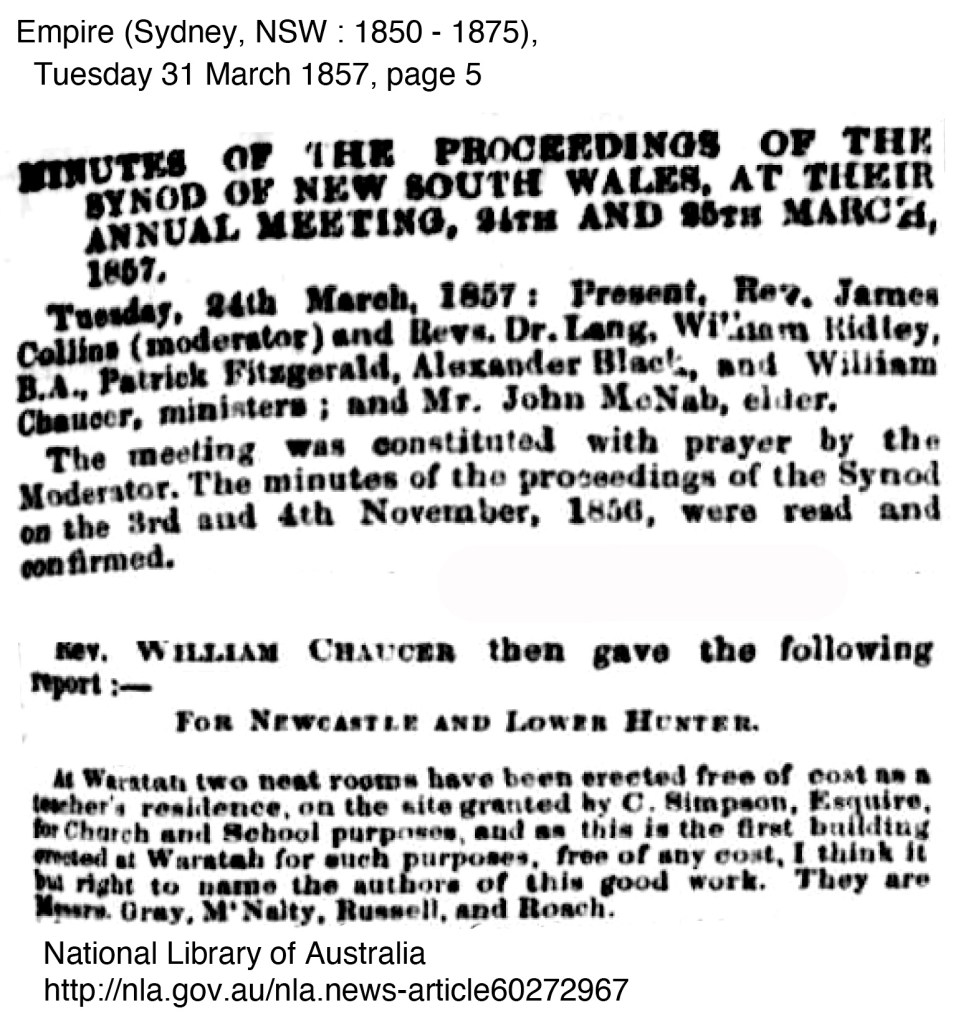
An early clue perhaps lies in the records of the establishment of the school at Waratah the minutes to the right are recorded in the Empire newspaper. ‘At Waratah two neat rooms have been erected free of cost as a teacher’s residence, on the site granted by C Simpson, Esquire. for Church and School purposes, and as this is the first building erected at Waratah for such purposes, free of any cost, I think it be right to name the authors of thus good work. They are Messrs Gray, McNulty, Russell and Roach.’
We know that George Gray was both a builder and stone mason so well qualified to erect these buildings, no doubt a whitesmith would have practical skills and likely have been a useful person to have working alongside him. It would mean that William McNulty could also learn and practice stone masonry and building skills. We know from George Gray son George Abner Gray’s journal that the Gray’s and McNulty’s were friends with George Abner Gray working with Mrs McNulty working alongside him to sell their produce from their gardens.
‘We had a garden of fruit and I used to go round the mines with our dray selling fruit. I used to do well and like the job. A Mrs McNultie [sic], a neighbour, had vegetable and she used to go with me in the dray. She was a darn good woman from France.’ 5
In his journal, George Abner tells of when the McNulty’s young daughter fell in a deep water hole: ‘I was chopping weeds in the garden near the water hole which was about 5 feet deep at one end and the other shallow. All at once I missed her and I ran to the hole and there saw her lying on the sand at the bottom.’ 6 George Abner rescued the young girl and was later thanked by her mother.
George Gray, builder and stone mason died on 30 June 1861 of consumption and dilation of the heart, his death certificate recorded that the illness had lasted three years. So after the school was built in 1857and by 1858, George Gray developed tuberculosis which likely affected his capacity to work from that time forward. This decline in health would have necessitated the need to employ other workers to keep his business going enabling him to keep his family. George Abner Gray in his journal refers to his father using ‘contractors’.
Given the small community of people in Waratah at this time there were others who William McNulty could have worked with other tradesmen including men like Josiah Hughes, another new settler whose indenture records, NSW Land Titles Book-Number: 42-938 on 31 March 1856 – on the sale of Charles Bolton’s land in allotment 57 where Josiah Hughes’ was a ‘Settler’. Baptismal records state his occupation as ‘Mason’. His obituary in 1897 say he was ‘an efficient plasterer and slater’.7
William McNulty – checking the facts
In her book ‘Mighty Mayfield’, Cath Chegwidden devotes a section to William McNulty8 however there are a number of anomalies in this account that do not align with the records.
The first is that the McNulty’s arrived in Waratah in 1859 however as established, they purchased land in allotment 59 from Benjamin Baker in June 1855 and William McNulty helped build the school buildings in 1857. It also states that whilst in Cassilis William McNulty helped build the church St Columbia of Iona. The offical Churches of Australia and other records state the original slab hut church building was built in 1850, where in 1933 a short history is recorded that’s states ‘It was a memorable occasion when on October 17, 1850, in the presence of Mr. Perry and about twenty of the congregation, Mr. Boodle laid the first ironbark sleeper of the little church … In 1856 we learn that a school was in course of construction at Cassilis, the contract for which was taken at £300; and the Bishop, in a letter dated September 28, 1857, speaks of a school and temporary church being built at Cassilis. The annual report of the Newcastle Church Society, held on May 8,1858, reports that the school at Cassilis is completed and ready for use’ 9 The original slab church was built in 1850 prior to the McNulty’s arrival in New South Wales, it is possible that the McNulty’s could have been involved in the school building in 1856-1857 but they were also in Waratah and named as being involved in building the school there in 1857. It is also a large distance between these two areas. The final stone church at Cassilis was not built until 1899.
The next anomaly is that ‘William built, with the help of convict labour the home known as ‘Waratah House’.10 As has been researched previously, George Gray was in fact the builder of Waratah House which was built prior to the arrival of William McNulty and his family in New South Wales. It is however, possible that William McNulty was involved in the later extensions to Waratah House undertaken by Thomas Tourle.
However, this book is accurate in regards to William McNulty as the builder of what is currently still called ‘Simpson’s Cottage’.11 It is just surmising but it is not unreasonable to assume that it is perhaps George Gray who taught William McNulty the trad of builder and stone mason, and in return George Gray benefited from the help giving his failing help of William McNulty. In her book Taught Mayfield, Cath Chegwidden states that: ‘Members of the McNulty family lived in the cottage from 1859.’ 12 There is no reference given for this statement within her book but this date would likely be later than the actual date with the clear link of the naming if William McNulty building the school buildings with George Gray in early 1857. We also know that george Gray’s son George Abner Gray left Waratah to travel to the Clarence River in Northern New South Wales by the early 1860’s after the death of his father, and alongside the story of the young girl Ann McNulty falling into a pond of water to be rescued by George Abner Gray.
William McNulty, ‘Mason’ – land purchase at Waratah
As seen William McNuty purchased his first small 1/4 acre of land where he built the stone cottage from Benjamin Baker on 10 March 1855, and a second ½ acre alongside this first block from William Coleman on 4 January, 1858.
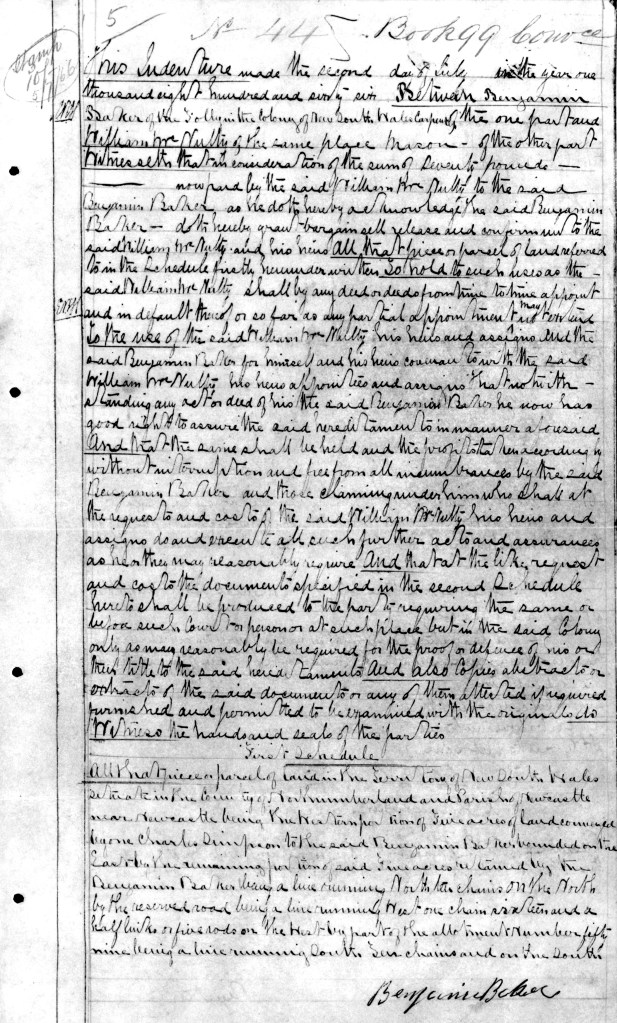
William McNulty purchased a final parcel of land alongside his cottage again from Benjamin Baker, this time on 2 July 1866. His occupation on this document is now ‘Mason’ which has been reflected both in the building of the stone cottage and his work on St Andrew’s Church.
This Indenture can be found in the NSW Land Titles – Book-Number 99-44. The costs for land had now increased dramatically, with the purchase of 1/4 acre now costing £70 which is now £28 per acre.
This record takes William McNulty’s land including his stone cottage to one acre.
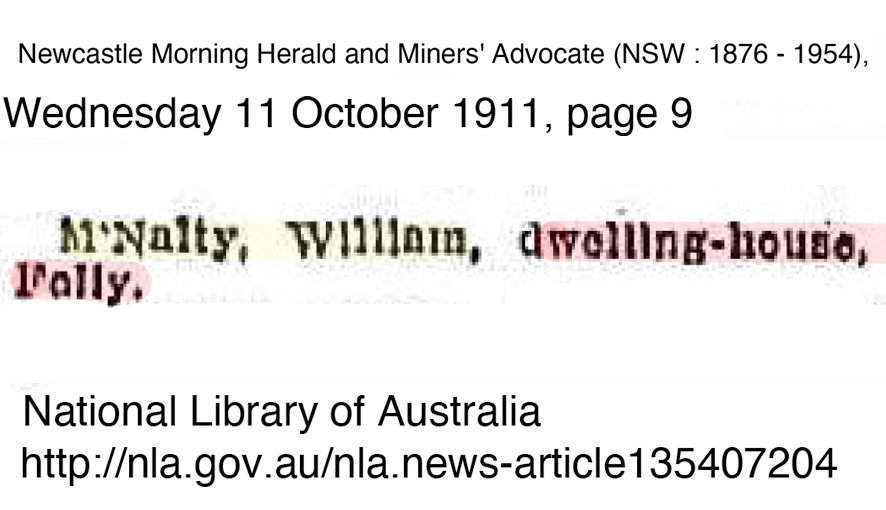
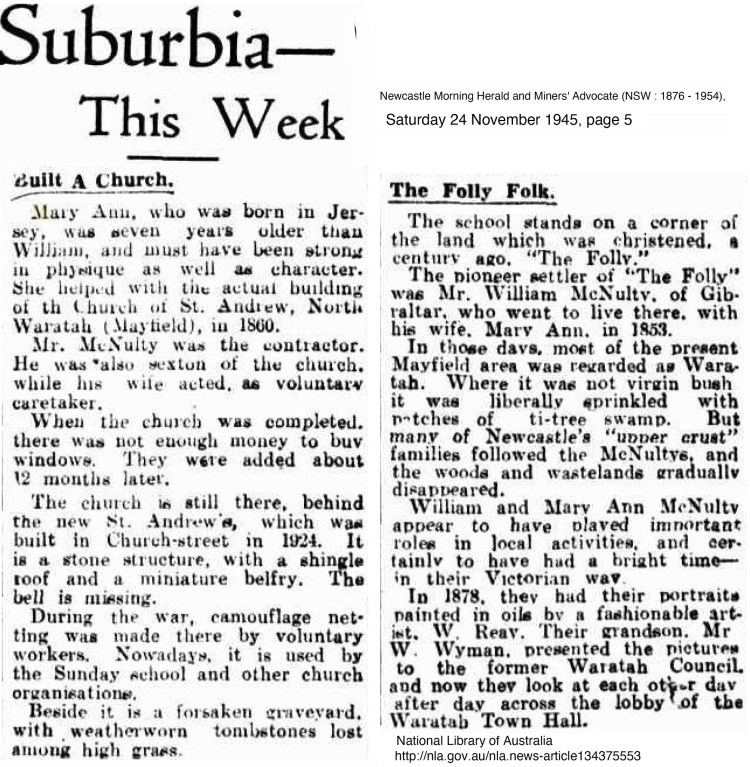
A small article appeared about the McNulties in 1945 which includes another reference to an artwork – portraits of William and Mary Ann McNulty which were also presented to the Waratah Council. In the newspaper article on the right it says: ‘In 1848, they had their portraits painted in oils by a fashionable artist, W Reav. Their grandson W Wyman presented the picture to the former Waratah council’.
McNulty’s Cottage, Mayfield
It is now obvious that by following the actual data, as with the story of Charles Simpson Esq misrepresentation as a Customs Office, the numerous claims of many as being the builders of Charles Simpson’s ‘Waratah House’ that the stories of William McNulty and his stone cottage has also been over many years misrepresented.
It may seem easy for this research and data to be ignored, easier to maintain the status quo of the long held name and story of ‘Simpson’s Cottage’ but I would argue that it is a misrepresentation of history of Mayfield [Waratah – The Folly].
As well as this misrepresentation, this approach does a disservice to the early settlers of the the area – Charles Simpson Esq, Benjamin Baker and most of all, the builder of the stone cottage, William McNulty and it seems likely his wife Mary Ann.
I would argue despite the reluctance because perhaps it is harder than maintaining the stsua quo it is better to present the history through the data and research.
References
- https://georgegraybuilderwaratah.com/2023/06/25/charles-simpson-esq-hunter-newcastle-districts/
- https://georgegraybuilderwaratah.com/2023/06/25/charles-simpson-esq-hunter-newcastle-districts/
- Newcastle Sun (NSW : 1918 – 1954), Monday 28 March 1932, page 4 – WARATAH 80 YEARS AGO Reminiscences of a Pioneer Veterinary
- ST ANDREW’S MAYFIELD, HANDSOME NEW CHURCH, AN INTERESTING HISTORY – Newcastle Morning Herald and Miners’ Advocate (NSW : 1876 – 1954) View title info Fri 13 Jun 1924 Page 5
- The Journal of George Abner Gray 1846 – 1941 from the Original Clarence River Historical Society Grafton Second Edition 1975 page 16
- The Journal of George Abner Gray 1846 – 1941 from the Original Clarence River Historical Society Grafton Second Edition 1975 page 16
- Newcastle Morning Herald and Miners’ Advocate (NSW : 1876 – 1954), Tuesday 14 December 1897, page 8
- MIGHTY MAYFIELD The Early Years – pages 47-48 – Author: Cath Chegwidden [Cardiff Heights, New South Wales] : Cath Chegwidden, 2023.
- DISTRICT CHURCH HISTORY – The Merriwa Parish – Trails of the Early Days – The Muswellbrook Chronicle (NSW : 1898 – 1955) Tue 30 May 1933 Page 6
- MIGHTY MAYFIELD The Early Years – page 48 – Author: Cath Chegwidden [Cardiff Heights, New South Wales] : Cath Chegwidden, 2023
- MIGHTY MAYFIELD The Early Years – page 47 – Author: Cath Chegwidden [Cardiff Heights, New South Wales] : Cath Chegwidden, 2023
- MIGHTY MAYFIELD The Early Years – page 48 – Author: Cath Chegwidden [Cardiff Heights, New South Wales] : Cath Chegwidden, 2023
 George Gray - Stonemason & Builder