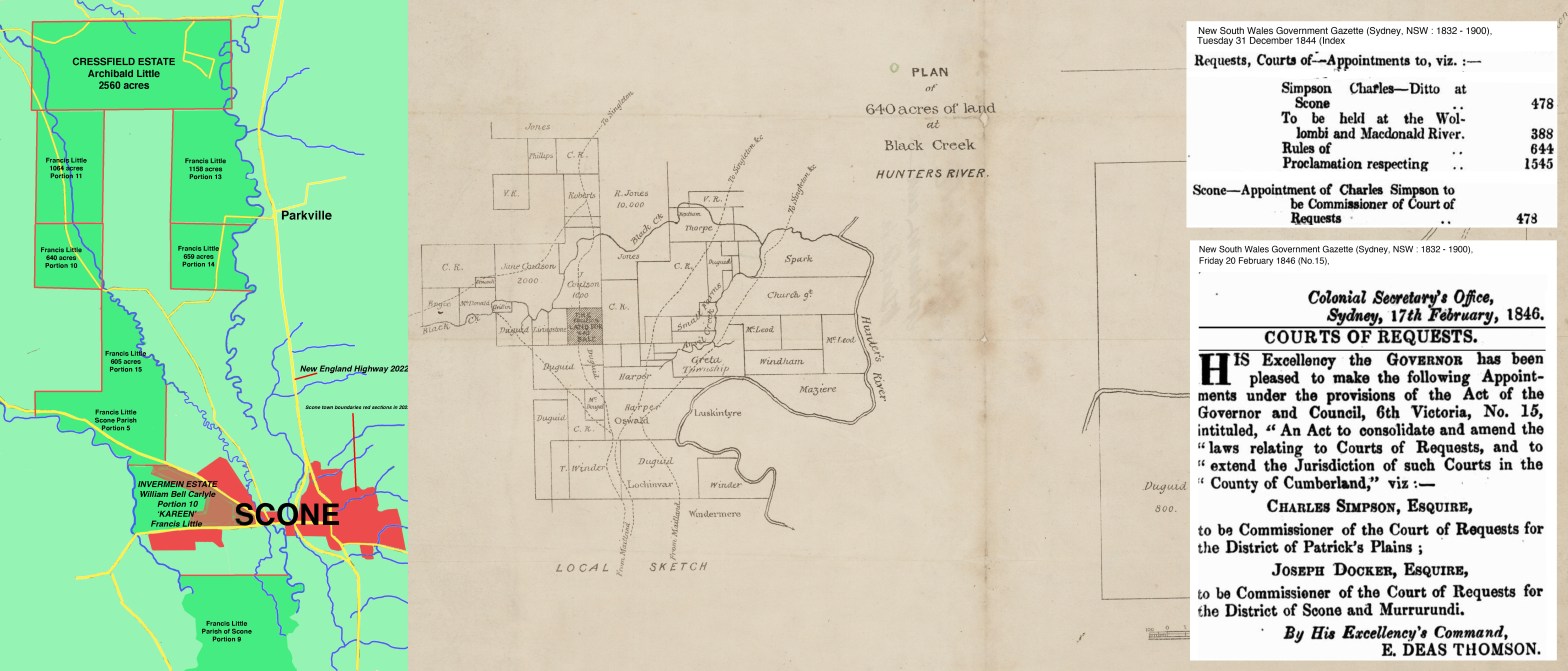
There has been a continuing narrative linking Charles Simpson Esq to working with Charles Bolton, Customs Officer. In fact as has been seen in previous chapters, Charles Simpson did not work for Charles Bolton, nor was he a Customs Officer.
Perhaps it was the same first names that confused people, or even the fact that both men had land purchases at the Folly around the same time and worked in the Public Service in different capacities, so would have known each other.
It is worthwhile providing a very brief summary of Major Charles Bolton’s work and land titles in the ‘Folly’, Waratah, Mayfield history context so the two men can be differentiated.
Charles Bolton – Department of Customs
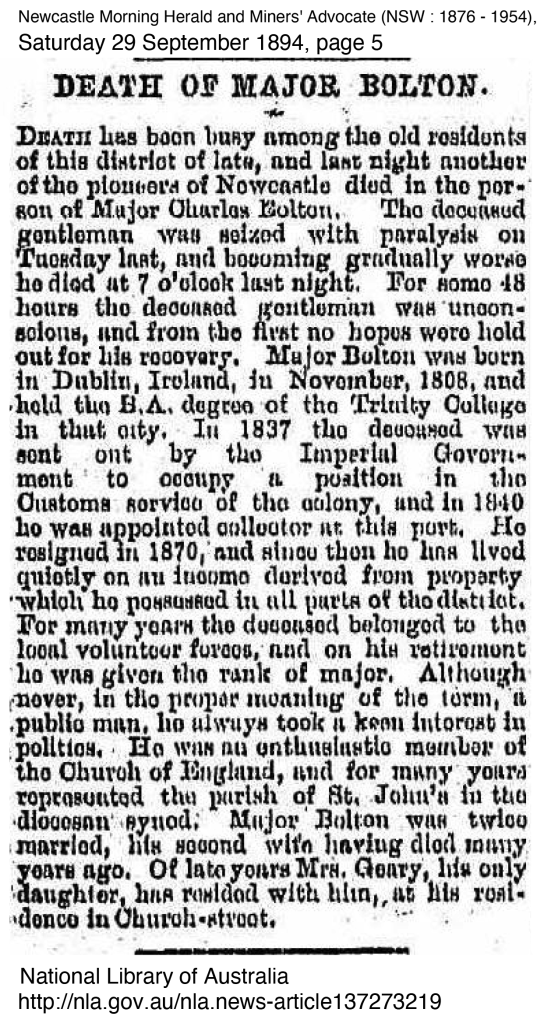
Newspaper articles on the history of the early Mayfield – Waratah – Folly and relating to Charles Simpson’s ‘Waratah House’ along his purchase of land at ‘the folly’ link him with Major Charles Bolton who was a Landing Waiter and later the Sub-Collector of Customs in Newcastle.
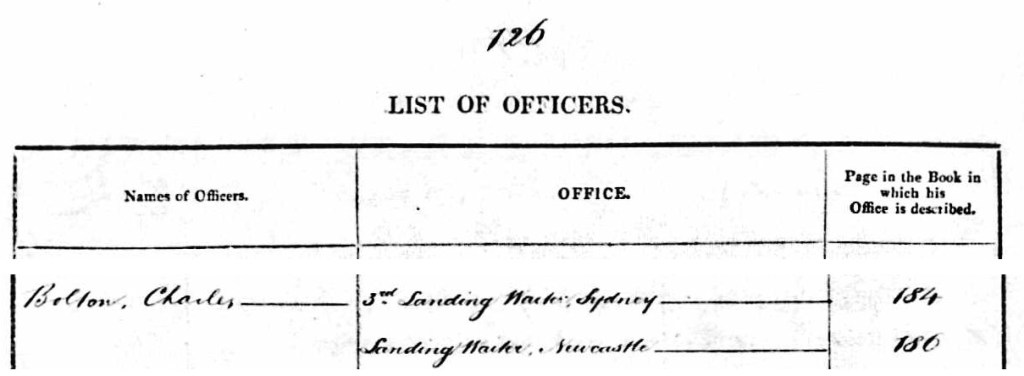
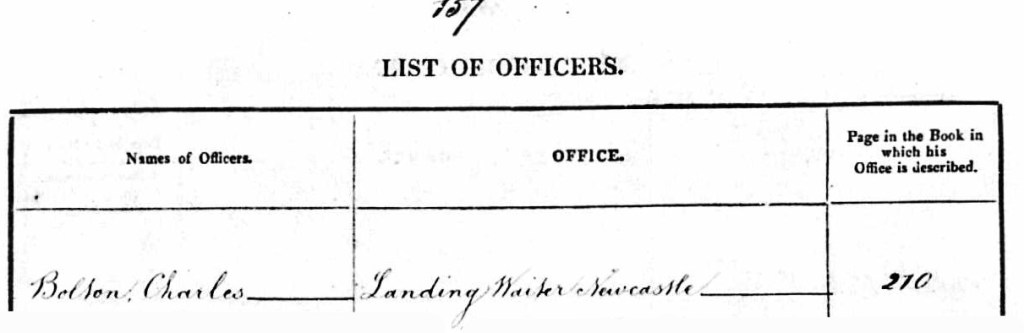
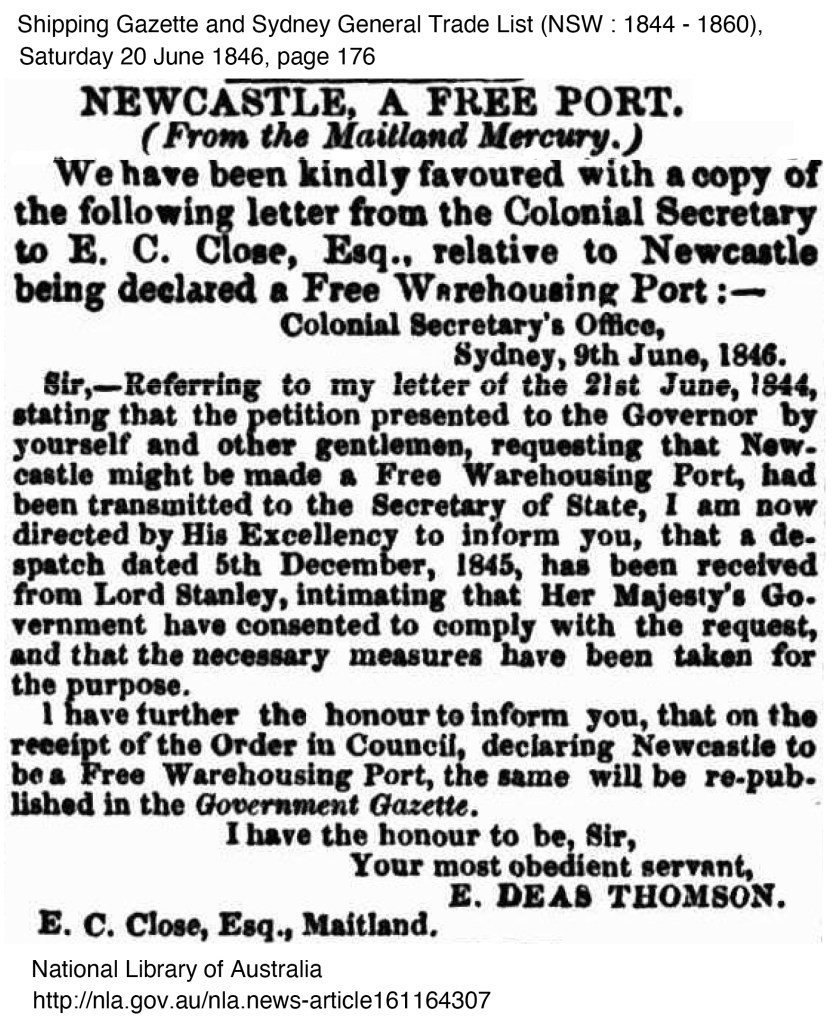
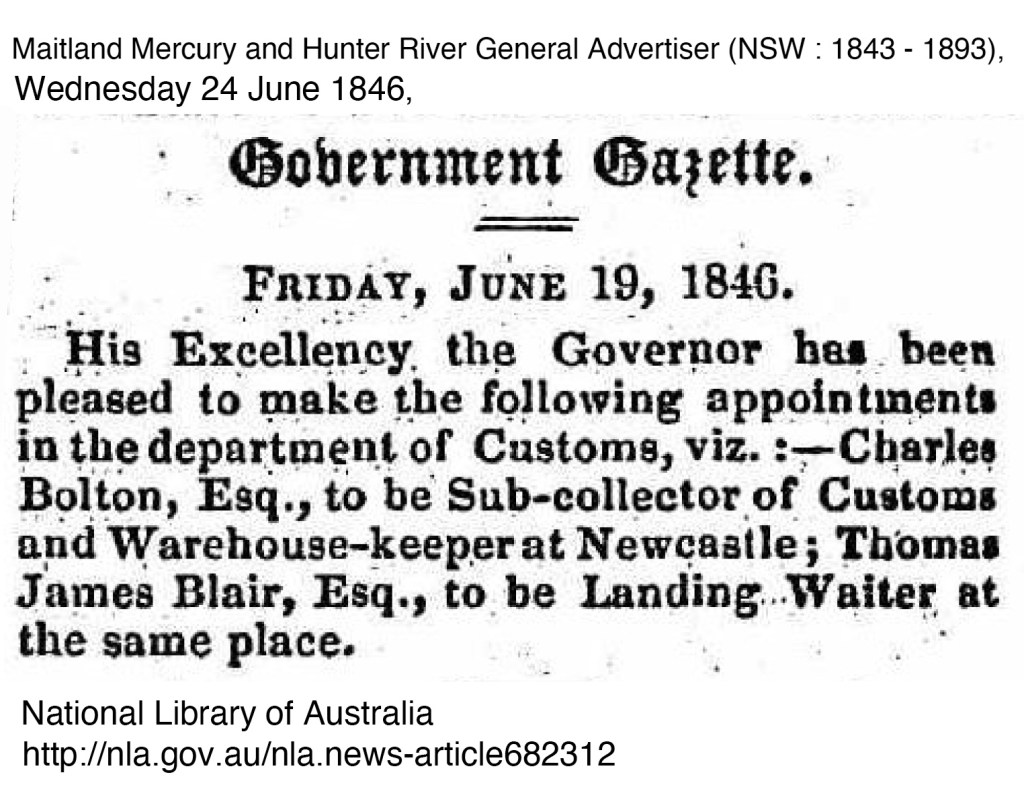
The Returns of the Colony, Blue Books, record that Charles Bolton was appointed the Landing Waiter at Newcastle on 1 June 1837 until 23 Oct 1840 when he became 3rd Landing Waiter in Sydney. He remained in the capacity of a Landing Waiter in Sydney until 1842 when he returned to Newcastle again as the Landing Waiter. In June 1846 Newcastle was made a Free Port and Major Charles Bolton was appointed the first Sub-Collector of Customs in Newcastle in 1846.
These records give us the time frame when Charles Bolton was working in Customs at Newcastle. Despite searching the Returns of the Colony for the similar time period there are no records of Charles Simpson contained in those records for Customs that could be found. It can be noted there are additional remarks on the record of 1837 which indicate he may have arrived on the ship ‘City of Edinburgh’ and his obituary confirms he ‘was sent out by the Imperial Government to occupy a position in the customs service of the colony’. The article was incorrect regarding the appointment of sub-collector of customs as it was 1846 not 1840.
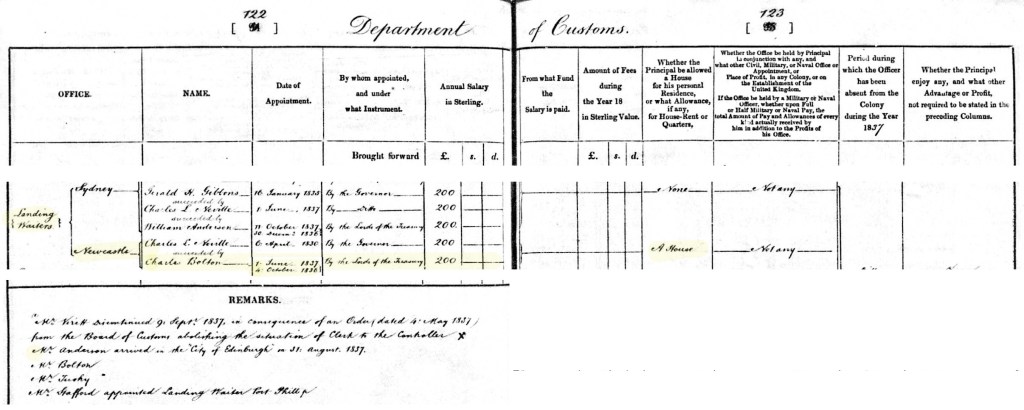
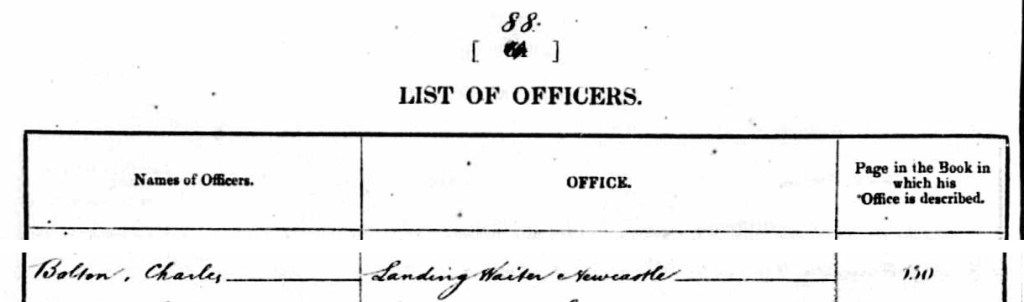
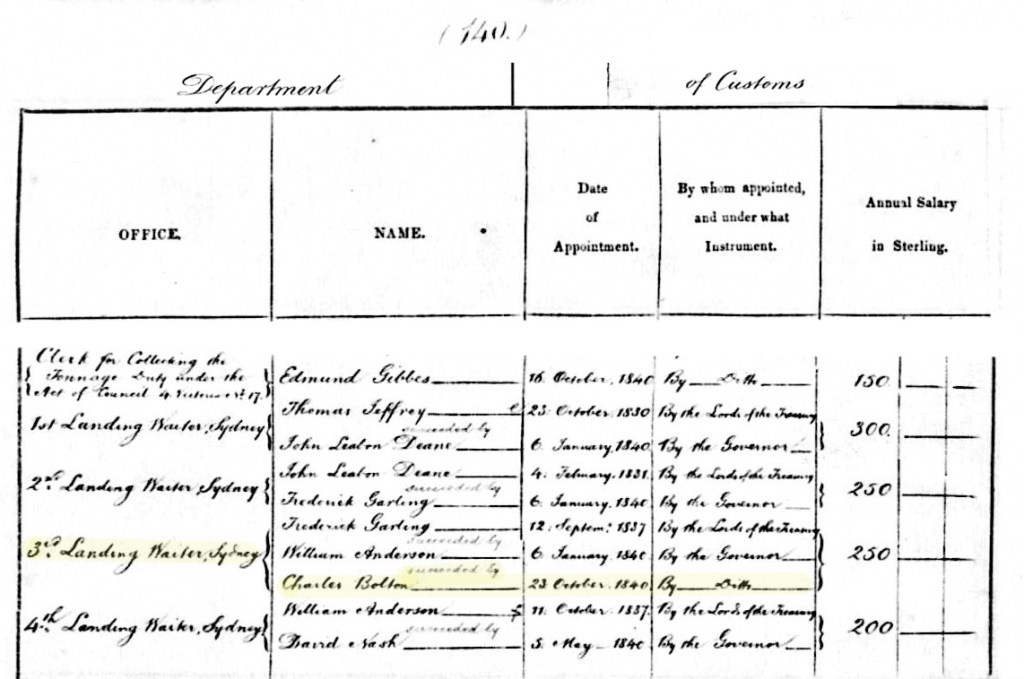

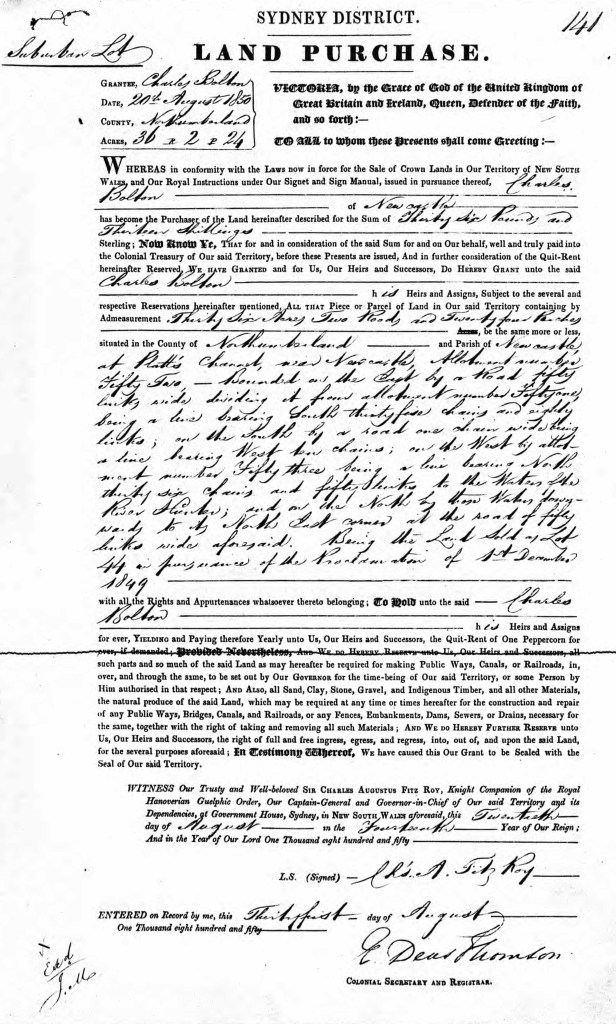
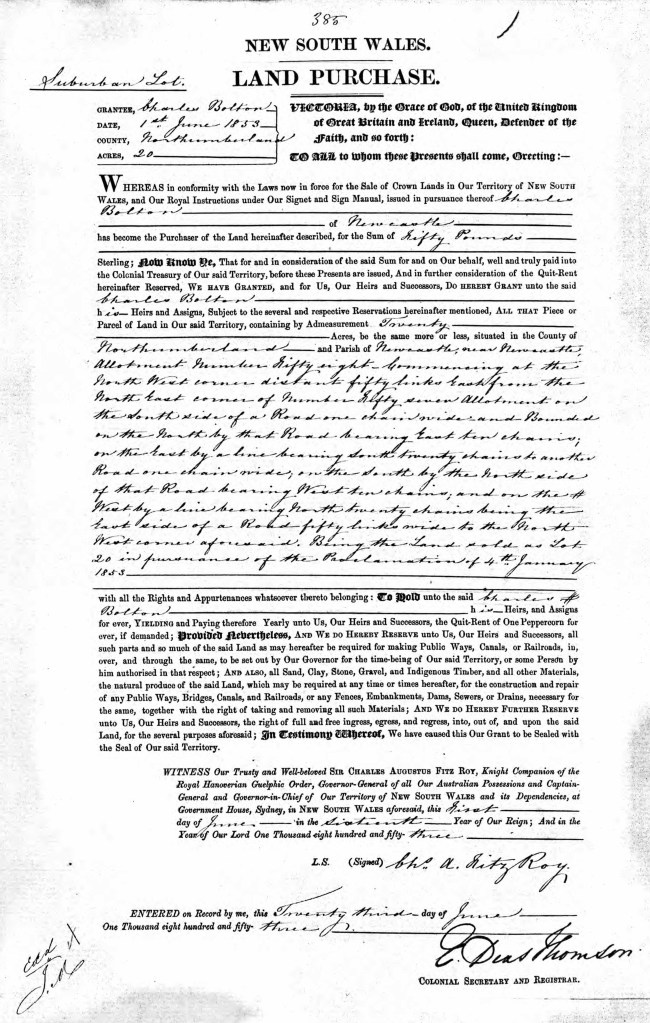
Charles Bolton purchased land at Platt’s Channel ‘the folly’ around the same time and adjacent to Charles Simpson’s allotments.
On 20 Aug 1850 he purchased 36 acres of Allotment 52 and on 20 August 1853 he purchased Allotment 58 which was 20 acres.
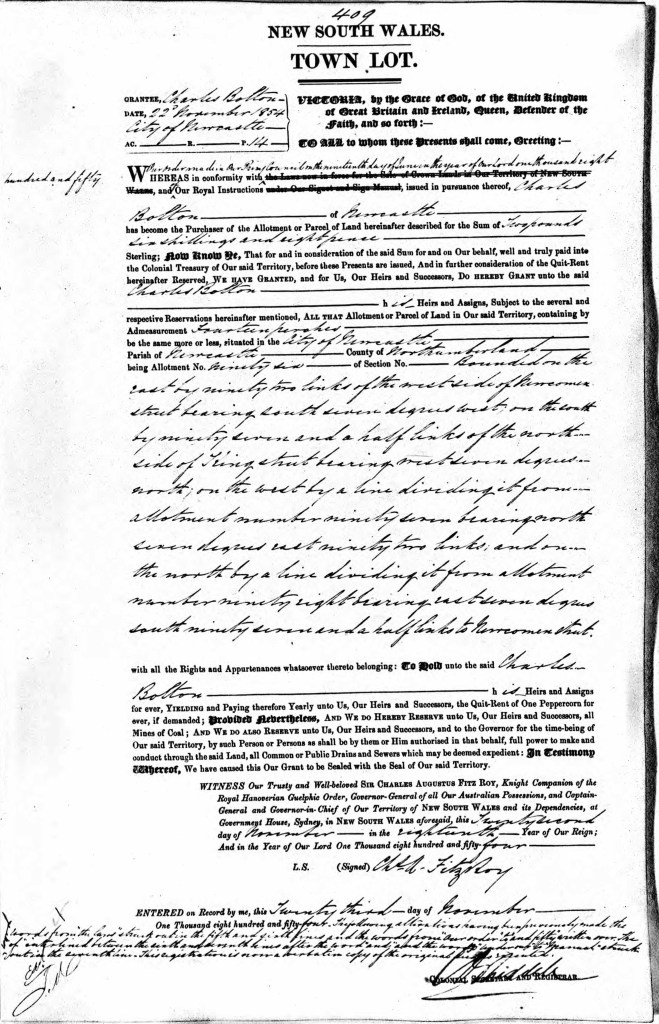
On 22 November he purchased Allotment 96 in the City of Newcastle. Perhaps the fact that both Bolton and Simpson’s first name was Charles, along with the fact they both purchased land around the same time at ‘the folly’, was the association that led to the story that Charles Simpson was connected to Bolton in the Newcastle Customs public service.
Major Charles Bolton
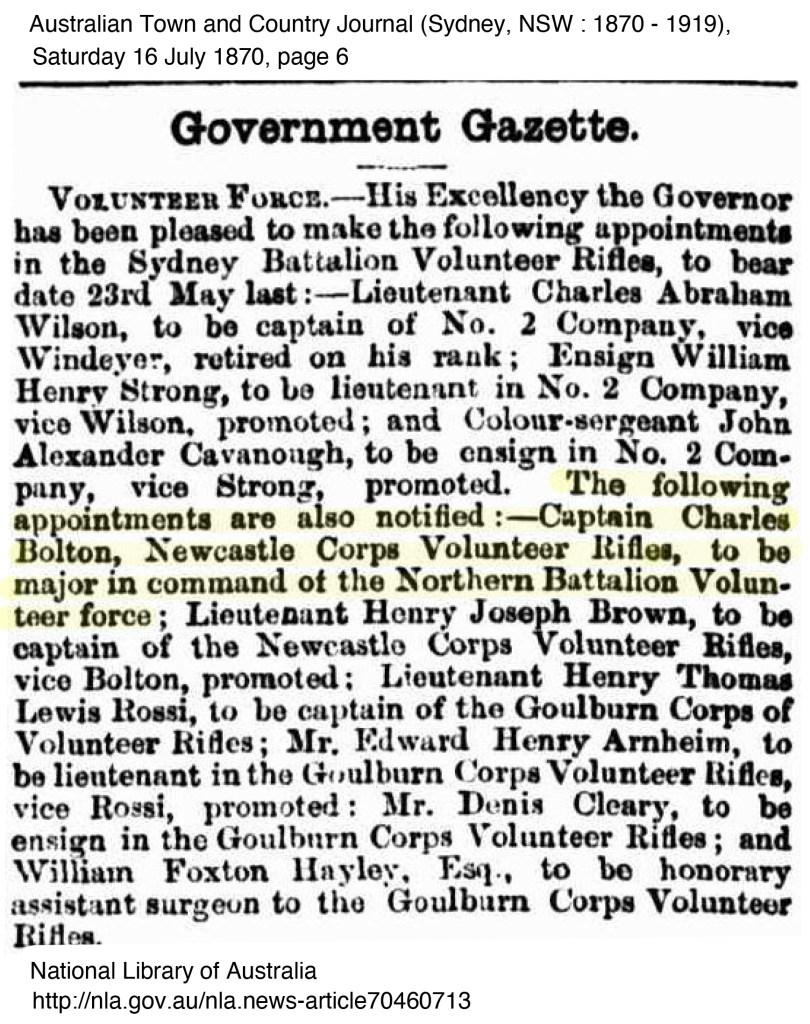
Charles Bolton Esq had been a member and supporter of the local Volunteer Reserves and in July 1870 it was announced that he was to be appointed from Captain to Major Charles Bolton.
‘Captain Bolton, Newcastle Corps Volunteer Rifles, to be major in command of the Northern Battalion Volunteer Force’ dated 23 May 1870
Charles Bolton Land Sales, Waratah – Early Settlers
Alongside Charles Simpson’s sale of his lands at Waratah in 1854, Charles Bolton sold allotments of land to new settlers in the area. Contained within the area of Allotments 52 and 58 there were purchases made from Charles Simpson to nine settlers.1 I have not included biographies of these settlers but provided the land title references so that others may use them to further explore any histories of this settlers, their wives and or families. I have included a little more detail regarding Henry Crowther and his wife Caroline Dew to follow on from that on the previous page Gray and Bull Families which cross references with excerpts from George Abner Gray’s journal entries along with the details regarding Henry Crowther’s admission and death in Gladesville and Callan Park Hospitals fir the Insane which are at the end of this chapter.
Thomas Hyde ‘Market Gardener’ of Moscheto (Mosquito) Island on 28 May 1853 purchased land from Charles Bolton.The Indenture record can be found in Book-Number – 26-627 in NSW Land Titles Register.
Thomas Walter (of the Glebe (railway) near Newcastle) on 4 October 1854 purchased land at Waratah (now Mayfield North) from Charles Bolton. The Indenture record can be found in Book-Number – 34-221 in NSW Land Titles Register.
John Robertson of the Glebe near Newcastle (of the Glebe railway) also on 4 October 1854 purchased land from Charles Bolton. The Indenture record can be found in Book-Number – 34-222 in NSW Land Titles Register.
Joseph Heal of The Folly in the precinct of Newcastle, on the 29 August 1857 purchased land from Charles Bolton. The Indenture record can be found in Book-Number – 50-939 in NSW Land Titles Register.
Reverend John Wallace of Moreton Bay on 20 March 1855 purchased land from Charles Bolton. The Indenture record can be found in Book-Number – 37-449 in NSW Land Titles Register.
Henry John Valentine Greenway of Newcastle Esquire on 1 July 1859 purchased land from Charles Bolton. The Indenture record can be found in Book-Number – 62-513 in NSW Land Titles Register.
Thomas Davis of Newcastle, Settler, on 31 March 1855 purchased land from Charles Bolton. The Indenture record can be found in Book-Number – 42-936 in NSW Land Titles Register.
Josiah Hughes of Newcastle, Settler, on 31 March 1856, purchased land from Charles Bolton. The Indenture record can be found in Book-Number – 42-938 in NSW Land Titles Register.
William Russell of Waratah near Newcastle, on 10 February 1858, purchased land from Charles Bolton. The Indenture record can be found in Book-Number – 53-961 in NSW Land Titles Register.
Henry Crowther who was later known as a Gardener, worked for Charles Simpson alongside Benjamin Baker on supplying timber for Waratah House. There appears to be no record to be found of the arrival of Henry Crowther to Australia but we know from George Abner Gray’s Journal that he recorded Henry Crowther alongside Benjamin Baker occupation as ‘Sawyer’ supplying the timber to build Waratah House. This places Henry Crowther alongside Benjamin Baker, George Gray and Edmund Bull as the original workers at the Folly working for Charles Simpson Esq. There is a record of his marriage to Caroline Crowther on 7 March 1856 at Charlestown near Newcastle.
Henry Crowther was admitted first into Gladesville Hospital for the Insane on 11 June 1888 his admission notes give additional details of Henry Crowther, his occupation and family.
The records states he was a ‘gardener’ who was born in Wiltshire England and was 72 years of age. His religion like many of the time was ‘Methodist.
His illness began four years earlier when he was ’68 years’ as a result of ‘sunstroke’ which was a commonly used cause of illnesses at that time. It is more likely that he had dementia.
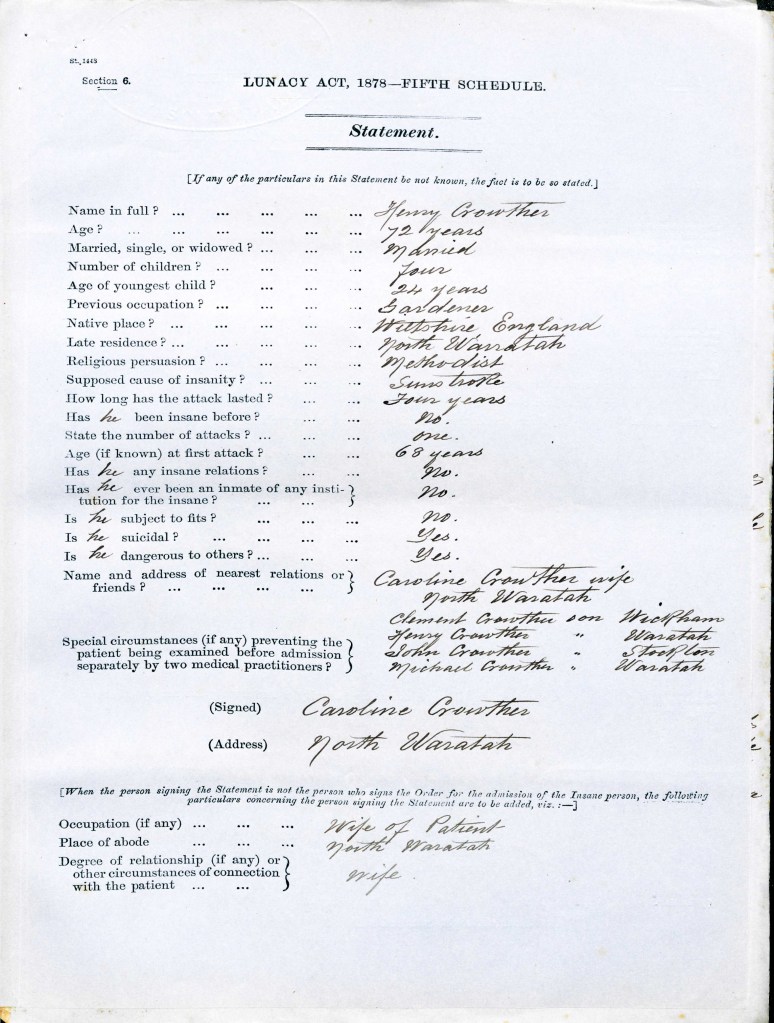
He was living at North Waratah with his wife Caroline at the time, was suicidal and dangerous to other. His nearest relations were named as: Caroline Crowther his wife living at North Waratah, and his four sons; Clement Crowther at Wickham, Henry Crowther at Waratah, John Crowther at Stockton and Michael Crowther at Waratah. The form is signed by his wife Caroline Crowther. The reports show the difficult time that Caroline Crowther and her family would have encountered in caring for Henry over what appears to be four years when it reached a stage where he was dangerous to both himself and others.
The Lunacy Act of 1878 was a well researched and thought our document developed by the very thoughtful, caring Dr Frederick Norton Manning1 who was originally the Superintendent at Gladesville Asylum appointed in 1868 by Sir Henry Parkes the Premier of New South Wales at the time before being asked to take on the role of ‘Inspector of the Insane in 1876. Before he took on the role he requested to be given time and capacity to visit all the well known hospitals and asylums for the insane around the world. He produce a report in 18682
Report on lunatic asylums / by Fredc. Norton Manning which is explained as ‘For this report Manning visited the “chief asylums in the United Kingdom, on the continent and in the United States” in order to draw up suggestions for remodelling the asylums in Australia’. There is an excellent video online at the University of Sydney Library which discusses the work of Dr Frederick Norton Manning helping to dispel many myths about the hospital and asylums in the time frame the he was in charge, in fact the asylums or hospitals as he renamed them, were quite well respected and trusted as caring for the patients that needed this specialised care in an institution. Dr Norton Manning was responsible for upgrading facilities including sanitation, providing activities such as gardening, boat trips on the river, sporting activities, zoos and pets for the patients and an emphasis on providing quiet places with opportunities to be involved in activities to occupy and help patients transition back to their homes and families. He had a remarkable success rate given the times.
There was very much a set process every person had to undergo before being finally admitted including the family or others referral, doctors certificates including visitations by the doctors for assessment, referral to the reception house at Darlinghurst for further assessment before a final admission if that is what was warranted.
The records in the archives can be quite detailed reports if they are still available at the NSW State Archives as is Henry Crowther’s, they can give a unique insight into the person and system at the time. They can include a full report on the admission of a patient which included reports from family and at least medical practitioners who were required to assess every person and write a report to corroborate any family or others reports.
The admission record for Henry Crowther reads: ‘The medical certificates state that he threatened his wife’s life, that he constantly wanders out in the street in his nightshirt – will not answer questions and his constantly whistling – carries a piece of hoop iron to dig up the stones in his way, is perfectly incoherent’
A further records mentions the hoop iron which no doubt links back to Henry Crowther’s occupation as a gardener: Was carrying a piece of hoop iron for the purpose of digging up the stones that got in his way.
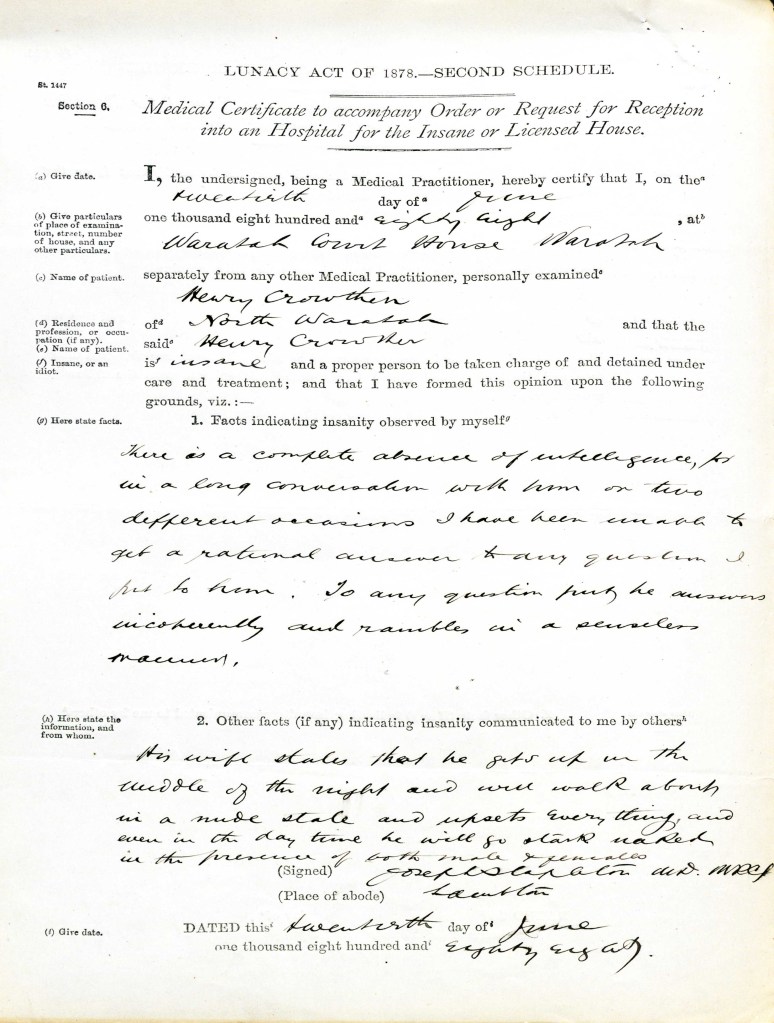
Doctor Medical Certificate: There is a complete absence of intelligence, in a long conversation with him on two different occasions I have been unable to get a rational answer to any question I put to him. To any question put he answers incoherently & rambles in a senseless manner … His wife states that he gets up in the middle of the night & will walk about in a nude state and upsets everything, & even in the day time he will go out naked in the presence of both male and females. A request for reception into a Hospital for there Insane or License House was made.
Henry Crowther remained at the Reception House in Darlinghurst before being placed for four days. He was noted that he was not taking any stimulants such as laudanum. His general conduct was ‘restless & troublesome’ including at night. It was also noted he had a cut on his head and a black eye. He was admitted from the Reception House originally to Gladesville Hospital for the Insae on
On 3 July 1888 the records shows that Henry Crowther along with three other patients were transferred from Gladesville Hospital for the Insane to the Hospital for the Insane at Callan Park by the then Medical Superintendent of Gladesville Hospital Eric Sinclair who wrote the letter of transfer on 26 June 1888. On admission to Callan Park Hospital for the Insane, and in his notes Henry Crowther’s report states: Form of mental disorder – Dementia senile.
On admission: A short thickset old man of powerful physique but bent by age & hard work, he is almost bald but has blue eyes & marked arcus senilis. Mentally in a restless sate of senile dementia – is noisy + constantly on the move pulling his cloths off – he is quite incoherent inclined to be noisy & appreciates nothing said to him – resisting violently any attempt at coercion. Physically is well nourished but very feeble & confined to bed.
July 2: Continues the same. Constantly gets out of his bed rolling up his bedding – takes food well & gaining strength’
July 9: Improved, gets up daily & wanders in the airing court in an aimless manner – is still very lost. Sleeps well, but is wet & dirty frequently.
July 16: No change at all
July 23: The same restless and demented
July 30: Confined to bed again with a swelled foot, is more restless knocking about his room constantly – st night is sleepless & noisy.
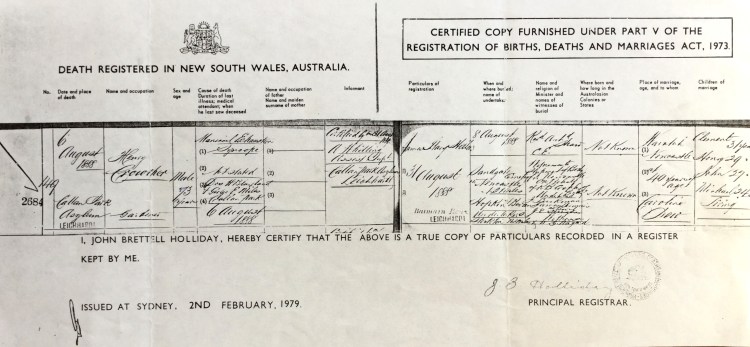
August 6: Has been about the same constantly restlessness & noisy but has taken his food well. This morning was found to have swelling over the right elbow, has taken no food but was apparently not much worse that usual. In the afternoon he suddenly ran down became comatose & in this state died very unexpectedly. Died.4
Michael Crowther and Lysaghts ‘Pommy Town’
After the initial purchases of land from Charles bolton, Michael Crowther in particular both purchased and inherited land on the Allotment 50 and 58 owned by Charles Bolton. This ladn went on the be purchased and developed by Lysaghts as what is known as ‘Pommy Town’. Whilst I have chosen to not research this as it does not relate to my family of George Gray, I have taken notes of Land Title references for different properties in those areas and am supplying those notes here in case they are of benefit to other researchers. Note that the references generally start from recent times going backwards in time to the original land title owners. I have referenced the names of the streets as Mayfield as this is the reference needed to access the land title in the historical view. I recognise that the area was also known as Waratah or Mayfield North.
ALLOTMENT 117
12 Bull St, Mayfield – Vol-Fol – 5264-75 then 3466-149 Michael Crowther ‘Gardener’ – 16 Jun 1923 Primary Application: 24579
4 Bull St, Mayfield – Vol-Fol – 6129-171 1. 5833-65 2. Primary Applications: 17402 and 28013 Lysaghts ‘Pommy Town 27 May 1948 3. Vol-Fol 5296-122 Lysaghts 13 Jan 1942 4. Primary Applications: 17402 and 28013 5. 4342-87 and 4532-127 6. Vol-Fol 4342-87 13 Oct 1929 John Lysaght – Primary Application: 17402 7. Vol-Fol – 2217-196 Clara Amy Windeyer Primary Application: 17402 8. Vol-Fol 4532-127 2 Jun 1932 Lysaghts Newcastle Works Ltd – Primary Application: 18013 9. Ref Vol-Fol 4395-205 Primary Application 18013 Lysaghts 9 Apr 1930
6 Bull St, Mayfield – Vol-Fol – 6213-176 – Elsie May Parker ‘Widow’ Primary Application: 28013 1. 5833-65 (see above) Lysaghts etc 2. 5296-122
8 Bull St, Mayfield – Vol-Fol – 5662-27 – Ray Tollis ‘Machinist’ and Reta Alice Hollis (wife) 11 Apr 1947 1. Primary Application 32340 2. Vol-Fol – 4763-218 Michael Crowther ’Retired Gardener’ 25 May 1936 Primary Application:32340
10 Bull St, Mayfield – Vol-Fol – 5731-246 1.Vol-Fol – 3466-149 Michael Crowther
25 Cowie St, Mayfield – Roy Gilson of Waratah ‘Fitter & Turner’ – Primary Application: 24579 and 32340 1. Vol-Fol 3466-149 – Michael Crowther 2. Vol-Fol 4763-218 – Michael Crowther
23 Cowie St, Mayfield – Vol-Fol – 5662-23 William Robert Graham ‘Ironworker’ and William Graham ‘wife’ 11 Apr 1947 1. Primary Application: 24579 and 32340 2. Vol-Fol 3466-149 – Michael Crowther 3. Vol-Fol 4763-218 – Michael Crowther
1 Cowie St, Mayfield – Henry Kelly ‘Gentleman’ 23 Feb 1928 Primary Application: 27889 Vol-Fol 3965-53 Herbert George Morris of Mayfield ‘Ex-Dairyman 1 Feb 1927 Application 27889
15 Cowie St, Mayfield – Vol-Fol – 5253-135 Eric Edwin Biggers of Mayfield ‘Electrician’ & Marion Biggers ‘wife’ 5 August 1941 1. Appn 24579 and 32340 2. Vol-Fol 3466-149 – Michael Crowther 3. Vol-Fol 4763-218 – Michael Crowther
5 Cowie St, Mayfield – Vol-Fol – 4158-135 Nellie Holmes wife of Alfred Ernest Homes of Islington West, Broadcaster 25 Jun 1928 1. Appn 27889 2. Vol-Fol 3965-53 Herbert Goerge Morris of Mayfield ‘Ex-Dairyman 1 Feb 1927 Appn 27889
41 Kerr St, Mayfield – Vol-Fol – 6559-204 Stewarts & Lloyds Appn 18346 and 28013 1. Vol-Fol 4077-105 Ralph Goninah of Mayfield ‘Engineer’ then 2415-126 – Appn 18346 Jemima Walker wife of John Kennedy Walker of Minmi ’Storekeeper’ 1 Nov 1913 Appn 18346 2. Vol-Fol 4523-127
47 Kerr St, Mayfield – Vol-Fol – 4618-194 Leonard Arthur Tugby of Newcastle ‘Agent’ 5 Apr 1934 1. Appn 17402 2. Vol-Fol 4326-87 Evelyn Jane Rae & Nora Gertrude Phelan of Newcastle ‘Spinsters’ 3. Appn 17402 4. Vol-Fol – 2217-196 Clara Amy Windeyer
References
- Newcastle Morning Herald and Miners’ Advocate (NSW : 1876 – 1954), Saturday 3 October 1936, page 5 WARATAH’S FIRST SETTLERS Mr. Braye Reviews Early History
- Frederic Norton Manning – Australian Dictionary of Biography
- Report on lunatic asylums / by Fredc. Norton Manning. Manning, Frederick Norton, 1839-1903. Date:1868 available online at welcome collection
- Rare Bites: Report on Lunatic Asylums by Dr Frederick Norton Manning (1868) online video University of Sydney Library
- NSW State Archives references for Henry Crowther admissions under the Lunacy Act 1. NRS 905 Consignment 346 Container 1/2709 Letter 88/7506 – 1 page 2. NRS 905 Consignment 346 Container 1/2712 Letter 88/7899 – 6 pages 3. NRS 905 Consignment 346 Container 1/2712 Letter 88/9145 – 2 pages 4. NRS 4994 Medical Container 3/4662 Case Books Folio 27 No on Register 1490 5. Case Papers File number 1490 – 9 pages 6. Medical Case book. Medical Container 3/4662 Case Books Folio 27 No on Register 1490 7. NRS 4984 Consignment 3 Container 3/3323 File number 1490.
 George Gray - Stonemason & Builder